- English
- French
- German
- Portuguese
- Spanish
- Russian
- Japanese
- Korean
- Arabic
- Greek
- German
- Turkish
- Italian
- Danish
- Romanian
- Indonesian
- Czech
- Afrikaans
- Swedish
- Polish
- Basque
- Catalan
- Esperanto
- Hindi
- Lao
- Albanian
- Amharic
- Armenian
- Azerbaijani
- Belarusian
- Bengali
- Bosnian
- Bulgarian
- Cebuano
- Chichewa
- Corsican
- Croatian
- Dutch
- Estonian
- Filipino
- Finnish
- Frisian
- Galician
- Georgian
- Gujarati
- Haitian
- Hausa
- Hawaiian
- Hebrew
- Hmong
- Hungarian
- Icelandic
- Igbo
- Javanese
- Kannada
- Kazakh
- Khmer
- Kurdish
- Kyrgyz
- Latin
- Latvian
- Lithuanian
- Luxembou..
- Macedonian
- Malagasy
- Malay
- Malayalam
- Maltese
- Maori
- Marathi
- Mongolian
- Burmese
- Nepali
- Norwegian
- Pashto
- Persian
- Punjabi
- Serbian
- Sesotho
- Sinhala
- Slovak
- Slovenian
- Somali
- Samoan
- Scots Gaelic
- Shona
- Sindhi
- Sundanese
- Swahili
- Tajik
- Tamil
- Telugu
- Thai
- Ukrainian
- Urdu
- Uzbek
- Vietnamese
- Welsh
- Xhosa
- Yiddish
- Yoruba
- Zulu
pure titanium tube
2.Standard: ASTM B338 ASTM B337 B861 B862
3.Dimension:OD10-300xWT0.5-10x L100-18000 MM
4.Condition: annealed
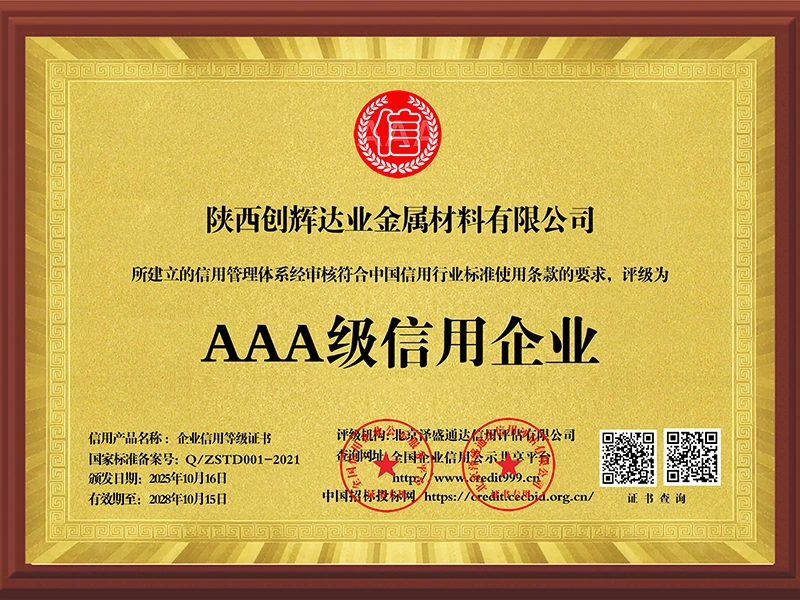
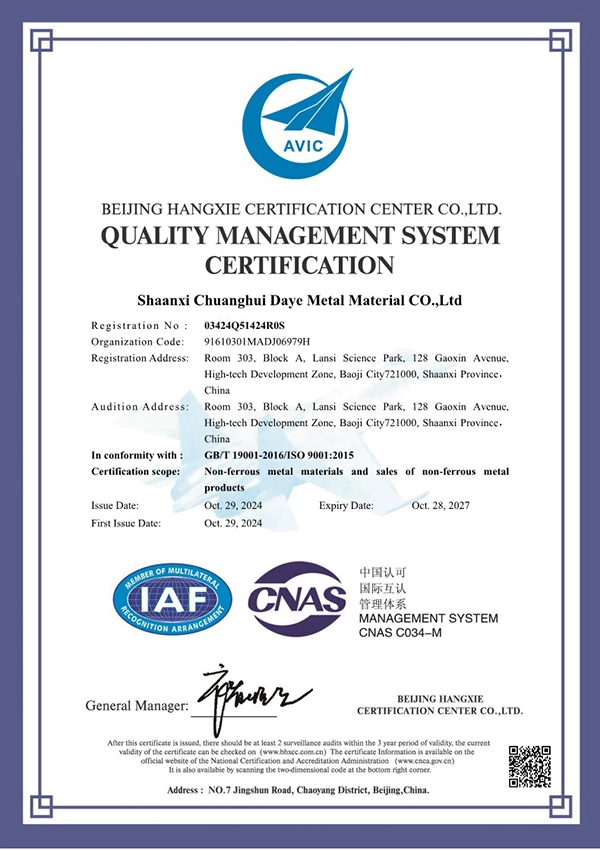
5.Certificate:ISO 9001:2015
6.Type: seamless and welded
Pure Titanium Tube for Condensers and Chemical Processing: Seamless and Welded, OD 10–300 mm
Baoji High-tech Development Zone is the base for Shaanxi Chuanghui Daye Metal Material Co., Ltd. From that site the firm supplies pure titanium tube for condensers, heat exchangers and chemical piping. Grades on offer: Gr1, Gr2, Gr7, Gr9, Gr12. Welded types get made. So do seamless ones. Outside diameter runs from 10 to 300 mm. Wall thickness spans 0.5 to 10 mm. Lengths go from 100 to 18000 mm. Every tube ships annealed. Four standards are followed: ASTM B338, ASTM B337, ASTM B861, ASTM B862. Production is covered by ISO 9001:2015 certification. Over 50 countries and regions use the company's products.
Specifications
|
Product name |
pure titanium tube |
|
Material |
Pure titanium and Titanium Alloy |
|
Grade |
Gr1, Gr2, Gr7, Gr9, Gr12 |
|
Application |
Construction/ Building/ Industry/Marine anti-corrosion |
|
Type |
Seamless and Welded |
|
Outer Diameter |
10--300mm |
|
Thickness |
0.5--20mm |
|
Sample |
Free samples are available |
|
Standard |
ASTM B337/338, AMSESB337/338 ASTM F67 ASTM F136 JIS |
|
Processing Service |
Cold rolling |
|
Port |
Shanghai or Tianjin |
|
Advantage |
Factory price,Fast delivery and can be customized |
|
Packing term |
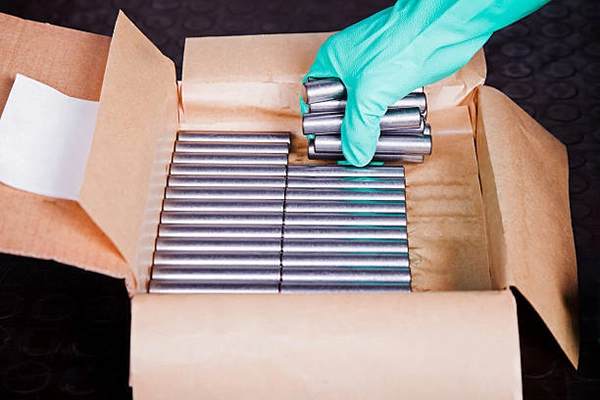
Foam packing inside,export wooden box outside |
|
Payments terms |
30%TT in advance, 70% balance before shipment according to the actual weight |
A few details are missing from this page. Tolerances are one example. Surface finish and delivery time are others. Confirm them with us first, before you place an order.

Gr2 Titanium Tube: What to Know
Gr2 gets picked more often than any other commercially pure (CP) titanium grade. It sits in the alpha phase. Strength stays moderate, and the ductility is good. On the strength scale it falls between the softer Grade 1 and the harder Grade 5 alloy (Ti-6Al-4V).
Cold rolling or extrusion is how Gr2 pure titanium becomes a seamless tube. Nowhere on the body is there a weld seam. A heat affected zone (HAZ) is missing as well. The structure that comes out stays the same all the way around the circumference.
Stainless steel pits in high-chloride service. That is when many people switch to titanium. Lighter equipment also matters in heat transfer work, and titanium gets picked for that too.
Material Properties and Corrosion Behavior
When oxygen is present, titanium forms a stable TiO2 oxide film that clings to the surface. In seawater, that film holds off pitting, crevice corrosion and microbiologically influenced corrosion (MIC). Still, check the temperature and chemistry limits for each job.
For general reference, Gr2 under ASTM B338 lists a minimum tensile strength of 345 MPa. Minimum yield strength is 275 MPa. Iron is capped at 0.30%, and hydrogen must stay below 0.015%. Density for titanium is 4.51 g/cm³, and magnets do not affect it. These figures are general material values. Put the requirements you actually need into your purchase order. We also supply the pure titanium tube in custom sizes to suit your drawing.
ASTM B338 puts caps on nitrogen and carbon. Hydrogen and iron are capped as well. All four affect ductility and fatigue resistance. This product weighs very little, which makes it a practical pick for heat exchange equipment.
Seamless or Welded: Which Should You Choose?
High-pressure transport lines need tube made without a weld seam. No joint runs along its length. A leak has no seam path to open up.
Large heat exchangers often use welded tube. Thin-wall condenser tubes do too. Eddy current testing checks the seam.
Equipment size decides which pure titanium tube type you pick. Operating pressure and wall thickness also count.
Be used in a wide range of industries.
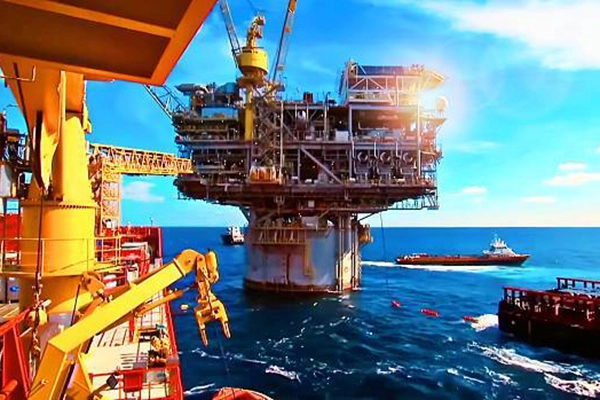
Marine engineering
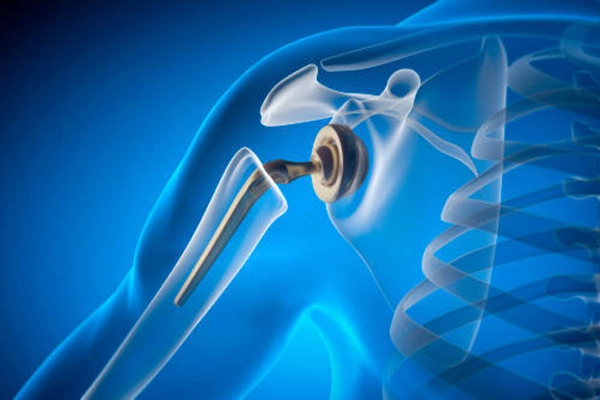
Medical implants
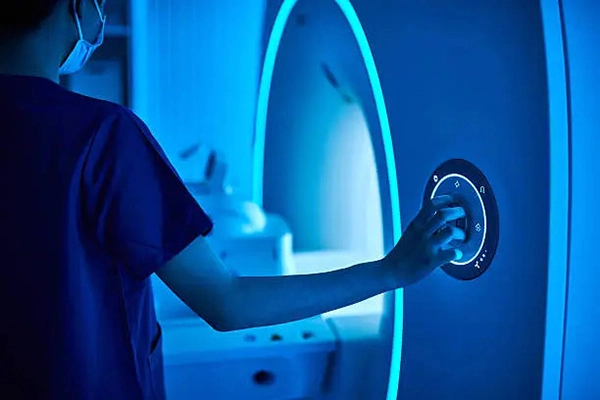
Medical Equipment
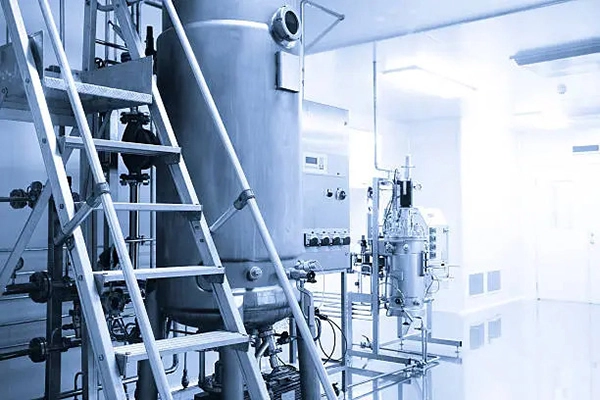
Chemical Processing
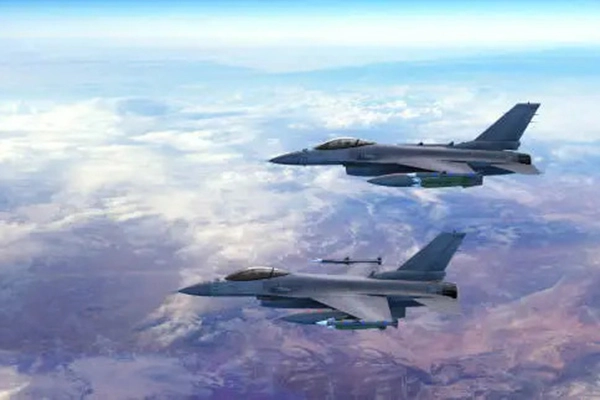
Aerospace and Defense
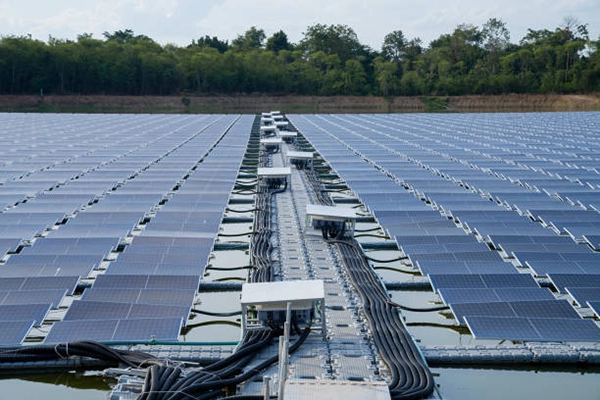
Energy and Environmental Engineering
Applications by Industry
Power generation and desalination. Surface condensers use titanium tube. Thin-wall welded condenser tubes do too. Multi-Stage Flash (MSF) evaporation units use it as well. Steam erosion and saltwater corrosion are concerns in these units.
Chlor-alkali. Two jobs come up most often here: cooling wet chlorine gas and heating brine. Titanium holds its passive film when wet chlorine is around. Stainless steel often gives out in that same service. Dry chlorine is another matter. Titanium is a poor fit for it.
Petrochemical and oil refining. Titanium shows up often in shell-and-tube heat exchangers that run sour crude or acidic hydrocarbons. Every process carries its own hydrogen sulfide (H2S) conditions. Check that the metal suits yours.
Chemical processing. PTA and oxidizing acid piping systems also use titanium tube. Seamless tube is often preferred for high-pressure lines.
Aerospace and automotive. Lower weight is the draw with titanium. Hydraulic return lines and exhaust systems can both gain from it.
Quality Control and Inspection of pure titanium tube
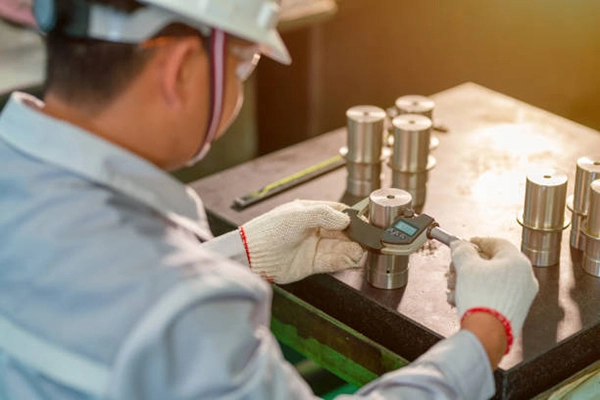
A titanium tube used in tough service calls for an inspection plan that is spelled out. Below are the methods used to inspect it:
- Eddy current testing (ASTM E426): every welded tube goes through this test. It picks up surface defects and longitudinal cracks that could break leak tightness.
- Ultrasonic testing: this test is used on seamless tubes. Flaws below the surface, hidden inside the wall, show up with it.
- Pneumatic and hydrostatic testing: a load is put on the tube. Both the pressure it holds and the soundness of the structure get checked.
- Chemical composition analysis: hydrogen content is measured as well. The limit sits under 0.015%. Go past it and hydride precipitation starts, which then brings embrittlement.
- Flaring and flattening tests: ductility of the weld seam and the base metal gets checked here. That way the tube will not crack when it is expanded into tubesheets.
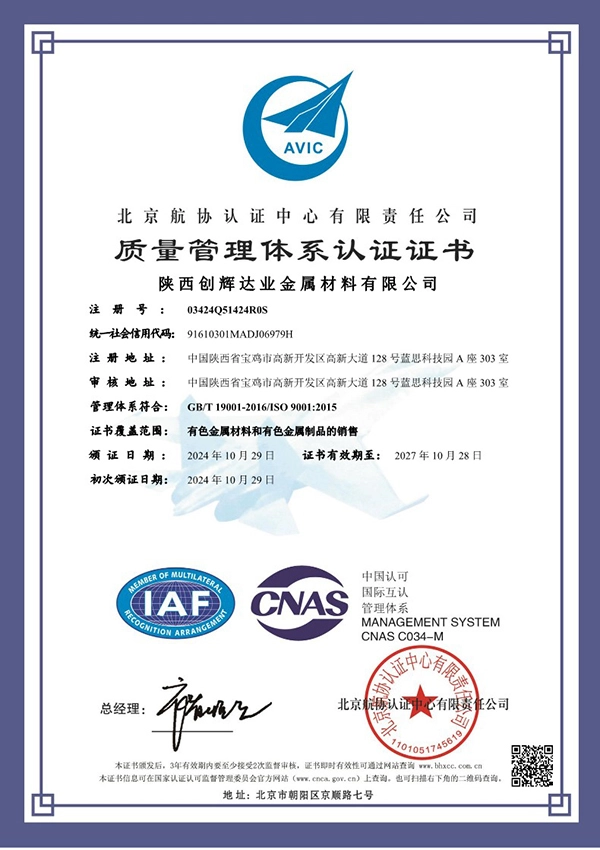
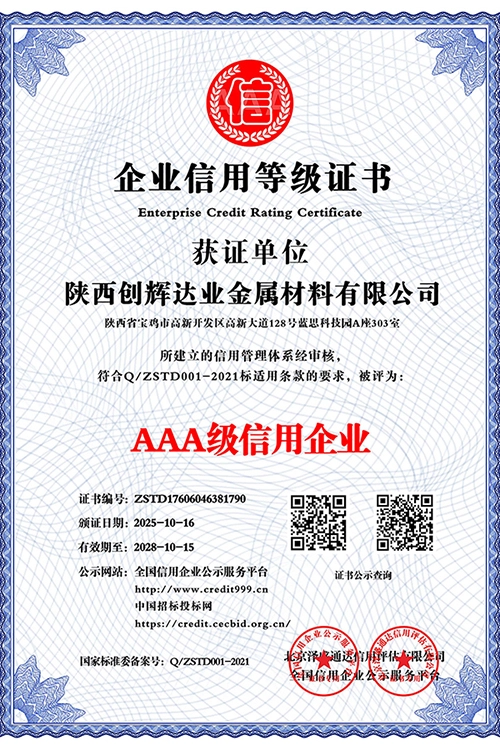
ISO 9001:2015 certification is held by our production.
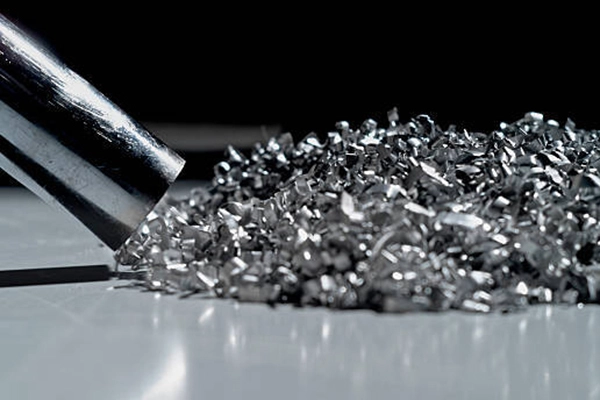
Purchasing Considerations
Choose the grade and tube type that suit the job. Seamless tube is what high-pressure lines need. Welded tube does the work for big heat exchangers. Two limits matter: hydrogen (below 0.015%) and iron (0.30%). Write both into your purchase order.
Want a quote on this product? Send us the grade, standard, type, OD, WT, length, quantity and the tests you need.
About Shaanxi Chuanghui Daye
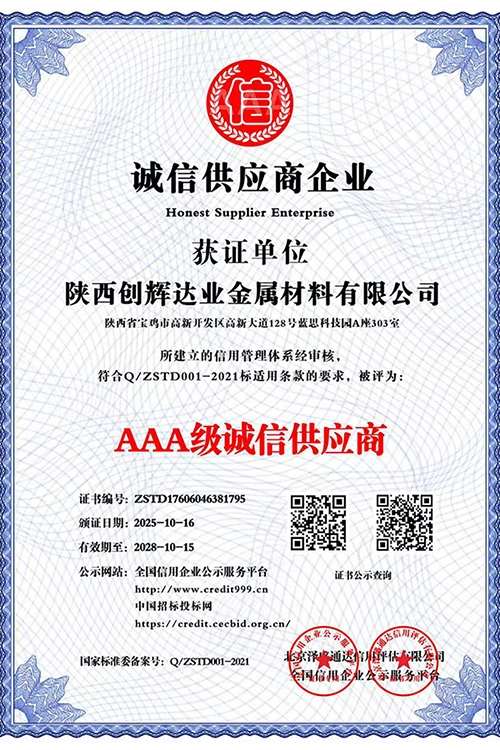
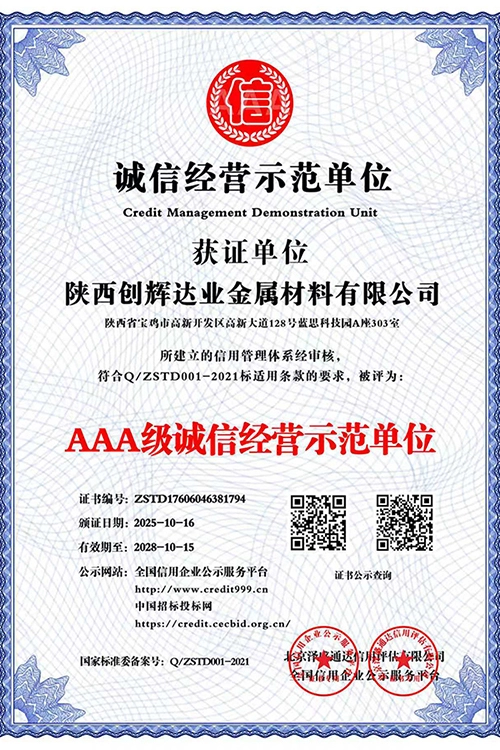
The company is located in Baoji High-tech Development Zone, Shaanxi Province, known as China's "Titanium Capital". Its founder has more than 30 years of experience in the rare metal industry.
Besides titanium, the company supplies tantalum, niobium, tungsten, molybdenum, zirconium, nickel and other non-ferrous and rare metal alloy products for the metallurgy, electronics, medical and special steel fields. Its products are used in the United States, Germany, South Korea, Singapore and more than 50 countries and regions in total.


|
Grades |
N |
C |
H |
Fe |
O |
Al |
V |
Pd |
Mo |
Ni |
|
Gr 1 |
0.03 |
0.08 |
0.015 |
0.20 |
0.18 |
/ |
/ |
/ |
/ |
/ |
|
Gr 2 |
0.03 |
0.08 |
0.015 |
0.30 |
0.25 |
/ |
/ |
/ |
/ |
/ |
|
Gr 3 |
0.05 |
0.08 |
0.015 |
0.30 |
0.35 |
/ |
/ |
/ |
/ |
/ |
|
Gr 7 |
0.03 |
0.08 |
0.015 |
0.30 |
0.25 |
/ |
/ |
0.12~0.25 |
/ |
/ |
|
Gr 9 |
0.03 |
0.08 |
0.015 |
0.25 |
0.15 |
2.5~3.5 |
2.0~3.0 |
/ |
/ |
/ |
|
Gr 11 |
0.03 |
0.08 |
0.015 |
0.20 |
0.18 |
/ |
/ |
0.12-0.25 |
/ |
/ |
|
Gr12 |
0.03 |
0.08 |
0.015 |
0.30 |
0.25 |
/ |
/ |
/ |
0.2~0.4 |
0.6~0.9 |
 |
 |
 |
 |
 |
 |
 |
 |
|
|
|
|
|
 |
 |
 |
 |


 |
 |
 |
 |
 |
 |
FAQ
Q: What grades and sizes are available?
A: Gr1, Gr2, Gr7, Gr9 and Gr12, in seamless and welded types. OD is 10–300 mm, WT is 0.5–10 mm and length is 100–18000 mm, all annealed.
Q: Why choose titanium over stainless steel in chloride service?
A: In seawater, the TiO2 film on titanium holds up against pitting, crevice corrosion and MIC. Stainless steel is a different story. High-chloride environments can pit it.
Q: Does a titanium tube cope with dry chlorine?
A: No. Wet chlorine keeps it passive. For dry chlorine, it is not suitable.
Q: What makes seamless tube different from welded tube?
A: Seamless tube is made by cold rolling or extrusion. There is no HAZ. For big heat exchangers and thin-wall condensers, welded tube is the usual pick.
Q: Which tests apply to welded tube?
A: Eddy current testing (ASTM E426) is applied to 100% of welded tubes. Flaring and flattening tests check weld seam ductility.
Q: How do I request a quote?
A: Email info@chdymetal.com with grade, standard, type, dimensions and quantity.
Contact Us
Email info@chdymetal.com with your grade, standard, type, size, quantity and required tests to request a quote for pure titanium tube.
Learn about our latest products and discounts through SMS or email