- English
- French
- German
- Portuguese
- Spanish
- Russian
- Japanese
- Korean
- Arabic
- Greek
- German
- Turkish
- Italian
- Danish
- Romanian
- Indonesian
- Czech
- Afrikaans
- Swedish
- Polish
- Basque
- Catalan
- Esperanto
- Hindi
- Lao
- Albanian
- Amharic
- Armenian
- Azerbaijani
- Belarusian
- Bengali
- Bosnian
- Bulgarian
- Cebuano
- Chichewa
- Corsican
- Croatian
- Dutch
- Estonian
- Filipino
- Finnish
- Frisian
- Galician
- Georgian
- Gujarati
- Haitian
- Hausa
- Hawaiian
- Hebrew
- Hmong
- Hungarian
- Icelandic
- Igbo
- Javanese
- Kannada
- Kazakh
- Khmer
- Kurdish
- Kyrgyz
- Latin
- Latvian
- Lithuanian
- Luxembou..
- Macedonian
- Malagasy
- Malay
- Malayalam
- Maltese
- Maori
- Marathi
- Mongolian
- Burmese
- Nepali
- Norwegian
- Pashto
- Persian
- Punjabi
- Serbian
- Sesotho
- Sinhala
- Slovak
- Slovenian
- Somali
- Samoan
- Scots Gaelic
- Shona
- Sindhi
- Sundanese
- Swahili
- Tajik
- Tamil
- Telugu
- Thai
- Ukrainian
- Urdu
- Uzbek
- Vietnamese
- Welsh
- Xhosa
- Yiddish
- Yoruba
- Zulu
niobium alloy wire
2. Diameter: 0.5–5 mm
3. Length:customized
4. Density: 8.6–9.0 g/cm³
5. Tensile strength: 250–400 MPa
6. Applications: Aerospace, chemical
7. Corrosion resistant
Niobium Alloy Wire: Nb-Ti and Nb-Zr Grades for Aerospace and Chemical Use
Shaanxi Chuanghui Daye Metal Material Co., Ltd. sells Nb-Ti and Nb-Zr alloys in wire form. Diameters of the niobium alloy wire start at 0.5 mm and go up to 5 mm. Lengths get cut to whatever you order. Listed density is 8.6–9.0 g/cm³. Tensile strength runs 250–400 MPa. Aerospace and chemical jobs that need corrosion resistance are where this wire usually ends up. High heat means you need a protective atmosphere. Niobium oxidizes fast in plain air above 400 °C. Send over the alloy you want and the diameter. Add the length too. Our team then reviews your requirements.
Specifications
| Property | Specification |
|---|---|
| Alloy Types | Nb-Ti, Nb-Zr |
| Diameter Range | 0.05 – 5.0 mm |
| Maximum Length | as your customized |
| Density | 8.6 – 9.0 g/cm³ |
| Tensile Strength | 250 – 400 MPa |
| Melting Point | 2,477°C (4,490°F) |
| Electrical Conductivity | 6.7×10⁶ S/m |
| Temperature Resistance | Up to 400°C continuous |
| Production time | Normal need 10-15 days mainly according to your quantity |
| Certificate | ISO 9001:2015 |
| Surface | bright surface |
| Payment terms | 30%TT in advance, 70% balance before shipment |
Chemical composition limits are not shown in the product data above. Dimensional tolerances are absent too. Temper is missing as well. Test standards and RRR do not appear either. Same story with MOQ and lead time. Before you order, ask us to confirm any of them. Each length is cut to order. For your this product, tell us the alloy grade you want, plus the diameter and the length you need.
Alloy Grades and Typical Behavior
Niobium gets a stabilizing element added to it. Titanium does that job in Nb-Ti grades. Zirconium covers it in Nb-Zr grades. Nb-1Zr is one well-known example of the zirconium type.
Zirconium goes in to hold the grain structure stable. Nb-Zr alloys therefore keep their strength better when hot. They also resist creep better than pure niobium does. Parts in hot zones carry load, and these alloys fit that kind of work. Superconducting magnet conductors mostly use another system, Nb-Ti.
Performance and Limits
Strength and weight come together well in this alloy. Its ductility also allows working. That helps when the wire is drawn, wound or formed.
Our listing calls the wire corrosion resistant. Acidic settings are one place it gets used, chemical processing equipment for instance. No corrosion test results appear in the product data. If corrosion performance matters for your case, tell us the medium and the concentration. Give us the temperature too.
Niobium starts to oxidize quickly in air once the temperature goes past 400 °C. For hot service, one option is a vacuum. Inert gas works too, argon or helium for example. A liquid alkali metal environment is another route. Where the wire must sit in hot air, it needs a protective coating. Silicide is one example.
Where the Wire Is Used
Common uses of niobium alloy wire are:
- Superconducting magnets: The coils inside MRI scanners and particle accelerators are built from Nb-Ti alloy. Cool the metal below its critical temperature and current passes through it. Resistance then falls to zero. Before you place an order, confirm your RRR target and the job the conductor has to do.
- Aerospace: Jet engine afterburners and rocket thrusters use niobium alloys. So do the parts and fasteners that must work at high heat. Work out which grade your part needs.
- Chemical and nuclear equipment: Nb-Zr parts inside reaction vessels tend to last. That metal holds up well there. Nuclear work also suits it, since it stays strong at high temperature.
- High-pressure sodium lighting: When heated, niobium expands at about the same rate as alumina ceramic. These lamps need that close match. It is what lets the metal serve as the sealing feed-through conductor.
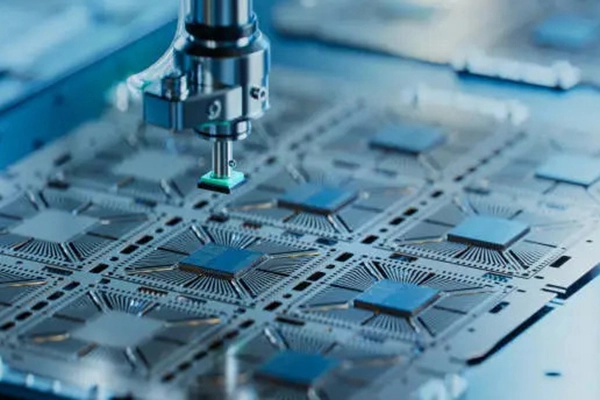
- Electronics: Niobium grows an anodic oxide layer. Some electrolytic capacitor designs make use of that layer.
Welding, Finishing and Anodizing
Standard lead-tin solder will not bond to this wire. Heat niobium in air and it oxidizes quickly. For this product, weld with TIG inside an argon chamber kept under tight control. EB welding works too. Hold the work in vacuum or in high-purity argon. Oxygen and nitrogen stay out that way. Brittleness comes from those two gases.
Three finishes are available: polished/ground, acid-pickled, and black-oxide. Which one you get depends on your use. Oxides come off during polishing or grinding. Where insulation adhesion matters, pick acid-pickled or black-oxide. A finish on its own does not prove biocompatibility. That is why medical projects need a separate certification.
Cleaning and pickling come first. Next the wire is anodized. That step gives teal, magenta, gold and blue, and no dyes are needed. Jewelry work suits it. So does color-coded electronic identification.
Be used in a wide range of industries.
Electronic devices
Medical implants
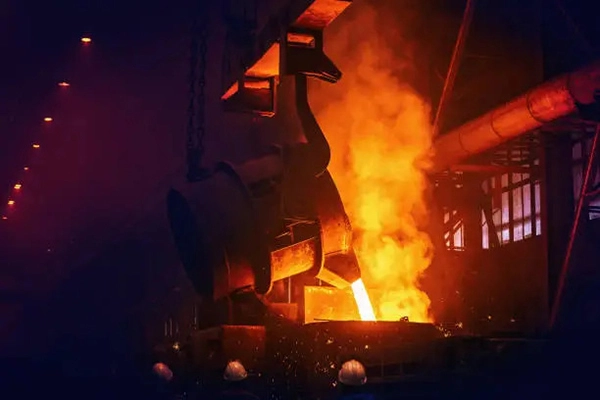
Steel industry

Chemical Processing

Aerospace and Defense

Energy and Environmental Engineering
Before You Request a Quote for niobium alloy wire
Want a quote on this product? Send us these details:
- Alloy grade: choose Nb-Ti for superconducting work, or Nb-Zr for structural use at high temperatures.
- Diameter and length: 0.5–5 mm across. Length gets made to your order.
- RRR value: if the wire goes into superconducting use, tell us the Residual Resistance Ratio you are aiming for.
- Surface condition: choose a finish that fits whatever insulation or implant requirement you have.
- Quantity and delivery timing: give us both, and our answer will be precise.
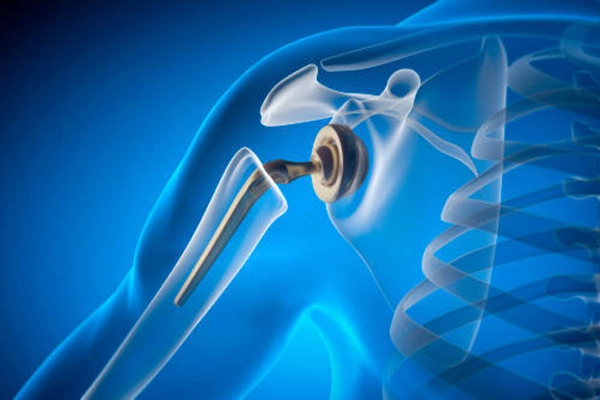
- Medical end use: industrial Nb-1Zr is often ordered to ASTM B392, which covers industrial and nuclear service. Other grades and medical-grade standards, such as the ASTM F series, are the usual requirement on medical projects. Check the biocompatibility certification first.
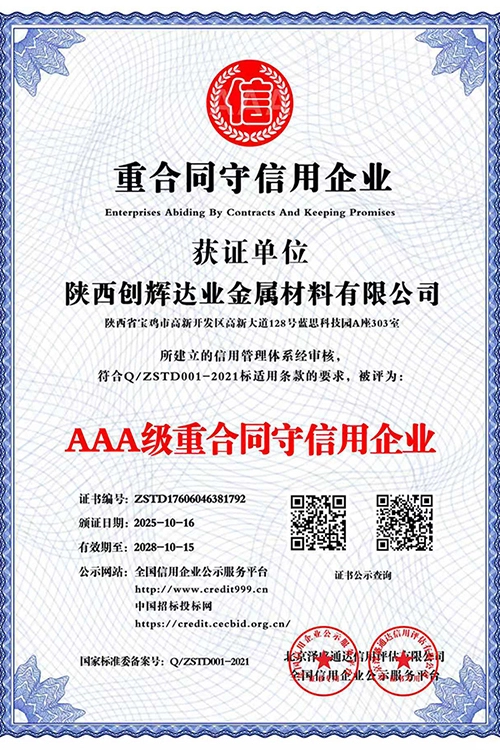
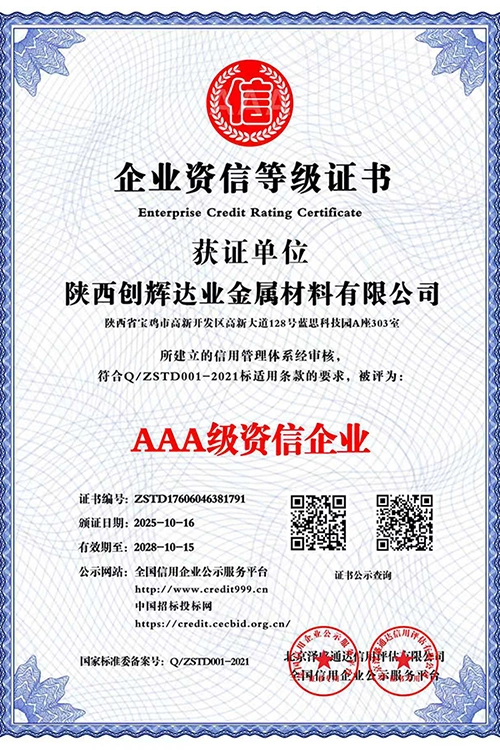
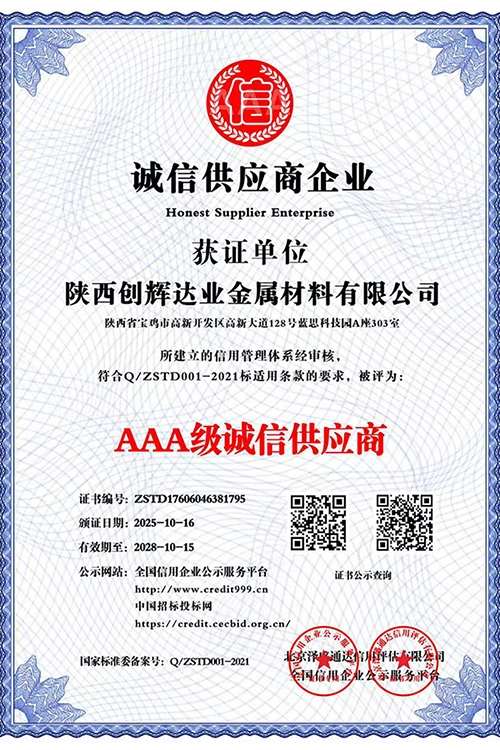
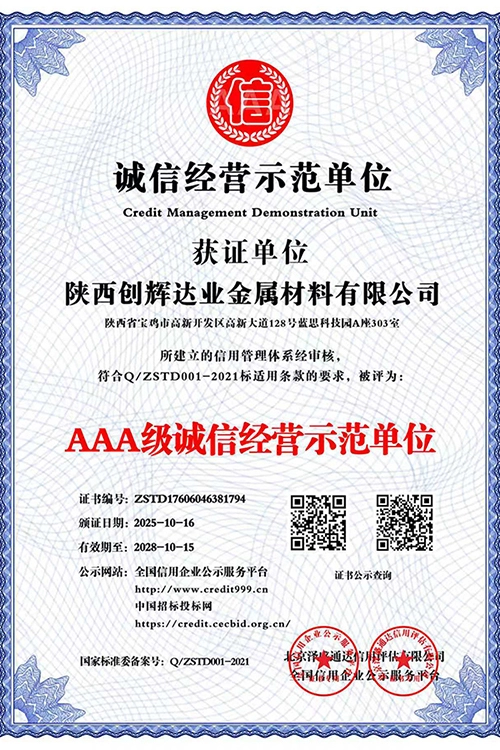
About Chuanghui Daye
Shaanxi Chuanghui Daye Metal Material Co., Ltd. sits in Baoji High-tech Development Zone. People in China call this area the "Titanium Capital". Our founder brings more than 30 years of experience in rare metals. Titanium, tantalum, niobium, tungsten, molybdenum, zirconium, nickel and other rare metal alloy products come out of the company for the metallurgy, electronics, medical and special steel fields. Customers in more than 50 countries have received shipments, among them the United States, Germany, South Korea and Singapore.
Storage
Chemicals are resisted well by this wire. Even so, its surface can oxidize over time. Leave it in the sealed pack with the desiccant until you are ready to use it. When you request a quote, tell us which niobium alloy wire packaging format you need.




 |
 |
 |
 |
 |
 |
 |
 |
|
|
|


 |
 |
 |
 |
 |
 |
Frequently Asked Questions
Q: For my case, which grade fits better, Nb-Ti or Nb-Zr?
A: Nb-Ti is the grade most customers pick for superconducting jobs. For structural and chemical service at high temperature, Nb-Zr is the one to use. Send us the details of your application and we will go through the grade choice with you.
Q: Can this wire be joined with standard soldering?
A: No. Once heat and air reach niobium, it oxidizes fast. Two methods do work. One is TIG welding inside a controlled argon chamber. The other is EB welding.
Q: Why does the RRR value matter?
A: RRR (Residual Resistance Ratio) tells you two things. First, how pure the metal is. Second, how well it conducts at cryogenic temperatures. Better thermal conduction usually comes with a higher value. Superconducting magnets stay steadier that way. Send us your target when you get in touch.
Q: Is it safe to use this wire in air at high heat?
A: No, not unless you protect it. In air it oxidizes fast once it goes above 400 °C. You can run it in a vacuum. Argon and helium also work, and so does liquid alkali metal. Another option is a protective silicide coating.
Q: Can the wire be anodized for color?
A: Yes. Once cleaned and pickled, it can be anodized to teal, magenta, gold or blue without dyes.
Contact Us
Send your alloy, diameter, length and quantity to info@chdymetal.com. We will review your niobium alloy wire requirements and reply with a quote.
Learn about our latest products and discounts through SMS or email