- English
- French
- German
- Portuguese
- Spanish
- Russian
- Japanese
- Korean
- Arabic
- Greek
- German
- Turkish
- Italian
- Danish
- Romanian
- Indonesian
- Czech
- Afrikaans
- Swedish
- Polish
- Basque
- Catalan
- Esperanto
- Hindi
- Lao
- Albanian
- Amharic
- Armenian
- Azerbaijani
- Belarusian
- Bengali
- Bosnian
- Bulgarian
- Cebuano
- Chichewa
- Corsican
- Croatian
- Dutch
- Estonian
- Filipino
- Finnish
- Frisian
- Galician
- Georgian
- Gujarati
- Haitian
- Hausa
- Hawaiian
- Hebrew
- Hmong
- Hungarian
- Icelandic
- Igbo
- Javanese
- Kannada
- Kazakh
- Khmer
- Kurdish
- Kyrgyz
- Latin
- Latvian
- Lithuanian
- Luxembou..
- Macedonian
- Malagasy
- Malay
- Malayalam
- Maltese
- Maori
- Marathi
- Mongolian
- Burmese
- Nepali
- Norwegian
- Pashto
- Persian
- Punjabi
- Serbian
- Sesotho
- Sinhala
- Slovak
- Slovenian
- Somali
- Samoan
- Scots Gaelic
- Shona
- Sindhi
- Sundanese
- Swahili
- Tajik
- Tamil
- Telugu
- Thai
- Ukrainian
- Urdu
- Uzbek
- Vietnamese
- Welsh
- Xhosa
- Yiddish
- Yoruba
- Zulu
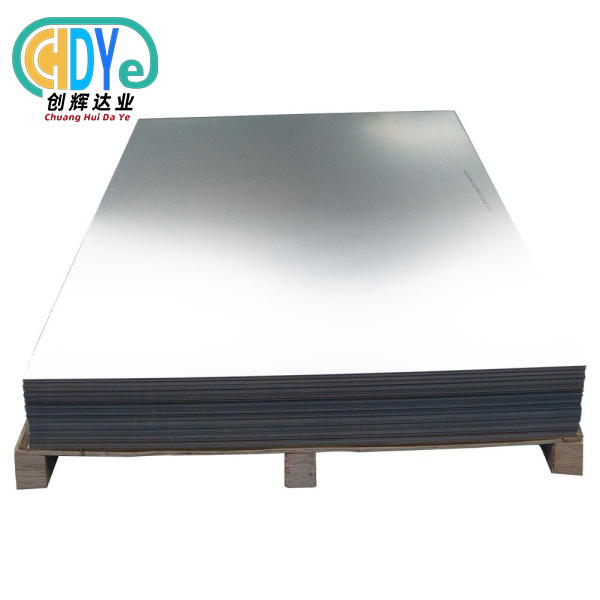
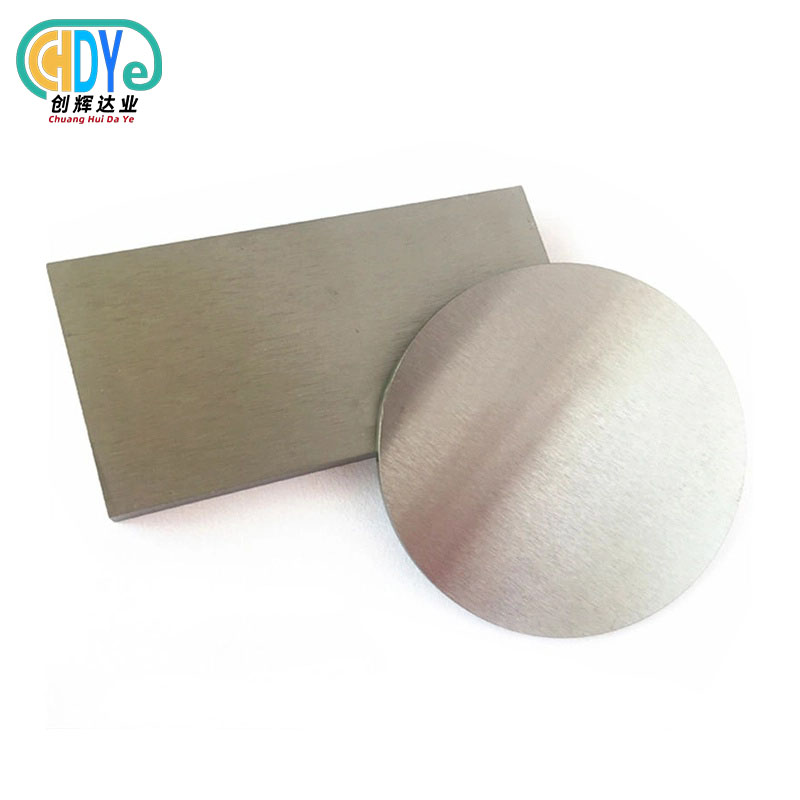
titanium sheet grade 2
2. Size: Thickness :0.5mm~50mm*Width:1000-3000mm
3. Standard: ASTM B265/ASME SB265, ASTMF67, ASTM F136
4. Type: plate, sheet, foil, strip
5. Surface: Bright, Polished, Pickling, Sandblasting 7. Processing method: cold rolling / hot rolling
Titanium Sheet Grade 2 for Chemical, Marine and Aerospace Use
Baoji High-tech Development Zone, Shaanxi is home to Shaanxi Chuanghui Daye Metal Material Co., Ltd. The company makes titanium sheet grade 2. Sheet thickness goes from 0.5 mm to 50 mm. Widths range from 1000 mm to 3000 mm. Mills roll it hot or cold. The spec is ASTM B265 / ASME SB265. Density for this commercially pure grade is 4.51 g/cm³. Tensile strength reaches 345 MPa minimum. 20% elongation is required as well. Buyers often come from chemical and marine part makers. Aerospace work also uses the sheet. Corrosion resistance is important in those parts. Weight savings count as well. The sheet also forms easily when cold.
What Is CP Grade 2 Titanium Sheet?
CP Grade 2 is a commercially pure titanium. No alloying elements go into it. The structure stays alpha phase. Strength sits at a moderate level. Ductility is high. Put the two together and cold formability turns out good.
Oxygen contact lets a stable TiO2 film form on the surface. The film heals itself. That layer explains why the metal stands up to oxidizing environments. Medical and food processing equipment makers look at this grade when biocompatibility matters.
Specifications
The values below are taken as supplied in the product specification data and have not been adjusted.
Titanium Sheet Specifications
|
Standard |
ASTM B265/ASME SB265, ASTMF67, ASTM F136 |
|
Grade |
GR1-GR5, GR7, GR9, GR11, GR12, TI-6AL-4V ELi |
|
thickness |
≤0.5mm-20mm |
|
Width |
≤2000mm |
|
Length |
1000mm-12000mm and customized |
|
Technique |
Cold rolling & Hot Rolling |
|
Surface |
Bright, Polished, Pickling, Sandblasting |
|
Shape |
Rectangular/Square/small pieces |
|
Application |
Metallurgy, electronics, medical, chemical, petroleum, pharmaceutical, aerospace, etc. |
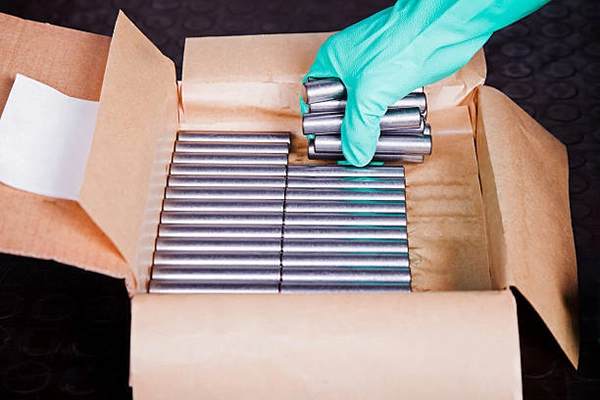
| Package Terms | Moisture-proof cloth, foam cotton inside, wooden case outside. |
| Paymnt term | 30%TT in advance, 70% TTbalance before shipping |
Be used in a wide range of industries.

Metallurgy and titanium sheet grade 2 Special Steel

Electronics and Semiconductors

Medical Equipment
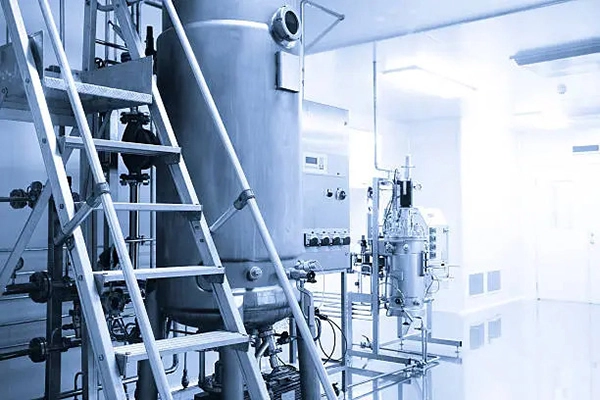
Chemical Processing

Aerospace and Defense
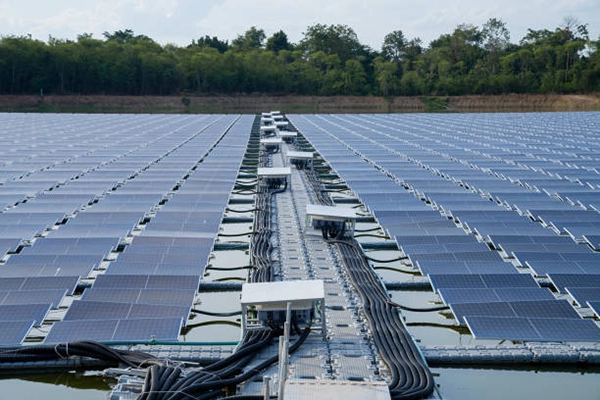
Energy and Environmental Engineering

Mechanical and Chemical Properties
|
Grade |
Status |
Tensile Strength |
Yield Strength |
Elongation |
Area of Reducation |
||
|
Ksi |
Mpa |
Ksi |
Mpa |
% |
|||
|
≥ |
|||||||
|
GR1 |
Annealed |
35 |
240 |
25 |
170 |
24 |
30 |
|
GR2 |
50 |
345 |
40 |
275 |
20 |
30 |
|
|
GR3 |
65 |
450 |
55 |
380 |
18 |
30 |
|
|
GR4 |
80 |
550 |
70 |
483 |
15 |
25 |
|
|
GR5 |
130 |
895 |
120 |
828 |
10 |
25 |
|
|
TI-6AL-4VELI |
125 |
860 |
115 |
795 |
10 |
25 |
|
|
GR6 |
120 |
828 |
115 |
483 |
15 |
25 |
|
|
GR7 |
50 |
345 |
40 |
275 |
20 |
30 |
|
|
GR9 |
90 |
620 |
70 |
483 |
15 |
25 |
|
|
GR11 |
35 |
240 |
25 |
170 |
24 |
30 |
|
|
GR12 |
70 |
483 |
50 |
345 |
18 |
||
Our specification data does not list the MOQ. Lead time, certificates, tolerances and test reports are missing from it as well. Send your inquiry and we will confirm each of them.
Why Buyers Choose Grade 2 Over Stainless Steel
Saltwater and chloride-rich media can pit 304 and 316L stainless steel. Stress corrosion cracking is a second risk. In many of those environments, grade 2 titanium sheet holds up better. Equipment in wet chlorine or hypochlorite service can gain years from that. Temperature plays a part. So does concentration. Crevice conditions can shift the result too. Check the real service conditions first. Then pick a grade.
Density works out to 4.51 g/cm³. Steel is much heavier. That gap pays off in aerospace ducting and architectural cladding, where every gram counts. The modulus sits near 105 GPa. Steel wins on stiffness. Even so, the sheet bends and springs back nicely.
Grade 5 is the stronger one, though cold forming it takes more work. With grade 2 you can bend and deep draw complex shapes, chemical tank liners for example, and in many cases no hot forming is needed. This grade also goes by this product, DIN 3.7035 and AMS 4902.
Applications
Common places grade 2 titanium sheet shows up:
- Chemical processing: Linings for reaction vessels and plate-and-frame heat exchangers handling wet chlorine gas, chlorites or hypochlorites.
- Power generation and desalination: Multi-stage flash plants use condenser tubing plates and flash chambers. Both parts have to deal with seawater.
- Aerospace: Take parts that carry no structural loads, and ducting is one example. Brackets and galley equipment are others. Less weight pays off here, and deep-drawn shapes help too.
- Medical and food processing: Equipment surfaces in these fields touch sensitive products. Fit comes down to the application.
Surface Finishes and Processing Routes
You can pick from four finishes. They are bright, polished, pickling, and sandblasting. Alpha case lies at the surface. The layer is brittle. It also holds a lot of oxygen. Pickling takes that layer off too.
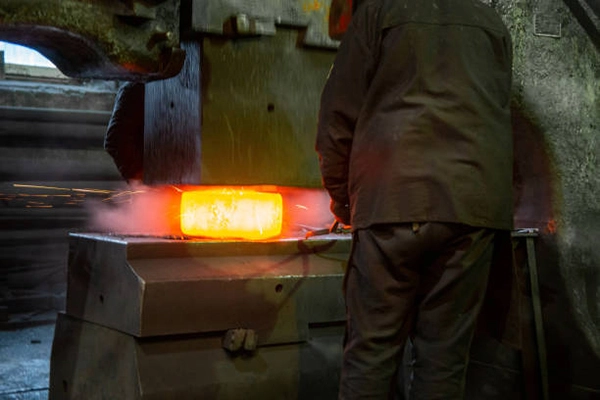
Thin sheet, foil and strip need tight control of the finish. That is a job for cold rolling. Plate goes thicker, up to 50 mm, and hot rolling handles it. Your project may call for more strength. In that case, ask about other grades in the range we list, Gr5 ELI and Gr12 among them.
Quality Checks Buyers Commonly Request for titanium sheet grade 2
Orders for this product keep raising these checks. Before you order, ask which reports and test scopes are really available.
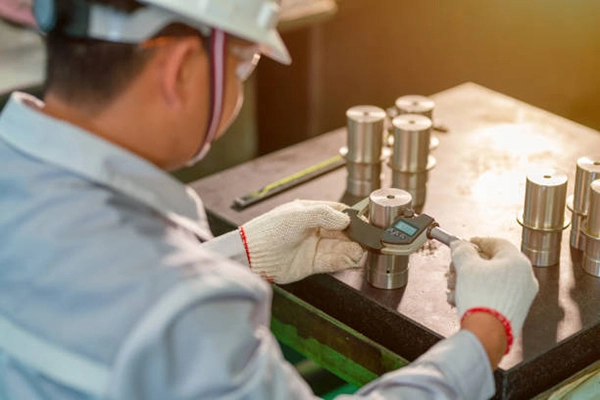
- Chemical analysis (ASTM E120 / E1409): Two elements deserve a close look here, oxygen and iron. Push the oxygen level up and formability drops. Cracking during fabrication is the other thing to watch.
- Mechanical testing: Do a pull test along the part. A second one goes across it. Put the two readings side by side, since the gap tells you how far the properties shift with direction. Stamped parts also get a bend test at a 2T or 3T radius. That one is your read on ductility. Paperwork to EN 10204 3.1 gets asked for by buyers quite often.
- Microstructure (ASTM E112): Properties stay steady as long as the alpha grains remain equiaxed.
- Surface condition: The alpha case has to be gone. Check that pickling or chemical milling took it off.
- Ultrasonic testing (AMS 2631): This test is used on thicker sheet and plate. Internal laminations or inclusions show up in it.
About the Supplier
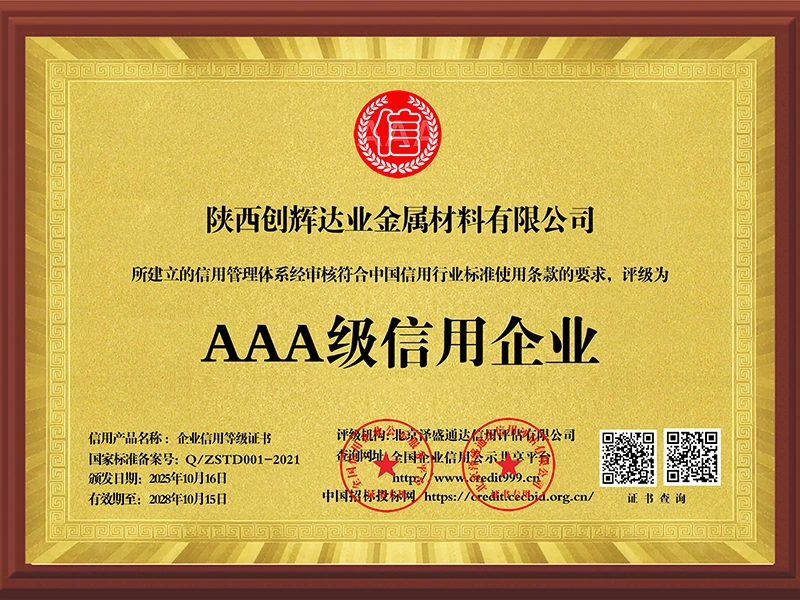
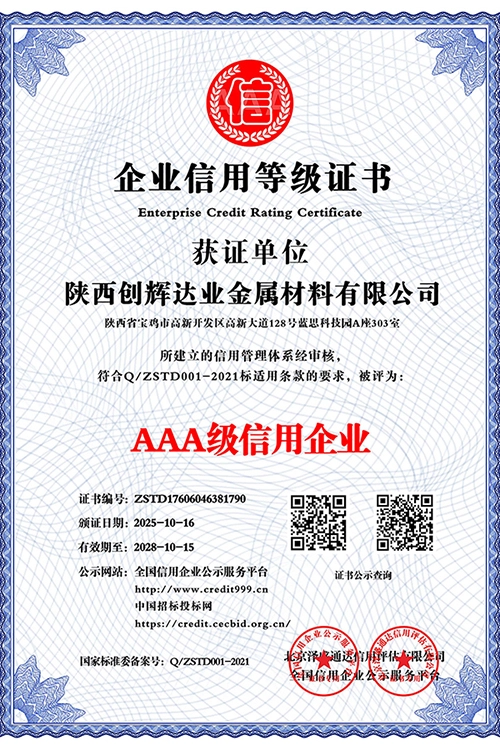
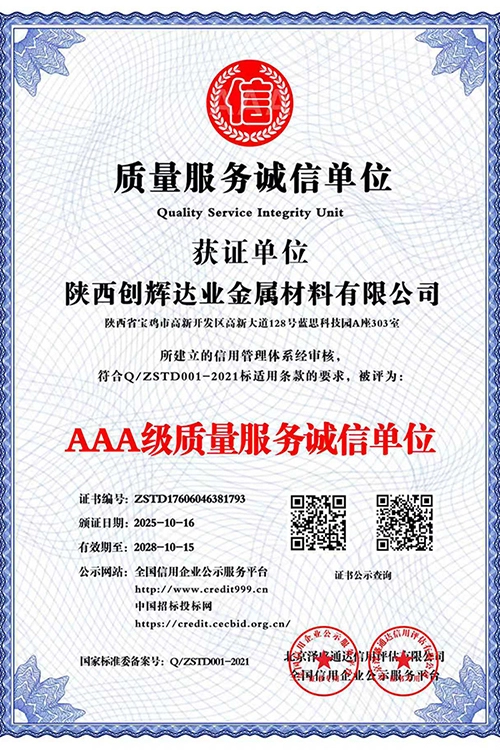
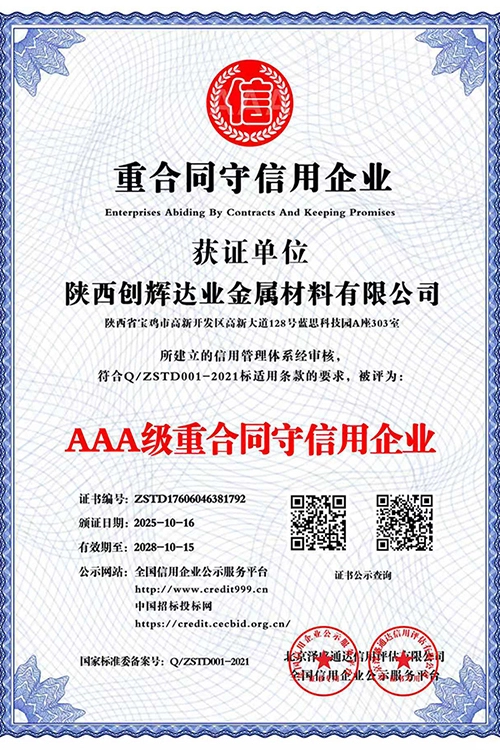
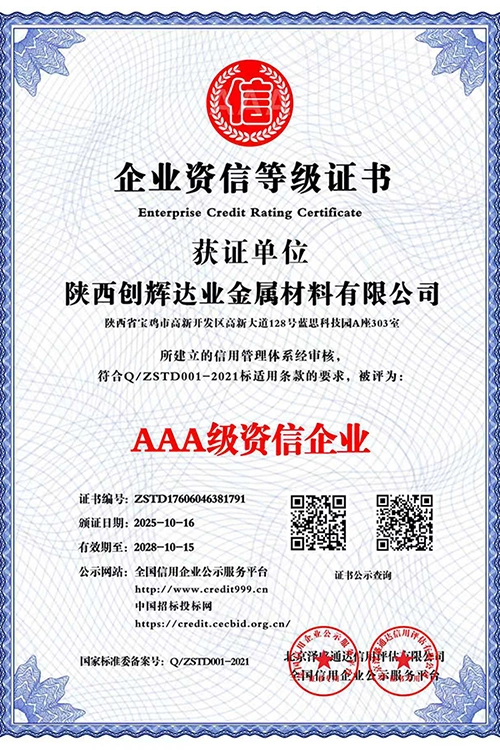
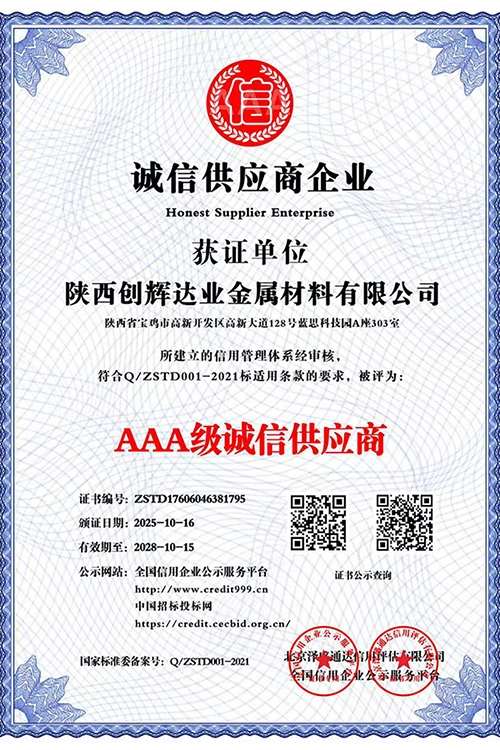
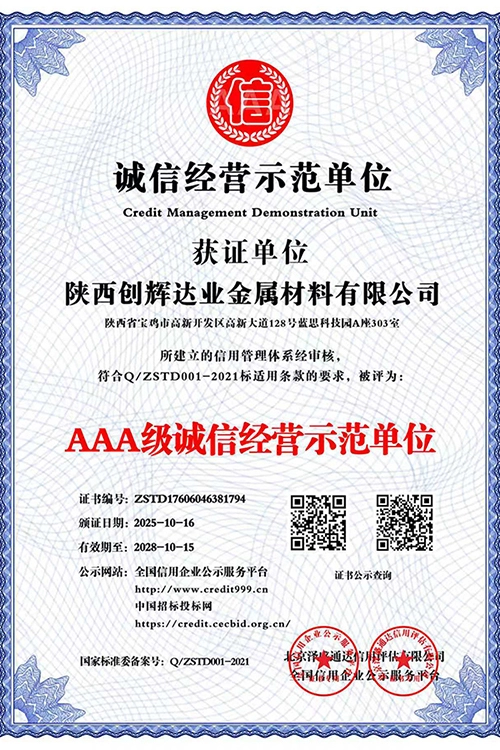
Shaanxi Chuanghui Daye Metal Material Co., Ltd. is based in Baoji, Shaanxi Province. Baoji is often called China's "Titanium Capital". The founder has over 30 years in the rare metal industry. Its products have gone to more than 50 countries and regions. The countries include the United States, Germany, South Korea and Singapore.
Other rare metal alloys come from the same supplier. Tantalum and niobium sit on that list. So do tungsten, molybdenum, zirconium and nickel. Send Titanium sheet grade 2 and any other metal in one inquiry.
|
|
|


|
|
|
|
|
 |
 |
 |
 |


 |
 |
 |
 |
 |
 |
|
|
|


FAQ
Q: How does it stack up against 304 or 316L stainless steel?
A: Pitting and stress corrosion cracking are where it tends to win in chloride settings. Its density is much lower too. Whether it fits still comes down to temperature. Concentration and crevice conditions count as well.
Q: What sizes are available?
A: Thickness ranges from 0.5 mm to 50 mm. For width, 1000 mm through 3000 mm is covered. Plate, sheet, foil or strip: all can be ordered.
Q: Which surface finishes can I choose?
A: Bright, polished, pickling and sandblasting finishes are listed.
Q: How does it perform at elevated temperature?
A: The specification data states that properties are maintained up to about 425 °C (800 °F).
Q: What quality checks are worth asking for?
A: Chemical analysis of oxygen and iron is a common request. Buyers also ask for tensile tests in both directions and bend tests. Microstructure review comes up too, along with alpha case inspection. For thicker material, ultrasonic testing fits well.
Q: What are the MOQ and lead time?
A: Those details aren't in the product data we have right now. Send us your spec and the quantity you need. We can confirm them after that.
Contact Us
Email your required grade, thickness, width, finish, quantity and drawing for titanium sheet grade 2 to info@chdymetal.com.
Learn about our latest products and discounts through SMS or email