- English
- French
- German
- Portuguese
- Spanish
- Russian
- Japanese
- Korean
- Arabic
- Greek
- German
- Turkish
- Italian
- Danish
- Romanian
- Indonesian
- Czech
- Afrikaans
- Swedish
- Polish
- Basque
- Catalan
- Esperanto
- Hindi
- Lao
- Albanian
- Amharic
- Armenian
- Azerbaijani
- Belarusian
- Bengali
- Bosnian
- Bulgarian
- Cebuano
- Chichewa
- Corsican
- Croatian
- Dutch
- Estonian
- Filipino
- Finnish
- Frisian
- Galician
- Georgian
- Gujarati
- Haitian
- Hausa
- Hawaiian
- Hebrew
- Hmong
- Hungarian
- Icelandic
- Igbo
- Javanese
- Kannada
- Kazakh
- Khmer
- Kurdish
- Kyrgyz
- Latin
- Latvian
- Lithuanian
- Luxembou..
- Macedonian
- Malagasy
- Malay
- Malayalam
- Maltese
- Maori
- Marathi
- Mongolian
- Burmese
- Nepali
- Norwegian
- Pashto
- Persian
- Punjabi
- Serbian
- Sesotho
- Sinhala
- Slovak
- Slovenian
- Somali
- Samoan
- Scots Gaelic
- Shona
- Sindhi
- Sundanese
- Swahili
- Tajik
- Tamil
- Telugu
- Thai
- Ukrainian
- Urdu
- Uzbek
- Vietnamese
- Welsh
- Xhosa
- Yiddish
- Yoruba
- Zulu
How to Choose Niobium Metal Wire for Industrial Applications?
Choosing the right niobium metal wire for your industrial application requires evaluating material purity, performance characteristics, and supplier reliability. High-quality niobium wire delivers exceptional corrosion resistance, superconductivity, and biocompatibility—making it indispensable for aerospace, electronics, chemical processing, and medical device manufacturing. Selecting a trusted manufacturer who offers 99.95% purity material, comprehensive certifications, and custom processing capabilities ensures your operations benefit from consistent quality and optimal performance in demanding environments.
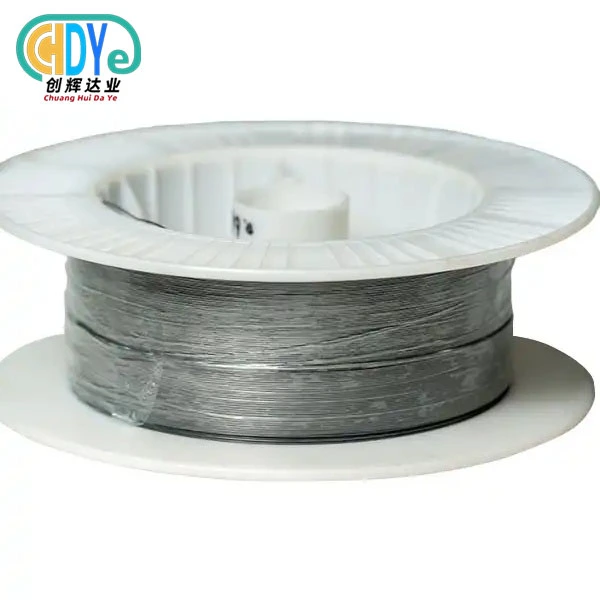
Understanding Niobium Metal Wire: Properties and Industrial Significance
Different industries need different shapes of fine-gauge or coarse-gauge wire, which are made by a very precise drawing process. The atomic number of this metal that doesn't melt is 41, and its density is 8.57 gm/cc. At 2468°C, it melts, and at 4742°C, it boils. This means that it stays solid at both very high and very low temperatures. Since the material can move heat 0.537 W/cm/K and electricity 12.5 microhm-cm at 0°C, it is perfect for electronics that need to send signals reliably and get rid of heat. Niobium wire is good for electricity, but it is also very resistant to acids and easy to shape, so it can be shaped into complicated forms without losing its strength.
Key Physical and Mechanical Properties
It is 99.95% pure and meets the standards of ASTM, AMS, and ISO. It is made by Shaanxi Chuanghui Daye Metal Material Co., Ltd. This very pure material doesn't turn black in air and stays bendable even after being worked on a lot. With a specific heat of 0.064 Cal/g/K, the temperature stays stable while it is being made and used. At very low temperatures, its superconductive properties show up. This makes it useful in MRI technology and particle reactors, where strong magnetic fields must be maintained without energy loss.
Industrial Applications Across Sectors
The aerospace industry uses niobium wire to make engine parts that can handle high temperatures without adding too much weight. This is because niobium wire is very light and stable at high temperatures. People who work in electronics use its ability to carry electricity to make capacitor lines and vacuum tube parts that need to work regularly with electricity. Niobium wire mesh is used by chemical companies to remove dangerous gases and liquids. This keeps the process clean and stops the wire from breaking down in places with harsh chemicals. Biocompatibility is important to people who make medical devices because they use it in surgical patches and pacemaker leads, where the body doesn't want to reject it too much. The fact that this wire can be used for so many things shows how important it is to know about its properties before buying it.
Essential Criteria for Selecting Niobium Metal Wire
Before you can pick the right material, you need to fully understand where it will be used. If you know about the temperature ranges, chemical exposures, physical pressures, and electrical factors, you can match the needs with the right Niobium Metal Wire specs.
Defining Application Requirements
Find out if the use calls for superconductivity at very low temperatures or thermal stability at high temperatures. When working with chemicals, you need wire that doesn't break down when it comes into contact with some acids, bases, or solvents. Electronics makers have to set numbers for electrical resistivity and heat conductivity that make sure circuits always work. The people who make medical gadgets need to make sure that their items are safe and meet medical standards set by the FDA or other countries.
Purity Grades and Material Certification
How well something works and how long it lasts are directly related to how clear it is. When it comes to quality, Chuanghui Daye's 99.95% purity level is reactor-grade and can be used in tough circumstances. Some lower types may have oxygen, nitrogen, hydrogen, and carbon in them, which weaken the metal and make it more likely to rust. Asking for a Glow Discharge Mass Spectrometry (GDMS) study of the chemical composition backs up claims of purity and makes sure that impurities between the molecules stay below 500 ppm. With the right papers, you can follow things all the way through the supply chain. With ISO 9001:2015 certification, quality is managed in a planned way, from making sure the raw materials are safe to putting them away at the end. When a material meets ASTM and AMS standards, it means it meets well-known industry standards. This makes the buying teams sure that the wire will work when they need it to in critical situations.
Customization Options
Which wire diameter to use depends on what the job calls for. Thin, fine-gauge wire is best for very fragile computer and medical pieces. But coarser gauges give strength to things like airplanes and chemical processing plants. When specifying length, it's important to think about how it will be put together and avoid joints, which add resistance and could be failure points. Wires stay in good shape while they're being shipped or stored thanks to different types of packaging. Vacuum-sealed packaging with desiccants can stop surface rusting, and acid-free wrapping materials can keep things from getting contaminated. If you talk to your supplier about these customization choices, the wire will be ready to use as soon as it gets to you, without having to be cleaned or prepared in any other way.
Procurement Tips: How to Source High-Quality Niobium Wire
It's not enough to just look at the prices that providers give you to find ones that you can trust. A planned method for picking a seller lowers risk and creates long-lasting connections that help keep production quality high.
Evaluating Supplier Credentials
The fact that a seller has ISO 9001:2015 certification means that they are committed to quality control systems that keep an eye on the whole production process. The certification should cover making niobium wire, so make sure that it does. Ask for proof that ASTM and AMS rules are being followed, like test results that show the material's features match the rules that have been made public. How well the supplier can make things will show you if they can meet your needs for quantity and customization. Modern facilities should have electron beam furnaces for melting materials that are very pure, precision drawing equipment for keeping an eye on sizes, and annealing furnaces for making materials better in every way. Industries that have been around for a long time, like Baoji, which is known as China's "Titanium Capital," offer suppliers specialized buildings and a ready supply of trained workers.
You can find out how well a company is doing by asking clients for feedback. Find companies in the same field and ask for references. Find out how consistent their material is, how reliable their delivery is, and how quickly they respond to requests for technical help. Years of experience are very helpful, and Chuanghui Daye's team has been making rare metals for over 30 years. They know a lot about how to solve problems that are specific to each application.
Understanding Pricing Structures
Niobium is not bought or sold on metal markets, so prices are set by buyers and sellers based on how pure the metal is, how much is being bought or sold, and the state of the market. Niobium costs about US$41.50 a kilogram and hasn't changed much in the last ten years. However, prices may go up for special orders. People who buy a lot of things often can save money on the cost per kilogram by placing larger orders. While different suppliers have different minimum order amounts, you can still make plans by telling them how much you plan to use. You should get detailed quotes from each seller that include the costs of goods, processing fees, and shipping in order to really compare them.
Lead Times and Sample Testing
When things are made, wait times depend on the type of wire and the number of orders. In a few weeks, standard diameters and lengths can be shipped. But custom orders that need special drawing dies or annealing profiles take longer to make. Planning purchase plans with enough lead time can keep production from being held up. Before full orders are placed, tests on samples lower the risk. Make sure the models you get are the right size, have a good surface, are strong enough to hold your weight, and don't have any electrical problems before you test them in-house. As a final check, this step makes sure that the seller can consistently send you the right Niobium Metal Wire materials for your needs.
Best Practices for Using and Maintaining Niobium Metal Wire in Industrial Settings
By taking care of and handling niobium wire the right way, you can make it last as long as possible and keep its performance qualities throughout its production and use.
Storage and Handling Protocols
As oxygen and nitrogen get hot, they react with niobium. This is why places that store it should keep their environments dry and under control. If you keep the wire in its original vacuum-sealed packaging until you need it, the surface won't rust. Surface rust can make wire less resistant to corrosion and less useful for electrical work. The way things are handled should keep dirt, dust, and oils from the skin from getting on them. When you use clean gloves and the right tools, you don't bring in dirt or other impurities that could hurt the performance of wire in delicate situations like medical implants or superconducting parts.
Installation Guidelines
There are special ways to weld niobium wire so that it doesn't get weak. When ultra-pure argon or a vacuum is used for TIG or electron beam welding, oxygen and nitrogen can't get into the metal and turn into brittle oxides. Following the manufacturer's directions for heating up before and after the weld makes the joint stronger and more flexible. For anodization jobs, like color-coding for identification, you need to use controlled DC voltage in an electrolytic bath to make a clear oxide layer. The thickness of the layer, not the dyes, determines the color. This makes it a long-lasting way to mark things that doesn't fade or react with chemicals.
Inspection and Maintenance
Regular inspections look for early signs of damage, like wear, rust, or motor wear, that could make a system not work as well. Eddy current testing finds flaws and cracks below the surface of important parts. Visual inspection, on the other hand, finds flaws on the surface that might get worse when stressed. You can tell if the working conditions are too high for the material by keeping track of how the sizes change over time. Parts that are suddenly bent or worn out need to be replaced right away so that systems that are linked don't fail all at once. By keeping track of inspection results, you can set performance standards that guide maintenance plans and replacement times. This keeps the product reliable while lowering costs over its lifetime.
Conclusion
When selecting Niobium Metal Wire for industrial use, it is important to carefully think about the material's properties, the supplier's credentials, and the needs of the application. When it comes to tough environments, niobium wire is the best choice for medical technology, electronics, airplanes, and chemical processing. It doesn't rust, is biocompatible, and stays stable at high temperatures. When you work with skilled manufacturers who offer pure materials, full certifications, and custom processing options, you can be sure that the products you use will always be of high quality and work well. When you use strategic procurement practices like researching suppliers, testing samples, and doing the right things, you can get the most out of your money while also lowering operational risks.
FAQ
Q: What factors influence niobium wire pricing?
A: The level of purity has a big effect on the price. For example, 99.95% reactor-grade material costs more than commercial rates. The price per kilogram changes based on how many kilograms you order. Buying more usually gets you a better deal. When you need to draw or heat something in a special way for a custom order, the processing fee goes up. The state of the market and the availability of raw materials can also change the prices that are negotiated. Its price, on the other hand, has stuck around US$41.50 per kilogram since 2010.
Q: How does niobium wire compare to tantalum in corrosion resistance?
A: It is very hard for rust to form on niobium and tantalum in a lot of different chemical environments. Tantalum works a little better than niobium in some very strong acids, but niobium is a better value for money in most business situations where protection is needed. A lot of the time, the choice between them is based on the chemicals used and the budget that is available, not on how well they work.
Q: Can niobium wire be customized for specific applications?
A: As an example, manufacturers let you choose from a wide range of diameters, from small ones for use in electronics to bigger ones for use in buildings. For length specs, it's important to think about how the item will be put and try to keep joints as few as possible. Use of vacuum packing and desiccants in shipping keeps the materials' quality. With custom manufacturing services from companies like Chuanghui Daye, wires are made to fit the needs of each operation.
Partner with Chuanghui Daye for Premium Niobium Metal Wire
More than 30 years ago, Shaanxi Chuanghui Daye Metal Material Co., Ltd. worked with rare metals. They now use ISO 9001:2015-certified methods to make niobium wire that is 99.5% pure and meets ASTM, AMS, and ISO standards. We make high-performance wire for use in chemicals, medicine, aircraft, and electronics with the help of modern electron beam furnaces, exact drawing tools, and full quality control systems. Our plant is in Baoji, which is known as the Titanium Capital of China. As part of our custom processing, we can give a range of diameters, custom lengths, and packing that keeps materials in good shape from the time they are made until they are delivered. As a reputable Niobium Metal Wire seller, we can give you low prices that come straight from the plant, fast production, and safe shipping all over the world. Thanks to our technical know-how and high-quality standards, we can help you with your buying needs. You can email us at info@chdymetal.com to tell us about your needs, get samples, or place large orders that come with full paperwork that can be used to find out where the metal came from.
References
1. Davis, J.R. (2000). Refractory Metals and Alloys: Properties, Selection, and Applications. ASM International Materials Park.
2. Sims, C.T., Stoloff, N.S., and Hagel, W.C. (1987). Superalloys II: High-Temperature Materials for Aerospace and Industrial Power. John Wiley & Sons.
3. Lütjering, G. and Williams, J.C. (2007). Titanium: Engineering Materials and Processes. Springer-Verlag Berlin Heidelberg.
4. ASTM International (2018). ASTM B394-18: Standard Specification for Niobium and Niobium Alloy Bars, Rods, and Wire. West Conshohocken.
5. Polmear, I.J., StJohn, D., Nie, J.F., and Qian, M. (2017). Light Alloys: Metallurgy of the Light Metals. Butterworth-Heinemann Oxford.
6. Donachie, M.J. (2000). Titanium: A Technical Guide. ASM International Materials Park.
Learn about our latest products and discounts through SMS or email