- English
- French
- German
- Portuguese
- Spanish
- Russian
- Japanese
- Korean
- Arabic
- Greek
- German
- Turkish
- Italian
- Danish
- Romanian
- Indonesian
- Czech
- Afrikaans
- Swedish
- Polish
- Basque
- Catalan
- Esperanto
- Hindi
- Lao
- Albanian
- Amharic
- Armenian
- Azerbaijani
- Belarusian
- Bengali
- Bosnian
- Bulgarian
- Cebuano
- Chichewa
- Corsican
- Croatian
- Dutch
- Estonian
- Filipino
- Finnish
- Frisian
- Galician
- Georgian
- Gujarati
- Haitian
- Hausa
- Hawaiian
- Hebrew
- Hmong
- Hungarian
- Icelandic
- Igbo
- Javanese
- Kannada
- Kazakh
- Khmer
- Kurdish
- Kyrgyz
- Latin
- Latvian
- Lithuanian
- Luxembou..
- Macedonian
- Malagasy
- Malay
- Malayalam
- Maltese
- Maori
- Marathi
- Mongolian
- Burmese
- Nepali
- Norwegian
- Pashto
- Persian
- Punjabi
- Serbian
- Sesotho
- Sinhala
- Slovak
- Slovenian
- Somali
- Samoan
- Scots Gaelic
- Shona
- Sindhi
- Sundanese
- Swahili
- Tajik
- Tamil
- Telugu
- Thai
- Ukrainian
- Urdu
- Uzbek
- Vietnamese
- Welsh
- Xhosa
- Yiddish
- Yoruba
- Zulu
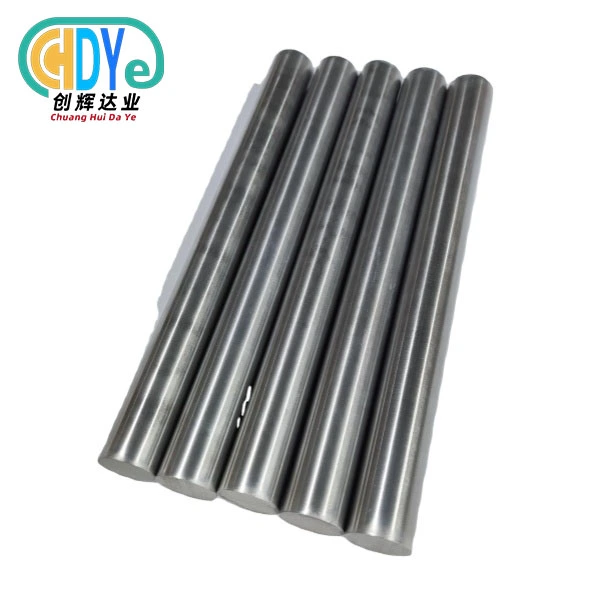
Where Can You Source a Reliable Polished Niobium Bar Rod?
If you're purchasing a polished niobium bar rod for medical devices, electronics, or aerospace components, the solution starts with recognizing where quality and responsibility cross. Trusted suppliers provide high-quality niobium (Nb >99.9%), tight dimensional tolerances, and proven polishing procedures under ASTM B392. Chuanghui Daye niobium rods are supplied in diameters from 1 to 50 mm and lengths up to 3000 mm, with tensile strength ranging from 200 to 350 MPa. Based in Baoji, officially acknowledged as China’s Titanium Capital, this manufacturer is a reliable alternative for demanding industrial sourcing needs.
Understanding Polished Niobium Bar Rods: Key Properties and Applications
A polished surface finish isn’t just about appearances. The polishing process eliminates surface oxides, microfractures, and impurities accumulated during milling, resulting in a cleaner passive oxide layer (Nb2O5), which vastly enhances corrosion immunity. Compared to a pickled or centerless ground rod, a chemically or mechanically polished rod has a lower surface roughness and better biocompatibility—important in medical implant applications where contact with bodily fluids is continual.
Niobium has a density of 8.57 g/cm³, a melting point of 2,468°C, and a Body-Centered Cubic (BCC) crystal structure. It is superconducting at 9.25 K, the highest critical temperature of any elemental metal. These qualities make it essential for particle accelerators, pacemaker leads, and semiconductor production equipment.
The main areas of application are:
- Medical devices: Niobium is a reliable material for components of orthopedic implants and pacemaker leads because of its physiological inertness. It resists attack by human fluids and prevents the allergic responses of nickel-containing metals.
- Electronics and semiconductors: High-purity niobium rods are employed in high-temperature vacuum situations where contamination sensitivity needs purity and surface integrity.
- Aerospace and propulsion: Niobium alloys (e.g., C-103) have tensile strength over 1300°C, allowing for thermal shock management in turbine components and thruster nozzles.
These applications need accuracy. Procurement success depends on a supplier that controls both alloy composition and surface polish throughout manufacture.
Comparing Polished Niobium Bar Rods with Alternative Materials
In high-performance procurement, choosing materials entails significant trade-offs. Tantalum is somewhat better in acid resistance in concentrated hot settings, but it is almost twice as dense (16.69 g/cm³ vs 8.57 g/cm³) and much more costly. Polished niobium bar rods provide equivalent corrosion properties at temperatures below 200°C at a far cheaper cost.
Titanium is biocompatible like niobium, but the mechanical behavior is different. Due to its increased ductility, niobium is used for parts that need a lot of cold work or drawing into precise shapes. Stainless steel is inexpensive, but it lacks the corrosion resistance and biocompatibility necessary for medicinal or chemical processing applications.
When picking a grade, these options should be considered:
- Reactor Grade (R04210): More stringent control of impurities, especially the tantalum concentration. For use in nuclear and superconducting applications.
- Commercial Grade (R04200): Economical choice for common industrial applications when an ultra-low tantalum standard is not required.
- Specialty alloy compositions: Offered to procurement groups with specialized applications, including niobium-titanium formulations for use in superconducting magnet systems.
Rod geometry is also relevant. Round rods are used for machined components and medical implants, whereas square or special cross-sections are better suited for structural or electrical hardware purposes. Chuanghui Daye provides complete five-way traceability for both setups.
How to Identify and Source High-Quality Polished Niobium Bar Rods
Procurement professionals need to defend their supply chain and ask for verifiable proof at each step. Material test reports (MTRs) to prove Nb >99.9% purity, hardness values, tensile strength (200-350 MPa), and surface polish standards are non-negotiable starting points. The governing standard for unalloyed niobium rod and wire is conformance to ASTM B392.
Also, a reputable provider should offer:
- Chemical composition analysis (ICP-MS or XRF)
- Dimensional inspection records to verify diameter tolerances and straightness.
- ISO 9001:2015 certification ensuring systematic quality control from intake of raw material to final packaging
- Chuanghui Daye is ISO 9001:2015 certified and has specific inspection methods for every manufacturing step, including raw material input, electron beam melting, precision machining, polishing, and final inspection. Each rod is provided with complete traceability documentation.
Flexibility of customization is equally vital. Diameter ranges from 1-50 mm, and lengths up to 3000 mm meet the needs of small batch R&D orders from universities and big volume industrial contracts. Supporting procurement strategies across sizes. Negotiable minimum order quantities
Procurement Process: Pricing, Delivery, and Logistics Considerations
Prices for polished niobium bar rod are subject to a number of factors like alloy grade, diameter, length, surface finish standard, and order quantity. The polished finish is somewhat more expensive than pickled or ground because of the extra manufacturing processes, but it does remove the need for any further surface preparation by the consumer.
When evaluating supplier bids, don’t just look at unit pricing – look at overall landed cost. The real cost of purchase will depend on customs charges, freight method (air or sea), and lead time. Chuanghui Daye's position in Baoji, a mature industrial city with solid logistical infrastructure, provides competitive transit times to North American destinations.
There are major benefits for OEMs and distributors with recurrent production schedules to enter into a long-term supply arrangement. Volume commitments allow pricing negotiations, priority scheduling, and buffer stock arrangements to mitigate supply interruption. Chuanghui Daye also has flexible small-batch manufacturing capacity and a rapid technical support staff to handle urgent prototype requirements.
Why Partner with a Trusted Polished Niobium Bar Rod Supplier?
For every B2B relationship, reliable quality is a cornerstone, especially in industries where a failure of materials might have regulatory or safety implications. Having a supplier with manufacturing depth and real technical understanding takes the pressure off the procurement team, from material selection all the way through to delivery verification.
Chuanghui Daye was created by an expert with more than 30 years of experience in the rare metal sector. The firm has state-of-the-art melting, forging, rolling, and machining capabilities, including electron beam furnaces and precision lathes, all inside a single integrated facility. This vertical integration allows customers a clear look into production status and quality results.
Looking forward, polishing technology will continue to progress along with the requirement for tighter surface roughness criteria in the semiconductor and medical application sectors. By working with a supplier who is engaging in process improvement and is aligned with sustainable sourcing principles, procurement teams can satisfy changing regulatory and consumer demands while ensuring supply continuity.
Conclusion
Finding a good polished niobium bar rod that’s polished isn’t just a matter of flipping through a catalog. Proven purity, documented surface quality, flexible customisation, and a supplier with the operational depth to deliver consistently on order quantities and schedules. Chuanghui Daye brings together ISO 9001:2015 certification, 30+ years of rare metal experience, and a fully integrated manufacturing plant in Baoji to satisfy those expectations. Whether your application is medical, electrical, aerospace or research, the correct sourcing choice begins with the right partner.
FAQ
Q: Does polished niobium rod offer better corrosion resistance than stainless steel?
A: Yes. Niobium forms a stable, adherent Nb₂O₅ passive film that resists most organic and inorganic acids. Stainless steel, by contrast, is vulnerable in chloride-rich or strongly acidic environments. Niobium is the preferred material when long-term corrosion immunity is a design requirement.
Q: What are the standard delivery conditions for niobium rods?
A: Rods are supplied in annealed (recrystallized) condition for maximum ductility or cold-worked condition for higher strength. Surface states include centerless ground, pickled, or polished, depending on application requirements.
Q: Can niobium rods be welded or machined?
A: Niobium can be welded using TIG in a fully inert argon environment or electron beam welding. For machining, carbide or high-speed steel tools with adequate lubrication are required. The material behaves similarly to soft copper—ductile but prone to galling without proper technique.
Q: What is the typical lead time for custom orders?
A: Lead times vary by specification and volume. Chuanghui Daye supports expedited small-batch production for prototyping and standard lead times for production orders. Contact info@chdymetal.com for a specific timeline based on your requirements.
Request a Quote from Chuanghui Daye — Polished Niobium Bar Rod Manufacturer
Shaanxi Chuanghui Daye delivers factory-direct pricing, ISO 9001:2015-certified quality, and full traceability documentation on every order. Whether you need a polished niobium bar rod in custom dimensions or consistent volume supply, our team provides technical guidance and competitive lead times. Reach out to our specialists at info@chdymetal.com to request a quote or discuss your project requirements today.
References
1. ASTM International. ASTM B392: Standard Specification for Niobium and Niobium Alloy Bar, Rod, and Wire. ASTM International, 2022.
2. Cardarelli, François. Materials Handbook: A Concise Desktop Reference. Springer, 2018.
3. Savitzky, B.H., et al. "Superconducting Properties of High-Purity Niobium for Accelerator Applications." Journal of Applied Physics, 2019.
4. Breme, J., and J.A. Helsen. "Titanium and Its Alloys." Metals as Biomaterials. John Wiley & Sons, 1998.
5. Lide, David R., ed. CRC Handbook of Chemistry and Physics, 97th ed. CRC Press, 2016.
6. European Commission. Critical Raw Materials for Strategic Technologies and Sectors in the EU: A Foresight Study. Publications Office of the European Union, 2020.
Learn about our latest products and discounts through SMS or email