- English
- French
- German
- Portuguese
- Spanish
- Russian
- Japanese
- Korean
- Arabic
- Greek
- German
- Turkish
- Italian
- Danish
- Romanian
- Indonesian
- Czech
- Afrikaans
- Swedish
- Polish
- Basque
- Catalan
- Esperanto
- Hindi
- Lao
- Albanian
- Amharic
- Armenian
- Azerbaijani
- Belarusian
- Bengali
- Bosnian
- Bulgarian
- Cebuano
- Chichewa
- Corsican
- Croatian
- Dutch
- Estonian
- Filipino
- Finnish
- Frisian
- Galician
- Georgian
- Gujarati
- Haitian
- Hausa
- Hawaiian
- Hebrew
- Hmong
- Hungarian
- Icelandic
- Igbo
- Javanese
- Kannada
- Kazakh
- Khmer
- Kurdish
- Kyrgyz
- Latin
- Latvian
- Lithuanian
- Luxembou..
- Macedonian
- Malagasy
- Malay
- Malayalam
- Maltese
- Maori
- Marathi
- Mongolian
- Burmese
- Nepali
- Norwegian
- Pashto
- Persian
- Punjabi
- Serbian
- Sesotho
- Sinhala
- Slovak
- Slovenian
- Somali
- Samoan
- Scots Gaelic
- Shona
- Sindhi
- Sundanese
- Swahili
- Tajik
- Tamil
- Telugu
- Thai
- Ukrainian
- Urdu
- Uzbek
- Vietnamese
- Welsh
- Xhosa
- Yiddish
- Yoruba
- Zulu
What Is Tantalum Metal Plate? A Buyer’s Guide
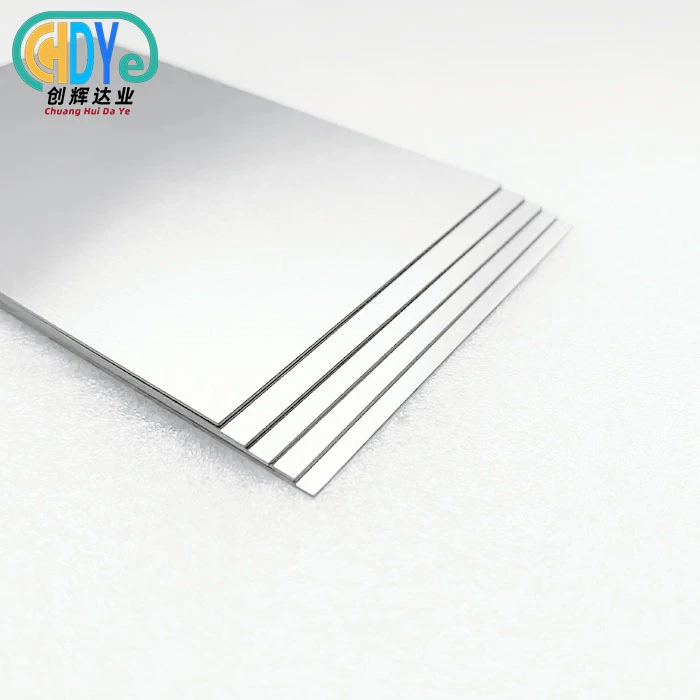
Tantalum metal plate is a flat-rolled refractory metal product made from elemental tantalum (Ta, Atomic Number 73). Characterized by its dark blue-gray hue, outstanding density, and amazing ductility, this material boasts unrivaled corrosion resistance, high-temperature stability, and consistent mechanical strength. Produced to ASTM B 708 standards at 99.95% purity, tantalum plate performs vital functions in chemical processing, aerospace, electronics, and medical device production. If you're investigating rare metal resources for demanding applications, this article guides you through all you need to know before making a sourcing choice.
Understanding Tantalum Metal Plate: Properties and Applications
Core Material Properties
Tantalum is one of the most corrosion-resistant metals known to industry. It resists practically all acids below 150°C and dissolves only in hydrofluoric acid—a feature that makes it actually irreplaceable in severe chemical settings. Its melting point is around 2,996°C, making it among the highest of all industrial metals. The material also creates a self-healing anodic oxide layer that functions as a near-impenetrable barrier against chemical degradation, a trait highly prized in semiconductor and capacitor manufacture. At Chuanghui Daye, our tantalum flat-rolled goods adhere to ASTM B 708 with a certified purity of 99.95%. Available dimensions include thickness from 0.5 mm to 30 mm, width from 10 mm to 2,500 mm, and length from 30 mm to 3,000 mm—covering a wide variety of industrial form factors.
Manufacturing Process Overview
Producing a high-integrity tantalum sheet requires numerous regulated processes. Here is how the material flows from raw ingot to completed plate:
- Hot rolling decreases the thickness of the ingot and also refines the structure of the grain at high temperature, which increases the ductility and homogeneity of the cross-section of the plate.
- Cold rolling may provide tight dimensional tolerances and improved surface finishes, which are important for electronic and medical grade applications where strict specifications are essential.
- The plate may be formed, machined, drilled, and cut to application-specific shapes, whether they are rectangular blanks or complicated contoured components.
- Grinding and polishing bring the surface roughness to the desired Ra value, which is important in vacuum systems and semiconductor settings where contamination control is critical.
- Dimensional, surface, chemical composition, and mechanical characteristics testing is conducted at each step to guarantee that it is in conformity prior to distribution.
These processing stages enable us to provide tantalum metal plate products meeting both dimensional and metallurgical criteria without compromise.
Comparing Tantalum Metal Plates with Alternative Metals
Tantalum vs. Titanium, Niobium, and Stainless Steel
Procurement managers typically compare tantalum with titanium, niobium, and stainless steel. Each material has its realm, but knowing where tantalum outpaces alternatives helps explain its higher initial cost. Titanium is corrosion resistant in oxidizing situations and has a good strength-to-weight ratio, but does not perform well in reducing acid environments, which is where tantalum shines. Tantalum is great for use in hot hydrochloric or sulfuric acid, where stainless steel is cheap but will corrode quickly. Niobium is used occasionally as a cheaper alternative with comparable refractory properties; however, it is not as stable in the form of oxide and is not biocompatible for long-term medical implantation. Often, the economics of service life rather than only the unit cost of the material governs the choice of material. The ability to withstand chemical attack under severe heat cycling immediately results in less equipment replacement and reduced lifetime maintenance costs – an important consideration for capital-heavy businesses.
Selecting the Right Grade and Thickness
ASTM B 708 addresses unalloyed tantalum flat-rolled materials for UNS numbers R05200 and R05400. R05200 is commercially pure tantalum at 99.95% purity; R05400 has a tiny tungsten additive for increased strength. R05200 is sufficient for most chemical process equipment. The thickness selected is directly dependent upon the operating pressure, mechanical load, and chemical concentration of the process media involved.
Procurement Guide: How to Buy Tantalum Plate Effectively
Getting tantalum flat items is all about a clear match between your technical drawings and what the provider can do in terms of processing. Standard Specification Range: Our standard specification range covers most industrial applications: 0.5–30 mm thickness, 10–2,500 mm width, 30–3,000 mm length. Near-net-shape components may be supplied by custom cutting, laser profiling, and CNC machining to save subsequent manufacturing time. When assessing a tantalum metal plate supplier, review the following supplier credentials:
- ISO 9001:2015 certified means a documented quality system is in place with records traceable from the receipt of raw material to final inspection.
- All material traceability paperwork is included, such as mill certifications, chemical composition reports, and mechanical test data to assure regulatory compliance for aerospace and medical customers.
- Meaningful distinction is proven expertise with rare refractory metals. Suppliers with specialized electron beam furnaces and controlled environment processing maintain purity integrity that generic metal service centers cannot match.
Chuanghui Daye is ISO 9001:2015 certified and has superior melting, forging, rolling, and machining equipment in Baoji, which is the acknowledged hub of titanium and rare metal manufacturing in China. Our founder has more than 30 years of hands-on expertise in this materials area, and it shows in the consistency of our work.
Advantages of Choosing Tantalum Plate for Industrial Applications
Tantalum’s industrial track record is well-documented and covers decades of real-world use. Here are the application benefits that influence procurement decisions:
- Chemical processing equipment: Tantalum plate is utilized in heat exchangers, distillation columns, reaction tanks, and bayonet heaters where boiling sulfuric or hydrochloric acid would destroy ordinary metals within months. Explosion cladding: a cost-effective route for large-scale production of corrosion-resistant tantalum-steel composites.
- Capacitor and electronics manufacturing: High-purity tantalum plate is used as feedstock for sputtering targets that deposit diffusion barrier layers on silicon wafers to prevent copper migration in integrated circuits. Its dielectric oxide layer is likewise fundamental to the technology of tantalum electrolytic capacitors.
- Hard-metal tooling and alloys: Tantalum carbide additives improve the hardness and thermal stability of cutting tool matrices, improving tool life in high-speed machining operations.
- Medical and prosthetic devices: The use of tantalum plates for cranioplasty plates and reconstructive implants has been driven by its complete biological inertness and osteoconductivity. Soft tissue attaches to the metal surface immediately, with no immunological reaction.
- Energy & household applications: Tantalum parts are used in wind turbine assemblies, power production systems, and in certain components of household appliances that need to withstand heat.
These benefits lead to real savings in unexpected downtime, equipment replacement costs, and regulatory compliance burden—all of which are meaningful to procurement and engineering teams.
Conclusion
Tantalum metal plate has a unique place in the supply chain of rare metals and offers solutions to challenges for which no affordable equivalent can be found. Its corrosion resistance at severe temperatures, biological inertness, and stability of oxide layer make it useful in chemical processing, semiconductor fabrication, and medical device manufacture. To source it successfully, you need to identify a supplier with proven purity controls, documented traceability, and the machining competence to supply bespoke geometries on time. Knowing these basic principles gives any procurement professional the toolset to make defensible, high-value material selections that will stand up to operational scrutiny.
FAQ
Q: What industries use tantalum plate most heavily?
A: Chemical processing, aerospace, electronics, and medical device manufacturing represent the primary end markets. Chemical equipment producers rely on it for acid-resistant heat exchangers and reaction vessels. Semiconductor manufacturers use high-purity grades for sputtering targets and capacitor production. Medical device companies value its biocompatibility for implantable components.
Q: How does tantalum compare to stainless steel for corrosion resistance?
A: Tantalum outperforms stainless steel significantly in reducing acid environments, particularly hot hydrochloric and sulfuric acids. Stainless steel corrodes rapidly under these conditions, whereas tantalum maintains full structural integrity. The performance gap is substantial enough that lifecycle cost calculations frequently justify tantalum's higher material price.
Q: Can tantalum plate be customized to non-standard dimensions?
A: Yes. Shaanxi Chuanghui Daye offers cutting, forming, drilling, machining, grinding, and polishing across our full specification range. Custom dimensions within the 0.5–30 mm thickness and up to 2,500 mm width envelope are standard practice, including small-batch and prototype orders for research institutions.
Q: What standard governs tantalum flat-rolled products?
A: ASTM B 708 is the governing standard for unalloyed tantalum plate, sheet, and strip in industrial applications.
Request a Quote from Chuanghui Daye — Certified Tantalum Metal Plate Manufacturer
Shaanxixi Chuanghui Daye supplies certified tantalum metal plate to clients across North America and globally, backed by ISO 9001:2015 quality controls, full material traceability, and 30+ years of rare metal expertise. Whether you need standard stock dimensions or precision-machined custom components, our team responds with competitive pricing and dependable lead times. Contact us at info@chdymetal.com or visit www.chdymetal.com to discuss your specifications and request a factory-direct quote today.
References
1. ASTM International. ASTM B708: Standard Specification for Tantalum and Tantalum Alloy Plate, Sheet, and Strip. ASTM International, 2022.
2. Hampel, Clifford A. Rare Metals Handbook. Reinhold Publishing Corporation, 1961.
3. Cardarelli, François. Materials Handbook: A Concise Desktop Reference. Springer, 2008.
4. Kroschwitz, Jacqueline I., ed. Kirk-Othmer Encyclopedia of Chemical Technology, Vol. 24. Wiley-Interscience, 2007.
5. Sibum, Heinz, et al. "Tantalum and Tantalum Compounds." Ullmann's Encyclopedia of Industrial Chemistry. Wiley-VCH, 2017.
6. Donachie, Matthew J. Refractory Metals and Their Industrial Applications: ASTM STP 849. ASTM International, 1984.
Learn about our latest products and discounts through SMS or email