- English
- French
- German
- Portuguese
- Spanish
- Russian
- Japanese
- Korean
- Arabic
- Greek
- German
- Turkish
- Italian
- Danish
- Romanian
- Indonesian
- Czech
- Afrikaans
- Swedish
- Polish
- Basque
- Catalan
- Esperanto
- Hindi
- Lao
- Albanian
- Amharic
- Armenian
- Azerbaijani
- Belarusian
- Bengali
- Bosnian
- Bulgarian
- Cebuano
- Chichewa
- Corsican
- Croatian
- Dutch
- Estonian
- Filipino
- Finnish
- Frisian
- Galician
- Georgian
- Gujarati
- Haitian
- Hausa
- Hawaiian
- Hebrew
- Hmong
- Hungarian
- Icelandic
- Igbo
- Javanese
- Kannada
- Kazakh
- Khmer
- Kurdish
- Kyrgyz
- Latin
- Latvian
- Lithuanian
- Luxembou..
- Macedonian
- Malagasy
- Malay
- Malayalam
- Maltese
- Maori
- Marathi
- Mongolian
- Burmese
- Nepali
- Norwegian
- Pashto
- Persian
- Punjabi
- Serbian
- Sesotho
- Sinhala
- Slovak
- Slovenian
- Somali
- Samoan
- Scots Gaelic
- Shona
- Sindhi
- Sundanese
- Swahili
- Tajik
- Tamil
- Telugu
- Thai
- Ukrainian
- Urdu
- Uzbek
- Vietnamese
- Welsh
- Xhosa
- Yiddish
- Yoruba
- Zulu
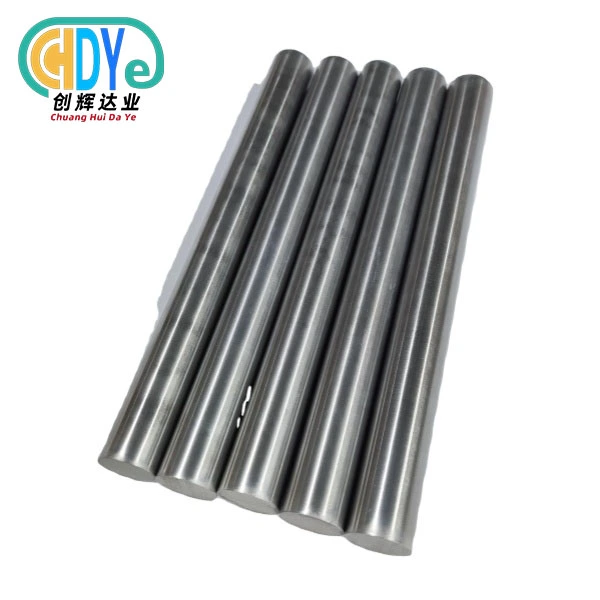
Why Choose a Polished Niobium Bar Rod for Precision Parts?
When accuracy really counts, material selection is not an afterthought – it is the basis of every dependable component. Polished niobium bar rod offers a unique combination of chemical purity of more than 99.9%, fault free surface finish and dimensional tolerances that meet the most demanding technical demands. Whether you are manufacturing implants for the medical industry, producing vacuum components for electronics, or providing structural parts for aerospace assembly, this material always exceeds other options in corrosion resistance, biocompatibility and long-term structural stability.
Understanding Polished Niobium Bar Rods: Properties and Manufacturing
Niobium is a refractory metal with a density of 8.57 g/cm3 and a melting point of 2,468°C. It has a Body-Centered Cubic (BCC) crystal structure, which gives it high ductility. The native oxide layer, Nb2O5, offers passive corrosion resistance to most organic and inorganic acids. Niobium rods have tensile strength of 200-350 MPa depending on temper state, providing a good combination of formability and mechanical integrity.
The Polishing Process and Surface Integrity
The polishing step transforms the raw material into a product suited for precise work. Starting with premium niobium feedstock, the rods are electron beam melted, precision forged and centerless ground before to the final chemical or mechanical polish. This sequence reduces surface micro-cracks, oxide inclusions and size abnormalities. The end result is a rod with a smooth and reflective surface that minimizes frictional wear in contact applications and removes crack-initiation spots that might affect fatigue life in cyclically loaded components.
Key Physical Specifications
Our niobium rods are available with the following verified parameters:
- Alloy purity: Nb >99.9% (ASTM B392- conforming)
- Diameter range: 1-50 mm with close tolerances
- Length: max. 3,000 mm/piece
- Tensile strength: 200 to 350 MPa (annealed to cold-worked).
- Density: 8.57 g/cm3
- Surface finish: Chemically polished or mechanically polished
These specifications make the material suitable for direct integration into machined assemblies without additional surface preparation in most cases.
Key Applications of Polished Niobium Bar Rods in Precision Engineering
Industries that require polished niobium bar rod always mention its physiological inertness and thermal stability and corrosion resistance as determining considerations. The areas where this substance provides the greatest quantifiable benefit are:
- Medical implants and devices: Due to its biocompatibility, niobium is a proven material for pacemaker leads and orthopedic components. It is resistant to bodily fluid corrosion and does not elicit allergic reactions, an important benefit over nickel-containing alloys.
- Electronics and semiconductor manufacturing: Polished surfaces prevent particle contamination in vacuum deposition systems and sputtering targets. Niobium also plays an important role in the manufacture of superconducting RF cavities for particle accelerators , with the highest superconducting transition temperature of any of the pure elements at 9.25 K .
- Aerospace and military components: Niobium alloys such as C-103 have a high tensile strength over 1300°C, and are used for thruster nozzles and turbine parts where resistance to thermal shock is important.
- Chemical processing equipment: The passive Nb_2O_5 film is resistant to attack by most concentrated acids below 200 °C and so niobium rod may be used as a building material for heat exchangers, agitator shafts and chemical reactor internals.
These applications range across a variety of procurement categories, so that a single approved supplier of niobium rod may support numerous engineering teams within an organization.
Comparing Polished Niobium Bar Rods to Alternative Materials
Niobium vs. Tantalum Rod
Tantalum has a little better corrosion resistance in very hot concentrated acids, but at 16.69 g/cm3 roughly double the density of niobium, it adds considerable heft to precise assemblies. Niobium is the cost efficient alternative in conditions below 200°C, offering similar chemical resistance at almost half the weight and a far lower raw material cost.
Niobium vs. Titanium Rod
Titanium is lighter (4.51 g/cm$^3$) and is frequently utilized in biomedical applications, but its tensile strength and thermal performance do not much increase and are well behind that of niobium in high temperature conditions. For working temperatures over 600°C or for superconducting qualities, polished niobium bar rod is still the technically better option.
Niobium vs. Stainless Steel
Stainless steel is cheap to buy, but it includes nickel and chromium that may leach into delicate biological or ultrapure chemical conditions. Since niobium is inert , it is the proper spec when contamination margins are near zero ( typical in semiconductor and medical-grade production ) .Understanding these differences helps procurement teams to justify the niobium rod expenditure with specific technical and lifecycle-cost justifications, rather than broad assumptions.
Procurement Considerations for Polished Niobium Bar Rods
Decisions on sourcing rare metal components demand more than comparing prices A reliable procurement strategy is characterized by the following factors:
- Certification and traceability: Give preference to vendors with ISO 9001:2015 certification. Complete material traceability from raw ingot to finished rod is required for aerospace and medical checks.
- Custom Sizing & MOQ Flexibility: Standard diameters are from 1 to 50 mm and standard lengths are up to 3000 mm. These cover most applications however development stages sometimes need small batch numbers. A good provider will meet both these requirements and will not impose stringent minimum order numbers.
- Lead time and delivery reliability: If you’re working on a time sensitive project, ask the supplier if they have stock inventory or strictly work on a make-to-order basis. An in-house producer with melting, forging and machining capabilities shortens lead times over trading businesses that employ third-party processors.
- Grade selection: Commercial Grade (R04200) is suitable for common industrial applications. Reactor Grade (R04210) has stricter limitations for the tantalum concentration and interstitial impurities which is required for nuclear and superconducting applications.
These factors of supplier evaluation mitigate risk in procurement and provide uniform quality of components across manufacturing runs.
Why Leading Manufacturers and B2B Clients Prefer Polished Niobium Bar Rods
A smooth surface finish is more than just ornamental. It significantly lowers secondary machining time, increases tool life in following cutting operations and offers a verified baseline for dimensional inspection. We know that tight-tolerance component manufacturers in the medical, electronics and aerospace industries see this as a direct cost reduction, not an extra expenditure.The long-term value proposition is bigger than the performance of individual parts. Corrosion immunity in a chemical environment and biocompatibility in medical device creation minimize maintenance and biocompatibility testing rounds, respectively. These considerations, together with the constant supply from a vertically integrated producer, make polished niobium rod more of a strategic procurement decision than a commodity buy.
Conclusion
The selection of rod material for precision components has a direct impact on product dependability, adherence to regulations, and manufacturing efficiency. A well-defined, polished niobium bar rod, is a single material that meets the technical criteria of medical, electronics, aerospace and chemical processing applications. Its purity, surface cleanliness and dimensional uniformity simplify downstream processing stages and align with traceability criteria in regulated sectors. Polished niobium rod is a technologically sound and economically sound standard for procurement teams looking for a material that operates dependably under rigorous working circumstances.
FAQ
Q: What purity level do your niobium rods meet?
A: Our rods carry a minimum purity of Nb >99.9%, conforming to ASTM B392 requirements. Each batch includes full material certification with chemical composition data.
Q: Can niobium rod be machined after delivery?
A: Yes. Niobium is ductile but behaves similarly to soft copper during cutting—it is "gummy" and prone to tool galling. Carbide tools, water-soluble coolants, and controlled feed rates are recommended for optimal results.
Q: Does niobium oxidize at elevated temperatures?
A: Niobium remains stable at ambient conditions but oxidizes rapidly above 400°C in air. High-temperature applications require a vacuum environment or a protective silicide coating.
Q: What delivery conditions are available?
A: Rods are supplied in annealed (recrystallized) condition for maximum ductility or cold-worked condition for elevated strength, with polished surface as standard.
Q: What is the typical lead time for custom orders?
A: Lead times vary by diameter and quantity. Standard stock sizes ship promptly; custom dimensions typically require 2–4 weeks depending on order volume.
Source Your Polished Niobium Bar Rod from Chuanghui Daye
Shaanxi Chuanghui Daye is your trusted polished niobium bar rod manufacturer, operating from Baoji—China's recognized rare metal production hub. We hold ISO 9001:2015 certification and maintain in-house melting, forging, and machining capabilities for consistent quality control. Whether you need bulk orders or small-batch prototypes in custom dimensions, our team provides competitive factory-direct pricing and full traceability documentation. Contact us today at info@chdymetal.com to request a quote.
References
1. ASTM B392 — Standard Specification for Niobium and Niobium Alloy Bar, Rod, and Wire, ASTM International, 2022.
2. Smyth, P. A., et al. "Biocompatibility of Refractory Metals in Medical Implant Applications," Journal of Biomedical Materials Research, 2019.
3. Schulze, K., & Müller, R. "Superconducting Niobium Cavities: Material Requirements and Surface Preparation," Superconductor Science and Technology, 2021.
4. Donachie, M. J. Titanium: A Technical Guide, 2nd ed., ASM International, 2000.
5. Hebda, J. "Niobium Alloys and High Temperature Applications," Proceedings of the International Symposium on Niobium, TMS, 2001.
6. Brunette, D. M., et al. Titanium in Medicine: Material Science, Surface Science, Engineering, Biological Responses and Medical Applications, Springer, 2001.

Learn about our latest products and discounts through SMS or email