- English
- French
- German
- Portuguese
- Spanish
- Russian
- Japanese
- Korean
- Arabic
- Greek
- German
- Turkish
- Italian
- Danish
- Romanian
- Indonesian
- Czech
- Afrikaans
- Swedish
- Polish
- Basque
- Catalan
- Esperanto
- Hindi
- Lao
- Albanian
- Amharic
- Armenian
- Azerbaijani
- Belarusian
- Bengali
- Bosnian
- Bulgarian
- Cebuano
- Chichewa
- Corsican
- Croatian
- Dutch
- Estonian
- Filipino
- Finnish
- Frisian
- Galician
- Georgian
- Gujarati
- Haitian
- Hausa
- Hawaiian
- Hebrew
- Hmong
- Hungarian
- Icelandic
- Igbo
- Javanese
- Kannada
- Kazakh
- Khmer
- Kurdish
- Kyrgyz
- Latin
- Latvian
- Lithuanian
- Luxembou..
- Macedonian
- Malagasy
- Malay
- Malayalam
- Maltese
- Maori
- Marathi
- Mongolian
- Burmese
- Nepali
- Norwegian
- Pashto
- Persian
- Punjabi
- Serbian
- Sesotho
- Sinhala
- Slovak
- Slovenian
- Somali
- Samoan
- Scots Gaelic
- Shona
- Sindhi
- Sundanese
- Swahili
- Tajik
- Tamil
- Telugu
- Thai
- Ukrainian
- Urdu
- Uzbek
- Vietnamese
- Welsh
- Xhosa
- Yiddish
- Yoruba
- Zulu
Best titanium alloy tube for heat exchanger systems
When the efficiency of your heat exchanger affects your production downtime and costs, picking the right tubing material is very important. A titanium alloy tube has the best corrosion resistance, mechanical sturdiness, and temperature stability. These are all qualities that are needed in harsh industrial settings. Unlike regular stainless steel or copper-nickel options, these special tubes last a very long time in places like power plants, chemical processing plants, and saltwater treatment plants. We at Shaanxi Chuanghui Daye Metal Material Co., Ltd. have spent more than 30 years improving the metallurgy and production processes that make sure our tubes meet the strict needs of B2B customers around the world in the marine, petrochemical, and aerospace industries.
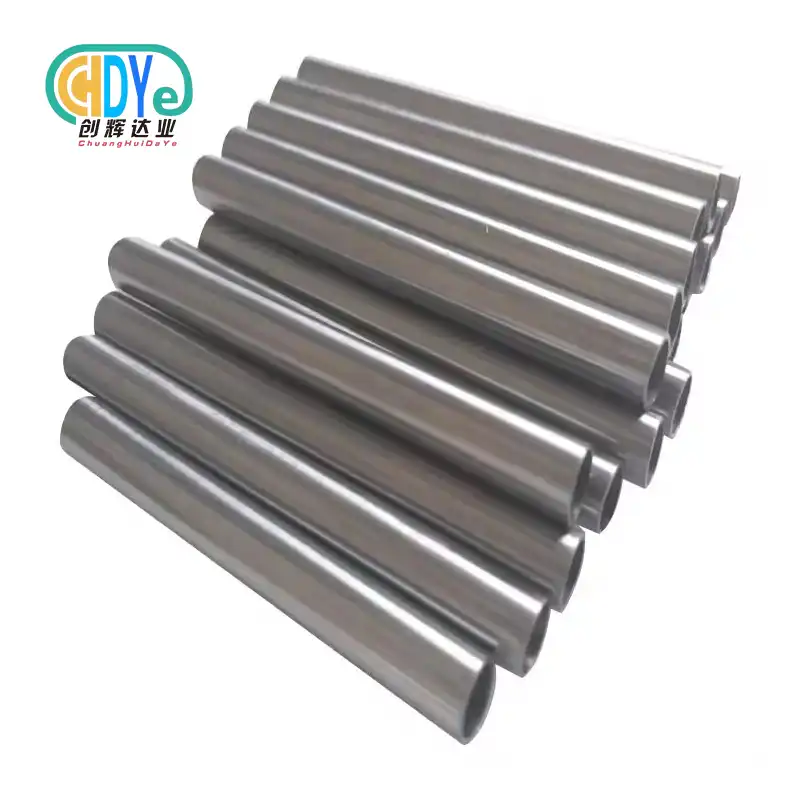
Understanding Titanium Alloy Tubes for Heat Exchangers
The work of heat exchangers is a mix of thermal performance and material science. The tubes we make are high-performance tubular goods made from titanium alloy tubes that combine elements like palladium, vanadium, molybdenum, or aluminum to get certain qualities. These aren't just hollow spheres; they're precision-engineered parts whose heat transfer efficiency and fouling resistance are directly affected by the grain structure, surface finish, and wall thickness standards.
What Makes These Tubes Different from Pure Titanium?
Commercially pure titanium (Gr1 and Gr2) is very resistant to rust, but alloyed forms are stronger and more stable at high temperatures. Grade 2, which is the most popular commercially pure type, can be shaped and welded easily, making it perfect for U-tube designs in shell-and-tube heat exchangers. Grade 5 (Ti-6Al-4V), on the other hand, has almost twice as much tensile strength, so it can be used in high-pressure situations. Palladium is added to Grade 7, which makes it more resistant to reducing acids. This is a big deal for chemical plants that deal with streams of hydrochloric or sulfuric acid. Grade 9 (Ti-3Al-2.5V) is often used in aircraft hydraulic oil coolers because it is strong and easy to work with. With the addition of molybdenum and nickel, Grade 12 works very well in hot brine conditions like those found in geothermal power plants.
Metallurgical Properties That Matter
Our annealed tubes have a near-alpha phase pattern in their substructure that keeps them from breaking when they are heated and cooled. This is important because heat exchangers' temperatures change all the time. Start-ups, changes in load, and sudden shutdowns all put stress on them. Our tubes don't change size when heated or cooled below -200°C and above 600°C. Stainless steel, on the other hand, may crack from repeated rounds of high temperatures. The low temperature expansion coefficient (8.6 µm/m·K) makes the tube-to-tubesheet joints less stressed, which increases service life by cutting down on leak paths.
Why Titanium Alloy Tubes Are Ideal for Heat Exchanger Systems
Material degradation is a problem for all of these places: chemical labs that work with chlorinated solvents, power plants that circulate brackish cooling water, and marine platforms that pump corrosive saltwater through condensers. Pitting corrosion, crevice attack, or stress corrosion cracking are the main ways that traditional metals break. Our titanium alloy tube doesn't fail in these ways because it has a self-healing oxide layer that forms back right away when it gets scratched, even in places with little air.
Corrosion Resistance in Aggressive Media
Chloride ions, which are bad for stainless steel, can't get through titanium's passive film. Our Grade 7 tubes have been used in heated saltwater (up to 90°C) for more than 15 years without any noticeable wall loss, according to test results from offshore sites. Petrochemical customers who work with sour gas (H₂S-filled streams) say that our Grade 12 material doesn't cause any sulfur stress cracks, which is a type of failure that often stops carbon steel exchangers from working. Our tubes can stand up to wet chlorine gas, nitric acid vapors, and organic acid condensates that would dissolve copper alloys in months. This protection isn't just in water.
Strength-to-Weight Advantages
It is the same as stainless steel tubes that are almost twice as thick, but a Grade 9 tube with a wall diameter of 1.0 mm can handle pressures higher than 200 bar. This weight loss is very important for offshore modules, where every kilogram affects the security of the base and the cost of shipping. When compared to steel, aluminum heat exchangers in airplane environmental control systems are 40% lighter, which directly saves fuel. The lighter weight also makes installation easier; maintenance crews can move tube bundles around without using heavy moving equipment, which speeds up the time it takes to fix problems during planned breaks.
Lifecycle Cost Analysis
Titanium costs about three to five times as much as 316L stainless steel, which makes purchasing managers think twice. Total cost of ownership estimates, on the other hand, show a different picture. Our clients who use desalination of saltwater say that the tubes last more than 25 years, while copper-nickel options only last 7 to 10 years. Getting rid of sacrificial anodes, cathodic protection systems, and descaling processes every two years gives a return on investment (ROI) in 5 to 7 years. One refinery on the Gulf Coast saved $2.3 million in unexpected downtime over a decade by moving to our Grade 12 tubes in their crude preheat exchangers. Tube leaks prevented three unplanned shutdowns.
Comparing Titanium Alloy Tubes with Alternative Materials
Stainless steel, copper-nickel alloys, and sometimes more unusual materials like Hastelloy have been used to make heat exchangers for a long time. Each has pros and cons that tech teams have to compare to the needs of the business.
Performance Against Stainless Steel
Because it is common and cheap, type 316L stainless steel is used most often for heat exchangers. Its resistance to chlorine works well in pure and slightly polluted streams. But limited rusting starts when chloride levels rise above 1000 ppm, which happens a lot in coastal cooling towers that use seawater to make up their water. Within 18 months, we had to replace 316L tube bundles that had cracking that went through 2 mm walls. Besides rust, stainless steel's higher density (8.0 g/cm³ vs. titanium's 4.5 g/cm³) puts more stress on tube supports, which can mean that retrofitting exchangers needs to be redesigned. People often say that titanium's lower thermal conductivity (17 W/m·K compared to 16 W/m·K for steel) is a weakness, but this small difference isn't really a problem when you consider fouling resistance; clean titanium surfaces keep their heat transfer coefficients longer than fouled stainless steel surfaces.
Aluminum and Copper-Nickel Comparisons
Aluminum metals are very good at moving heat, but they corrode very badly when the pH is below 4 or above 9. Copper-nickel (90/10 or 70/30) has been the standard for seawater for decades, but it needs flow rates above 2 m/s to stop biofouling, which makes the design less flexible. Ammonia contamination is common in power plant cooling systems that use river water near farm waste. It makes brass lose its zinc and copper-nickel, rusting faster. In these conditions, our Grade 2 tubes don't need any upkeep, and after five years of constant exposure, surface checks show that there has been no attack.
Carbon Steel's Hidden Costs
Carbon steel's low starting cost makes it appealing to projects that want to save money, but the reality of operations quickly eats away at savings. Because carbon steel tubes have a rough surface and oxide scales form, they can foul 10 times faster than titanium alloy tubes. This means that the exchangers have to be cleaned mechanically or with acid more often, which uses chemicals, makes toxic trash, and limits their availability. Customers who switch from carbon steel to our seamless tubes say that the heat transfer rate goes up by 30 to 50 percent just because there is no more scale buildup.
How to Choose the Best Titanium Alloy Tube for Your Heat Exchanger System
To find the best grade, you have to match the qualities of the object to the conditions of the process. This decision tree starts with the chemistry of the fluid, the working temperature, the pressure needs, and the limitations of the manufacturing process. To pick the best titanium alloy tube for your heat exchanger, matching material properties to process conditions is essential.
Grade Selection Based on Operating Environment
Grade 2 is the best choice for salt solutions up to 100°C, seawater, and brackish water. Because it is flexible, it can be bent into U-tubes without cracking, and bonded forms meet ASTM B338 standards for use in condensers. When there are reducing acids or metal ion pollution, grade 7 is needed. The palladium addition costs more, but it stops hydrogen absorption that would weaken pure titanium. Chemical companies that use vapor condensers for hydrochloric acid only define Grade 7. Grade 9 is used in aircraft and high-pressure hydraulic systems where the higher strength metal is needed to save weight. Geothermal and sour gas use Grade 12 the most. Its molybdenum presence protects it from crevice corrosion in hot, stagnant brine, where even Grade 2 might get localized attack after years of service.
Standards Compliance and Certification Requirements
We follow the guidelines set by ASTM B338 for welded tubes used in condensers and heat exchangers, ASTM B861 for seamless tubes used in general corrosion-resistant service, and ASTM B862 for seamless tubes used in certain situations. ICP-OES chemical analysis is used to check the composition of each output lot. This is especially important for Grade 12, where the molybdenum level (0.2–0.4%) must be within strict limits. As part of non-destructive testing, 100% eddy current inspection according to ASTM E426 is used to find longitudinal cracks, and ultrasonic testing according to AMS 2631 is used for pressure-service seamless tubes. Tensile qualities are checked by mechanical testing, and flattening tests make sure tubes can handle installation deformation during rolling or explosive growth from tube to tubesheet. Before shipping, hydrostatic testing at 1.5 times the original pressure makes sure there are no leaks. Our ISO 9001:2015 certification lets you track everything from the heat numbers of the raw materials to the final inspection reports. This meets the standards of the ASME Boiler and Pressure Vessel Code.
Dimensional Specifications and Customization
The outside width can be anywhere from 10mm to 300mm, the wall thickness can be anywhere from 0.5mm to 10mm, and the length can be up to 18,000mm. But heat exchanger designs often need setups that aren't common. We offer U-bend tubes with centerline curves that match certain shell sizes, helical coil tubes for small heat exchangers, and finned tubes to improve heat transfer on the air side. For pharmaceutical uses that need to be compatible with both CIP and SIP, the surface finishing can be smoothed to a roughness of 0.4µm. For industrial use, they can be left as annealed. Custom metal formulas can be made for research institutions that are looking into new heat transfer fluids or uses that need to work at very high temperatures.
Procurement Best Practices and Market Insights
To strategically source titanium alloy tubes, you need to know how the market works, what your suppliers can do, and how to check the quality of the tubing. Strategic sourcing requires matching material properties to process conditions.
Supplier Evaluation Criteria
Vertical integration is something that reputable producers do. Being in charge of melting, shaping, and tube production makes sure that the metal is always the same. Our building in Baoji, China's "Titanium Capital," has electron beam melting furnaces that use high-purity waste to make ingots. The ingots are then homogenized by vacuum arc remelting. Cold pilger mills and extrusion mills make tubes that are smooth, and TIG welding stations make tubes with horizontal seams. This end-to-end control gets rid of the variation that happens when traders buy tubes from more than one mill. Buyers should make sure the product is certified by ISO 9001, ask for mill test records (MTRs) that include chemical and mechanical data for different heats, and make sure the NDT can do the job. Lead times for normal grades are 8 to 12 weeks, and for custom metals, they are 12 to 16 weeks. However, our stocking program keeps common sizes (19.05mm OD x 1.24mm WT in Grade 2) in stock so that they can be sent out more quickly.
Pricing Dynamics and Negotiation Strategies
Titanium prices are linked to the cost of sponges, the cost of energy, and the demand from aircraft industries around the world. To get the best deals on prices, purchasing teams can group orders together to get big discounts, ask for welded tubes instead of smooth ones when it's not required (30% less expensive), and be willing to wait longer for deliveries when demand is low. When there isn't enough supply, don't buy on the spot market. Instead, make framework deals with annual volume promises to get better prices and more production slots. Our factory-direct plan gets rid of markups for distributors, so you can save 15–20% compared to selling companies.
Quality Assurance and Inspection Protocols
When buyers receive an item, they should do an arriving check. Use accurate micrometers to check the accuracy of the measurements, PMI (positive material identification) testers to confirm the grade of the material by reading its Ti, Al, and V signatures, and MTRs to make sure they meet the requirements. Testing tube samples with air at 1.5 times the design pressure makes sure they are solid, and testing cut ends with flare tests shows how flexible they are—brittle materials will crack instead of expanding smoothly. Reliable providers are happy for third parties to look at their work. For example, we often let SGS, Bureau Veritas, and customer reps watch tests at our facility.
Conclusion
To choose the best heat exchanger tubing, you need to weigh the performance of the material, the prices over its lifetime, and the trustworthiness of the provider. Titanium alloy tubes, especially Grades 2, 7, 9, and 12, are the only ones that can fight corrosion and last a long time mechanically in places where other materials would break down quickly. The cost is higher than stainless steel at first, but the lack of upkeep, longer service life, and operational reliability make it worth it for important uses. To be successful in procurement, you need to work with producers who can show they have metallurgical knowledge, quality certifications, and quick technical help.
FAQ
Q: Which titanium grade performs best in seawater heat exchangers?
A: Titanium that is commercially pure grade 2 is the standard for heat exchanges in saltwater condensers and desalination plants that work below 100°C. It is resistant to rust, easy to weld, and easy to shape, and it's priced competitively. It meets the needs of shell-and-tube designs. For saltwater that is hotter than 100°C or brackish water that has sulfides in it, Grade 12 with molybdenum and nickel added to it has better resistance to rust in cracks and still areas.
Q: Can titanium tubes be welded to stainless steel tubesheets?
A: When titanium is directly welded to stainless steel, weak intermetallic compounds are made that are easy to crack. To make titanium-steel transition joints, heat exchanger builders use explosive bonding, friction welding, or mechanical tube-to-tubesheet links like roller expansion with holes. Our expert team helps with joint design to make sure that links don't leak and meet TEMA standards while keeping their corrosion resistance.
Q: What quality certifications should buyers require?
A: Make sure the material meets ASTM B338 or B861 standards, has ISO 9001:2015 quality management approval, and has test records that show its chemical make-up, tensile strength, and NDT results. When it comes to pressure vessels, ASME approval is important. Ask for the ability to trace finished titanium alloy tubes back to the heat numbers of the raw materials. This will allow for root cause research if problems happen in the field.
Partner with Chuanghui Daye for Superior Heat Exchanger Solutions
Getting your titanium alloy tubes from the right company will decide whether your heat exchanger works well for decades or needs to be replaced before its time. Shaanxi Chuanghui Daye Metal Material Co., Ltd. has been working with rare metals for more than 30 years and uses ISO 9001:2015-approved production methods to make sure that every tube meets the highest international standards. We have a large selection of Grades 1, 2, 7, 9, and 12 in sizes ranging from 10mm to 300mm OD. They can be made without joints or with joints, according to ASTM B338, B337, B861, and B862 standards. We are in Baoji's titanium industrial center, so we can offer factory-direct prices without the markups that come from distributors. We also offer quick delivery, help with choosing materials, and fast technical support. Email our engineering team at info@chdymetal.com to talk about your heat exchanger needs and get a full quote from a reputable titanium alloy tube maker that is ready to meet your toughest corrosion and performance requirements.
References
1. Boyer, R., Welsch, G., & Collings, E.W. (1994). Materials Properties Handbook: Titanium Alloys. ASM International, Materials Park, Ohio.
2. Schutz, R.W. & Thomas, D.E. (1987). "Corrosion of Titanium and Titanium Alloys." ASM Handbook, Volume 13: Corrosion, ASM International, pp. 669-706.
3. American Society of Mechanical Engineers. (2021). ASME Boiler and Pressure Vessel Code, Section II: Materials Specifications. ASME, New York.
4. Kakiuchi, H., Miyano, N., & Yanagisawa, A. (2012). "Long-term Performance of Titanium Condenser Tubes in Seawater Service." Corrosion Engineering Science and Technology, 47(4), 295-302.
5. Donachie, M.J. (2000). Titanium: A Technical Guide, 2nd Edition. ASM International, Materials Park, Ohio.
6. Peters, M. & Leyens, C. (2003). Titanium and Titanium Alloys: Fundamentals and Applications. Wiley-VCH, Weinheim, Germany.
Learn about our latest products and discounts through SMS or email