- English
- French
- German
- Portuguese
- Spanish
- Russian
- Japanese
- Korean
- Arabic
- Greek
- German
- Turkish
- Italian
- Danish
- Romanian
- Indonesian
- Czech
- Afrikaans
- Swedish
- Polish
- Basque
- Catalan
- Esperanto
- Hindi
- Lao
- Albanian
- Amharic
- Armenian
- Azerbaijani
- Belarusian
- Bengali
- Bosnian
- Bulgarian
- Cebuano
- Chichewa
- Corsican
- Croatian
- Dutch
- Estonian
- Filipino
- Finnish
- Frisian
- Galician
- Georgian
- Gujarati
- Haitian
- Hausa
- Hawaiian
- Hebrew
- Hmong
- Hungarian
- Icelandic
- Igbo
- Javanese
- Kannada
- Kazakh
- Khmer
- Kurdish
- Kyrgyz
- Latin
- Latvian
- Lithuanian
- Luxembou..
- Macedonian
- Malagasy
- Malay
- Malayalam
- Maltese
- Maori
- Marathi
- Mongolian
- Burmese
- Nepali
- Norwegian
- Pashto
- Persian
- Punjabi
- Serbian
- Sesotho
- Sinhala
- Slovak
- Slovenian
- Somali
- Samoan
- Scots Gaelic
- Shona
- Sindhi
- Sundanese
- Swahili
- Tajik
- Tamil
- Telugu
- Thai
- Ukrainian
- Urdu
- Uzbek
- Vietnamese
- Welsh
- Xhosa
- Yiddish
- Yoruba
- Zulu
Titanium Anode Basket corrosion resistance benefits explained
When it comes to electroplating and electrochemical processes, the life and effectiveness of the system depend on the material that is used. Titanium Anode Baskets are unique because they are very resistant to rust. This is because titanium can form a steady, self-healing passive oxide layer. This protected film keeps the base from being damaged too quickly by strong electrolytes, while still allowing electricity to flow through it. Titanium-based solutions last for years, while most materials break down after being exposed to harmful chemicals. This means that metalworking companies around the world can avoid downtime and save money in the long run.
Understanding Titanium Anode Baskets and Their Corrosion Resistance
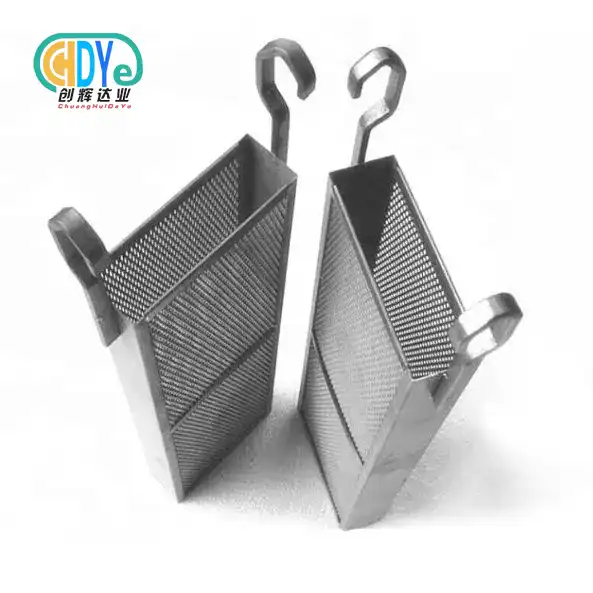
Electrochemical systems need parts that can handle being attacked by chemicals over and over again while still carrying electricity. Titanium Anode Baskets are important hanging tools used to hold soluble or insoluble anode materials while nickel plating, copper plating, or chrome plating is happening. These baskets are mostly made from commercially pure titanium, usually Grade 1 or Grade 2, with a purity level above 99.5%. They are very strong and don't react with chemicals at all.
What's really helpful is hidden below the surface. Titanium makes a thin, stick-together oxide layer (mainly TiO₂) on its own in microseconds when it comes into contact with air or electrolytes. This passive film keeps the material from oxidizing or breaking down chemically, even in acidic places with sulfuric acid, hydrochloric acid, or chromic acid. Titanium does not rust as bare steel or aluminum does in the same situations. Its structure stays strong even after decades of use.
Why Corrosion Resistance Matters in Electroplating
Corrosion doesn't just make things look bad; it also adds metal contaminants to plating baths, changes the way current flows, and causes expensive, unexpected shutdowns. Graphite baskets that are used now break down in acidic environments, and stainless steel baskets that are used now rust and pit in chloride-rich solutions. These failures lead to quality problems, batches that are thrown away, and more work that needs to be done on the machine. These risks are eliminated by titanium's resistance, which guarantees uniform plating quality and steady production plans.
The Science Behind Titanium's Protective Oxide Layer
Passivation of titanium happens naturally and doesn't need any outside help. If the oxide layer gets scratched or worn down, it grows back right away, protecting the basket for as long as it is used. Titanium is different from coated materials because it can fix itself. Damage to coated materials leaves weak substrates exposed. Titanium is perfect for a wide range of chemical processing conditions because its oxide film stays solid over a wide pH range (about 2 to 12) and up to 400°C.
Core Benefits of the Titanium Anode Basket's Corrosion Resistance
Putting money into materials that don't rust gives you real, measurable operating benefits. Titanium Anode Baskets have benefits that go far beyond just being durable. They can change how much energy is used, how often upkeep is done, and how much the whole process costs.
The most obvious benefit is that it lasts longer. Normal baskets need to be replaced every 12 to 24 months, but titanium baskets that are well taken care of usually last 10 years or longer. This longer lifespan cuts down on the time it takes to buy new parts and the amount of time that production is interrupted by having to replace them quickly. After switching to titanium-based systems, chemical processing plants say they have a lot fewer extra parts and the costs that come with them.
Titanium's stable electrical qualities make it more energy efficient. The inactive oxide layer effectively moves electrons around, but the basket itself can't be involved in electrochemical processes. This means that the electricity goes straight to the anode material instead of corroding the basket and losing energy. When compared to corroding options, which become less resistant over time as oxide scales and rust products build up, facilities that use titanium baskets save 8 to 15 percent of the energy they use.
Reduced Maintenance and Contamination Risks
Corrosion leftovers add iron, chromium, and other metal impurities to plating solutions, which results in surface flaws and color differences. Titanium is not reactive, so it doesn't get contaminated in this way. This keeps the bath pure and cuts down on the need for expensive solution cleaning treatments. Maintenance times get much longer—regularly rinsing is usually enough—while corroding baskets need to be inspected often, wire-brushed, and eventually thrown away as dangerous waste.
Enhanced Process Reliability
Manufacturing needs results that can be predicted and repeated. Titanium baskets distribute current evenly over their entire useful life, which ensures that all workpieces have the same amount of metal. Because the equipment is so reliable, there are no more batch-to-batch differences caused by rusting, which means less waste and repairs. When equipment factors stay the same, it's easier to keep an eye on quality and make sure that approval paperwork is complete.
Types of Titanium Anode Baskets and Their Corrosion Resistance Features
Not all electrochemical uses need the same basket specs. When buying, teams know what choices are out there, they can better match products to process conditions, which improves both performance and cost-effectiveness.
Mixed Metal Oxide Coated Baskets
Catalytic coatings made of ruthenium, iridium, or tantalum oxides are added to the titanium base of MMO-coated Titanium Anode Baskets. These coatings improve the basket's ability to carry power at lower voltages while keeping the titanium's ability to fight rust. MMO types work best in situations where the anode doesn't dissolve, like when treating water, making copper foil electrolytically, or in some electrowinning processes. In these cases, the basket needs to help electrochemical reactions happen instead of just keeping used anodes.
The coating makes the base more useful without affecting its defensive qualities. Even if the coating wears off after years of high current density use, the titanium underneath stays whole and doesn't rust. Recoating is a cheap way to fix up something, and it adds another turn to the life of the basket for a small part of the cost of replacing it.
Platinum-Coated Options
Platinum-coated baskets are the best way to handle chemicals in harsh settings. Platinum is the best catalyst because it is very resistant to oxidizing acids and solutions high in halogens. Platinum is completely chemically neutral, which is helpful for facilities that work with fluoroboric acid baths, certain bright nickel formulas, or high chloride concentrations. Even though it costs more than regular titanium at first, the longer service life and ability to remove contamination make the cost worth it in serious situations.
Custom and OEM Titanium Solutions
Modern electroplating operations have different tank shapes, power needs, and chemical processes. We at Chuanghui Daye are experts at making custom-designed baskets out of Grade 1 and Grade 2 titanium bases. Customers send us CAD or PDF files with measurements, mesh setups, and hook designs. Our research team then makes the design better for strength and current flow.
Customization goes beyond just changing the shape. Different types of hooks are used for different amperage needs. Titanium-clad copper hooks are best for high-current uses because they mix copper's better conductivity (which lowers voltage drop and heat generation) with titanium's resistance to corrosion. Mesh sizing adjusts to the particle sizes of the anode material, which stops material loss and makes sure there is enough electrolyte movement. Off-the-shelf goods can't solve all of these operating problems that these custom solutions can.
Practical Maintenance Tips to Maximize Corrosion Resistance
Even materials that don't rust benefit from being handled properly and getting regular maintenance. By following these steps, you can make the Titanium Anode Basket last longer and keep its best electrical performance.
Regular Cleaning Protocols
Take out the baskets and rinse them well with deionized water after every production run or once a week, depending on how busy the process is. This will get rid of any leftover plating solution and anode sludge. Metallic salts that build up at the bottom of the basket can cause rust cells to form in one area or make the flow of current uneven. Mild acid cleaning with 5% nitric acid and water rinse gets rid of tough oxide coloring and makes the surface bright again without hurting the protective passive layer.
When you clean titanium, don't use rough methods like wire brushing or cutting, because they can embed foreign metals into the surface and create galvanic corrosion sites. Also, never use hydrofluoric acid or strong alkalis with a pH higher than 13. These chemicals directly damage titanium's oxide layer.
Inspection and Monitoring
Visual inspection is still the most important tool for upkeep. Check the welds for staining. Silver or light straw means the TIG welding was done correctly under an argon atmosphere, while blue or purple means there is contamination and the metal could become weak. Check the soundness of the mesh for cracks that could have been caused by handling impacts. Check the hooks for looseness or damage at the point where they connect to the busbar, which is where the electricity keeps heating them up.
Electrochemical impedance spectroscopy is used in advanced facilities to measure the stability of passive layers and find early signs of degradation before they show any obvious signs. This forecast method plans maintenance based on how things are right now instead of at set times. This makes the best use of both downtime and maintenance resources.
Proper Handling and Storage
Chemical rust is not the main way that titanium baskets break. Instead, physical damage is. When putting baskets in and taking them out, don't drop them or hit them against the edges of the tank. Keep cleaned baskets dry and away from steel tools that could transfer iron particles through touch. Protective packing should be used when moving to avoid scratches and dents that could cause mechanical stress when the item is used again.
Comparing Titanium Anode Baskets with Alternative Materials
When choosing a material, you have to weigh the initial input against the total costs over its entire life. Titanium Anode Baskets are more expensive than other materials, but a full cost study shows that they are a better long-term investment.
Titanium Versus Graphite
Graphite is initially inexpensive and conducts electricity well, which makes it seem appealing. But under anodic polarization, graphite wears away all the time, fouling baths with carbon bits and needing to be replaced often. The material is fragile and breaks easily when handled, and its porous nature lets plating solutions soak in, making it hard to get rid of. Graphite baskets rarely last longer than 18 months when used continuously, while titanium baskets usually last longer than ten years. Lifecycle study shows that titanium has a 60–70% lower total cost of ownership when you consider how often it needs to be replaced, how much it costs to throw away, and the quality losses that come from contamination.
Titanium Versus Stainless Steel
Aluminum alloys don't fight rust very well, and stainless steel is easy to weld. However, stainless steel can pit and crack when it comes into contact with salt or acidic coating baths. Nickel and chromium that leak out of steel that is corroding contaminate solutions. This is especially a problem in processes that use bright nickel or ornamental chromium, where small impurities cause flaws. In harsh conditions, passivation processes can slow corrosion, but they can't stop it. Titanium's complete protection takes away all of these worries.
Selecting Reputable Suppliers
The quality of different makers changes a lot. As a first step in the selection process, certification is used. ISO 9001:2015 certification means that the company has a system for managing quality that includes tracking materials, following proper welding processes, and following strict rules for the final review. Customization is just as important as fabrication; providers who offer technical help and design optimization add value above and beyond fabrication.
Our factory in Baoji, China's Titanium Capital, has over 30 years of experience working with rare metals and the most up-to-date production tools, such as electron beam furnaces, precise machining centers, and TIG welding systems. Material certifications link titanium billets to their original test results, which list their chemical makeup and mechanical qualities. Before being shipped, each basket is checked for its dimensions, its weld strength, and its overall quality. This makes sure that the quality is uniform and meets international standards.
Conclusion
The worth of Titanium Anode Baskets lies in their ability to prevent corrosion. The material's inactive oxide layer protects itself against a wide range of chemicals, so it can be used for more than ten years instead of just a few months for other materials. This means that it will last longer, which means lower repair costs, less work for upkeep workers, and no chance of contamination that would lower the quality of the product. Stable electrical properties make energy economy better, and the ability to customize ensures the best performance in a wide range of electroplating and electrochemical uses. Titanium is the most cost-effective material over its entire lifespan, taking into account things like how often it needs to be replaced, how much energy it uses, and the costs that come with quality.
FAQ
Q: What is the typical lifespan of titanium anode baskets in corrosive environments?
A: Titanium Anode Baskets that are well taken care of usually last between 10 and 15 years in normal plating methods like nickel, copper, and chromium. The main thing that determines how long something lasts is how it is handled mechanically. Facilities that follow rules for careful handling and regular cleaning describe baskets that have been used for more than 20 years. The coating on MMO versions usually lasts between 2 and 5 years, based on the current density. After that, it needs to be recoated to work again.
Q: Can titanium baskets be used in all electroplating applications?
A: Titanium works very well with most metal chemicals, but it does have some problems. Titanium should not be mixed with fluoride-containing solutions, like some bright nickel mixtures with fluoroboric acid, because the fluoride ions will attack the protective oxide layer very quickly. In these situations, zirconium can be used instead of titanium. Also, keep the working voltage below 12 volts in some bath chemicals to stop the breakdown of oxides and passivation.
Q: How should I maintain titanium anode baskets to preserve corrosion resistance?
A: After each use, rinse the baskets well to get rid of any leftover plating solution and anode sludge. Pickling with 5% nitric acid should be done on a regular basis to get rid of oxide coloring. Check the welds and mesh strength often for damage caused by mechanical forces. Keep dry and away from metals that contain iron. Do not clean with rough materials, and do not subject them to hydrofluoric acid or strong alkalis that are higher than pH 13.
Partner with Chuanghui Daye for Superior Titanium Anode Basket Solutions
Long-term business success depends on choosing the right Titanium Anode Basket provider. Shaanxi Chuanghui Daye offers solutions that are perfectly matched to your electrochemical processes because they mix a high level of scientific knowledge with a wide range of customization options. Our factory is ISO 9001:2015 approved and makes baskets out of certified Grade 1 and Grade 2 titanium. They use TIG welding in a controlled atmosphere to make sure the welds are strong and resistant to rust. No matter if you need standard cylinders or rectangular shapes or designs made just for you using your CAD files, our engineering team makes sure that the geometry, mesh size, and hook design are all optimized for the power and chemical conditions you need. As a reliable Titanium Anode Basket maker, we offer full material traceability documents and quick expert help for the whole lifecycle of your product. Contact info@chdymetal.com right away to talk about your needs and get a thorough quote that fits your needs.
References
1. ASM International Handbook Committee. "Corrosion Resistance of Titanium and Titanium Alloys." ASM Handbook Volume 13B: Corrosion Materials, 2005.
2. Shreir, L.L., Jarman, R.A., and Burstein, G.T. "Corrosion Behavior of Titanium in Electrochemical Systems." Corrosion Control, Third Edition, Butterworth-Heinemann, 2000.
3. Jones, Denny A. "Principles and Prevention of Corrosion: Titanium and Its Alloys." Prentice Hall, Second Edition, 1996.
4. Pourbaix, Marcel. "Atlas of Electrochemical Equilibria in Aqueous Solutions: Titanium." NACE International, Second English Edition, 1974.
5. Schutz, Robert W. "Titanium Anodes for Electrochemical Processing." Industrial Applications of Titanium and Zirconium: Third Conference, ASTM International, 1984.
6. Landolt, Dieter. "Corrosion and Surface Chemistry of Metals: Passivity of Titanium." EPFL Press, 2007.
Learn about our latest products and discounts through SMS or email