- English
- French
- German
- Portuguese
- Spanish
- Russian
- Japanese
- Korean
- Arabic
- Greek
- German
- Turkish
- Italian
- Danish
- Romanian
- Indonesian
- Czech
- Afrikaans
- Swedish
- Polish
- Basque
- Catalan
- Esperanto
- Hindi
- Lao
- Albanian
- Amharic
- Armenian
- Azerbaijani
- Belarusian
- Bengali
- Bosnian
- Bulgarian
- Cebuano
- Chichewa
- Corsican
- Croatian
- Dutch
- Estonian
- Filipino
- Finnish
- Frisian
- Galician
- Georgian
- Gujarati
- Haitian
- Hausa
- Hawaiian
- Hebrew
- Hmong
- Hungarian
- Icelandic
- Igbo
- Javanese
- Kannada
- Kazakh
- Khmer
- Kurdish
- Kyrgyz
- Latin
- Latvian
- Lithuanian
- Luxembou..
- Macedonian
- Malagasy
- Malay
- Malayalam
- Maltese
- Maori
- Marathi
- Mongolian
- Burmese
- Nepali
- Norwegian
- Pashto
- Persian
- Punjabi
- Serbian
- Sesotho
- Sinhala
- Slovak
- Slovenian
- Somali
- Samoan
- Scots Gaelic
- Shona
- Sindhi
- Sundanese
- Swahili
- Tajik
- Tamil
- Telugu
- Thai
- Ukrainian
- Urdu
- Uzbek
- Vietnamese
- Welsh
- Xhosa
- Yiddish
- Yoruba
- Zulu
Niobium Round Bar vs Titanium: Which Metal Fits Your Project?
Choosing between niobium and titanium is a common decision for engineers working on aerospace, chemical, medical, and electronic projects. Both metals resist corrosion and perform well in demanding service, yet they differ in density, melting point, cost, and workability. A niobium round bar offers an exceptionally high melting point, outstanding chemical stability, and the ductility needed for precision machining, while titanium delivers a famous strength-to-weight ratio at a lower price. This article compares the two metals side by side, explains where a niobium round bar makes the most sense, and gives practical guidance for specifying the right material for your project.
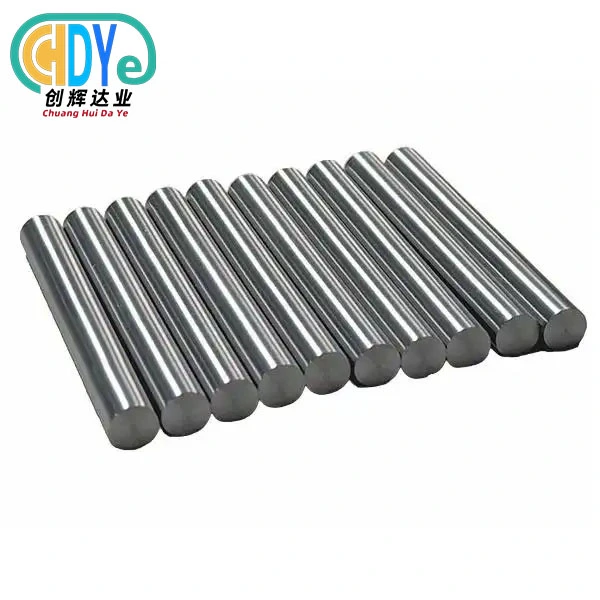
Niobium Round Bar and Titanium: Key Differences That Shape Your Choice
Material Properties at a Glance
Niobium round bar is a refractory metal that is soft, ductile, and has a silver-gray color. It becomes as hot as 4744 degrees Celsius while boiling and as cold as 2477 degrees Celsius when melting. At 2477 degrees Celsius, it melts and has a density of 8.57 grams/cubic centimeter. Titanium has a density of close to 4.5 grams per cubic centimeter and melts at temperatures of approximately 1668 degrees Celsius. As a first consideration, designers should make note of this discrepancy in thermal performance. To maintain its form and strength in a vacuum furnace or high-temperature reactor, a niobium round bar provides a far greater margin of safety than other component types. Titanium is frequently the material of choice when weight is the main issue.
The table that follows compares the most important physical characteristics of the two metals.
| Property | Niobium Round Bar | Titanium (Grade 2) |
|---|---|---|
| Density | 8.57 g/cm³ | ~4.51 g/cm³ |
| Melting Point | 2477°C | ~1668°C |
| Boiling Point | 4744°C | ~3287°C |
| Appearance | Silver-gray, soft, ductile | Silver-gray, strong, lightweight |
| Superconductivity | Yes | No |
Corrosion Resistance in Real Operating Conditions
The oxide coating that forms on a niobium round bar is extremely resistant to powerful acids such as hydrochloric and sulfuric acid, although both metals in question produce an oxide coating. This conclusion is reached as a consequence of the fact that both hydrochloric acid and sulfuric acid are powerful acids. When different grades of titanium start to deteriorate, this is the point at which it occurs. Due to titanium's outstanding performance in oxidizing environments, such as seawater and chlorides, it is frequently used in projects that are carried out in the marine and desalination industries. Additionally, water treatment systems strongly prefer titanium. In chemical plants that deal with powerful reducing acids, circular bars constructed of niobium have a tendency to last longer and emit less pollutants than other types of bars. It is for this reason that it is preferable to match the metal to the specific chemical environment rather than just asking which metal is superior.
Strength, Ductility, and Machinability
Because of their capacity to achieve exceptionally high strengths, titanium alloys are ideally suited for use as structural components in aircraft and the equipment used in sports. The aerospace industry is yet another business that depends on titanium alloys for its production. Niobium round bars, on the other hand, are extremely malleable and ductile, which enables them to be cold-handled, drawn, and machined into intricate patterns without shattering. The reason for this is that they are malleable, which enables them to take on a variety of intricate forms. Following the precision-forging process, our bars are subjected to annealing to improve their mechanical homogeneity and ductility before they are put to use. As a result of this, machine operators are provided with a material that is highly conducive to turning, drilling, and threading. Niobium round bars are simple to deal with and have the potential to cut down on waste when it comes to the production of items that have intricate geometries and stringent tolerances. Round bars made of niobium can be used for a tremendous variety of purposes.
Where does a Niobium Round Bar outperform Titanium?
High-Temperature and Vacuum Applications
A niobium round bar is the more reasonable choice in situations when the working temperatures are substantially higher than what titanium is able to bear by itself. Due to the fact that it has a melting point of 2477 degrees Celsius, it can be utilized as heating elements, supports, and fixtures within vacuum furnaces and any type of apparatus that operates at high temperatures. It is utilized in aerospace and defense applications for the purpose of constructing structural components and sections that are exposed to heat. In these applications, it is vital to preserve strength while also maintaining low reactivity. Engineers widely use niobium round bars to achieve consistent performance at high temperatures. Titanium is not always the material of choice for these engineers. At temperatures that are lower, titanium begins to lose its strength and absorb additional gases. This is the reason why this occurs.
Superconducting and Electronic Uses
Superconductivity is a property that titanium does not possess in the same way as niobium does. Niobium possesses a high level of superconductivity in comparison to titanium. It is for this reason that a circular bar composed of niobium is chosen for use in superconducting magnets, components of particle accelerators, and other advanced technologies that are comparable to these. Electrodes, connectors, and conductive components are all examples of applications for this material in the field of electronics and semiconductors, where electrical purity and stability are of the utmost importance. We help manufacturers maintain low contamination levels and ensure that device performance remains consistent from one production batch to the next by supplying our bars with a purity level of up to 99.99%. This allows us to support manufacturers in our efforts to maintain low contamination levels.
Chemical Processing and Medical Equipment
During the process of chemical processing, a niobium round bar can be machined into components for reactors, components for pipes that are resistant to corrosion, and vessel fittings that are subjected to harsh media on a daily basis. These components can be used in a variety of application areas. The biocompatibility of this material, on the other hand, makes it suitable for use in surgical instruments, implants, and other types of medical equipment. Niobium offers designers an extra safe option, particularly in circumstances where its ductility or electrical qualities give an advantage. Titanium continues to be a popular material choice in the field of orthopedics; however, niobium offers designers an additional safe option. If the niobium round bar is adequately designed, it is possible for it to have a longer service life and fewer maintenance interruptions in each of these fields. This is given that the bar is used in a suitable manner.
How to Choose the Right Metal and Specify Your Niobium Round Bar?
Which Metal Suits Your Operating Conditions and Budget?
The operational conditions, which include temperature, chemical exposure, mechanical load, weight limits, and budgetary restraints, are the first step in the process of selecting something that is practical from a practical standpoint. Titanium is often the most cost-effective material to utilize in instances when your design is focused on weight and runs at temperatures that are quite low. If it is necessary for it to be able to withstand conditions that are superconducting, extremely high temperatures, or strong acids, then a niobium round bar is the most appropriate choice. Both titanium and niobium are utilized in a variety of projects. Titanium is utilized for lightweight buildings, while niobium is utilized for the most corrosive or hottest places. Additionally, titanium is utilized for a variety of projects. Before committing to the system, it is beneficial to conduct a comprehensive assessment of the entire system in order to avoid costly redesigns in the future.
The comparison below summarizes typical selection factors.
| Selection Factor | Niobium Round Bar | Titanium |
|---|---|---|
| Best Use | Extreme heat, strong acids, superconductivity | Lightweight structures, marine, general corrosion |
| Weight | Heavier | Lighter |
| Machinability | Very ductile, easy to form | Harder to machine |
| Upfront Cost | Higher | Lower |
| Long-Term Value | Strong in severe environments | Strong in general service |
Grades, Standards, and Purity Options
To meet the requirements of demanding applications, our niobium round bar is manufactured in accordance with ASTM B 392-95 and is offered in grades RO4200 and RO4210. Its purity reaches 99.99%. In contrast to RO4210, which has a regulated oxygen content and a more stringent mechanical consistency, RO4200 is a commercially pure niobium that is acceptable for the majority of general applications. The length can be trimmed to meet your specifications, and we also provide diameters that are made to order. Because selecting the appropriate grade at the outset helps to avoid incompatibilities between the material and the application, it also contributes to the guarantee that the niobium round bar will continue to function as anticipated over its entire service life.
Manufacturing Quality and Supplier Support
The manufacturing process of a niobium round bar has a significant impact on the performance of the bar. Before hot forging and rolling the niobium ingots into preliminary bar forms, we first pick only the highest-purity ingots, then vacuum melt them to remove any impurities that may be present. To achieve precise diameters and tight tolerances, precision machining is utilized. Annealing is utilized to enhance ductility, and surface finishing and inspection are utilized to ensure that the product is flawless and free of any defects. Working with a supplier that controls each step eliminates risk, enhances traceability, and provides purchasers with increased assurance that each and every niobium round bar will be up to the specifications they have specified.
Conclusion
In the field of modern engineering, it is abundantly clear that titanium and niobium each hold a position of importance. A round bar formed of niobium, on the other hand, has superior properties in terms of heat resistance, chemical stability, ductility, and superconductivity. Titanium, on the other hand, is a material that is both lightweight and affordably priced. From the inspection of raw materials to the packaging of finished products, Shaanxi Chuanghui Daye Metal Material Co., Ltd., which has its headquarters in Baoji, China's "Titanium Capital," relies on more than thirty years of experience working with rare metals and processes that have been certified to the ISO 9001:2015 standard. This experience applies to all aspects of the company's operations. It is imperative that you get in touch with our experts as soon as possible in order to locate the metal that is most suited for your project. Providing you with components and materials that are dependable and economical is something that we will do for you.
FAQ
Q: What is the main difference between a niobium round bar and titanium?
A: Niobium is denser and has a much higher melting point of 2477°C, along with superconductivity, while titanium is lighter and generally less expensive.
Q: Which grades of niobium round bar do you supply?
A: We supply RO4200 and RO4210 under ASTM B 392-95, with purity reaching 99.99% depending on your requirements.
Q: Can the niobium round bar be cut to a specific length?
A: Yes. Length can be customized to your requirements, and we also machine bars to exact diameters and tight tolerances.
Q: Is a niobium round bar suitable for medical use?
A: Yes. Niobium is biocompatible and is used in surgical tools, implants, and other medical devices.
Q: Does your company supply titanium as well?
A: Yes. We produce titanium and titanium alloy plates, rods, tubes, wires, fasteners, and precision-machined components, in addition to niobium, tantalum, tungsten, and molybdenum products.
Ready to Choose the Right Metal? Contact Us Today
Whether your project calls for the extreme heat resistance of a niobium round bar or the lightweight strength of titanium, Shaanxi Chuanghui Daye Metal Material Co., Ltd. can help you decide and deliver. Our team offers technical advice, custom sizes, and consistent quality backed by ISO 9001:2015 certification and more than three decades of experience. Send us your drawings, specifications, or questions, and we will respond with a clear quotation. Email us at info@chdymetal.com and let us support your next project.
References
1. ASTM International. (1995). ASTM B392-95: Standard Specification for Niobium and Niobium Alloy Bars, Rods, and Wire. West Conshohocken, PA: ASTM International.
2. Lütjering, G., & Williams, J. C. (2007). Titanium (2nd ed.). Berlin: Springer.
3. Cardarelli, F. (2008). Materials Handbook: A Concise Desktop Reference (2nd ed.). London: Springer.
4. Nico, C., Monteiro, T., & Graça, M. P. F. (2016). Niobium oxides and niobates physical properties: Review and prospects. Progress in Materials Science, 80, 1–37.
5. Schweitzer, P. A. (2010). Fundamentals of Corrosion: Mechanisms, Causes, and Preventative Methods. Boca Raton, FL: CRC Press.
6. Haynes, W. M. (Ed.). (2016). CRC Handbook of Chemistry and Physics (97th ed.). Boca Raton, FL: CRC Press.

Learn about our latest products and discounts through SMS or email