- English
- French
- German
- Portuguese
- Spanish
- Russian
- Japanese
- Korean
- Arabic
- Greek
- German
- Turkish
- Italian
- Danish
- Romanian
- Indonesian
- Czech
- Afrikaans
- Swedish
- Polish
- Basque
- Catalan
- Esperanto
- Hindi
- Lao
- Albanian
- Amharic
- Armenian
- Azerbaijani
- Belarusian
- Bengali
- Bosnian
- Bulgarian
- Cebuano
- Chichewa
- Corsican
- Croatian
- Dutch
- Estonian
- Filipino
- Finnish
- Frisian
- Galician
- Georgian
- Gujarati
- Haitian
- Hausa
- Hawaiian
- Hebrew
- Hmong
- Hungarian
- Icelandic
- Igbo
- Javanese
- Kannada
- Kazakh
- Khmer
- Kurdish
- Kyrgyz
- Latin
- Latvian
- Lithuanian
- Luxembou..
- Macedonian
- Malagasy
- Malay
- Malayalam
- Maltese
- Maori
- Marathi
- Mongolian
- Burmese
- Nepali
- Norwegian
- Pashto
- Persian
- Punjabi
- Serbian
- Sesotho
- Sinhala
- Slovak
- Slovenian
- Somali
- Samoan
- Scots Gaelic
- Shona
- Sindhi
- Sundanese
- Swahili
- Tajik
- Tamil
- Telugu
- Thai
- Ukrainian
- Urdu
- Uzbek
- Vietnamese
- Welsh
- Xhosa
- Yiddish
- Yoruba
- Zulu
Premium 6al 4v titanium round bar for High-Performance Parts
Our quality 6Al-4V titanium round bar is ready to give you the best performance when your industrial project needs materials that won't break down under stress. This Grade 5 titanium metal is the best for fields where failure is not a choice. It is made up of 90% titanium, 6% aluminum, and 4% vanadium. This material is very strong for its weight and doesn't rust, so it can be used in many different ways. It's used to make structural parts for spacecraft, medical tools, and equipment for chemical processing. Learning the details of buying 6Al-4V titanium round bar can help your supply chain work better and improve the quality of your products.
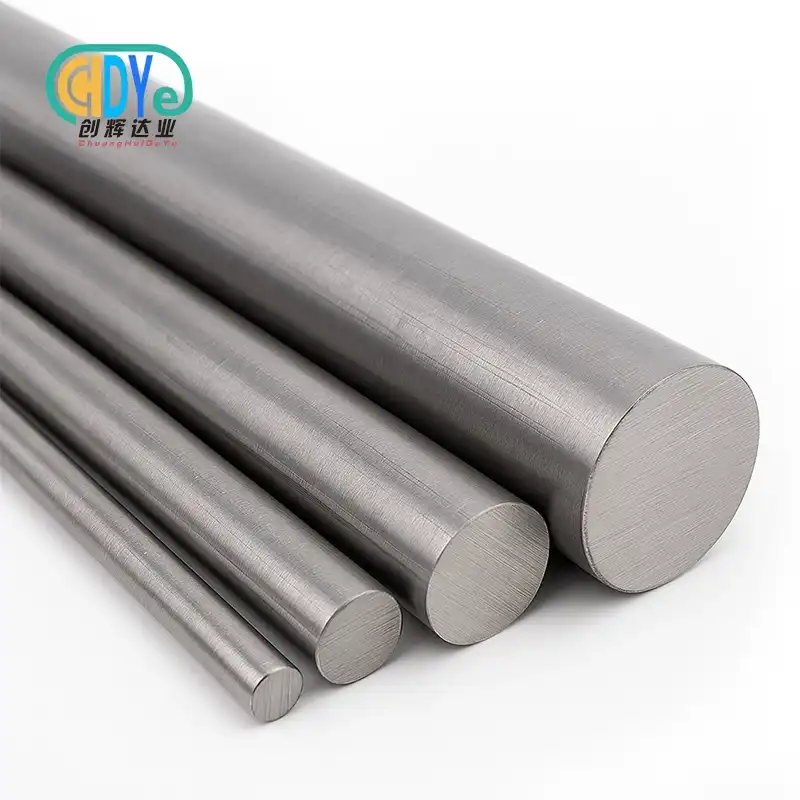
Understanding 6al 4v Titanium Round Bar: Composition, Properties & Performance
Grade 5 titanium works so well because its chemical makeup is perfectly balanced and its microstructure is one of a kind. Aluminium stabilises the alpha phase, and vanadium stabilizes the beta phase in this alpha-beta combination, which gives it qualities that pure titanium can't match.
Chemical Composition and Microstructure
There are strict chemical rules that govern how our 6Al-4V titanium round bars are made, and these rules have a direct effect on how well they work. The 6% aluminum content makes the material stronger at room temperature and more stable at temperatures up to 400 °C (750°F). The 4% vanadium content makes it easier to heat treat and harden. To keep the material from becoming too weak, the iron content stays below 0.40%, the oxygen content below 0.20%, and the hydrogen content below 0.015%. This exact chemistry, which has been checked using the vacuum arc remelt (VAR) and electron beam (EB) melting methods, makes sure that all batches have the same mechanical properties.
Mechanical Properties and Performance Standards
Our 6Al-4V titanium round bars meet the requirements of ASTM B348 and AMS 4928 and have excellent tensile properties. When the steel is annealed, its tensile strength should be at least 895 MPa (130 ksi), and its yield strength should be at least 828 MPa (120 ksi). It should also stretch about 10% on average. The mass of the material, which is about 4.43 g/cm³, makes it 40% lighter than steel while still being stronger. The 113.8 GPa elastic stiffness gives it the flexibility needed for fastener uses, and the 30-34 Rockwell C hardness range strikes a good mix between being easy to machine and lasting a long time. These traits make the parts very resistant to fatigue and very hard to break, which are very important for parts that work in situations with repeated loading or contact.
Corrosion Resistance and Environmental Stability
The oxide coat that naturally forms on titanium surfaces protects them very well from harsh conditions. Our 6Al-4V titanium round bars can stand up to sea, marine atmospheres, wet chlorine, and chlorine dioxide, all of which quickly break down stainless steel bars. These bars are resistant to weathering from oxidizing acids and most organic compounds. This makes them perfect for chemical processing equipment, platforms in the ocean, and aircraft structures that are exposed to harsh weather. Even when temperatures change and heat stress is put on the material, its structure stays the same.
Heat Treatment Capabilities
Solution treatment and age (STA) processes work well on 6Al-4V titanium round bars but not on commercially pure titanium grades. With this heat treatment feature, producers can change the amount of strength to suit different uses, and when needed, they can reach tensile strengths of over 1100 MPa. When working with complicated shapes, annealed materials are the most flexible and easy to machine, while STA conditions make parts that are under a lot of stress the strongest they can be. Because of this, planning your purchases is more open, since the state of the materials can be changed to fit your production process.
Comparing 6al 4v Titanium Round Bar with Alternative Materials
When choosing a material, you have to think about more than just the price. When you look at how Grade 5 titanium stacks up against other options, you can see how valuable it really is for tough uses.
Performance Advantages Over Stainless Steel
Stainless steels like 316 and 17-4 PH are still commonly used for uses that need to be resistant to rust, but they are much heavier than other steels. Our 6Al-4V titanium round bars are as strong as or stronger than steel bars while being less than 60% of the weight. This is a huge benefit for industries like flight, cars, and portable equipment where every gram counts. In chloride conditions, stress corrosion cracking happens to stainless steel, but titanium stays strong. Lifecycle cost analysis often chooses titanium even though it costs more, especially when structural weight is reduced, protective coats are not needed, and the product lasts longer without needing to be replaced.
Comparison with Other Titanium Grades
Grade 2 economically pure titanium is very resistant to rust, but it's not strong enough for parts that are heavily loaded; its yield strength is only about 275 MPa, which is less than a third of that of 6Al-4V titanium round bar. Grade 23 (Ti-6Al-4V ELI) has a similar make-up, but it is better for medical implants because it has stricter limits on the interstitial elements. It costs more, though. The way they are processed is what makes forged bars different from 6Al-4V titanium round bars. Forged material usually has directional grain flow that makes it stronger in certain directions, while rolled 6Al-4V titanium round bars have more regular qualities that make them good for general machining and turning operations.
Pricing Considerations and Value Analysis
Titanium alloy prices change with the market, but for commercial amounts, they usually fall between $15 and $35 per kilogram, based on the diameter, the tolerance, and the certification needs. Volume-based scaling is better for buying things because orders over 500 kilograms often get savings of 15 to 20 percent compared to small-batch prices. When looking at cost, you should think about how long it takes to machine the titanium. Because it is less dense, less material needs to be removed during the production process, which helps to offset some of the higher material costs. Our factory-direct prices cut out the middleman and their markups, while still allowing full tracking and certification compliance.
How to Procure Premium 6al 4v Titanium Round Bars for High-Performance Projects?
Strategic buying keeps your project safe from problems with materials and the supply chain. If you follow tried-and-true best practices, you can be sure that the material you receive is real, approved, and up to code.
Evaluating Supplier Certifications and Quality Systems
If a provider has ISO 9001:2015 approval, it means they handle quality in a systematic way throughout all of their production processes. In addition to general quality systems, make sure that providers can give you material test records (MTRs) that show the chemical make-up, mechanical properties, and heat lot tracking. When working with flight customers, aerospace providers must show that they know what AMS 4928 requires and keep their AS9100 certification up to date. Medical device makers can get better materials for surgical implants if their sources know what ISO 5832-3 says. Our factory in Baoji, China's "Titanium Capital", has been working with rare metals for 30 years and has state-of-the-art melting, forging, rolling, and cutting equipment. We can provide approved materials with full paperwork.
Understanding Minimum Order Quantities and Custom Options
Minimum numbers for standard production runs are usually between 100 and 500 kilograms, but research institutions and pilot projects often need smaller amounts. We can handle a range of order amounts, even small batches for research and development. With standard diameter tolerances of ±0.5 mm or tighter h9/h11 tolerances when asked for, custom diameters from 10 mm to 300 mm can be met. Customizing the length fits your cutting plans, which reduces waste and extra work. By talking about your size needs early on in the buying process, we can make the best use of our production schedule and cut down on wait times.
Lead Times and International Shipping Logistics
Stock material with a standard diameter ships in 7–10 business days, while custom specs usually take 4–6 weeks, based on the size and amount. International shipping to the US usually takes 3–4 weeks by ocean freight for large orders that are cheaper that way or 5–7 days by air freight when project deadlines need to be met faster. Our operations team takes care of export paperwork, clearing customs, and coordinating final delivery, which makes the process of importing easier. When customers who buy from you often negotiate bulk orders, they can often get better shipping rates and better payment terms.
Why Choose Our Premium 6al 4v Titanium Round Bars? Trusted Solutions for Performance and Reliability
There's more to choosing a titanium provider than just looking at price lists. The right partnership will give you consistent quality, professional help, and a reliable supply chain that will keep your output plan and image safe.
Rigorous Testing and Certification Processes
Before it is shipped, every production batch goes through a thorough quality check. Spectroscopic study of the raw material proves its chemistry, and then it is melted in vacuum arc remelt furnaces to make sure the material is pure. Forging and rolling operations are watched over by process control, and melting furnace cycles are recorded to prove the heat treatment. Tensile strength, yield strength, and extension are checked against standards by mechanical testing. Non-destructive testing, on the other hand, finds internal cracks. The final review checks the tolerances for straightness, surface finish, and correctness of measurements. This multi-step quality procedure makes sure that the material you receive works the way it's supposed to and doesn't give you any problems during service or machining.
Traceability and Comprehensive Documentation
Full tracking of materials helps with quality checks and following rules, which is common in military, medical, and aircraft uses. Our paperwork comes with official material test results that show chemical analysis, mechanical qualities, and heat treatment records that can be linked to specific lots of ingots. We include compliance certificates for ASTM B348 and AMS 4928 with shipments, along with paperwork from the country of origin and, if needed, export licences. This paper trail meets the needs of the customer qualification system and helps internal quality control systems work better, which makes your buying team's job easier.
Customization Capabilities and Technical Support
Supplying materials is only one part of completing a job successfully. Our expert team can help you choose the right material and tell you what the best conditions are (annealed vs. STA) based on your needs. Recommendations for machining parameters help improve the surface finish and tool life during drilling, milling, and turning. When special property needs go beyond what can be achieved with normal mill-annealed conditions, custom heat treatment services can be set up. By working together, we go from being a simple provider to a strategic partner who cares about the success of your project.
Proven Performance in Critical Applications
Aerospace companies all over North America use our 6Al-4V titanium round bars to make landing gear parts, airframe frames, and turbine engine parts. The durability of these materials has a direct effect on flight safety. Medical device makers use our approved 6Al-4V titanium round bars to make hip implants, spine fusion hardware, and surgery tools that are biocompatible and don't rust. Chemical processing companies use our material for heat exchanges, reactor tanks, and pipe systems that deal with corrosive materials. These tough applications test our quality processes and show that they work the way users expect them to in the real world.
Competitive Pricing and Streamlined Supply Chain
Being in the middle of China's titanium production area gives us cost savings that we pass on to our customers. When you buy directly from the factory, you don't have to pay the markups that are common when you buy through middlemen. Because we have long-term ties with smelters in the area, we can always get the raw materials we need, even when the market isn't available. This keeps your production going. Flexible contract terms allow for both one-time buying and long-term supply deals with price breaks based on volume. Over 95% of deliveries are made on time, thanks to production planning systems that put customer promises first and keep extra stock of popular specifications.
Conclusion
6Al-4V titanium round bar is strong, doesn't rust, and is reliable, all of which are qualities that high-performance uses need. Knowing what it is made of, how it works, and how to get it helps you make smart choices that balance performance needs with cost limitations. The material is widely used in aircraft, medicine, and industry because it has a high strength-to-weight ratio, can withstand harsh environments, and can be treated in a variety of ways using heat. Strategically choosing suppliers by focusing on quality standards, expert support, and the dependability of the supply chain is a better way to protect the success of a project than just comparing prices. Grade 5 titanium can turn difficult engineering problems into beautiful, long-lasting answers with the right specifications and sources.
FAQ
Q: What certifications should I request when procuring titanium bars?
A: Ask your provider for ISO 9001:2015 quality system approval and material test records (MTRs) that show the chemical make-up and mechanical properties of the goods in line with ASTM B348 or AMS 4928 standards. For use in aerospace, materials must meet AMS standards, and for medical implants, they must be checked to make sure they meet ISO 5832-3 requirements.
Q: How does heat treatment affect mechanical properties?
A: When a material is annealed, its yield strength is around 828 MPa, and it is also the easiest to shape for cutting. Solution treatment and age (STA) make the material stronger to over 1100 MPa while making it less flexible. Choose the state that meets your needs for fabrication and end performance.
Q: Can I order custom dimensions with short lead times?
A: You can get custom diameters and lengths of 6Al-4V titanium round bars, and the wait time is usually between 1 and 2 weeks, based on your needs and the number of items you buy. Standard sizes in stock usually ship in 7 to 10 days. Get in touch with our team to talk about your size needs and time constraints so that we can make an accurate schedule.
Partner with Chuanghui Daye for Your Titanium Round Bar Requirements
You can get high-quality Grade 5 titanium products directly from the plant at Shaanxi Chuanghui Daye Metal Material. They are certified by ISO 9001:2015 and have 30 years of experience working with rare metals. As a reliable 6Al-4V titanium round bar provider based in Baoji, China, which is known as the world's titanium manufacturing hub, we make it easier for aircraft, medical, and industrial makers to buy by offering detailed material documentation, flexible order quantities, and expert support. Our high-tech production facilities, which include vacuum freezing, precise cutting, and strict quality testing, make sure that our materials always meet the requirements of ASTM B348 and AMS 4928. We are the best partner for making high-performance parts because we offer competitive prices, can customize products, and can ship them anywhere in the world. Email our team at info@chdymetal.com right now to talk about your project needs and get a full quote that fits your needs.
References
1. American Society for Testing and Materials. "Standard Specification for Titanium and Titanium Alloy Bars and Billets." ASTM B348-13, 2021.
2. SAE International. Titanium Alloy Bars and Rings 6Al-4V, Annealed. AMS 4928R, Aerospace Material Specification, 2019.
3. Boyer, R., Welsch, G., and Collings, E.W. "Materials Properties Handbook: Titanium Alloys." ASM International, 1994.
4. Donachie, Matthew J. "Titanium: A Technical Guide, 2nd Edition." ASM International, 2000.
5. Lütjering, Gerd and Williams, James C. "Titanium: Engineering Materials and Processes, 2nd Edition." Springer-Verlag Berlin, 2007.
6. Peters, M., Kumpfert, J., Ward, C.H., and Leyens, C. "Titanium Alloys for Aerospace Applications." Advanced Engineering Materials, Vol. 5, Issue 6, 2003.
Learn about our latest products and discounts through SMS or email