- English
- French
- German
- Portuguese
- Spanish
- Russian
- Japanese
- Korean
- Arabic
- Greek
- German
- Turkish
- Italian
- Danish
- Romanian
- Indonesian
- Czech
- Afrikaans
- Swedish
- Polish
- Basque
- Catalan
- Esperanto
- Hindi
- Lao
- Albanian
- Amharic
- Armenian
- Azerbaijani
- Belarusian
- Bengali
- Bosnian
- Bulgarian
- Cebuano
- Chichewa
- Corsican
- Croatian
- Dutch
- Estonian
- Filipino
- Finnish
- Frisian
- Galician
- Georgian
- Gujarati
- Haitian
- Hausa
- Hawaiian
- Hebrew
- Hmong
- Hungarian
- Icelandic
- Igbo
- Javanese
- Kannada
- Kazakh
- Khmer
- Kurdish
- Kyrgyz
- Latin
- Latvian
- Lithuanian
- Luxembou..
- Macedonian
- Malagasy
- Malay
- Malayalam
- Maltese
- Maori
- Marathi
- Mongolian
- Burmese
- Nepali
- Norwegian
- Pashto
- Persian
- Punjabi
- Serbian
- Sesotho
- Sinhala
- Slovak
- Slovenian
- Somali
- Samoan
- Scots Gaelic
- Shona
- Sindhi
- Sundanese
- Swahili
- Tajik
- Tamil
- Telugu
- Thai
- Ukrainian
- Urdu
- Uzbek
- Vietnamese
- Welsh
- Xhosa
- Yiddish
- Yoruba
- Zulu
Top gr2 titanium pipe Manufacturer for Custom OEM Requirements
When sourcing high-performance piping solutions for demanding industrial applications, finding a reliable Gr2 titanium pipe manufacturer becomes paramount. Shaanxi Chuanghui Daye Metal Material Co., Ltd., located in Baoji—China's renowned "Titanium Capital"—stands out as a specialized producer with over three decades of expertise in commercially pure titanium products. Our seamless and welded Grade 2 titanium pipes deliver exceptional corrosion resistance, superior formability, and proven reliability across chemical processing, marine engineering, and power generation sectors. We combine ISO 9001:2015 certification with factory-direct pricing and custom OEM capabilities to meet the precise specifications of global procurement professionals seeking dependable, long-term supply partnerships.
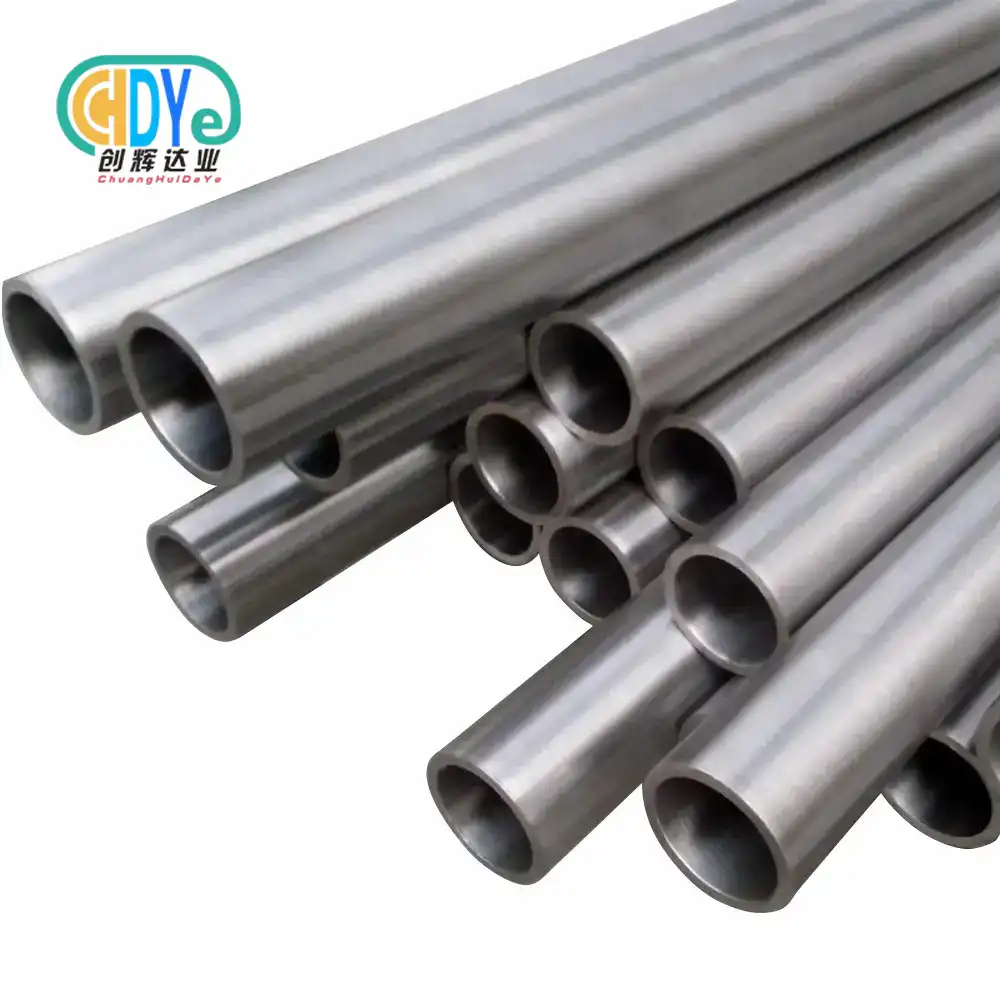
Understanding GR2 Titanium Pipe: Properties, Specifications, and Applications
In industrial markets, Grade 2 titanium is the form of commercially pure titanium that is most often used. Its chemical make-up is carefully managed, with oxygen levels no higher than 0.25%, iron levels no higher than 0.30%, and hydrogen levels no lower than 0.015%. This exact balance makes an alpha-phase microstructure that has a tensile strength of at least 345 MPa and great flexibility, keeping stretch values above 20%. The material is unique because it forms a titanium dioxide film on its surface on its own. This film heals itself even after being damaged by mechanical forces, protecting it from harsh conditions all the time.
Mechanical and Physical Performance
While gr2 titanium pipe is still very strong, the material has a mass of only 4.51 g/cm³, which is about half that of stainless steel. This great strength-to-weight ratio cuts down on the weight of the whole system without lowering safety standards. With a thermal efficiency of 16.4 W/m·K, thin-walled structures work very well for heat transfer tools. ASME B31.3 rules say that the highest temperature that a machine can work at is 315°C. Any higher than that and oxygen can start to diffuse and damage the material's qualities through alpha case formation.
Core Industrial Applications
Our commercially pure titanium pipes are very important in surface condensers, evaporators, and heat exchanges that need to be resistant to rust and easy to make. These lines are used by chemical companies to move wet chlorine, hypochlorites, and other chloride solutions when other materials break down quickly. Power plants along the coast use Grade 2 tubing for their seawater cooling systems because it doesn't erode or corrode at speeds over 20 meters per second. The biocompatibility of the material also helps the production of medical equipment, and the fact that it is not magnetic helps the production of electronics and semiconductors.
GR2 Titanium Pipe vs. Other Grades and Materials: Making the Right Choice
To choose the right materials for pipes, you need to know how the performance of different grades and alloy systems compares. Important choices have a big effect on both the initial investment and the operating costs over the life of the business.
Comparing Titanium Grades
When people talk about buying, they often compare Grade 2 to Grade 5. Grade 5 (Ti-6Al-4V) has a much higher tensile strength, getting close to 895 MPa. However, this alpha-beta metal is less resistant to weathering in seawater that is high in chloride. Grade 5 is harder than Grade 4, which makes cold forming more difficult and raises the cost of making things. Gr2 titanium pipe remains the best choice when resistance to rust and weldability are more important than strength. As a result of adding palladium to Grade 7, which makes it more resistant to reducing acids, it usually costs 40–60% more than Grade 2. Our factory can change different grades, like Gr1, Gr5, Gr7, Gr9, Gr12, and Gr23, to fit the needs of different applications.
Titanium Against Conventional Alloys
When you compare widely pure titanium to austenitic stainless steels (304/316L), you can see that titanium is better for chemical and sea applications. Stainless steel has problems with pitting, pocket rust, and stress cracking caused by chloride that titanium doesn't have at all. Titanium is more expensive to buy at first, but it lasts longer and costs less overall because it is often guaranteed to last 40 years or more. The lighter weight also means that offshore platforms and shipboard installations don't need as much structural support. Copper-nickel alloys are another option, but they don't work as well as titanium in applications with high-velocity seawater or high-temperature brine, like those found in desalination plants.
How to Procure Custom GR2 Titanium Pipes from Trusted Manufacturers
A good buying process starts with a careful review of the seller, paying special attention to their technical skills, quality systems, and service dependability.
Critical Selection Criteria
Compliance with certification is the basis for qualifying a seller. Along with ASME SB338 and ISO 9001:2015 requirements, our products meet ASTM B338 standards for heat exchanger tubing and ASTM B861 standards for seamless pipe. The infrastructure for manufacturing is very important. Our building has modern melting equipment like electron beam furnaces, precision rolling mills, annealing furnaces, lathes, sawing machines, and shearing equipment for full machining capabilities. This unified way of making things makes sure that the metal's qualities and measurements stay the same. Quality assurance is shown by checking the traceability of raw materials, following inspection protocols during production, and testing the finished product.
Custom Ordering Process
The first step in the procurement process is usually to list all the specifics, such as the pipe's measurements (outer diameter, wall thickness, length), the surface finish that is needed, how the ends are to be prepared, and the number that is required. We can work with both seamless and welded tube designs, depending on the pressures needed for the purpose and the needs of the fabrication. Our technical team looks at your operating temperatures, fluid compositions, and flow rates to figure out the best way to heat treat and prepare the surface. Prices are based on how many items you order, and if you buy a lot, you can get competitive factory-direct rates. Standard lead times range from 4 to 8 weeks, but shorter production plans can be used for projects that need to be done quickly. Every shipment comes with full material test reports, chemical analysis certificates, and mechanical property paperwork to help you meet the standards for quality control and legal compliance.
Benefits of Partnering with a Top GR2 Titanium Pipe Manufacturer for OEM Needs
Building ties with skilled manufacturers has strategic benefits that go beyond just getting materials. Chuanghui Daye has specialised knowledge that he has gained over many years of working in the aircraft, defence, chemical processing, and marine engineering industries around the world.
Technical Customization Capabilities
OEM projects often need configurations that aren't available in a standard catalogue. We make helically-coiled tubing, U-bend assemblies, serpentine coil designs, and concentric-coiled arrangements that are specific to the plan of your heat exchangers. The custom flanging, threading, and end fitting operations work well with the way you want to install things. Because we know a lot about metals, we can change the heat process to get certain mechanical qualities or stress-relieving states. With tight precision cutting, parts are sure to fit correctly when they are put together in the field. This cuts down on installation time and the risk of leaks.
Quality Assurance and Support Services
Every production batch of gr2 titanium pipe goes through a strict inspection process that includes ultrasonic testing (UT) according to AMS 2631 standards to find internal cracks, eddy current examination to find surface flaws, and hydrostatic pressure testing to make sure the structure is solid. Through flattening and flaring tests, destructive proof proves that the ductility meets the limits set by the standard. Positive Material Identification (PMI) devices check the chemical make-up, which eliminates the risk of replacement. In addition to production, our team offers expert advice on things like choosing the right materials, making sure they work with process fluids, and fixing problems.
Competitive Value Proposition
Without distributor markups, factory-direct access cuts costs and improves the economics of a project without lowering quality. Because Baoji is in China's titanium industry hub, we are close to producers of raw materials and specialised subcontractors, which makes the supply chain more efficient. Our locational advantage and ISO-certified quality management system work together to give you great value: high-quality goods at reasonable prices and reliable delivery. Clear quotes include the costs of materials, processing, and shipping, which lets you plan your budget accurately. For research labs and equipment makers, flexible minimum order amounts let them do both large-scale production runs and small-batch development.
Conclusion
Picking the right Grade 2 titanium pipe manufacturer is a big decision that will affect the success of the project in many ways, including how well the materials work, how much they cost, how reliably they deliver, and how good the technical support is. Grade 2 commercially pure titanium has the best corrosion resistance, is easy to work with, and has been used for a long time in demanding chemical, marine, and energy applications. You can trust Shaanxi Chuanghui Daye Metal Material Co., Ltd. to meet your custom OEM needs because they have thirty years of specialised experience, modern manufacturing infrastructure, and ISO 9001:2015 quality assurance. Our dedication to technical excellence, quick response times, and low factory-direct prices helps you meet your procurement goals while providing the high-performance piping solutions your projects need.
FAQ
Q: What distinguishes Grade 2 from Grade 5 titanium pipe?
A: Grade 2 titanium is commercially pure titanium that has been improved to resist corrosion and be easy to shape. This makes it perfect for piping systems that are exposed to acids, chlorides, and seawater. Grade 5 (Ti-6Al-4V) is an alloy that is stronger but less resistant to corrosion in marine environments and harder to work with. Grade 2 material is easier to work with when it comes to welding, bending, and cold forming.
Q: Can commercially pure titanium handle dry chlorine service?
A: This is a very important safety issue to think about. Titanium reacts strongly with dry chlorine, which could cause it to catch fire. To keep the protective oxide film, applications need a minimum moisture level (usually more than 0.5%). Grade 2 is the standard for chlor-alkali industry uses because it doesn't cause any problems when chlorine is wet.
Q: What maximum operating temperature applies to Grade 2 titanium pipe?
A: According to ASME B31.3 standards, Grade 2 service can't go above 315°C (600°F). Higher temperatures let oxygen move into the base metal, making an alpha case layer that is rigid and weakens the structure. This layer needs to be removed by cutting.
Q: How can weld quality be verified on titanium piping?
A: Visually inspecting colours gives an immediate assessment. The right amount of inert gas protection during welding is shown by a silver or light straw colour. Oxygen pollution causes blue, purple, or white surface oxidation, which leads to weak welds that need to be rejected and reworked. Radiographic and ultrasonic testing can be used to check things even more, which is very important in some situations.
Partner with Chuanghui Daye for Your Custom Titanium Pipe Requirements
Shaanxi Chuanghui Daye offers precision-engineered Gr2 titanium pipe solutions and has been making rare metals for over 30 years, as shown by their ISO 9001:2015 certification. Our Baoji factory makes both seamless and welded shapes that meet ASTM B338, ASTM B861, and ASME SB338 standards. For OEM uses, we can fully customise the shapes and sizes. Our expert team is available to help you from the time you review the specifications until the final delivery, whether you need a few prototypes for a study project or a lot of them for an industrial installation. Get in touch with us at info@chdymetal.com to talk about your needs with knowledgeable titanium pipe experts. Find out why procurement professionals in the aerospace, chemical processing, and marine engineering industries choose Chuanghui Daye as their top titanium pipe supplier by asking for detailed specifications, competitive quotes, and material certifications.
References
1. Boyer, R., Welsch, G., & Collings, E.W. (1994). Materials Properties Handbook: Titanium Alloys. ASM International, Materials Park, Ohio.
2. Schutz, R.W. & Thomas, D.E. (1987). Corrosion of Titanium and Titanium Alloys. In Metals Handbook, 9th Edition, Volume 13: Corrosion. ASM International.
3. American Society for Testing and Materials (2021). ASTM B338-21: Standard Specification for Seamless and Welded Titanium and Titanium Alloy Tubes for Condensers and Heat Exchangers. ASTM International, West Conshohocken, Pennsylvania.
4. American Society of Mechanical Engineers (2020). ASME B31.3: Process Piping. ASME Code for Pressure Piping, New York.
5. Donachie, M.J. (2000). Titanium: A Technical Guide, 2nd Edition. ASM International, Materials Park, Ohio.
6. Peters, M., Kumpfert, J., Ward, C.H., & Leyens, C. (2003). Titanium Alloys for Aerospace Applications. Advanced Engineering Materials, Volume 5, Issue 6, pp. 419-427.

Learn about our latest products and discounts through SMS or email