- English
- French
- German
- Portuguese
- Spanish
- Russian
- Japanese
- Korean
- Arabic
- Greek
- German
- Turkish
- Italian
- Danish
- Romanian
- Indonesian
- Czech
- Afrikaans
- Swedish
- Polish
- Basque
- Catalan
- Esperanto
- Hindi
- Lao
- Albanian
- Amharic
- Armenian
- Azerbaijani
- Belarusian
- Bengali
- Bosnian
- Bulgarian
- Cebuano
- Chichewa
- Corsican
- Croatian
- Dutch
- Estonian
- Filipino
- Finnish
- Frisian
- Galician
- Georgian
- Gujarati
- Haitian
- Hausa
- Hawaiian
- Hebrew
- Hmong
- Hungarian
- Icelandic
- Igbo
- Javanese
- Kannada
- Kazakh
- Khmer
- Kurdish
- Kyrgyz
- Latin
- Latvian
- Lithuanian
- Luxembou..
- Macedonian
- Malagasy
- Malay
- Malayalam
- Maltese
- Maori
- Marathi
- Mongolian
- Burmese
- Nepali
- Norwegian
- Pashto
- Persian
- Punjabi
- Serbian
- Sesotho
- Sinhala
- Slovak
- Slovenian
- Somali
- Samoan
- Scots Gaelic
- Shona
- Sindhi
- Sundanese
- Swahili
- Tajik
- Tamil
- Telugu
- Thai
- Ukrainian
- Urdu
- Uzbek
- Vietnamese
- Welsh
- Xhosa
- Yiddish
- Yoruba
- Zulu
What makes pure niobium round bars ideal for superconductors?
Pure niobium round bars are the best for superconducting uses because they are more than 99.9% pure, have low electrical resistance, and have the best superconducting transition temperature of 9.2 K. These solid cylinder-shaped bars keep their shape in very cold places while also being very stable at high temperatures and having consistent mechanical properties. They are perfect for particle accelerators, quantum computers, and advanced aerospace applications that need to be sure of performance reliability because they have a high Residual Resistance Ratio (RRR), lose very little energy at very low temperatures, and are easy to shape.
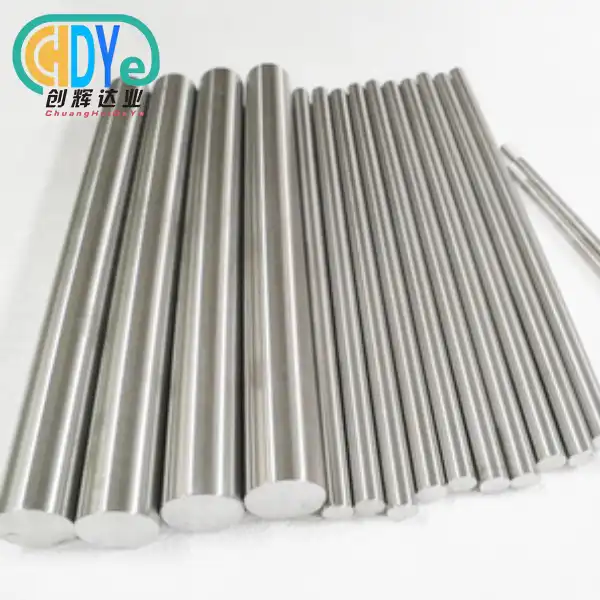
Understanding Pure Niobium Round Bars
The Chemical Composition and Purity Standards
Pure niobium round bars made to ASTM B392 standards have more than 99.9% niobium and strict rules on elements that can get into the bars. Inert gas fusion methods and Glow Discharge Mass Spectrometry (GDMS) are used to carefully keep an eye on the amounts of oxygen, nitrogen, carbon, and hydrogen. These small particles have a big effect on how well superconductors work. Even small amounts of contamination can make it harder for the material to keep its zero electrical resistance at very low temperatures. Modern vacuum melting methods are used in Shaanxi Chuanghui Daye Metal Material Co., Ltd.'s production process to achieve the highest quality standards. This makes sure that every batch meets the strict requirements of superconducting radio frequency (SRF) cavity production.
With a density of 8.57 g/cm³, pure niobium round bars provide a great stiffness-to-weight ratio. Its density is about half that of tantalum, but it still resists rust just as well in many situations. Weight reduction directly leads to higher working efficiency and lower costs, which makes this trait very useful in aerospace applications.
Mechanical Properties for Cryogenic Environments
Pure niobium round bars have amazing mechanical properties that make them effective even in harsh circumstances. The tensile strength is between 200 and 350 MPa, which is strong enough for the structural stability needed to machine complex parts. Better ductility lets makers shape materials into complex shapes without breaking them, which is a big plus when making accurate parts for particle accelerator systems.
Temperature resistance is still one of the things that makes niobium unique. The material stays mechanically stable at temperatures close to 2400°C and works as a superconductor at 9.2 K at the same time. Because it can do two things, it can't be replaced in places that need both high-temperature stability and low-temperature superconductivity. The controlled grain structure—usually ASTM No. 6 or finer—makes sure that the material's qualities are the same all over, which has a direct effect on how easy it is to machine and shape during component manufacturing.
Quality Indicators and Certification Requirements
When looking for pure niobium round bars for superconducting uses, procurement managers and quality experts put a high priority on certain inspection procedures. Ultrasonic Testing (UT) is a way to check the whole volume of something to find any holes, cracks, or other problems inside that could lead to a catastrophic failure in high-pressure or vacuum situations. Laps, gaps, or surface flaws can be found with a surface integrity check. Centerless grinding can achieve tight diameter tolerances (h9/h11) and certain Ra surface roughness values.
Our ISO 9001:2015 Quality Management System Certification makes sure that strict control is used at every step of the production process, from checking the raw materials to melting, casting, cutting, and finally packing them. Each batch has full documentation that can be used to track where the materials came from, which gives buying teams faith in the quality and consistency of the materials. This all-around method to quality control tells the difference between suppliers you can trust and those whose goods aren't up to par and could damage important superconducting systems.
Why Pure Niobium Round Bars Are Preferred for Superconductors
Intrinsic Superconducting Properties
Pure niobium round bars are the purest elemental superconductors with a superconducting transition temperature of 9.2 K. This makes them the obvious choice for real-world superconducting uses. Niobium has no electrical resistance when cooled below a certain temperature. This allows current to move without any loss, which is necessary for efficient energy transfer in superconducting magnets and RF cavities. It is possible to get very high Residual Resistance Ratio (RRR) values in very pure niobium. These high values directly link to less energy being lost in particle reactors, where even small losses add up to high costs over time.
In normal media, electrical resistance causes heat and energy loss. But superconducting niobium keeps its perfect conductivity, which means that resistive heating doesn't happen. In high-energy physics, this trait is especially useful because keeping magnetic fields stable needs steady current flow that doesn't break down. Because the material can carry high current levels without resistance, it can be used to make small, strong electromagnetic systems that weren't possible with other materials before.
Material Comparison and Performance Analysis
Pure niobium round bars have clear benefits over other materials when it comes to superconducting uses. Even though stainless steel and titanium are strong and don't rust, they don't have any superconducting qualities. Niobium-titanium alloys (NbTi) work well as superconductors in low-field situations, but pure niobium is better in high-field situations where the best superconducting performance is needed.
Tantalum is chemically close to niobium, but its superconducting transition temperature is much lower (4.5 K), so it needs more powerful cooling equipment. Tantalum's higher density (16.65 g/cm³) also makes it less desirable for aircraft uses that need to be light. Aluminum superconductors have lower material prices, but they need to be operated at even lower temperatures (1.2 K), which makes cryogenic systems much more complicated and costs a lot more to run.
Cost-Benefit Analysis Across Industries
When aerospace and defense companies buy pure niobium round bars, they get big returns because the systems are more reliable and need less upkeep. Niobium's thermal stability and zero-loss current transfer help superconducting parts in satellite communication systems and advanced radar sites last longer and have fewer expensive breakdowns in hard-to-reach places.
For quantum computing to work, the electromagnetic world has to be very steady. Even small temperature changes can damage delicate quantum states. Niobium superconducting qubits and resonators make it possible for quantum information processing to be stable. Niobium is used in Magnetic Resonance Imaging (MRI) systems in the medical field. In these systems, superconducting magnets create strong, stable magnetic fields that are needed for detailed diagnostic images. The original investment in high-quality niobium materials pays off with less downtime, less energy use, and better diagnostic skills that lead to better patient results.
Industrial Applications of Pure Niobium Round Bars in Superconductors
Particle Accelerators and High-Energy Physics
The structures that speed things up in modern particle accelerators are made of pure niobium round bars that are used to make superconducting radio frequency cavities. To effectively speed up particle beams to speeds close to the speed of light, these carefully made parts must keep their near-perfect superconductivity. Large Hadron Colliders at CERN and Fermilab's accelerator systems need niobium SRF cavities to get the electromagnetic field levels they need to do groundbreaking physics research.
Pure niobium round bars are machined into complicated hollow shapes by turning them precisely, etching them with chemicals, and finishing them with electricity. Preparing the surface is very important; getting ends that are as smooth as a mirror lowers field emission and raises the quality factor (Q-value), which has a direct effect on how well the accelerator works. We can make things at Chuanghui Daye using high-tech cutting centers with accurate lathes and controlled-atmosphere processing to keep the material pure while it's being made.
Quantum Computing Infrastructure
Superconducting circuits are used by quantum computers to change the quantum bits (qubits) that store and handle quantum information. Pure niobium round bars are the main material used to make superconducting qubits because they are stable as a superconductor and work well with microfabrication methods. Quantum computers can keep quantum states stable for long enough to do complicated operations because the material has low surface loss and long coherence times.
Small amounts of high-purity niobium materials are needed for testing, research, and development by research organizations and tech companies working on quantum computers. Our production methods are very flexible, so we can make unique sizes and surface finishes for different quantum circuit designs. Rapid prototyping with uniform quality shortens the time it takes to build new products, which helps leaders in quantum technology bring new ideas to market more quickly.
Medical Imaging and Diagnostic Equipment
Magnetic Resonance Imaging devices use superconducting magnets made from pure niobium round bars to make the strong, even magnetic fields needed for clear images of tissues. The current flow in superconducting coils has no resistance, so they don't use as much power as resistive electromagnets do. They also make fields that are stronger and more stable.
Niobium can be used for more than just superconducting magnets because it is biocompatible. It can also be used to make straight medical device components. Niobium is great for surgical tools and implantable devices because it doesn't rust in biological settings and isn't magnetic, so it works with MRI machines. Medical device makers like that they can get materials from a single reliable source that can be used for both biological implants and superconducting systems.
Procurement Considerations for Pure Niobium Round Bars
Ordering Protocols and Customization Options
Understanding the unique needs of your project is the first step to successful buying. These pure niobium round bars come in sizes from 1 mm to 50 mm and lengths up to 1000 mm. Custom sizes outside of these normal numbers can be made to fit the needs of a specific purpose. Different types of surface finishes, such as finished, ground, or "as-rolled," are best for different ways of making things and different uses.
Minimum order amounts depend on the type of material and how complicated the design is. For standard requirements, lead times are usually between four and eight weeks, but urgent jobs can get production sped up. Some things that need to be thought about in the global supply chain are the right packing to keep goods from getting contaminated during transport, the paperwork needed to clear customs, and how to work with transportation providers who know how to handle sensitive materials.
Pricing Factors and Negotiation Strategies
Pure niobium round bar prices are affected by a number of things. The level of purity has a direct effect on price. Materials that are purer than 99.95% are more expensive because they need more work to get rid of minor flaws. Specifications for diameter and length affect the yield of the material during production. Non-standard measurements may cause higher per-unit costs because they need special tools.
Certification and tests are valuable because they give you peace of mind about the qualities of an object. Full material traceability, mechanical property tests, and chemical makeup analysis all add to the overall cost, but they are necessary in situations where a failed material would have big effects. Long-term supply deals are good for businesses that need the same materials over and over again because they can get better prices when they commit to buying in bulk.
Supplier Selection Criteria
To pick the right provider, you need to look at more than just price. A supplier's ISO 9001:2015 approval shows that they are dedicated to quality management systems and process control. A market reputation that has been built up over many years shows how reliable a company is and how happy its customers are. Shaanxi Chuanghui Daye Metal Material Co., Ltd. has over 30 years of experience in the rare metal business, which gives us the credibility to serve demanding foreign clients.
If a provider can meet your technical needs, their manufacturing skills will tell you. Our building in the Baoji High-tech Development Zone has high-tech tools for melting, forging, rolling, and milling, such as electron beam furnaces, annealing furnaces, and precise lathes. We don't have to rely on outside processors, who may bring variation, because this complete system lets us control quality at every stage of production.
It's important not to forget about technical help. Suppliers who know a lot about materials can help you choose the right materials, make suggestions for how to machine them, and fix problems that come up while you're making a component. Because our team has a lot of experience in aircraft, chemical processing, and electronics, we can give customers advice that is specific to their needs and helps them make their ideas and manufacturing processes better.
Future Outlook: The Evolving Role of Pure Niobium Round Bars in Superconducting Technology
Emerging Innovations and Material Integration
Hybrid material systems that mix niobium with materials that work well with it are helping superconducting technology move forward. Niobium-tin (Nb₃Sn) molecules have higher critical magnetic fields than pure niobium. This means that they can be used in more advanced particle reactors and fusion energy systems. Pure niobium round bars are still used in these areas as starting materials for alloying processes or as structural parts in composite systems.
Niobium is already a very good superconductor, but new surface treatment methods make it even better. Nitrogen doping and other ways of changing the surface of a material make SRF cavities better, which allows higher acceleration gradients and better particle acceleration to happen. These new ideas make more people want ultra-pure niobium materials that can stand up to complex processing without breaking down.
Sustainability and Supply Chain Resilience
Environmental factors are becoming more and more important in choosing materials. Pure niobium round bars are very strong and last a long time in superconducting uses. This helps the environment by lowering the number of replacements needed and cutting waste. Superconducting power transfer and magnetic systems help cut down on carbon emissions, which is in line with efforts around the world to fight climate change.
After recent world problems, making sure the supply chain is resilient has become a top concern. Having a variety of supplier relationships and working with makers in safe areas can help lower the risks that come with global unpredictability and logistics problems. Our location in Shaanxi Province, China's "Titanium Capital," gives us access to well-established facilities and safe sources of raw materials. This means that we can keep supplying our customers even when the global market is unstable.
Strategic Recommendations for B2B Clients
Procurement workers should use forward-looking buying strategies that take into account both current needs and the way technology will change in the future. Getting to know sources who can help with both current output needs and future research and development projects makes it easier to make changes as technologies change. Through collaborative relationships, people can work together to create new products and processing methods that are better suited to new uses.
As rules get stricter across all businesses, investing in systems that keep track of materials and record them pays off. Full records of where materials came from, their tests, and quality standards make compliance checks easier and give useful information for efforts to keep getting better. When suppliers provide thorough paperwork as normal, they make it easier for buying teams to do their work and improve quality assurance overall.
Conclusion
Pure niobium round bars are still needed for superconducting uses because they have the best mix of high-purity composition, optimal transition temperature, and mechanical qualities that work well in harsh conditions. Niobium is used in technologies that will shape our future, from particle accelerators that help advance basic physics study to quantum computers that will change the way we process information. For procurement to go well, you need to work with skilled providers who can show that they are good at manufacturing, quality control, and technical know-how. As superconducting technologies keep getting better, the choices you make today about where to get your materials will affect your place in the market tomorrow.
FAQ
Q: What distinguishes pure niobium round bars from niobium alloy bars?
A: Pure niobium round bars are mostly niobium, with very few other elements added. Niobium alloys, on the other hand, add elements like zirconium (Nb-1Zr) on purpose to change certain qualities. It is pure niobium round bars that have the highest superconducting transition temperature (9.2 K) and work best for SRF cavity uses. Alloys have better weldability and higher mechanical strength, but their superconducting performance is slightly lower. Depending on the application, the right material must be chosen. Talk to experts in materials to find the best standard for your project.
Q: How can I verify the purity and quality of niobium round bars?
A: Ask for full proof of the material, which should include studies on its chemical makeup (using GDMS), mechanical properties, and ultrasonic testing. Reliable providers give paperwork that connects each batch to a specific production lot so that they can be tracked. Getting ISO 9001:2015 approval means that your quality control systems are well-established. Testing by a third party that is not connected with the project provides extra assurance for important uses. At Chuanghui Daye, our quality control procedures include thorough testing at several steps of production, and we keep records for customers to look over.
Q: What are typical delivery timelines for customized niobium round bar orders?
A: Standard orders usually ship four to six weeks after the order is confirmed. If you need custom sizes, a different finish on the surface, or more testing, the lead time could go up to eight weeks. When possible, expedited production meets the needs of projects that need to be done quickly. One to three weeks are added for international shipping, based on where it's going and how long it takes to clear customs. Getting in touch with suppliers early on in the planning stages of a project helps make sure that the supply of materials matches your output schedule.
Partner with Chuanghui Daye for Premium Pure Niobium Round Bars
Shaanxi Chuanghui Daye Metal Material Co., Ltd. is your one-stop shop for pure niobium round bars. They provide materials that meet the strict requirements of superconducting uses all over the world. Our manufacturing methods are ISO 9001:2015-certified, and we have over 30 years of experience working with rare metals. This means that you can be sure that the goods you buy will work reliably in even the most difficult situations. We have widths ranging from 3 mm to 350 mm, lengths that can be changed, surfaces that can be polished or left as-rolled, and full paperwork that can be used to track the product. Email our technical team at info@chdymetal.com to talk about your particular needs, get full specs, or set up samples of the material. See the difference in your superconducting projects when you use good products and get quick service.
References
1. Wilson, M.N. (2017). Superconducting Magnets: Materials, Properties, and Applications. Oxford University Press.
2. Padamsee, H. (2009). RF Superconductivity: Science, Technology, and Applications. Wiley-VCH.
3. American Society for Testing and Materials. (2020). ASTM B392-20: Standard Specification for Niobium and Niobium Alloy Bar, Rod, and Wire. ASTM International.
4. Gurevich, A. (2014). "Superconducting radio-frequency fundamentals for particle accelerators." Reviews of Accelerator Science and Technology, 7, 1-42.
5. Clarke, J. & Wilhelm, F.K. (2008). "Superconducting quantum bits." Nature, 453(7198), 1031-1042.
6. Davis, J.R. (Ed.). (2000). Nickel, Cobalt, and Their Alloys. ASM International Handbook Committee.
Learn about our latest products and discounts through SMS or email