- English
- French
- German
- Portuguese
- Spanish
- Russian
- Japanese
- Korean
- Arabic
- Greek
- German
- Turkish
- Italian
- Danish
- Romanian
- Indonesian
- Czech
- Afrikaans
- Swedish
- Polish
- Basque
- Catalan
- Esperanto
- Hindi
- Lao
- Albanian
- Amharic
- Armenian
- Azerbaijani
- Belarusian
- Bengali
- Bosnian
- Bulgarian
- Cebuano
- Chichewa
- Corsican
- Croatian
- Dutch
- Estonian
- Filipino
- Finnish
- Frisian
- Galician
- Georgian
- Gujarati
- Haitian
- Hausa
- Hawaiian
- Hebrew
- Hmong
- Hungarian
- Icelandic
- Igbo
- Javanese
- Kannada
- Kazakh
- Khmer
- Kurdish
- Kyrgyz
- Latin
- Latvian
- Lithuanian
- Luxembou..
- Macedonian
- Malagasy
- Malay
- Malayalam
- Maltese
- Maori
- Marathi
- Mongolian
- Burmese
- Nepali
- Norwegian
- Pashto
- Persian
- Punjabi
- Serbian
- Sesotho
- Sinhala
- Slovak
- Slovenian
- Somali
- Samoan
- Scots Gaelic
- Shona
- Sindhi
- Sundanese
- Swahili
- Tajik
- Tamil
- Telugu
- Thai
- Ukrainian
- Urdu
- Uzbek
- Vietnamese
- Welsh
- Xhosa
- Yiddish
- Yoruba
- Zulu
Advantages of Titanium Alloy Tube Over Aluminum or Steel Tubes
The titanium alloy tube regularly shows measurable benefits over standard aluminium and steel options when considering material choices for high-performance uses. These tubes are the strongest, most corrosion-resistant, and longest-lasting of their kind. This means that they will last longer and cost less over their whole time. Titanium alloy tubes in grades Gr1, Gr2, Gr7, Gr9, and Gr12 are made to strict standards like ASTM B338, ASTM B337, and ASTM B861. They meet the tough requirements of aircraft, chemical processing, and sea settings where failure of the material is not an option.
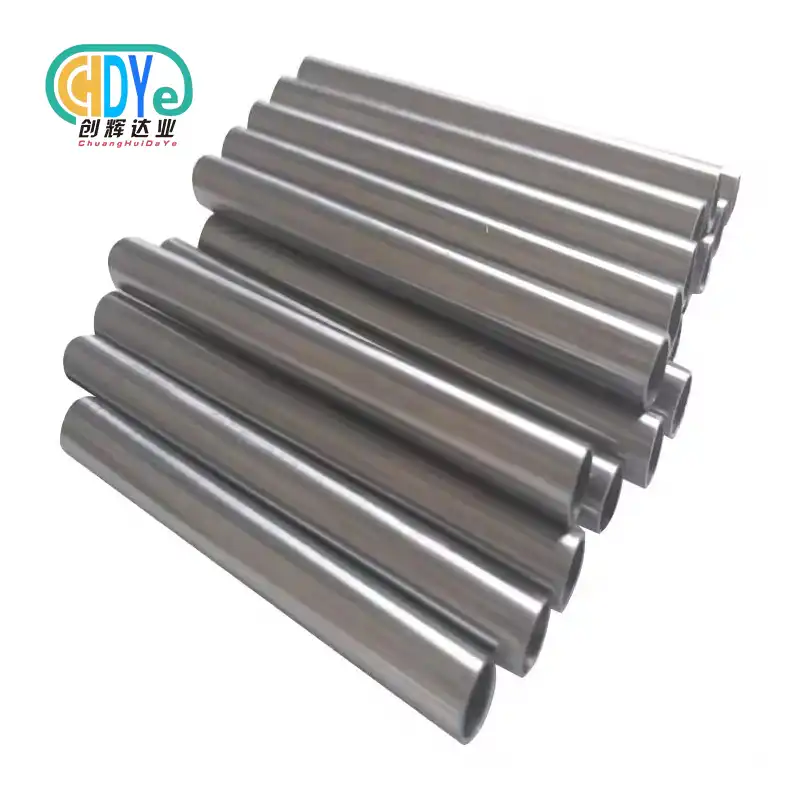
Understanding Titanium Alloy Tubes: Properties and Performance
Tubular goods made from titanium alloy tubes are a specialised material type that is designed to work in situations where regular metals do not perform well. We make these titanium alloy tubes at Shaanxi Chuanghui Daye Metal Material Co., Ltd. using precise melting, extrusion, and cold-working techniques that make sure the microstructure and functional stability of the whole product are the same.
Defining Titanium Alloy Grades and Their Characteristics
Different types of titanium alloy tubes have completely unique performance properties. Commercially pure types like Gr1 and Gr2 are very easy to shape and join, and their tensile strengths are between 240 and 345 MPa. When ductility is important in mildly corrosive conditions, these types do very well. Adding palladium to Gr7 (0.12-0.25%) makes it much more resistant to reducing acids and crack damage in chemical processing equipment. Gr9 (Ti-3Al-2.5V) has a higher strength (about 620 MPa tensile strength) and can still be worked well when cold. This makes it perfect for high-performance car parts and hydraulic systems in spacecraft. Gr12 (Ti-0.3Mo-0.8Ni) is useful in petrochemical heat exchangers because it makes the metal more resistant to corrosion in conditions that are both oxidising and slightly reducing.
Manufacturing Processes That Define Performance
The way the titanium alloy tubes are made has a direct effect on their properties. Our seamless titanium alloy tubes go through rotary cutting and cold pilger rolling, which gets rid of the weld lines that can break when the titanium alloy tubes are loaded and unloaded over and over again. Welded titanium alloy tubes, which are made by TIG welding with an inert gas shielding, are cheaper for bigger sizes and keep their structural integrity when heated correctly. Annealing methods, which are usually done at 650–750°C, remove leftover stresses and improve grain structure, which makes sure that the mechanical properties are all the same. This controlled heat treatment is especially important for titanium alloy tubes that will be used in pressure vessels or places where temperatures change a lot.
Mechanical Properties Compared to Aluminum and Steel
Titanium's density of 4.5 g/cm³ is in the middle of aluminium (2.7 g/cm³) and steel (7.85 g/cm³), but it is stronger than both of them when it comes to strength-to-weight ratio. The specific strength of Gr9 titanium alloy is about 40% higher than that of high-strength aluminium alloys and 60% higher than that of structural steel. This means that the wall pieces can be smaller and the system can weigh less without affecting its structural requirements. Titanium's elastic modulus (110 GPa) is higher than steel's (200 GPa), making it more flexible and lowering stress concentrations in systems that are vibrating or expanding due to heat. When Gr9 is loaded and unloaded 10 times, its fatigue strength hits 500 to 550 MPa, which is much higher than similar aluminium alloys under the same conditions.
Comparative Analysis: Titanium Alloy Tubes vs. Aluminium and Steel Tubes
To understand how well a material works, you need to look at specific operating factors instead of making assumptions. The analysis that follows is based on known business uses and approved test results for materials.
Strength-to-Weight Ratio: Quantifying the Advantage
In the aerospace and car industries, where every kilogram affects fuel economy and payload capacity, choosing the right material is based on how light it is. A pressure tank made of 2mm thick walls of Gr9 titanium alloy tube has the same burst strength as one made of 3.2mm thick aluminium 6061-T6 or 1.5mm thick stainless steel 316L. Titanium alloy tube, on the other hand, is 43% lighter than aluminium and 66% lighter than steel. When aircraft hydraulic systems switch from steel tubing to titanium alloy tubing, they report weight savings of 300 to 450 kg per airframe. This directly increases range and lowers running costs. It's much easier to set up offshore platforms with titanium riser systems because they don't need as much handling equipment and don't have to deal with as much dynamic stress when they are put in place.
Corrosion Resistance Across Operating Environments
The real lifecycle value of a material is based on how long it lasts in harsh settings. Titanium's inactive oxide layer (TiO₂) fixes itself when it is broken, protecting it from corrosion. In ocean uses, titanium alloy tubes have almost no corrosion—less than 0.025 mm per decade—while aluminium tubes rust 0.5 to 2.0 mm per year and carbon steel tubes rust 2 to 5 mm per year, even with coatings that protect them. Chemical processing plants that use Gr7 titanium in chloride-rich settings say that the systems last 25 years or more without needing to be replaced, while similar systems made of stainless steel need to be replaced every 8 to 10 years. Desalination plants that use titanium alloy tube heat exchanger tubes don't have to manage the expensive downtime that comes with broken titanium alloy tubes, and they keep their thermal efficiency over the whole life of the plant. Eliminating upkeep caused by corrosion has measurable cost benefits that pay for themselves within 3–7 years, based on the severity of the application.
Thermal and Mechanical Performance Parameters
Titanium stays strong even when temperatures are very high or very low. Operating windows that can handle temperatures from -253°C (cryogenic) to 600°C can be used for tasks that metal can't do because it softens above 200°C. Its thermal expansion coefficient is 8.6 × 10⁻⁶/°C, which is about half that of aluminium and stainless steel. This lowers thermal stress in systems that are subject to changing temperatures. This quality is very useful in places like chemical labs, exhaust systems, and power plants where different metal assemblies can fail at the joints because of differential expansion. Titanium doesn't transfer heat well (16 W/m·K vs. 205 W/m·K for aluminium), which can be helpful in situations where process fluids need to be kept cool from the outside world.
Lifecycle Cost Analysis and Return on Investment
Titanium alloy tubes usually cost 3–8 times more to make than aluminium tubes and 5–12 times more than carbon steel tubes at first, but this depends on the grade and the market. A full lifetime study, on the other hand, shows a different economic picture. If a chemical processing plant installs Gr12 titanium alloy tube heat exchanger tubes that last 20 years instead of stainless steel tubes that need to be replaced every 6 years, the total cost of ownership is cheaper when installation labour, production downtime, and waste costs are taken into account. In marine uses, avoiding cathodic protection devices, sacrificial anodes, or coating maintenance makes operations simpler and costs less. Aerospace makers like the benefits of weight loss that come from saving fuel over the course of decades of flying. Buying choices that are only based on price miss these important practical benefits.
Why Are Titanium Alloy Tubes the Preferred Choice in High-Performance Industries?
Because of performance needs that aluminium and steel can't meet, some industries have come to see titanium alloy tubes as necessary rather than nice to have.
Aerospace and Defense Applications
Titanium alloy tube hydraulic tubing is used by aircraft makers in pressurised systems that work at 3,000 to 5,000 psi, where the dependability of the material directly impacts flight safety. Titanium's ability to withstand high temperatures and prevent oxidation makes it ideal for engine bleed air systems that move gases at 500°C. Titanium's nonmagnetic properties are useful for systems on military aeroplanes that are close to critical electronics and weapon guidance equipment. As commercial aircraft move toward composite airframe structures, they need fastening and fluid systems that work well with them. Titanium's galvanic compatibility with carbon fibre composites stops the electrochemical corrosion that breaks down metal parts. Titanium is used a lot in the propulsion systems of space rockets, where the temperature of the cold fuel lines changes by 600°C in just a few seconds during engine start processes.
Chemical Processing and Petrochemical Sectors
Chlor-alkali companies that make chlorine gas and caustic soda use Gr7 titanium alloy tubes for their brine circulation systems because no other material lasts long enough. Titanium is useful in pharmaceutical factories because it is biocompatible and simple to clean in systems with very pure water and process tanks that need to be sanitised often. Titanium alloy tube heat exchangers are used in vacuum distilling units by petrochemical plants because hydrogen sulphide and naphthenic acid can damage stainless steel. Fertiliser factories use titanium in urea synthesis units, even though the conditions are very acidic. All of these uses have one thing in common: if a material fails, it leads to significant output loses that are much bigger than the difference in material cost.
Marine and Offshore Engineering
Titanium alloy tube seawater cooling systems are used on military ships, luxury boats, and specialised research vessels where dependability supports using high-end materials. Fire suppression systems made from titanium alloy tubes are used on offshore oil rigs. These systems still work after decades of exposure to saltwater without any upkeep. Titanium is resistant to chloride pitting and stress corrosion cracking, which is important for desalination plants that handle millions of gallons of water every day. Aquaculture businesses that switched from copper-nickel to titanium alloy tubes report they no longer have to deal with biofouling problems or toxic metal leaking that hurts fish health. The predictable service life of 30 years or more makes it difficult to make true lifecycle budgets for materials that need to be replaced over time.
How to Select and Procure Titanium Alloy Tubes: Key Considerations for B2B Buyers?
To buy titanium alloy tubes successfully, you need to make sure that the material specifications match the needs of the application and that the supplier's skills and quality systems meet project standards.
Defining Application-Specific Requirements
The engineering specs should list the working pressure, temperature range, corrosive media makeup, and necessary service life. To keep them from cracking during production, titanium alloy tubes that will be bent or flared need to be annealed in a controlled grain size state. For welded uses, the material must have certificates that show it has low interstitial content (oxygen, nitrogen, and hydrogen), which affects how flexible the weld is. When it comes to heat exchangers, where tube-to-tubesheet fit directly affects leak integrity, dimension errors become critical. Chuanghui Daye can make things with an outside diameter of 10 to 300 mm, a wall thickness of 0.5 to 10 mm, and lengths of up to 18,000 mm, and we can meet both standard and unique requirements.
Material Standards and Certification Requirements
ASTM B338 sets the rules for the chemical composition, mechanical properties, and testing methods for both seamless and welded titanium alloy tubes used in condensers and heat exchangers. For general corrosion-resistant uses, ASTM B337 covers seamless titanium alloy tubes. It has specific standards for flare tests and flattening tests to make sure they can be shaped. For pressure plumbing systems, ASTM B861 talks about seamless titanium alloy pipes with tighter size limits. ASTM B862 is a standard that says welded titanium alloy pipes must be inspected without damaging them. Buyers should be clear about which standard applies and ask for mill test records (MTRs) that show chemical analysis, tension testing, and size confirmation. ISO 9001:2015 approval proves that suppliers' quality management systems consistently produce conforming products, which is critical when a failure of this nature could have major effects.
Supplier Evaluation and Partnership Criteria
Reliable providers show they can make things by keeping records of their facilities, such as specs for heating equipment, heat treatment capabilities, and calibration records for inspection equipment. Lead times for production depend on the grade and size. Commercially pure grades usually ship within 4 to 6 weeks, but custom metals may take 8 to 12 weeks. Project timelines are shortened when standard amounts of inventory are available. When an application needs to work in odd situations or with fabrication issues, being able to provide technical help is important. How close you are to major shipping hubs affects both the cost of handling and the efficiency of delivery. Established suppliers keep in touch with aeroplane OEMs, chemical engineering firms, and research institutions. These ties give customers trust in the supplier's skills and quality.
Conclusion
Titanium alloy tubes perform better than aluminium and steel in several important ways. They have higher strength-to-weight ratios, which makes structures more efficient; they also have better corrosion resistance, which means they don't need as many expensive maintenance cycles; and they can be used reliably in harsh environments where other materials fail. Even though the original costs of procurement are higher than options, lifecycle analysis constantly shows that the economics are better because the system lasts longer, is lighter, and doesn't need to be replaced. Decades of operating data in industries that need to be very reliable, like aircraft, chemical processing, and marine engineering, have proven titanium's value. When procurement professionals consider different material choices, they shouldn't just focus on the purchase price. They should also look at the total cost of ownership, since choosing the right material early in the design process stops expensive fails and early replacements later on in the system's life.
FAQ
Q: Why does titanium resist corrosion better than aluminium or steel?
A: Titanium alloy tube makes a stable, adhering oxide layer (TiO₂) that heals itself when it gets broken, giving it long-lasting passive defence. In acidic or alkaline conditions, aluminium's oxide layer breaks down. Steel, on the other hand, needs coats on the outside that wear off over time. Titanium alloy tube keeps this shield up even in seawater that is high in chloride, acidic process streams, and oxidising conditions where other materials are quickly damaged.
Q: Does the higher cost of titanium tubing justify the investment?
A: Lifecycle cost research usually shows that titanium alloy tubes are better in harsh or demanding situations. When you add up the costs of installation work, downtime, and disposal, a chemical plant heat exchanger with Gr12 titanium alloy tubes that lasts 20 years or more is cheaper than one made of stainless steel that needs to be changed every 5 to 7 years. Applications in aircraft that care about weight save more on fuel than the extra cost of materials over the course of their useful lives.
Q: Which industries benefit most from titanium alloy tubes?
A: Aerospace companies want hydraulic systems and engine parts that are reliable and don't add too much weight. Chemical makers need media that doesn't rust when they handle it roughly. Marine uses require long-term resistance to saltwater that does not need maintenance. Biocompatibility is important for medical device makers when making internal parts. Titanium alloy tubes are used in cooling units at power plants. The benefits of titanium alloy tubes are justified in any situation where failure of a material could lead to safety risks or costly downtime.
Partner with Chuanghui Daye for Premium Titanium Alloy Tube Solutions
The Shaanxi Chuanghui Daye Metal Material Co., Ltd. has been working with rare metals for 30 years and uses ISO 9001:2015-approved production methods to make titanium alloy tubes that meet the strictest requirements. We have full production skills, from melting to final inspection, and are located in Baoji, which is known as China's Titanium Capital. This ensures consistent quality and full material tracking. We sell Gr1, Gr2, Gr7, Gr9, and Gr12 tubes that meet ASTM B338, B337, B861, and B862 standards. The tubes range in size from OD 10 to 300 mm, wall thickness from 0.5 to 10 mm, and lengths up to 18 metres. Whether you need seamless tubes for aerospace hydraulics, welded tubes for chemical heat exchangers, or custom specs for specialised equipment, our expert team can help. They can also provide suggestions based on your specific needs and make prototypes quickly. We are a reliable provider of titanium alloy tubes to companies around the world that make medical devices, chemicals, aerospace, and ships. We offer reasonable factory-direct prices and on-time deliveries. Get in touch with our purchasing experts at info@chdymetal.com to discuss your project needs and get thorough quotes backed by full material certifications and technical documents.
References
1. Boyer, R., Welsch, G., & Collings, E.W. (1994). Materials Properties Handbook: Titanium Alloys. ASM International, Materials Park, Ohio.
2. Schutz, R.W. & Watkins, H.B. (1998). Recent developments in the application of titanium alloys in the energy industry. Materials Science and Engineering: A, Volume 243, Issues 1-2, Pages 305-315.
3. Donachie, M.J. (2000). Titanium: A Technical Guide, 2nd Edition. ASM International, Materials Park, Ohio.
4. Peters, M., Kumpfert, J., Ward, C.H., & Leyens, C. (2003). Titanium Alloys for Aerospace Applications. Advanced Engineering Materials, Volume 5, Issue 6, Pages 419-427.
5. ASTM International (2021). ASTM B338-21: Standard Specification for Seamless and Welded Titanium and Titanium Alloy Tubes for Condensers and Heat Exchangers. West Conshohocken, Pennsylvania.
6. Sedriks, A.J. (1996). Corrosion of Stainless Steels, 2nd Edition—Comparative Analysis with Titanium Alloys in Marine Environments. John Wiley & Sons, New York.
Learn about our latest products and discounts through SMS or email