- English
- French
- German
- Portuguese
- Spanish
- Russian
- Japanese
- Korean
- Arabic
- Greek
- German
- Turkish
- Italian
- Danish
- Romanian
- Indonesian
- Czech
- Afrikaans
- Swedish
- Polish
- Basque
- Catalan
- Esperanto
- Hindi
- Lao
- Albanian
- Amharic
- Armenian
- Azerbaijani
- Belarusian
- Bengali
- Bosnian
- Bulgarian
- Cebuano
- Chichewa
- Corsican
- Croatian
- Dutch
- Estonian
- Filipino
- Finnish
- Frisian
- Galician
- Georgian
- Gujarati
- Haitian
- Hausa
- Hawaiian
- Hebrew
- Hmong
- Hungarian
- Icelandic
- Igbo
- Javanese
- Kannada
- Kazakh
- Khmer
- Kurdish
- Kyrgyz
- Latin
- Latvian
- Lithuanian
- Luxembou..
- Macedonian
- Malagasy
- Malay
- Malayalam
- Maltese
- Maori
- Marathi
- Mongolian
- Burmese
- Nepali
- Norwegian
- Pashto
- Persian
- Punjabi
- Serbian
- Sesotho
- Sinhala
- Slovak
- Slovenian
- Somali
- Samoan
- Scots Gaelic
- Shona
- Sindhi
- Sundanese
- Swahili
- Tajik
- Tamil
- Telugu
- Thai
- Ukrainian
- Urdu
- Uzbek
- Vietnamese
- Welsh
- Xhosa
- Yiddish
- Yoruba
- Zulu
Best Tantalum Metal Plate Supplier for OEM Projects
The selection of a tantalum metal plate supplier is among the most critical decisions when sourcing materials for demanding OEM applications. Tantalum plates are made to the ASTM B 708 specification, with a purity of 99.95% and a thickness range of 0.5mm to 30mm. They provide unequaled corrosion resistance, thermal stability (melting point of 2996°C), and structural integrity for aerospace, chemical processing, electronics, and medical industries. This book explains what a procurement expert needs to know to assess materials, compare providers, and achieve a sustainable long-term supply arrangement.
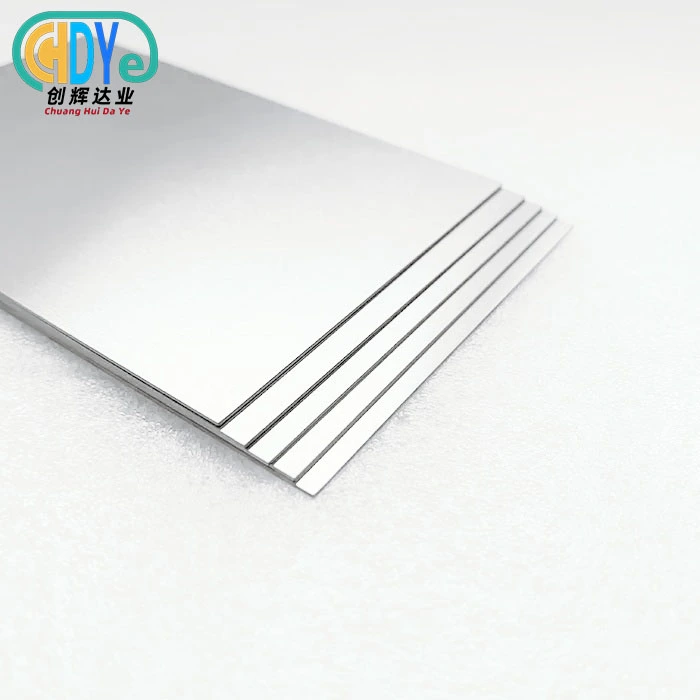
Understanding Tantalum Metal Plates: Properties and Applications
What Makes Tantalum Plates Exceptional?
Tantalum is a refractory metal of dark blue-gray color with a density of around 16.6 g/cm3, roughly twice that of steel. It has a self-healing anodic oxide layer which gives almost impenetrable resistance to acids, including boiling sulfuric and hydrochloric acids below 150°C. Tantalum flat-rolled goods have a tensile strength of 205 MPa and exceptional ductility, allowing them to retain structural integrity under severe thermal and mechanical loading. Tantalum flat-rolled products are the preferred material in applications where stainless steel or titanium are not suitable.
Where Are These Plates Used in OEM Projects?
Most procurement teams don’t first grasp just how wide the range of real-world OEM uses for tantalum sheet and plate goods is. The key sectors where the investment is justified by performance requirements are:
- Chemical Process Equipment: Tantalum plates are manufactured into bayonet heaters, heat exchangers (shell and tube), distillation columns, and corrosion-resistant reaction vessels exposed to harsh acids that would destroy ordinary alloys in a matter of months.
- Capacitors and Electronics: High-purity tantalum is a critical feedstock for capacitor manufacture and for sputtering targets for depositing semiconductor diffusion barrier layers, since it creates a very thin dielectric oxide layer.
- Aerospace and Hard-Metal Alloys: Tantalum-tungsten increases creep resistance and oxidation stability of components for jet engines at continuous high temperatures.
- Medical Implants: Tantalum's total biological inertness and osteoconductivity make it a perfect metal for cranioplasty plates and reconstructive implants. In such applications, soft tissue binds directly to the metal surface, without immunological reactions.
- Wind Turbines for Power Generation: Its corrosion resistance helps in extended service components under adverse environmental exposure.
These applications illustrate why procurement teams across industries keep tantalum metal plate specifications on their critical materials list.
Comparing Tantalum Metal Plates to Alternative Materials
Choosing tantalum, titanium, niobium, and stainless steel includes trade-offs in corrosion resistance, temperature range, and cost. Titanium is cheaper, has good resistance to corrosion, and is used in saltwater and oxidizing acid conditions, but is not good in reducing acids like hydrochloric acid at high temperatures, where tantalum excels.
Stainless steel is cost-effective for moderate chemical conditions but does not have the chemical stability for concentrated acid processing. Niobium has many of the features of tantalum but at a lower density and cost. It does not function as well as tantalum in the most hostile acidic environments.
Equipment manufacturers with zero-failure tolerance OEM projects have regularly found that tantalum flat-rolled material outperforms these alternatives, despite the greater unit cost—an investment that is paid back via considerably longer equipment service life.
How to Choose the Best Tantalum Metal Plate Supplier for OEM Projects
Supplier selection requires a methodical assessment, not a price-only approach. Every procurement evaluation should be based on the following criteria:
- Material Certification & Standards Compliance: Seek vendors that produce to ASTM B 708 with certified confirmation of 99.95% purity. Each shipment must be accompanied by full chemical composition reports and mill test certifications.
- Custom Processing Capability: OEM projects are seldom of conventional proportions. Ensure the supplier has in-house capabilities for hot rolling, cold rolling, cutting, forming, drilling and machining, grinding and polishing, and eliminate any stages that are outsourced that might create quality risk.
- Quality Management Certification: ISO 9001:2015 certification means that the supplier has traceable quality control from the inspection of raw materials, melting, forging, machining, and final packing.
- Production Capacity and Lead Time: A supplier that has electron beam furnaces, rolling machines, annealing furnaces, and shearing equipment all under one roof can make realistic and dependable promises on delivery times for prototype and volume orders.
- Technical Support: Metallurgical knowledge is available to assist procurement teams in choosing the proper alloy grade, surface polish, and dimensional tolerance for a given application.
Good suppliers see each project as a technical partnership, not simply a sale. These characteristics together enable the procurement specialists to develop supplier partnerships for tantalum metal plate that are able to withstand project strain.
The Procurement Process: Buying Tantalum Metal Plates with Confidence
Tantalum is a commercial commodity that is vulnerable to conflict. Global spot prices are influenced by the level of mine production (mainly in the Democratic Republic of Congo and Australia) and the level of strategic stockpiling activities. That makes openness in pricing from your supplier a crucial trust indicator. Cost factors to consider include material grade and purity standard, plate size (width to 2500mm, length to 3000mm), surface finishing requirements, and order volume. Custom machined parts cost more per part than normal flat-rolled sheets. But integrating your cutting and shaping orders with one vertically integrated supplier will often provide better economics than obtaining raw plate and machining separately.
The HTS code for Tantalum items is 8103. For purchasers in the US who are importing from China. Working with a supplier that is familiar with export documents, such as certificates of origin and compliance documentation, helps ensure smooth customs clearance and decreases the chance of delay. Also, requesting factory-direct pricing from ISO-certified manufacturers removes distributor markups, which is especially helpful for recurring OEM manufacturing runs.
Why Partner with Chuanghui Daye for Your Tantalum Plate Needs
Shaanxi Chuanghui Daye Metal Material Co., Ltd. is located in Baoji, Shaanxi Province, China, which is a famous titanium and rare metal production base of China known worldwide. The firm was started by an industry veteran with more than 30 years of experience in refractory metals and delivers true metallurgical competence to every order. Our tantalum flat-rolled goods are made to ASTM B 708 at a purity level of 99.95% with parameters from thickness 0.5-30mm, width 10-2500mm and length 30-3000mm. In-house processing capabilities span the whole manufacturing sequence from hot and cold rolling to precise cutting, forming, drilling and machining, grinding and polishing. Before release, all shipments will undergo examination of dimensions, surface, chemical composition, and mechanical characteristics.
Quality Control is ISO 9001:2015 Certified and provides full traceability from raw tantalum ingot to final packaging. We have electron beam furnaces, annealing furnaces, rolling machines, lathes and shearing machines in-house, so we have direct control over lead time and dimensional accuracy without outsourcing. We assist OEM procurement groups with small lot prototypes, flexible volume scaling, and technical consulting on material selection and application engineering. If your project calls for tantalum plate for a corrosion-resistant heat exchanger, a precision-machined implant component, or a high-purity sputtering substrate, we have the infrastructure and skills to deliver.
Conclusion
Choosing the proper source of tantalum metal plate affects project results in chemical processing, semiconductor manufacturing, aerospace, and medical device industries. Reliable suppliers are distinguished from unreliable suppliers by material purity, dimensional accuracy, processing capability, and documented quality control. With over 30 years of experience in refractory metals, complete in-house processing capabilities, ISO 9001:2015 certification, and factory-direct pricing, Chuanghui Daye can provide the whole range of OEM procurement needs. By evaluating suppliers on factors that go beyond pricing, you may regularly achieve improved material performance and fewer supply chain interruptions.
FAQ
Q: What lead time should I expect for custom tantalum plates?
A: Standard dimensions typically ship within 7–15 business days. Custom-cut or machined tantalum plate orders generally require 15–30 business days depending on dimensional complexity and order volume. Prototype batches can often be prioritized on request.
Q: How does tantalum compare to stainless steel for acid-resistant applications?
A: Tantalum resists virtually all mineral acids below 150°C, including concentrated hydrochloric and sulfuric acids, where stainless steel corrodes rapidly. For aggressive chemical process environments, tantalum offers significantly longer service life despite its higher initial material cost.
Q: What purity and standard does Chuanghui Daye's tantalum plate meet?
A: Our tantalum flat-rolled products are produced at 99.95% purity in compliance with ASTM B 708, with full mill test certificates available for every shipment.
Q: Is technical support available for OEM integration?
A: Yes. Our engineering team provides material selection guidance, dimensional tolerance consultation, and application-specific processing recommendations throughout your project lifecycle.
Get Your Tantalum Metal Plate Quote from Chuanghui Daye
Shaanxi Chuanghui Daye offers factory-direct tantalum metal plate for sale, manufactured to ASTM B 708 at 99.95% purity with comprehensive OEM processing support. From prototype to production volume, our ISO 9001:2015-certified facility delivers verified quality, flexible lead times, and competitive pricing tailored to your specifications. Send your project requirements directly to info@chdymetal.com or visit www.chdymetal.com to request a detailed quote today.
References
1. ASM International. ASM Handbook, Volume 2: Properties and Selection—Nonferrous Alloys and Special-Purpose Materials. ASM International, 1990.
2. ASTM International. ASTM B708: Standard Specification for Tantalum and Tantalum Alloy Plate, Sheet, and Strip. ASTM International, 2022.
3. Becker, P., & Rittner, M. N. "Tantalum: Market and Supply Chain." JOM: Journal of the Minerals, Metals & Materials Society, 2003.
4. Cardarelli, François. Materials Handbook: A Concise Desktop Reference. Springer, 2008.
5. European Commission. Study on the Critical Raw Materials for the EU: Final Report. Publications Office of the European Union, 2023.
6. Savitsky, E. M., & Burkhanov, G. S. Physical Metallurgy of Refractory Metals and Alloys. Consultants Bureau, 1970.
Learn about our latest products and discounts through SMS or email