- English
- French
- German
- Portuguese
- Spanish
- Russian
- Japanese
- Korean
- Arabic
- Greek
- German
- Turkish
- Italian
- Danish
- Romanian
- Indonesian
- Czech
- Afrikaans
- Swedish
- Polish
- Basque
- Catalan
- Esperanto
- Hindi
- Lao
- Albanian
- Amharic
- Armenian
- Azerbaijani
- Belarusian
- Bengali
- Bosnian
- Bulgarian
- Cebuano
- Chichewa
- Corsican
- Croatian
- Dutch
- Estonian
- Filipino
- Finnish
- Frisian
- Galician
- Georgian
- Gujarati
- Haitian
- Hausa
- Hawaiian
- Hebrew
- Hmong
- Hungarian
- Icelandic
- Igbo
- Javanese
- Kannada
- Kazakh
- Khmer
- Kurdish
- Kyrgyz
- Latin
- Latvian
- Lithuanian
- Luxembou..
- Macedonian
- Malagasy
- Malay
- Malayalam
- Maltese
- Maori
- Marathi
- Mongolian
- Burmese
- Nepali
- Norwegian
- Pashto
- Persian
- Punjabi
- Serbian
- Sesotho
- Sinhala
- Slovak
- Slovenian
- Somali
- Samoan
- Scots Gaelic
- Shona
- Sindhi
- Sundanese
- Swahili
- Tajik
- Tamil
- Telugu
- Thai
- Ukrainian
- Urdu
- Uzbek
- Vietnamese
- Welsh
- Xhosa
- Yiddish
- Yoruba
- Zulu
Can Anodized Titanium Wire Improve Surface Durability?
When procurement teams evaluate materials for demanding industrial applications, a fundamental question arises: Can anodized titanium wire improve surface durability? The answer is unequivocally yes. Anodized titanium wire delivers measurable improvements in wear resistance, corrosion protection, anodized titanium wire and surface hardness through an electrochemical process that thickens the natural oxide layer. This enhancement addresses critical operational challenges—from preventing component galling in aerospace assemblies to enabling bio-safe color coding in medical devices. Unlike coatings that peel or degrade, the anodized layer becomes an integral part of the titanium substrate, offering long-term reliability that directly translates to reduced maintenance costs and extended equipment lifecycles.
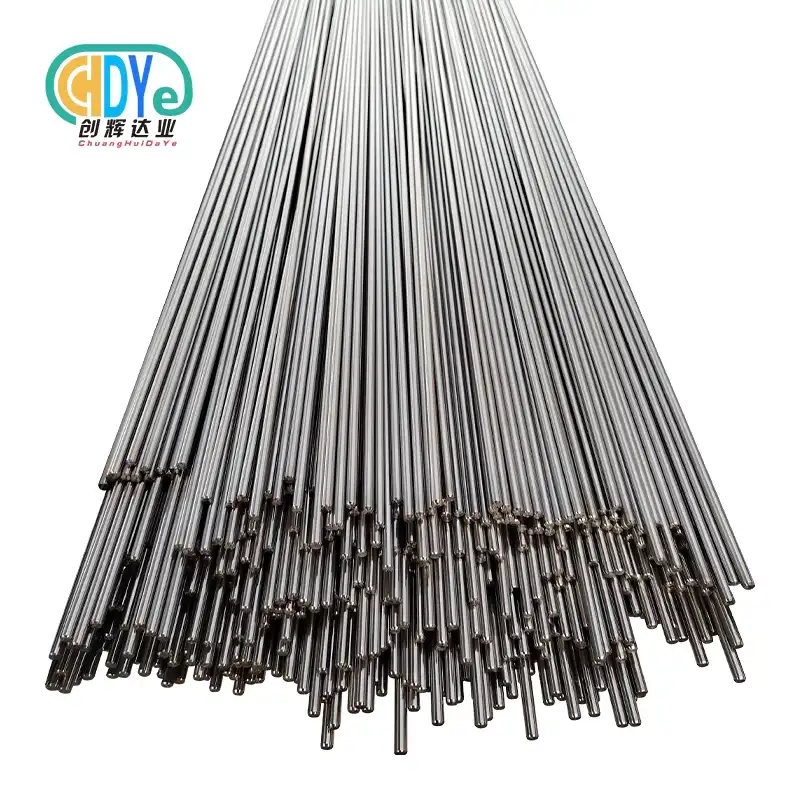
Understanding Anodized Titanium Wire and Its Surface Durability
The Anodization Process Explained
Electrolytic passivation is used to anodise titanium wire, which is a very different process from painting or treating something on the outside. The anode in an electrolytic bath is a titanium wire. Oxygen ions from the liquid mix with the metal surface to form a controlled oxide layer. What makes the finished wire look good, and work right, depends on how thick this layer is, which is usually between 30 and 300 nanometres. This electrochemical growth makes a crystal structure that sticks to the titanium base at the atomic level. The oxide layer that forms is much harder than the titanium surfaces that have not been treated. According to the SAE AMS 2488 guidelines for Type II anodising, this treatment changes the surface in a way that keeps it from seizing up under high loads. This is very important in fastening applications where parts need to stay usable after many assembly cycles.
Key Performance Characteristics
The longer durability is due to several anodized titanium wire qualities that work together. The anodised oxide layer makes the surface harder, so it can handle rough touch, which increases its resistance to wear. This quality is very important in wire-forming tasks where the material has to go through many dies and rollers. Anodised surfaces keep their shape better for longer than raw ones, which lowers the amount of scrap and tool wear. Through anodisation, corrosion protection is greatly increased. The oxide layer protects the metal surface from chloride ions, acidic environments, and galvanic processes that usually break down metal surfaces. Anodised titanium wire has been tested and shown to stay strong in salt spray chambers for more than 1,000 hours. This performance level is useful for marine uses and chemical processing equipment. The dielectric qualities are another useful benefit. With breakdown voltages up to 100V, the oxide layer can act as electrical insulation. This makes it useful in specific electrical uses where conductive substrates need to be isolated from the surface. Combining titanium's mechanical qualities with its surface electrical resistance gives designers more options than they would have with materials that are only conductive or only insulating.
Comparison of Anodized Titanium Wire With Other Wire Materials
Performance Against Plain Titanium Wire
Titanium that hasn't been treated already has great corrosion resistance and strength-to-weight ratios, but the anodisation method fixes some problems. Galling is a type of wear where metal surfaces cold-weld under pressure and friction. Because plain titanium surfaces aren't very hard, they can be damaged by it. The hard oxide layer on anodised surfaces stops this way of failing. When you look at friction factors, you can measure the difference. When the surfaces are dry, plain titanium-on-titanium contact creates coefficients of about 0.6 to 0.8. When the surfaces are anodised, these coefficients drop to 0.2 to 0.4, depending on the thickness of the oxide and the finish of the surface. This decrease has a direct effect on how long a component lasts in situations where it slides against something or is put together over and over again.
Stainless Steel Wire Alternatives
Stainless steel wire is also used in similar situations and is resistant to rust because it forms chromium oxide. The material comparison shows the trade-offs that are used to make choices about procurement. Because it has a higher tensile strength in the same diameters, stainless steel can be used for structural cable applications. However, anodised titanium wire is better at resisting corrosion in chloride-rich conditions than stainless steel, which pits. Titanium options are better because they are lighter. Titanium wire has a density of about 56% that of stainless steel, which makes the system lighter. This is very important in aerospace assemblies where every gram affects fuel economy. The anodised surface makes sure that this weight savings doesn't mean less toughness in tough environments. When you do a cost study, you need to look at total lifecycle costs instead of prices per kilogram. Stainless steel usually costs more up front, but in high-temperature or corrosive environments, anodised titanium wire often has lower total ownership costs because it needs less upkeep and can be used for longer periods of time between services.
Real-World Applications Highlighting Surface Durability Benefits
Aerospace and Defense Manufacturing
Aerospace manufacturers utilize anodized titanium wire in specialized racking systems for component finishing. When processing aluminum structural parts through Type II or Type III hard-coat anodizing, the fixturing must withstand aggressive sulfuric acid baths at controlled temperatures. Titanium wire racks provide the necessary chemical resistance while maintaining electrical conductivity for proper current distribution. The durability advantage manifests in extended rack service life. Aluminum racks typically require replacement after 50 to 100 processing cycles due to coating buildup and dimensional changes. Titanium wire racks operate through 500+ cycles before requiring refurbishment, reducing consumable costs and process interruptions. The anodized surface prevents unwanted coating adhesion while maintaining precise contact points for electrical connection. Fastener applications in aircraft assemblies benefit from the anti-galling properties of anodized titanium. Safety wire used to secure critical bolts and fittings must be anodized titanium wire, allowing installation without surface damage that could initiate stress corrosion cracking. The hard oxide layer enables repeated handling while preserving wire integrity for reliable mechanical locking.
Medical Device Production and Implantable Components
Medical device manufacturers employ anodized titanium wire for both production tooling and final products. In manufacturing surgical instruments, the wire serves as feedstock for springs, retention clips, and fixation elements that require sterilization compatibility. The anodized surface withstands repeated autoclave cycles without degradation, maintaining functional properties through the product lifecycle. Implantable device applications leverage the color-coding capability inherent in anodization. Orthopedic screw systems utilize different anodized colors to indicate size variations—enabling surgeons to identify components visually without reading tiny laser engravings under surgical lighting. The oxide thickness creating blue coloration differs from that producing gold or purple hues, with each corresponding to specific dimensional specifications. This visual differentiation reduces surgical errors while maintaining complete biocompatibility. The corrosion resistance proves essential for long-term implant performance. Components remain in the human body for decades, exposed to saline environments and mechanical loading. Anodized surfaces prevent ion release that could trigger inflammatory responses, contributing to osseointegration success rates in dental and orthopedic applications.
Chemical Processing Equipment
In electrochemical industries, anodized titanium wire finds application in specialized electrode assemblies and current distribution systems. The combination of base metal conductivity with surface dielectric properties enables precise current control in electroplating operations. The wire maintains dimensional stability in acidic copper, nickel, and chromium plating baths that rapidly degrade alternative materials. Heat exchanger assemblies in corrosive service utilize anodized titanium wire for retention systems and anti-vibration supports. The material withstands chloride concentrations, thermal cycling, and mechanical stress without the pitting or crevice corrosion that limits stainless steel service life. Process engineers specify anodized titanium wire where extended maintenance intervals justify the material investment.
Procurement Considerations for Anodized Titanium Wire
Material Specification and Quality Verification
Procurement teams must establish clear specifications covering wire diameter tolerances, anodized layer thickness, and mechanical properties. Standard practice involves requesting material certifications documenting chemistry analysis, tensile testing results, and oxide thickness measurements. Reputable suppliers provide traceability documentation linking finished wire to source ingot lot numbers, supporting quality audits and regulatory compliance. Sample evaluation represents a critical procurement step before committing to production quantities. Requesting prototype quantities allows verification that the material meets application requirements through actual testing rather than relying solely on specification sheets. Mechanical testing, corrosion exposure, and dimensional verification identify potential issues before large-scale integration into manufacturing processes. Surface finish requirements demand careful specification of anodized titanium wire. Anodizing can produce matte, satin, or bright finishes depending on pre-treatment and process parameters. Medical applications often require polished substrates before anodizing to minimize surface roughness that could harbor bacteria. Industrial applications may accept rougher finishes where appearance doesn't impact function. Clearly communicating finish expectations prevents costly rework or rejection of delivered material.
Color Customization and Consistency
Applications requiring specific anodized colors need detailed specification of target hues and acceptable variation ranges. The interference-based coloration depends on precise oxide thickness control, typically specified in nanometers. Color consistency across production lots requires supplier process controls, including voltage monitoring, bath temperature regulation, and periodic thickness verification. Procurement agreements should address color-matching protocols, especially when ordering supplemental quantities to match existing inventory. Suppliers capable of spectrophotometric color measurement provide objective verification beyond visual comparison. Understanding that slight color variation occurs naturally helps establish realistic acceptance criteria that balance aesthetic requirements with practical manufacturing tolerances.
Supply Chain Reliability and Lead Time Management
Anodized titanium wire often requires longer procurement lead times compared to commodity materials. The production sequence involves wire drawing, surface preparation, anodizing, and quality verification—each step requiring specialized equipment and technical expertise. Typical lead times range from 6 to 12 weeks for custom specifications, though standard configurations may ship more quickly. Building relationships with suppliers based in established titanium processing regions provides access to integrated supply chains and technical resources. Baoji, China—recognized globally as "Titanium Capital"—hosts concentrated expertise in titanium processing from raw material refinement through finished component production. Suppliers operating in these industrial clusters offer advantages in technical support, quality consistency, and responsive communication. Understanding minimum order quantities helps procurement planning. Custom anodizing setups often require processing batches of 50 to 100 kilograms to achieve cost-effective pricing. Volume commitments enable negotiated pricing structures while maintaining economic viability for suppliers producing specialized materials.
Conclusion
Anodized titanium wire demonstrably improves surface durability through electrochemically grown oxide layers that enhance wear resistance, corrosion protection, and functional performance. The material addresses specific industrial challenges where conventional alternatives fall short—delivering biocompatibility for medical applications, anti-galling properties for aerospace assemblies, and chemical resistance for process equipment. Procurement decisions benefit from understanding the technical mechanisms behind these improvements and evaluating suppliers based on quality systems, technical capability, and supply chain reliability. The investment in anodized titanium wire generates measurable returns through extended component service life, reduced maintenance intervals, and improved system performance.
FAQ
1. How does anodized titanium wire durability compare to stainless steel alternatives?
Anodized titanium wire outperforms stainless steel in corrosion resistance, particularly in chloride-rich environments where stainless steel experiences pitting. The anodized oxide layer provides superior wear resistance with lower friction coefficients. Stainless steel offers higher tensile strength per diameter, but titanium's strength-to-weight ratio delivers better performance in weight-sensitive applications. Service life comparisons depend on specific environmental conditions, though anodized titanium typically extends maintenance intervals by 40-60% in corrosive applications.
2. What factors affect the lifespan of anodized titanium wire in industrial applications?
Lifespan depends on oxide layer thickness, operating environment, and mechanical stress levels. Properly anodized wire maintains integrity for 5-10 years in moderate corrosive environments. High-temperature cycling above 450°C may gradually reduce oxide effectiveness. Mechanical abrasion from repeated bending or contact wears the oxide layer over time. Chemical exposure to hydrofluoric acid concentrations exceeding 50ppm can compromise the protective layer. Regular inspection protocols help identify wear patterns before functional failure occurs.
3. Can suppliers provide samples before large-scale procurement commitments?
Reputable suppliers routinely provide sample quantities for qualification testing before production orders. Sample programs typically offer 1-5 kilograms of material matching proposed specifications, allowing mechanical testing, corrosion evaluation, and process compatibility verification. Lead times for custom-anodized samples range from 3-6 weeks. Procurement teams should request material certifications accompanying samples, documenting chemistry, mechanical properties, and oxide thickness measurements to ensure consistency with future production deliveries.
Partner With Chuanghui Daye for Premium Anodized Titanium Wire Solutions
Procurement success depends on partnering with suppliers who combine technical expertise, quality assurance systems, and reliable delivery performance. Shaanxi Chuanghui Daye operates from Baoji High-tech Development Zone in Shaanxi Province—the globally recognized center of titanium processing excellence. Our facility houses integrated capabilities, including electron beam melting, precision wire drawing, and controlled anodizing systems that deliver consistent material properties.
With ISO 9001:2015 certification governing our quality management systems, we maintain rigorous process controls and anodized titanium wire from raw material inspection through final product verification. Every anodized titanium wire shipment includes comprehensive traceability documentation supporting your regulatory compliance requirements. Our technical team brings over 30 years of rare metal processing experience, providing application engineering support to optimize material specifications for your specific requirements.
Whether your application demands biocompatible wire for medical devices, anti-galling solutions for aerospace assemblies, or corrosion-resistant components for chemical processing, we offer customized anodizing services tailored to your performance criteria. Our responsive manufacturing approach accommodates both prototype quantities for qualification testing and production volumes with scheduled delivery programs.
Contact our applications engineering team at info@chdymetal.com to discuss your anodized titanium wire requirements. As a direct manufacturer and supplier, we provide factory-direct pricing with transparent quotations covering material, processing, and logistics.
References
1. Davis, J.R. (Ed.). Handbook of Materials for Medical Devices. ASM International, 2003. Chapter 7: Titanium and Titanium Alloys for Medical Applications.
2. Brunette, D.M., Tengvall, P., Textor, M., and Thomsen, P. Titanium in Medicine: Material Science, Surface Science, Engineering, Biological Responses and Medical Applications. Springer-Verlag Berlin Heidelberg, 2001.
3. SAE International. AMS 2488D: Anodic Treatment of Titanium and Titanium Alloys Solution pH 13 or Higher (Type II). Society of Automotive Engineers Aerospace Material Specification, 2018.
4. International Organization for Standardization. ISO 10993-1:2018 Biological Evaluation of Medical Devices — Part 1: Evaluation and Testing Within a Risk Management Process. Geneva: ISO, 2018.
5. Lutjering, G. and Williams, J.C. Engineering Materials and Processes: Titanium. 2nd Edition. Springer-Verlag Berlin Heidelberg, 2007. Chapter 9: Corrosion and Surface Treatment.
6. Zwilling, V., Aucouturier, M., and Darque-Ceretti, E. "Anodic Oxidation of Titanium and TA6V Alloy in Chromic Media: An Electrochemical Approach." Electrochimica Acta, Vol. 45, No. 6, 1999, pp. 921-929.
Learn about our latest products and discounts through SMS or email