- English
- French
- German
- Portuguese
- Spanish
- Russian
- Japanese
- Korean
- Arabic
- Greek
- German
- Turkish
- Italian
- Danish
- Romanian
- Indonesian
- Czech
- Afrikaans
- Swedish
- Polish
- Basque
- Catalan
- Esperanto
- Hindi
- Lao
- Albanian
- Amharic
- Armenian
- Azerbaijani
- Belarusian
- Bengali
- Bosnian
- Bulgarian
- Cebuano
- Chichewa
- Corsican
- Croatian
- Dutch
- Estonian
- Filipino
- Finnish
- Frisian
- Galician
- Georgian
- Gujarati
- Haitian
- Hausa
- Hawaiian
- Hebrew
- Hmong
- Hungarian
- Icelandic
- Igbo
- Javanese
- Kannada
- Kazakh
- Khmer
- Kurdish
- Kyrgyz
- Latin
- Latvian
- Lithuanian
- Luxembou..
- Macedonian
- Malagasy
- Malay
- Malayalam
- Maltese
- Maori
- Marathi
- Mongolian
- Burmese
- Nepali
- Norwegian
- Pashto
- Persian
- Punjabi
- Serbian
- Sesotho
- Sinhala
- Slovak
- Slovenian
- Somali
- Samoan
- Scots Gaelic
- Shona
- Sindhi
- Sundanese
- Swahili
- Tajik
- Tamil
- Telugu
- Thai
- Ukrainian
- Urdu
- Uzbek
- Vietnamese
- Welsh
- Xhosa
- Yiddish
- Yoruba
- Zulu
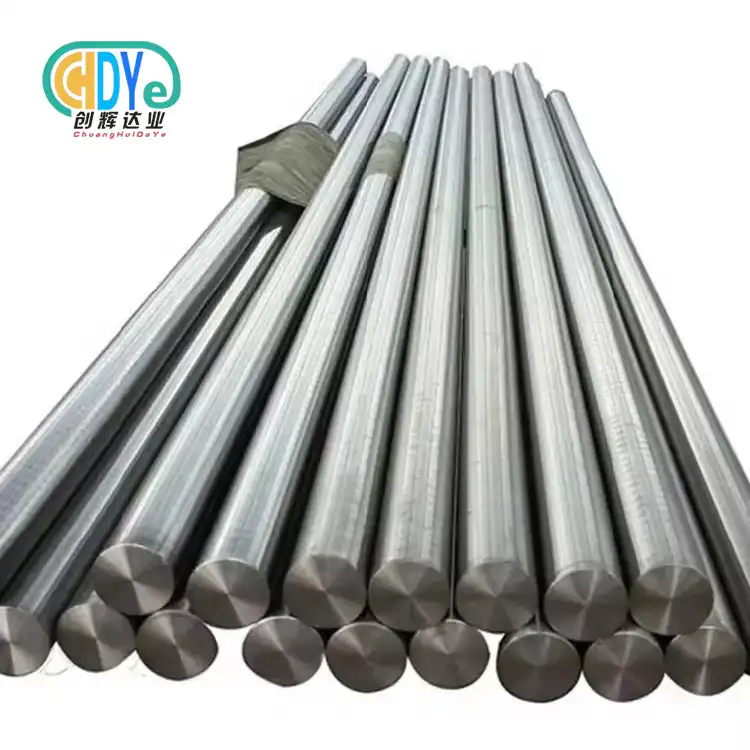
How Strong Is a Titanium Rod Compared to Other Metals?
When purchase managers and design engineers have to choose which materials to use, they always ask, "How strong is a titanium rod compared to other forms of industrial metal?" The grade of alloy, the location where it will be used, and the performance of the titanium rod all affect the answer. As the purity level of Grade 1 titanium bars goes up, their tensile strength goes up to 240 MPa. Grade 5 (Ti-6Al-4V) bars have a strength of over 900 MPa. They are in the same class as high-strength steel and aluminium. One thing that makes them unique is that they don't rust in chloride- or oxidising-rich settings and are about 56% lighter than steel while still being strong. This one-of-a-kind mix solves important design problems in chemical processing, marine, medical, and aerospace areas where weight, durability, and cost over time are all very important.
Understanding Titanium Rod Strength and Properties
Titanium rods represent a fundamental semi-finished product in high-performance metallurgy, manufactured from commercially pure titanium or titanium alloys through precision forging, rolling, and annealing processes. We recognise that material selection begins with understanding the mechanical properties that define performance boundaries in real-world applications.
Mechanical Performance Characteristics
Titanium's strength changes a lot from one grade to the next. This is because different types are made to trade off how easily they bend and how much weight they can hold. Grade 1 titanium bars are the most bendable and soft. Their tensile strength is about 240 MPa, and they can be shaped in many different ways. This makes them ideal for tough cold-forming jobs in chemistry and building parts. It is often called the "workhorse" of the industry. Grade 2 titanium has a strength of 345 MPa and is very flexible, so it can be used in places where salt causes equipment to break down often. It works best when made from Grade 5 titanium metal (Ti-6Al-4V). Pulling strength is over 900 MPa, and it only weighs 45% as much as steel. Patterns like these can be seen in yield strength, which shows the stress level at which distortion begins to last. Most of the time, titanium alloys are more resistant to wear than aluminium alloys. This is important for parts that get moved and unloaded a lot. Due to its low elastic modulus (about 110 GPa vs. 200 GPa for steel), the material is useful when stress spread is more important than total rigidity.
Corrosion Resistance and Environmental Stability
Titanium rods are strong, and they also solve problems like high titanium rod repair costs and long-term maintenance that often happen in harsh work environments. The stuff makes a stable titanium dioxide (TiO₂) passive sheet by itself, and if it gets broken, it fixes itself. Some of the corrosion problems that stainless steel has are salt pitting, crevice corrosion, and stress corrosion cracking. This makes it almost impossible for these problems to happen. It works well with media that are slightly reducing to slightly oxidising, and it has its own built-in defence system. It stops equipment used in chemical processing, on offshore platforms, and for desalination from failing in terrible ways because of corrosion.
Comparative Analysis: Titanium Rod vs Other Common Metals
Material selection demands systematic evaluation of competing options against specific performance criteria, cost constraints, and supply chain considerations. Understanding how titanium compares to alternative metals helps procurement teams make evidence-based decisions rather than relying on assumptions or outdated material preferences.
Titanium vs Steel
Many places still use steel as their main building material because it is simple to find and doesn't cost much. Mild steel has a tensile strength of 400 MPa, while high-strength metals have a tensile strength of over 1,200 MPa. Steel is stronger than titanium, but it weighs 7.85 g/cm³ more than titanium, which weighs 4.5 g/cm³. One thing that makes titanium stand out is that its strength-to-density ratio is higher than most structural steels. Grade 5 titanium has a specific strength that is similar to or higher than most structural steels. Titanium doesn't have the same "weight penalty" as steel, so it can be used in places where lighter weight directly leads to better performance, like in aeroplane parts, racing gear and portable tools. It is better to use titanium over steel because steel can rust and corrode in saltwater and chemical conditions. This is true even though titanium costs more at first. Stainless steels like 316L are less likely to rust when chromium and molybdenum are added to them, but they still don't work well in tough chloride environments where titanium does. These parts made of titanium last a long time and don't need to be fixed or changed for a long time. This means that they often pay for themselves three to five times over in material costs.
Titanium vs Aluminum
This is because aluminium pieces are about 60% less dense than titanium, so they can be used for tasks that need to be light. Tensile strengths of 310 MPa and 570 MPa for popular aluminium alloys like 6061-T6 and 7075-T6. These alloys are lighter than titanium and can be used in less demanding situations. The efficiency gap shows up when it is exposed to high temperatures and acids. When aluminium gets above 150°C, it loses its mechanical qualities very quickly. Titanium, on the other hand, can handle temperatures up to 400°C and even higher, depending on the grade. Galvanic rust is another issue that comes up in real life. When aluminium parts come into contact with more noble metals in an electrolyte, they rust fast. But titanium is so noble that it protects both itself and the materials around it. Aluminium equipment breaks down too quickly when it comes into contact with acidic or salty solutions, but titanium equipment doesn't break down at all.
The following comparison clarifies key decision factors:
| Property | Titanium Grade 5 | Carbon Steel | Stainless 316L | Aluminum 7075 |
|---|---|---|---|---|
| Density (g/cm³) | 4.43 | 7.85 | 8.00 | 2.81 |
| Tensile Strength (MPa) | 900-950 | 400-1200 | 515-620 | 570 |
| Corrosion Resistance | Excellent | Poor | Good | Moderate |
| Temperature Limit (°C) | 400 | 500 | 800 | 150 |
Selecting the Right Titanium Rod for Specific Industrial Applications
Optimal material specification requires matching titanium grade with titanium rod characteristics to operational demands, regulatory requirements, and economic constraints. Different industries have evolved distinct preferences based on accumulated field experience and documented performance data.
Aerospace and Defense Applications
Plane makers like Grade 5 titanium alloy because it is stronger than other types of titanium alloy and can be used to make parts of the engine, the landing gear, and the structure of the plane. In terms of construction, it fills in the gaps where steel is too heavy, and aluminium isn't strong enough. The Grade 5 bars used to make fasteners, hydraulic fittings, and structural braces are 20–40% lighter than steel versions of the same things. They can also last more than 50,000 flight cycles without breaking. It is possible to use both Grade 5 and Grade 2 for defence purposes, such as rocket bodies, armour plate backing, and parts of military ships. To build things, Grade 5 is used, and Grade 2 is for systems that need to be able to handle salt spray and humidity without rusting. Documentation for material traceability and meeting AMS standards is still needed, and suppliers who aren't certified can't bid on military contracts.
Medical Device Manufacturing
Which titanium implants, dentistry fixtures, and surgical tools are used depends on how well they work with the body. Most hip and knee implant stems are made of grade 5 titanium, which has the same mechanical strength as cortical bone and helps osseointegration, the process by which implant and bone tissue naturally join. Because it is less stressed, grade 2 titanium is used in tooth implant abutments and bone screws when commercially pure material can't be used. Since titanium isn't magnetic, people with titanium implants can go through MRI tests without getting any artefacts or tissue heating. This is a big advantage over stainless steel implants. Regulatory bodies like the FDA need products to meet the requirements of ISO 5832 and ISO 10993 for biocompatibility tests. Medical-grade titanium makers can meet these standards with the help of strict quality control systems.
Procurement Insights and Best Practices for Titanium Rods
Effective sourcing strategies balance material specifications, supplier capabilities, quality assurance protocols, and total acquisition cost to ensure reliable supply chains supporting production schedules and quality objectives.
Supplier Selection and Qualification
Reliable titanium suppliers keep their ISO 9001:2015 certification, which shows that they handle quality in a planned way from receiving the raw materials to the final inspection. Suppliers like Shaanxi Chuanghui Daye Metal Material Co., Ltd., which is based in Baoji, China's "Titanium Capital," take advantage of the region's supply chain and have built up scientific knowledge over decades of working with aerospace, chemical, titanium rod, and medical markets around the world. Material test reports (MTRs), dimensional inspection certificates, and traceability paperwork must all be checked by procurement teams to make sure that they are not using low-quality materials that hurt the performance of parts. Audits of suppliers should look at their manufacturing skills, such as their melting technology (vacuum arc remelting makes sure that the chemicals are all the same), forging equipment (which determines the sizes that can be made and their mechanical properties), and machining accuracy (which affects the tolerances of the finished parts). Custom processing services, such as special diameters, precise cutting, and surface finishing, lower the costs and wait times of manufacturing further down the line.
Understanding Cost Drivers and Pricing Dynamics
Titanium rod prices are affected by several factors, including the cost of the raw materials, the size of the rod (longer rods cost more), the complexity of the alloy (Grade 5 costs 30–50% more than Grade 2), and the number of rods that are bought. For standard diameters, Grade 2 rods cost about $15 to $25 per kilogram right now. Grade 5 rods, on the other hand, cost about $25 to $40 per kilogram, based on the testing and certification needs. The minimum order amount is different for each seller and product. Most normal sizes have them at 100 kg, but they can be higher for custom sizes that need to be made in small batches. For stock items, lead times are 4 to 8 weeks, and for custom orders, they are 8 to 16 weeks. To make sure you don't miss any dates, you should plan. You can get more technical help and save 15 to 25 per cent on costs when you buy straight from manufacturers instead of distributors.
Quality Assurance and Testing Protocols
For important uses, the incoming review must be very thorough. Calibrated measuring tools must be used to check the chemical makeup using spectrographic analysis, the mechanical properties using ASTM E8 tensile tests, and the accuracy of the dimensions. The ultrasonic test finds flaws inside the structure that make it less strong, and the surface check finds scratches, splits, or damage from handling that needs to be repaired or fixed. Traceability systems link the numbers on a lot of materials to specific amounts of melt, processing factors, and test results. If something goes wrong in the field, this lets you figure out what went wrong. Customers can use private portals to look at electronic records that suppliers keep. Being honest like this helps build trust in long-term relationships. Getting certification from a third party, like a separate testing lab, adds another level of safety for medical and aviation uses that need to follow the rules.
Conclusion
Titanium bars are interesting because they are non-biocompatible, have a high strength-to-weight ratio, and don't rust. Since they have these qualities, they are perfect for use in the chemical, marine, military, and medical fields. Titanium costs more up front than steel and aluminium, but it is more cost-effective over its entire life and is better for demanding uses where low weight, no upkeep, and a long service life add up to real value. To do good procurement, you need to know what each grade is good for, find sources you can trust with strong quality systems, and set up supply chain strategies that balance cost, trustworthiness, and expert support.
FAQ
1. How does the tensile strength of titanium rods compare to steel?
Grade 5 titanium alloy rods achieve tensile strength of 900-950 MPa, comparable to medium-strength steel alloys, while weighing 45% less. Grade 2 commercially pure titanium offers 345 MPa tensile strength, similar to mild structural steel but with superior corrosion resistance. The strength-to-density ratio makes titanium competitive with high-strength steels in weight-critical applications despite lower absolute strength values.
2. What factors influence the corrosion resistance of titanium rods?
Titanium's passive titanium dioxide film forms spontaneously and regenerates when damaged, providing immunity to chloride pitting and crevice corrosion. Performance varies slightly by grade—Grade 7 with palladium additions resists reducing acids better than Grade 2. Temperature, pH, and contamination levels affect the film's stability, though titanium outperforms stainless steel across most industrial environments except concentrated sulfuric acid and hydrofluoric acid.
3. Can I order custom-sized titanium rods?
Manufacturers routinely produce custom diameters, lengths, and tolerances to match specific application requirements. Custom sizing requires longer lead times (typically 8-16 weeks) and may involve minimum order quantities based on production setup economics. Precision machining services transform standard rod stock into finished components with tight dimensional control, surface finishes, and threaded features.
4. What are typical delivery timelines for bulk titanium rod orders?
Standard diameter Grade 2 and Grade 5 rods in stock configurations ship within 4-8 weeks. Custom specifications, including unique sizes, special testing requirements, or large volumes, extend timelines to 8-16 weeks, depending on production scheduling and raw material availability. Expedited processing reduces standard lead times by 30-50% for urgent project needs, though premium pricing applies.
Partner with Chuanghui Daye for Your Titanium Rod Requirements
At Shaanxi Chuanghui Daye Metal Material Co., Ltd., we combine three decades of rare metal titanium rod expertise with modern manufacturing capabilities to serve as your trusted titanium rod supplier. Our Baoji facility produces Grade 1, Grade 2, and Grade 5 titanium rods meeting ASTM B348 and ISO standards, backed by ISO 9001:2015 certification and complete traceability documentation. We offer custom processing, including precision machining, specialised diameters, and rapid prototyping, to accelerate your project timelines. Contact our technical team at info@chdymetal.com to discuss your specifications, receive competitive factory-direct pricing, and experience the reliability that global aerospace, medical, and chemical processing leaders depend on.
References
1. Boyer, R., Welsch, G., & Collings, E.W. (1994). Materials Properties Handbook: Titanium Alloys. ASM International, Materials Park, Ohio.
2. Donachie, Matthew J. (2000). Titanium: A Technical Guide, 2nd Edition. ASM International, Materials Park, Ohio.
3. Schutz, R.W. & Watkins, H.B. (1998). "Recent developments in titanium alloy application in the energy industry." Materials Science and Engineering: A, Volume 243, Issues 1-2, Pages 305-315.
4. Rack, H.J. & Qazi, J.I. (2006). "Titanium alloys for biomedical applications." Materials Science and Engineering: C, Volume 26, Issue 8, Pages 1269-1277.
5. ASTM International (2021). ASTM B348-13: Standard Specification for Titanium and Titanium Alloy Bars and Billets. West Conshohocken, Pennsylvania.
6. Lutjering, Gerd & Williams, James C. (2007). Titanium, 2nd Edition. Springer-Verlag, Berlin Heidelberg.
Learn about our latest products and discounts through SMS or email