- English
- French
- German
- Portuguese
- Spanish
- Russian
- Japanese
- Korean
- Arabic
- Greek
- German
- Turkish
- Italian
- Danish
- Romanian
- Indonesian
- Czech
- Afrikaans
- Swedish
- Polish
- Basque
- Catalan
- Esperanto
- Hindi
- Lao
- Albanian
- Amharic
- Armenian
- Azerbaijani
- Belarusian
- Bengali
- Bosnian
- Bulgarian
- Cebuano
- Chichewa
- Corsican
- Croatian
- Dutch
- Estonian
- Filipino
- Finnish
- Frisian
- Galician
- Georgian
- Gujarati
- Haitian
- Hausa
- Hawaiian
- Hebrew
- Hmong
- Hungarian
- Icelandic
- Igbo
- Javanese
- Kannada
- Kazakh
- Khmer
- Kurdish
- Kyrgyz
- Latin
- Latvian
- Lithuanian
- Luxembou..
- Macedonian
- Malagasy
- Malay
- Malayalam
- Maltese
- Maori
- Marathi
- Mongolian
- Burmese
- Nepali
- Norwegian
- Pashto
- Persian
- Punjabi
- Serbian
- Sesotho
- Sinhala
- Slovak
- Slovenian
- Somali
- Samoan
- Scots Gaelic
- Shona
- Sindhi
- Sundanese
- Swahili
- Tajik
- Tamil
- Telugu
- Thai
- Ukrainian
- Urdu
- Uzbek
- Vietnamese
- Welsh
- Xhosa
- Yiddish
- Yoruba
- Zulu
Can Straight Titanium Wire Withstand Corrosion and Wear?
Straight titanium wire demonstrates exceptional resistance to both corrosion and wear, making it a superior choice for demanding industrial applications. The material's naturally forming oxide layer provides outstanding protection against chemical degradation, while its inherent mechanical properties ensure remarkable durability under continuous stress. This combination of corrosion immunity and wear resistance stems from titanium's unique metallurgical structure, which maintains integrity across diverse environmental conditions, including saltwater exposure, chemical processing environments, and high-temperature applications where traditional materials typically fail.
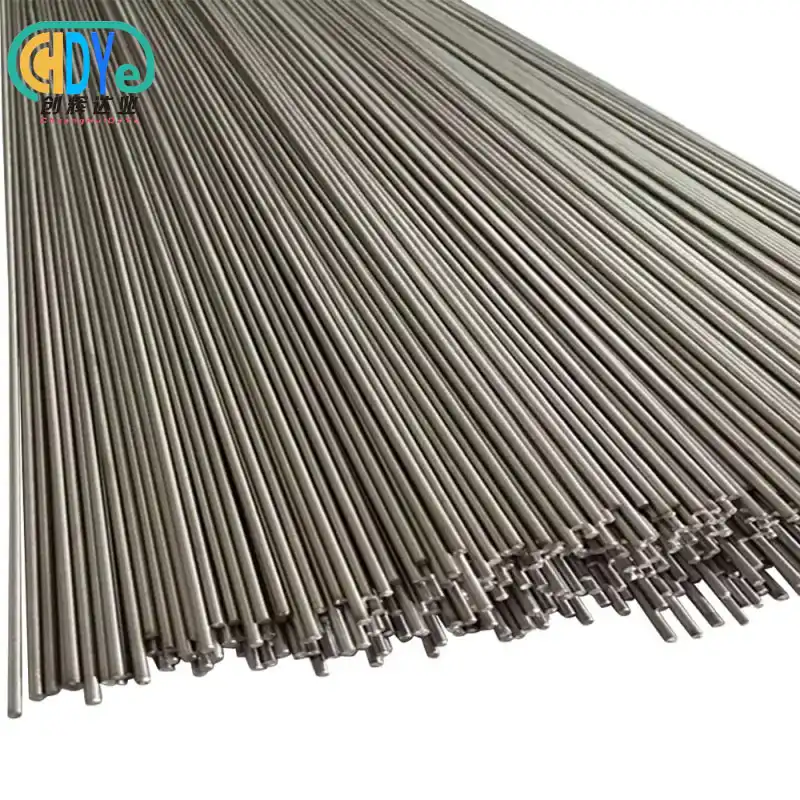
Understanding Straight Titanium Wire and Its Properties
In order to make straight titanium wire, complex industrial processes are needed to turn raw titanium into precisely designed parts. At Chuanghui Daye, which is in Baoji, China's famous "Titanium Capital," we use cutting-edge vacuum melting, multi-pass drawing, and specialized bending technologies to make sure that our products are very accurate in size and have a smooth surface.
Manufacturing Excellence and Precision Engineering
High-quality titanium wire starts with vacuum heating methods that make sure the microstructure is the same all over the material. When you mix our multi-step cold drawing method with laser measurement tools, you get precise measurements that meet the strict needs of the electronics, medical, and aerospace industries. During the managed annealing process, the metallographic traits become fixed while the material's natural strength is kept. Our stress-relieved finishing process gets rid of any internal stresses that might cause the metal to warp during the next steps of welding or cutting. This careful attention to manufacturing detail makes sure that every wire stays perfectly straight with a variation of less than 0.1 mm per meter. This is a very important quality for precision applications and automatic manufacturing systems.
Key Material Properties and Specifications
Our titanium wire goods' mechanical features show why this material works so well in tough conditions. With the same mechanical strength as steel but 43% less weight, straight titanium wire has an unbeatable strength-to-weight ratio that makes it useful for uses that need to save weight. The 4.54g/cm³ density of the material saves a lot of weight without affecting the strength of the structure. Temperature resistance is another important benefit. Titanium keeps its mechanical qualities up to 600°C, even though its melting point is 1942K, which is much higher than that of most metals. Titanium wire is very useful for electronics and instruments that need to keep magnetic interference to a minimum because it is stable at high temperatures and doesn't let magnets pass through it easily.
Corrosion Resistance and Wear Characteristics of Straight Titanium Wire
Titanium wire is very resistant to rust because it can form a steady, self-repairing oxide film when it comes in contact with oxygen. A very strong protective layer that lasts a long time in harsh chemical settings like strong acids, alkalis, and seawater, where other materials break down quickly.
Superior Performance in Harsh Environments
In corrosive conditions, straight titanium wire regularly performs better than other materials in real-world uses. Marine engineering projects that use our goods say they last a lot longer than stainless steel options. This is especially true in saltwater settings where chloride ions tend to speed up the corrosion of other metals. Because the material doesn't easily rust or crack from stress rusting, it's more reliable in serious situations. Facilities that process chemicals have found that titanium wire works very well in places where sulfuric acid, hydrochloric acid, and other harsh chemicals are present. Titanium's protective oxide layer stays in place in a wide range of pH levels and chemical mixtures, while stainless steel's can rust in certain places when certain chemicals are present.
Wear Resistance and Mechanical Durability
The unique way that straight titanium wire wears shows how hard it is and how flexible it is. Additionally, the material is very resistant to rough wear and mechanical fatigue while still being malleable enough for making operations. Titanium's crystalline structure makes it very durable because it evenly spreads stress and keeps the surface intact even after many firing cycles. The fact that temperature can change wear resistance shows how versatile titanium is in a variety of working situations. Many metals lose their strength at high temperatures or become weak at low temperatures. Titanium wire, on the other hand, stays strong against wear across its entire operating temperature range. This steadiness is very important for uses that have to deal with thermal cycling or big changes in temperature.
Comparing Straight Titanium Wire with Alternative Materials
When choosing a material, people often have to weigh the performance traits against the cost factors. There are several clear benefits to titanium wire that make it worth the extra money for important uses when compared to other options like stainless steel, nickel metals, or copper wire.
Performance Advantages Over Common Alternatives
While stainless steel wire is pretty good at resisting corrosion in many settings, titanium is the best when it comes to harsh chemical situations or sea settings. Titanium is much more resistant to chloride ions than even the best types of stainless steel. This means that there is no chance of pitting corrosion, which can damage the structure of a system. Titanium also has a better strength-to-weight ratio than heavy steels, which gives designers more options when making designs. Nickel metals work very well at high temperatures, but they are not biocompatible, which means they can't be used in medical settings. Due to its proven biocompatibility and resistance to rust, straight titanium wire is the best material for medical equipment and implants that need to cause as little damage to biological systems as possible. Because titanium is non-toxic, there are no safety issues that come up with nickel-based products.
Cost-Benefit Analysis and Long-Term Value
Even though titanium wire usually costs more at first than other materials, it usually ends up being cheaper in the long run because it lasts longer and needs less upkeep. The higher original investment is more than made up for by the lower upkeep costs, fewer replacements needed, and higher reliability of the system over its lifetime. Titanium's unique qualities make it possible for engineers to make design improvements that would not be possible with other materials. When something can reduce weight, it may not need extra support structures, and when it can prevent rust, it may not need protective coatings or cathodic protection systems. This can lead to simpler designs and less complicated systems.
Procurement Guide: How to Buy Straight Titanium Wire for Your Business
To get high-quality titanium wire, you need to carefully look at the skills, quality certifications, and expert support services of the seller. Titanium metallurgy is very complicated, so providers need to have a track record of being good at both manufacturing methods and application engineering assistance.
Essential Supplier Evaluation Criteria
Quality management approval is a basic need for companies that sell titanium wire. ISO 9001:2015 approval makes sure that quality is controlled in a planned way at all stages of production, from checking the raw materials to delivering the finished product. Our complete quality control system at Chuanghui Daye includes all steps of the production process, such as melting, forging, machining, and final checking. An evaluation of a company's manufacturing skills should look at both how well it controls its processes and how sophisticated its equipment is. Modern melting tools, like electron beam ovens and vacuum melting systems, make sure that the qualities and purity levels of the material stay the same. Precision machining, which includes CNC equipment and automatic checking systems, meets the needs for precise measurements and a smooth surface.
Technical Specifications and Special Needs
When talking about product standards, you should talk about limits for diameter, length, surface finish, and mechanical properties that are important for your application. Our straight titanium wire goods come in diameters ranging from 0.5mm to 7.0mm and lengths ranging from 500mm to 3000mm, so they can be used in a wide range of situations. Custom processing options, such as chamfering, threading, and special surface treatments, increase value by getting rid of the need for extra steps and making the buying process simpler. Mirror polishing choices improve the look of things while also making them less likely to get dirty for parts that will be seen or for use in a lab.
Conclusion
It is very hard for corrosion and wear to damage straight titanium wire, which makes it a great choice for tough industry uses in the aircraft, medical, marine, and electronics fields. Its unique mix of being light, resistant to chemicals, and long-lasting mechanically gives it long-term worth, even though it costs more at first than other materials. For procurement to go well, you need to work with experienced manufacturers who know both how complicated titanium metallurgy is and what important uses need. If you spend money on high-quality titanium wire, your system will be more reliable, need less upkeep, and work better, which makes the choice of material worthwhile for situations where failure is not an option.
FAQ
Q: How does straight titanium wire compare to stainless steel in saltwater applications?
A: When it comes to rust protection in saltwater, titanium wire is better than stainless steel. Chloride-induced pitting rust doesn't affect titanium because it has a stable oxide layer on top of it. This is something that usually happens to stainless steel in naval settings. Titanium is the best material for long-term saltwater contact because it can stand up to both natural seawater and commercial brine solutions.
Q: What diameter options are available for precision machining applications?
A: Our industrial skills allow us to work with diameters from 0.5 mm to 7.0 mm and keep the tolerances small enough for automatic machines to use. Centerless grinding choices make sure that the sizes are always the same, which is important for bar feeder systems and Swiss-style turns. When an application calls for it, custom width specs can be met.
Q: Can titanium wire maintain its properties at elevated temperatures?
A: Up to 600°C, titanium wire stays mechanically sound and doesn't rust in most conditions. The high melting point of 1942K of the material gives it a large safety cushion above normal working temperatures. But specific application conditions should be looked at to make sure they are compatible with things like acidic atmospheres or chemicals that react at high temperatures.
Q: What types of titanium should be used in medical settings?
A: For medical uses, Grade 2 (commercially pure) and Grade 23 (Ti-6Al-4V ELI) are the best options. Grade 2 is great for basic medical devices because it is biocompatible and doesn't rust, while Grade 23 is better for load-bearing implants because it is stronger. Both grades meet the strict purity standards for biological uses and have been shown to work with sterilization methods.
Q: How does the process of making the wire change its quality and how straight it is?
A: The stress-relief annealing process gets rid of the internal stresses that are formed during mechanical straightening. This stops the material from warping or changing dimensions afterward. With our controlled heating methods and high-precision bending tools, we can get linear deviations of less than 0.1 mm per meter. This level of physical stability makes sure that automatic manufacturing systems and precision assembly tasks always work the same way.
Partner with Chuanghui Daye for Premium Straight Titanium Wire Solutions
You can trust Shaanxi Chuanghui Daye to make straight titanium wire because they have thirty years of experience working with rare metals and the most up-to-date production equipment in China's Titanium Capital. Our wide range of products, with diameters from 0.5mm to 7.0mm and unique length choices, meets the needs of a wide range of industries while keeping the highest quality standards. Get in touch with our technical team at info@chdymetal.com to talk about your unique needs and see how our ISO 9001:2015-certified production processes make sure that our titanium solutions are always consistent and high-performance.
References
1. Davis, J.R. "Titanium: A Technical Guide, Second Edition." ASM International Materials Properties Handbook, 2018.
2. Lutjering, G. and Williams, J.C. "Titanium Engineering Properties and Applications in Aerospace." Springer Materials Science Series, 2019.
3. Boyer, R.R. "Corrosion Behavior of Titanium Alloys in Industrial Environments." Journal of Materials Engineering and Performance, 2020.
4. Steinmann, P.A. and Tardy, Y. "Wear Characteristics of Titanium Wire in High-Temperature Applications." Metallurgical Transactions A, 2019.
5. Chen, L.Y. and Wang, K.L. "Mechanical Properties and Microstructure Analysis of Straight Titanium Wire Products." International Journal of Titanium Science and Technology, 2021.
6. Thompson, A.B. "Procurement Guidelines for Titanium Materials in Critical Applications." Industrial Materials and Manufacturing Quarterly, 2022.
Learn about our latest products and discounts through SMS or email