- English
- French
- German
- Portuguese
- Spanish
- Russian
- Japanese
- Korean
- Arabic
- Greek
- German
- Turkish
- Italian
- Danish
- Romanian
- Indonesian
- Czech
- Afrikaans
- Swedish
- Polish
- Basque
- Catalan
- Esperanto
- Hindi
- Lao
- Albanian
- Amharic
- Armenian
- Azerbaijani
- Belarusian
- Bengali
- Bosnian
- Bulgarian
- Cebuano
- Chichewa
- Corsican
- Croatian
- Dutch
- Estonian
- Filipino
- Finnish
- Frisian
- Galician
- Georgian
- Gujarati
- Haitian
- Hausa
- Hawaiian
- Hebrew
- Hmong
- Hungarian
- Icelandic
- Igbo
- Javanese
- Kannada
- Kazakh
- Khmer
- Kurdish
- Kyrgyz
- Latin
- Latvian
- Lithuanian
- Luxembou..
- Macedonian
- Malagasy
- Malay
- Malayalam
- Maltese
- Maori
- Marathi
- Mongolian
- Burmese
- Nepali
- Norwegian
- Pashto
- Persian
- Punjabi
- Serbian
- Sesotho
- Sinhala
- Slovak
- Slovenian
- Somali
- Samoan
- Scots Gaelic
- Shona
- Sindhi
- Sundanese
- Swahili
- Tajik
- Tamil
- Telugu
- Thai
- Ukrainian
- Urdu
- Uzbek
- Vietnamese
- Welsh
- Xhosa
- Yiddish
- Yoruba
- Zulu
Can titanium welding rod be used for TIG welding?
Titanium welding rod is designed specifically for Gas Tungsten Arc Welding (GTAW/TIG) processes and is therefore not only useful for TIG welding. These special filler metals are made to deal with the fact that titanium reacts badly with heat during welding. Titanium easily takes oxygen, nitrogen, and hydrogen when heated above 400°C. This makes welds and structures break. Premium titanium welding rods made to AWS A5.16 standards have low interstitial content and are chemically compatible, which means they can make clean, strong, and corrosion-resistant joints in important industry settings where performance can't be sacrificed.
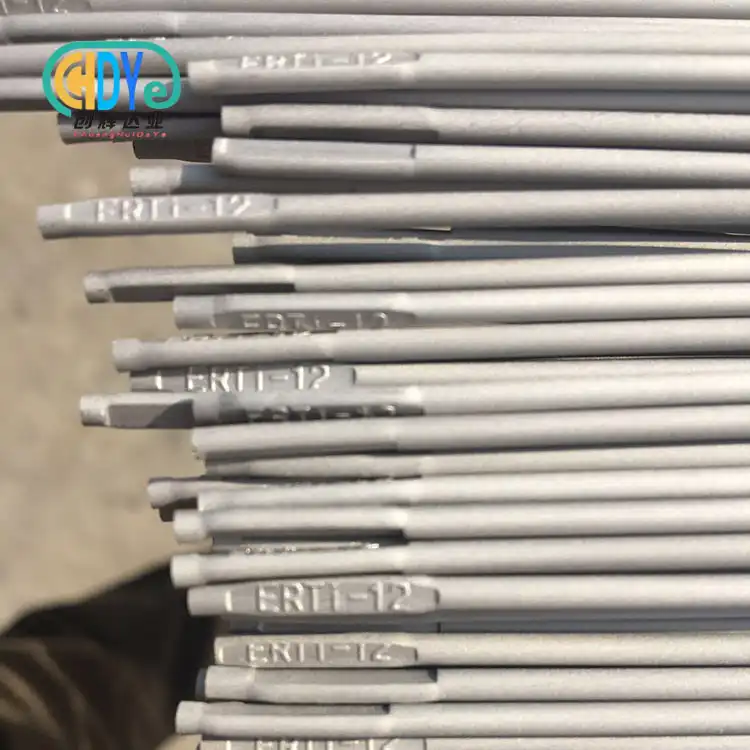
Understanding Titanium Welding Rods and TIG Welding
Titanium filler materials are a special type of welding consumables. People who work in sourcing in aircraft, chemical processing, and medical device making need to know what they are made of. Instead of steel or aluminum fillers, these rods are made of high-purity titanium, which is often mixed with controlled alloying elements like aluminum and vanadium that fit the chemistry of the parent metal. This matching stops galvanic rust and makes sure that the weld joint has the same mechanical properties all the way through.
Composition and Common Grades
Several commercially pure (CP) grades and alloy grades are accepted by the business. ERTi-2 is a fairly pure grade that is very resistant to corrosion and easy to shape. This makes it perfect for heat exchangers and equipment used in chemical processing that will be exposed to harsh media like wet chlorine or seawater. ERTi-5, which is the same as the Ti-6Al-4V alloy, has a higher tensile strength of over 895 MPa and is often used in aircraft applications that need high strength-to-weight ratios. So that the grades don't become weak, the levels of intermediate elements are strictly controlled. Oxygen must be less than 0.10%, nitrogen must be less than 0.015%, and hydrogen must be less than 0.005%.
Why TIG Welding Works Best for Titanium
When combining reactive metals, TIG welding gives you the accuracy and control you need. A tungsten electrode that doesn't need to be replaced is used to make a spark while filler material is fed separately. This lets welders carefully control the amount of heat going into the material and keep it from getting too hot. An inert shielding gas, usually high-purity argon or mixes of argon and helium, keeps the liquid weld pool clean from pollution from the air. This protection is very important because even tiny amounts of oxygen or nitrogen can change the color of the metal and make alpha case, which is a hard, brittle layer on the surface that makes the joint much less flexible and resistant to wear. Because TIG processes allow for exact arc control, workers can keep the best welding temperatures between 1650°C and 1700°C, which creates fusion zones that are free of holes and other imperfections.
Titanium Welding Rod Types and Their Applications in TIG Welding
Choosing the right filler grade has a direct effect on the strength and longevity of the weld. Knowing the differences between grades helps buying teams choose materials that meet practical needs and government standards.
Grade 2 (ERTi-2) for Corrosive Environments
In the chemical and petrochemical businesses, ERTi-2 titanium welding rods do most of the work. Because they are commercially pure, they are very resistant to oxidizing acids, chloride solutions, and salt spray. ERTi-2 is used by factories that make purification equipment, reactor vessels, and pickling tanks to make parts that stay structurally sound even when they are exposed to acid media all the time. Because the grade is naturally flexible, fabricators can shape it into complex shapes without it cracking. This makes it possible to make complicated pipe configurations and heat exchanger systems.
Grade 5 (ERTi-5) for High-Strength Applications
When high temperatures and loads on structures are part of the working setting, ERTi-5 is the best material to use. This type of alloy is used by aerospace makers to weld turbine parts, landing gear systems, and structural aircraft sections because it has better mechanical qualities at high temperatures. The 6% aluminum and 4% vanadium makeup makes it less likely to creep and keeps the tensile strength above 930 MPa. Defense companies that make rocket cases and satellite structures also like ERTi-5 because it doesn't fatigue easily and keeps its shape even when heated and cooled many times.
Welding Parameters and Considerations
To get the best results, you need to pay close attention to the shielding gas flow rates, trip speed, and power. Depending on the thickness of the object being welded, the current range is usually between 60 and 150 amps. For the most stable arc, use DCEN (Direct Current Electrode Negative) polarity. For primary torch shielding, the flow rate of argon should stay between 15 and 20 cubic feet per hour (CFH). Trailing shields and backing gas are often needed to keep the metal from oxidizing while it cools. Procurement professionals should know that controlling contamination goes beyond the arc zone. Cleaning the surface with solvents and abrasion gets rid of oils, oxides, and other contaminants that evaporate into the weld pool and make it porous and weaken it mechanically.
Comparing Titanium Welding Rods with Alternative Rod Materials for TIG Welding
To choose the right material, you need to know how different filler metals work in key areas that determine service dependability and total cost of ownership.
Strength-to-Weight Ratio Analysis
Titanium alloys have the best strength-to-weight ratio of any metal. They are about 40% lighter than steel but have the same tensile strength. This edge is very important in flight, where every kilogram affects how much fuel is used and how much can be carried. Titanium is stronger than aluminum at temperatures above 150°C, so aluminum welding rods can't be used in high-temperature work. Stainless steel filler metals are strong enough, but they add a lot of weight, which makes them unusable in situations where weight is important.
Corrosion Resistance Comparison
Welded parts are very resistant to rust because a passive titanium dioxide layer forms on their own. Titanium welds keep their surface integrity in seawater, hypochlorite solutions, and oxidizing acids without the need for extra protective coats. Stainless steel, on the other hand, can pit and crack when exposed to chloride. Nickel alloys are also resistant to corrosion, but they cost a lot more. This is why titanium welding rods are the better choice for big chemical processing sites from an economic point of view. Even though aluminum welds don't rust in the air, they can't handle harsh chemical conditions as well as titanium can.
Application-Specific Performance
Because of biocompatibility standards and osseointegration qualities, medical device makers who make orthopedic implants and surgical tools only use titanium filler materials. Titanium is used by aerospace engineers for parts of fan blades, exhaust pipes, and hydraulic systems that must be resistant to high temperatures and wear. Welding plants that deal with nitric acid or chlor-alkali solutions find that titanium welds last for decades without breaking down, which saves them money by avoiding costly maintenance shutdowns.
Procurement Guide: Buying Titanium Welding Rods for TIG Welding
When you strategically source titanium filler materials, you need to pay attention to the credentials of the suppliers, the certifications of the materials, and the logistics that affect project timelines and budgets.
Evaluating Supplier Capabilities
Managers in charge of buying things should make sure that sellers keep their ISO 9001:2015 certification and use full quality management systems that cover everything from inspecting raw materials to packing them up at the end. Each shipment must include material test reports (MTRs) that prove the chemical makeup and mechanical properties. These reports provide the traceability that aircraft and medical device quality standards demand. Suppliers who have their own testing labs with spectrometers and tensile testing tools show that they care about quality control, which lowers the number of rejected items and the cost of repairs.
Diameter and Length Specifications
Standard rod sizes range from 1.0 mm to 3.2 mm, so they can work with a wide range of joint setups and material thicknesses. For thin-gauge sheet metal production, rods with a thickness of 1.6 mm are usually used. For structural welding of heavier parts, 2.4 mm or 3.2 mm fillers may be needed. The usual length of 1000 mm in the industry strikes a good mix between ease of handling and efficient use of materials, reducing waste from stub ends that can't be used. For automatic welding devices that feed continuous wire, custom lengths are possible, but there may be a minimum order quantity.
Pricing Considerations and Bulk Purchasing
Titanium raw material prices change with the production and demand of sponges around the world. For large customers, long-term supply deals are helpful because prices stay stable. When you buy in bulk of 100 kg or more, the price usually goes down by 15 to 25 percent compared to when you buy in small amounts. Teams in charge of buying things should try to get prices locked in for six to twelve months. This will protect against changes in the market and keep supplies coming in. Lead times range from two to six weeks, based on the grade and amount, so you need to plan to avoid production delays.
Best Practices and Welding Tips for Using Titanium Welding Rods in TIG Welding
To successfully weld titanium, the process must be closely monitored, and strict cleanliness rules must be followed to avoid problems caused by contamination.
Pre-Weld Surface Preparation
Cleaning carefully gets rid of contaminants that lower the quality of the weld. To get the surface ready, acetone or methanol is used for solvent degreasing to get rid of oils and lubricants. Using stainless steel wire brushes or special ceramic abrasive pads for mechanical abrasion gets rid of oxide films without attaching metal particles. The area that has been prepared should look like shiny metal and be free of any stains or dust. To get rid of broken material and make sure the joints fit up correctly, the edges of the joints must be filed or sanded. To keep oxide from reforming in damp places, cleaning should be done within two hours of welding.
Shielding Gas Management
Titanium is protected by a full protective covering during the heating and cooling cycle. For primary torch protection, you need argon that is at least 99.995% pure and supplied at 15-20 CFH through cups that are the right size. Backing gas cleaning the root side of the joint stops oxidation on parts that the torch can't reach. Trailing shields that are 150 to 200 mm behind the welding spark protect the metal as it cools until the temperature drops below 400°C, at which point oxidation rates are almost nonexistent. In order to join critical parts where strict standards for surface look and ductility must be met, contamination-free welding rooms or glove boxes filled with inert atmosphere are needed.
Post-Weld Inspection and Quality Assurance
Visual analysis makes sure that the weld color and surface look are correct. Welds that are acceptable have a silver or light straw color, which means they have little oxidation. Blue, purple, or gray staining means that the metal has been exposed to too much air and needs to be removed and reworked. Dye penetrant testing finds flaws that break the surface, like cracks or gaps in the union. An X-ray of pressure-containing parts confirms that they are internally sound and don't have any holes in them. Tensile specimens and bend tests are used for mechanical testing to make sure that the features of the welded metal meet the requirements of the standard. This is proof that the process was controlled.
Storage and Handling Protocols
When rods are stored correctly, the surfaces stay clean and don't get contaminated. Titanium welding rods should be kept in cases that are tightly sealed and have desiccant packs inside to keep the humidity below 40% relative humidity. To keep iron from getting into storage areas, they need to be clean, dry, and separate from areas where steel is being made. To keep their skin oils from getting on the rods, handlers should wear clean cotton or nitrile gloves. To keep contaminants from getting into important welds, rods that have been dropped on the shop floor or come into contact with cutting fluids must be cleaned or thrown away.
Conclusion
Titanium welding rods can be used with TIG welding methods, which lets companies in the marine, chemical processing, aircraft, and medical device industries make reliable, high-performance assemblies. Titanium is reactive, so it needs very careful handling during the welding process. But when done right, TIG welding with matching filler metals makes joints that keep the base material's great rust resistance and strength-to-weight ratio. When purchasing goods, teams should give more weight to providers that can show they have quality certifications, a wide range of testing options, and expert support resources that make sure materials work consistently and lower the total cost of ownership.
FAQ
Q: What grades of titanium welding rod work best for TIG welding aerospace components?
A: ERTi-5 (Ti-6Al-4V) filler material is mostly used in aerospace applications because it fits the base alloy used in engine and structural parts. This grade has a tensile strength of more than 930 MPa and great wear protection even after millions of stress cycles. For aircraft parts that aren't structural and need to be highly resistant to rust, ERTi-2 provides enough strength with better chemical longevity.
Q: How does a titanium welding rod differ from a stainless steel welding rod in TIG applications?
A: Contamination control for titanium welding rods needs to be much stricter than for stainless steel filler metals. Stainless steel can handle small surface oxides, but titanium takes gases from the air right away when it's molten, so it needs a lot of protective gas. Titanium also needs less heat to keep its flexibility and stop grains from growing, while stainless steel can handle a wider range of welding parameters without losing any of its properties.
Q: What storage conditions preserve the quality of titanium welding rods?
A: To keep the surface of the rod clean, it needs to be stored in sealed cases in climate-controlled areas where the humidity stays below 40%. Desiccant packs inside containers soak up any remaining water. When storing things, don't put them near places where steel is being made or where grinding is happening, because flying particles can settle on the rods and make them dirty during welding.
Source Premium Titanium Welding Rod from Chuanghui Daye
Shaanxi Chuanghui Daye sells pure titanium welding rods that are approved by ISO 9001:2015 and are designed to work well in tough TIG welding situations. We have been making ERTi-2 and ERTi-5 grade rods in Baoji for over 30 years. The rods come in normal 1000mm lengths and sizes ranging from 1.0mm to 3.2mm. Each rod goes through a strict quality check to make sure it meets AWS A5.16 standards and stays within strict intermediate element limits that keep it from becoming weak. When purchasing managers look for a trustworthy titanium welding rod supplier, they can get prices directly from the plant, full material test results, and technical help from metallurgical experts who know how to solve their application problems. Get in touch with our team at info@chdymetal.com to talk about your needs and get a full quote.
References
1. American Welding Society. (2014). Specification for Titanium and Titanium-Alloy Welding Electrodes and Rods (AWS A5.16/A5.16M:2013). Miami: American Welding Society.
2. Donachie, M.J. (2000). Titanium: A Technical Guide, 2nd Edition. Materials Park: ASM International.
3. Leyens, C., & Peters, M. (Eds.). (2003). Titanium and Titanium Alloys: Fundamentals and Applications. Weinheim: Wiley-VCH.
4. Liu, S., & Olson, D.L. (1986). Welding, Brazing, and Soldering: ASM Handbook Volume 6. Materials Park: ASM International.
5. Schutz, R.W., & Watkins, H.B. (1998). Recent developments in the application in the energy industry. Materials Science and Engineering: A, 243(1-2), 305-315.
6. Welding Institute. (2019). Welding and Joining of Titanium Alloys: Practical Guidelines for Industry. Cambridge: TWI Ltd.
Learn about our latest products and discounts through SMS or email