- English
- French
- German
- Portuguese
- Spanish
- Russian
- Japanese
- Korean
- Arabic
- Greek
- German
- Turkish
- Italian
- Danish
- Romanian
- Indonesian
- Czech
- Afrikaans
- Swedish
- Polish
- Basque
- Catalan
- Esperanto
- Hindi
- Lao
- Albanian
- Amharic
- Armenian
- Azerbaijani
- Belarusian
- Bengali
- Bosnian
- Bulgarian
- Cebuano
- Chichewa
- Corsican
- Croatian
- Dutch
- Estonian
- Filipino
- Finnish
- Frisian
- Galician
- Georgian
- Gujarati
- Haitian
- Hausa
- Hawaiian
- Hebrew
- Hmong
- Hungarian
- Icelandic
- Igbo
- Javanese
- Kannada
- Kazakh
- Khmer
- Kurdish
- Kyrgyz
- Latin
- Latvian
- Lithuanian
- Luxembou..
- Macedonian
- Malagasy
- Malay
- Malayalam
- Maltese
- Maori
- Marathi
- Mongolian
- Burmese
- Nepali
- Norwegian
- Pashto
- Persian
- Punjabi
- Serbian
- Sesotho
- Sinhala
- Slovak
- Slovenian
- Somali
- Samoan
- Scots Gaelic
- Shona
- Sindhi
- Sundanese
- Swahili
- Tajik
- Tamil
- Telugu
- Thai
- Ukrainian
- Urdu
- Uzbek
- Vietnamese
- Welsh
- Xhosa
- Yiddish
- Yoruba
- Zulu
Cost-Effective GR5 Titanium Wire for Long-Term Projects
When evaluating materials for long-term industrial projects, gr5 titanium wire emerges as the optimal solution for organizations seeking superior performance without compromising cost efficiency. Known scientifically as Ti-6Al-4V, this premium-grade titanium alloy wire delivers exceptional strength-to-weight ratios, outstanding corrosion resistance, and remarkable biocompatibility. The strategic selection of gr5 titanium wire for extended-duration applications represents a calculated investment that reduces lifecycle costs while ensuring consistent performance across demanding operational environments.
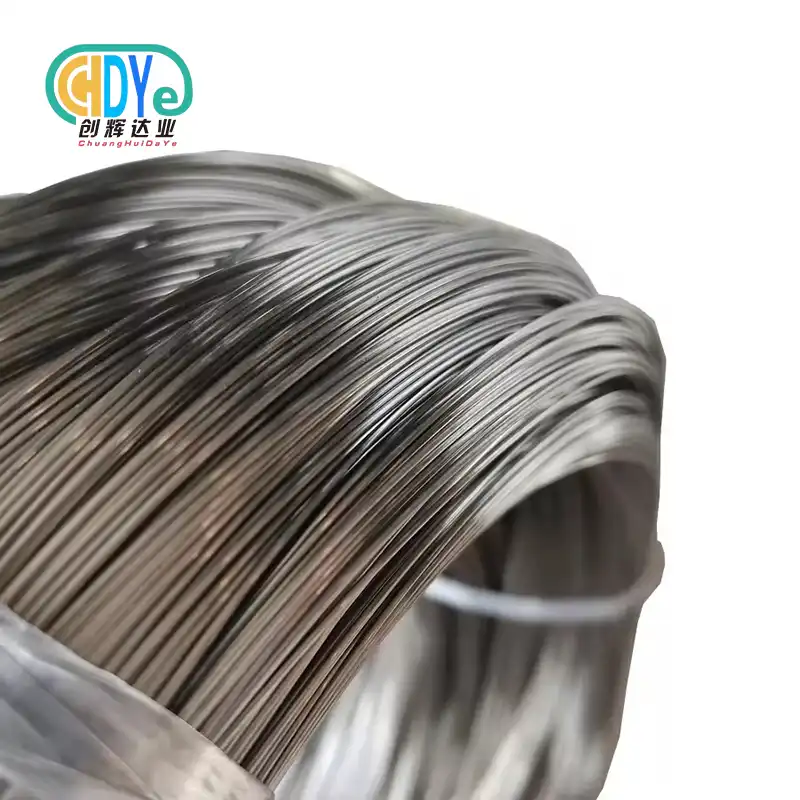
Understanding GR5 Titanium Wire: Properties and Composition
Metallurgical Composition and Structure
Gr5 titanium wire is mostly titanium, with 6% aluminum and 4% vanadium mixed in. This makes a two-phase lattice that blends the best features of alpha and beta titanium phases. Aluminum acts as an alpha stabilizer, making the metal stronger and better at handling high temperatures. Vanadium, on the other hand, acts as a beta stabilizer, making the metal more flexible and easier to shape. With this exact mechanical balance, a material is made that has a tensile strength of more than 925 MPa and a yield strength of more than 870 MPa. The controlled makeup makes sure that the mechanical qualities are the same from batch to batch. Impurities that could hurt the performance of a material are removed during manufacturing processes like vacuum freezing and controlled atmosphere processing. The wire that is made has the same chemical makeup and grain structure all the way through its cross-section, so it can be predicted how it will behave under different pressure situations.
Mechanical and Physical Properties
Ti-6Al-4V wire has a great strength-to-weight ratio because it has a density of 4.43 g/cm³, which makes it about 45% lighter than similar steel types while still having the same or better strength properties. For aircraft uses, this weight advantage directly means less fuel use, and for architectural projects, it means less structural load. Another important benefit of this titanium metal is that it doesn't rust. There is great performance from the material in saltwater, acidic situations, and alkaline solutions. Ti-6Al-4V wire doesn't break down in different chemical conditions as stainless steel does, which can be damaged by pitting rust or stress corrosion cracking.
Temperature stability makes it possible for the material to be used in high-temperature environments. The alloy keeps its structural features even at temperatures as high as 400°C, which means it can be used in situations where temperatures change or where working temperatures are high. This thermal stability means that materials don't have to be changed as often as they would have to be because of changes in temperature.
Comparison with Alternative Materials
Even though stainless steel wire is cheaper at first, it often needs to be replaced because it breaks down due to rust in harsh settings. The lifecycle cost study always recommends Ti-6Al-4V wire when repair needs and replacement times are taken into account. Also, titanium alloy wire is more reliable under cyclic loading situations that are typical in long-term use because it is better at resisting fatigue.
Applications of GR5 Titanium Wire in Long-Term Projects
Aerospace and Defense Manufacturing
For important uses such as aircraft fasteners, engine parts, and structural elements, aerospace makers depend heavily on gr5 titanium wire. Because the material can handle large changes in temperature, corrosive air conditions, and mechanical stresses, it is essential for airplanes that fly in a wide range of world settings. The material has been used in commercial aviation projects for decades because it has been shown to last and work consistently. The material's nonmagnetic qualities and radar transparency make it very useful for defense uses. These traits are very important for military ships that work in areas full of mines and for electronic warfare systems that need to have little electromagnetic interference. The longer service life makes it easier to transport and maintain military equipment that is being used in combat zones.
Medical Device and Biomedical Applications
Biocompatibility is a very important quality for medical devices that are meant to be implanted in people and stay in place for a long time. Ti-6Al-4V wire is very compatible with human flesh and doesn't cause any problems or raise any safety concerns even when it's in touch with it for long periods of time. The material is strong and doesn't harm living things, which makes it useful for orthopedic implants, dental fixtures, and surgery tools. It's especially useful in physiological settings where body fluids create difficult chemical conditions that make rusting difficult. Unlike some materials that may break down over time, titanium alloy wire stays structurally sound for as long as medical gadgets are supposed to work.
Chemical Processing and Marine Environments
Chemical processing plants that run on nonstop production plans need materials that can stand up to harsh chemical conditions and still keep their shape. Most industrial chemicals can't damage Ti-6Al-4V wire, which cuts down on unexpected repair shutdowns and makes operations more reliable. Materials used in marine settings are subject to corrosion from saltwater, biofouling, and mechanical forces from waves. The exceptional corrosion resistance of titanium alloy wire eliminates concerns about galvanic corrosion and extends service intervals for marine equipment and offshore structures.
How to Choose the Right GR5 Titanium Wire for Your Project
Dimensional Specifications and Tolerances
Specific size standards for titanium alloy wire choices are set by the project. Diameters range from 0.5mm to 6.0mm, so they can be used for a wide range of tasks, from making small electrical parts to putting together large structural systems. There are different ways to configure wires, such as straight lengths for precise tasks and coil shapes for automatic production processes. Different uses have very different tolerance needs. For example, very tight tolerances may be needed for precision medical devices, while wider tolerances may be okay for structural uses. By knowing these standards, you can choose the right specifications that balance cost with efficiency needs.
Strength and Flexibility Requirements
Gr5 titanium wire has great spring qualities, which means it can be used in situations where it needs to stretch when it's loaded. The material's ability to bend over and over again without breaking down is useful for parts that are subject to vibrational loads or heat growth cycles. For uses that need specific bending qualities, spring temper conditions make the elastic properties better. Annealed conditions make it easier to shape things for uses that need to be cold worked or that require complex shaping operations. Which of these conditions to use depends on the needs of the program and the processes that will follow.
Quality Certifications and Traceability
With ISO 9001:2015 approval, quality control is maintained throughout the whole production process. This certification lets you know that the things you're buying meet certain standards and go through the right testing and paperwork processes. Traceability paperwork lets you keep track of the qualities of materials from the sources of the raw materials to the delivery of the finished product. Mill test papers prove that each production lot has the right chemical makeup and mechanical qualities. This paperwork is very important for applications that need to confirm certain properties or make sure they follow the rules. Full tracking lets you look into any problems with performance and gives you trust in the quality of the materials.
Procurement Guide: Buying Cost-Effective GR5 Titanium Wire
Supplier Selection Criteria
Finding providers who can consistently provide high-quality goods and on-time delivery is the first step to successful buying. Suppliers that have been around for a while usually have thorough quality control systems and a lot of experience making titanium alloys. When evaluating a company's manufacturing skills, it should look at its melting tools, processing facilities, and testing abilities. Both shipping prices and arrival times are affected by where something is located. Suppliers in areas where titanium is already produced can often offer lower prices because they are closer to sources of raw materials and infrastructure that support them. China's titanium industry, especially in the Baoji area, which is known as the "Titanium Capital," has a lot of industrial power and lower costs.
Cost Optimization Strategies
Through economies of scale in production and handling, buying in bulk can save you a lot of money. Suppliers can offer better prices and make the best use of their production plans when they have annual contracts or blanket orders. Inventory management tools can sort out the costs of keeping things in stock and the money saved by buying in bulk. The improvement of specifications is another way to cut costs. Avoiding too-tight standards or unusual conditions lowers the complexity and cost of manufacturing. When you work with suppliers to make specifications, you can often find cheaper choices that still meet the functional requirements and lower the cost of buying.
Quality Verification and Testing
Incoming checking methods make sure that the materials that are received meet the standards that were set. Basic dimensional checking checks that the width limits and surface condition standards are met. Chemical analysis proof makes sure that the alloy's makeup meets the standards that were set. Testing for mechanical properties confirms the power and flexibility of a material. Tensile testing confirms the final strength and yield strength numbers, and elongation testing confirms the ductility standards. With these tests, you can be sure that the materials will work as planned when they are put to use.
Optimizing Use and Performance of GR5 Titanium Wire
Welding and Joining Techniques
Gr5 titanium wire works great as a filler when welding titanium parts together. Inert gas protection is needed for proper welding methods to keep the air from contaminating the weld and weakening the joint. Atmospheres of argon or helium keep oxygen and nitrogen from picking up on the melting metal and weakening it. The width of the piece and the shape of the joint determine how much preheating is needed. Some thin pieces might not need to be heated up first, but controlled preheating is better for thicker parts because it lowers temperature gradients and stops leftover stress from building up. When needed, a post-weld heat treatment can improve the microstructure and ease any remaining stresses.
Finding the best welding parameters combines the need for entry with the need for as little heat input as possible. Too much heat can make grains grow faster and weaken the material's mechanical qualities in the area that is affected by the heat. By choosing the right parameters, you can keep the microstructure at its best while still getting the strength qualities you need for the joint.
Heat Treatment and Processing
Heat treatment methods change the mechanical qualities of materials to fit the needs of a given application. Annealing processes make metals less strong while making them more flexible and easier to shape. When a lot of cold working is needed or when the material needs to be as flexible as possible for service uses, these processes are helpful. Solution treatment and age can make something stronger than it is when it is just hardened. To get the right mix of properties, these treatments need to be timed and heated just right. Because of this, the microstructures are stronger while still being flexible enough for most uses.
Maintenance and Longevity Considerations
Using the right methods for keeping and handling keeps the quality of materials during inventory times. Keeps the surface clean and stops problems that could happen with rust by keeping oils, fingerprints, and other unwanted materials from getting on it. Moisture-related problems can't happen in storage areas that are clean and dry for long periods of time. Schedules for regular inspections find possible problems before they hurt the system's performance. Visual checks can find harm to the surface or corrosion that could be a sign of problems in the surroundings. Measurements of dimensions make sure that parts stay within acceptable tolerances for the whole time they are in use.
Surface cleaning choices can make settings more resistant to corrosion that are very tough. Anodizing processes add extra protection and make color coding possible for easy recognition. These treatments are especially helpful for parts that are exposed to harsh chemicals or marine settings.
Conclusion
When gr5 titanium wire is chosen strategically for long-term industrial projects, it is an investment in business quality and cost efficiency. This high-quality titanium metal has unmatched levels of strength, resistance to rust, and biocompatibility, so it will work reliably for long periods of time. The material has a history of success in several different industries, which shows how flexible and reliable it is for high-stakes situations where failure is not a choice. For implementation to go smoothly, specific needs must be carefully considered, along with the choice of provider and the right way to handle the material so that its natural benefits are fully utilized.
FAQ
Q: What makes GR5 titanium wire cost-effective for long-term projects?
A: While the initial purchase price may exceed alternative materials, Ti-6Al-4V wire delivers superior lifecycle value through extended service life, minimal maintenance requirements, and exceptional resistance to environmental degradation. The material's longevity eliminates frequent replacement cycles that drive up total project costs over time.
Q: How does GR5 titanium wire compare to stainless steel for corrosion resistance?
A: Ti-6Al-4V wire is better at resisting corrosion than stainless steel types, especially in chloride conditions where stainless steel gets pitting and crevice corrosion. The titanium metal stays strong in salty, acidic environments and alkaline solutions that would damage stainless steel.
Q: What quality certifications should I look for when purchasing GR5 titanium wire?
A: Having ISO 9001:2015 certification makes sure that quality control is uniform throughout the whole production process. Compliance with ASTM B863 also makes sure that the qualities of the material meet industry standards. The quality paperwork package is finished off with mill test papers that show chemical analysis and mechanical property verification.
Q: Can GR5 titanium wire be used in medical device applications?
A: The Ti-6Al-4V wire is very biocompatible and has been used a lot in medical devices and implants, like prosthetic ones and surgical tools. The material doesn't react badly with flesh and keeps its shape for long amounts of time after implantation.
Q: What diameter ranges are available for GR5 titanium wire?
A: Standard diameters run from 0.5 mm to 6 mm, which meet the needs of most industry applications. If you need it for a certain purpose or process, you can get it in both straight lengths and coil shapes.
Contact Chuanghui Daye for Premium GR5 Titanium Wire Solutions
Shaanxi Chuanghui Daye Metal Material Co., Ltd. stands ready to support your long-term project requirements with premium Grade 5 titanium wire manufactured under strict ISO 9001:2015 quality standards. Our facility in Baoji, China's renowned "Titanium Capital," combines over 30 years of rare metal expertise with advanced production capabilities, including electron beam furnaces and precise machining equipment. As a trusted Gr5 titanium wire supplier, we provide complete material traceability, custom processing services, and competitive factory-direct pricing for global clients. Contact our technical team at info@chdymetal.com to discuss your specific requirements and request sample materials for evaluation.
References
1. Boyer, R.R. Part A of Materials Science and Engineering: A is called "An Overview on the Use of Titanium in the Aerospace Industry." 213, 1996.
2. Donachie, Matthew J. 2000. ASM International, Materials Park, Ohio. "Titanium: A Technical Guide, 2nd Edition."
3. Peters, M., Kumpfert, J., Ward, C.H., und Leyens, C. Advanced Engineering Materials, Vol. 5: "Titanium Alloys for Aerospace Applications." 5, No. 6, 2003.
4. Rack, H.J. and Qazi, J.I. Materials Science and Engineering: C, Vol. 9, "Titanium Alloys for Biomedical Applications." 2006.06.26.
5. Gaard, Gerd, and Williams, James C. 7 Springer-Verlag Berlin Heidelberg, 2007: "Titanium: Engineering Materials and Processes."
6. There is an American Society for Testing and Materials. "ASTM B863-14 Standard Specification for Titanium and Titanium Alloy Wire." 2014. ASTM International. West Conshohocken, PA.
Learn about our latest products and discounts through SMS or email