- English
- French
- German
- Portuguese
- Spanish
- Russian
- Japanese
- Korean
- Arabic
- Greek
- German
- Turkish
- Italian
- Danish
- Romanian
- Indonesian
- Czech
- Afrikaans
- Swedish
- Polish
- Basque
- Catalan
- Esperanto
- Hindi
- Lao
- Albanian
- Amharic
- Armenian
- Azerbaijani
- Belarusian
- Bengali
- Bosnian
- Bulgarian
- Cebuano
- Chichewa
- Corsican
- Croatian
- Dutch
- Estonian
- Filipino
- Finnish
- Frisian
- Galician
- Georgian
- Gujarati
- Haitian
- Hausa
- Hawaiian
- Hebrew
- Hmong
- Hungarian
- Icelandic
- Igbo
- Javanese
- Kannada
- Kazakh
- Khmer
- Kurdish
- Kyrgyz
- Latin
- Latvian
- Lithuanian
- Luxembou..
- Macedonian
- Malagasy
- Malay
- Malayalam
- Maltese
- Maori
- Marathi
- Mongolian
- Burmese
- Nepali
- Norwegian
- Pashto
- Persian
- Punjabi
- Serbian
- Sesotho
- Sinhala
- Slovak
- Slovenian
- Somali
- Samoan
- Scots Gaelic
- Shona
- Sindhi
- Sundanese
- Swahili
- Tajik
- Tamil
- Telugu
- Thai
- Ukrainian
- Urdu
- Uzbek
- Vietnamese
- Welsh
- Xhosa
- Yiddish
- Yoruba
- Zulu
GR4 Titanium Bar Price Factors: What Affects Cost Most?
When buying gr4 titanium bar materials for important industrial uses, it's important to know how prices work so you can plan your budget and choose a seller. A 4 titanium bar's price changes depending on many factors that are linked to each other, such as where the raw materials come from, how hard the manufacturing process is, and how the global market is doing. Grade 4 titanium is the strongest purest titanium that can be bought. It has a tensile strength of over 550 MPa and is very resistant to corrosion. We at Shaanxi Chuanghui Daye Metal Material Co., Ltd. know that procurement managers can make better choices when pricing factors are clear. The end price is based on the quality of the raw materials, the production methods used, the certification requirements, the size requirements, and the conditions in the supply chain. When buyers work with experienced makers, knowing about these factors helps them plan for changes in costs and find ways to get the most for their money.
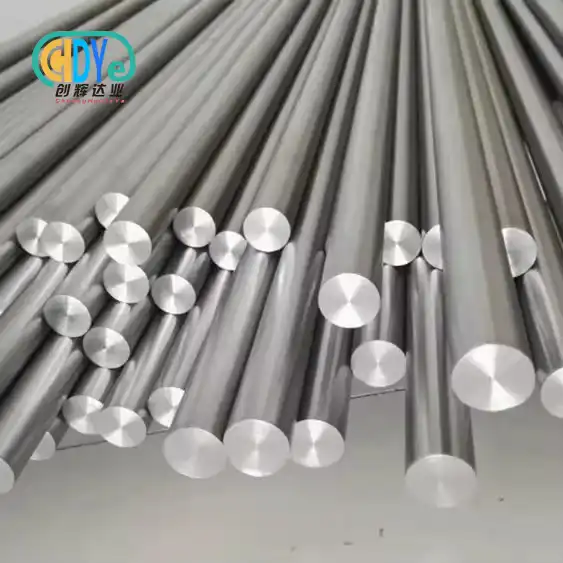
Understanding GR4 Titanium Bar: Composition and Properties
What Makes Grade 4 Titanium Unique
Grade 4 titanium is different because it has controlled interstitial strengthening instead of alloying additions. The high oxygen content (up to 0.40%), along with the higher iron levels, gives the material mechanical qualities similar to mild steel while keeping the chemical stability of pure titanium. Our production process in Baoji, which is known as China's Titanium Capital, makes sure that the makeup is always controlled to meet ASTM B348 and ASME SB348 standards. This economically pure material keeps its alpha-phase microstructure, which makes it very easy to weld and shape in ways that alloy grades can't. Because it is biocompatible, it can be used in medical devices where alloys with vanadium are limited by rules.
Mechanical Performance Characteristics
Because of how strong they are, Grade 4 titanium bars are in a good spot between less pure grades and complex metals. These bars can handle heavy loads in structures while still being flexible enough for production processes. They have a minimum yield strength of 480 MPa and an elongation retention of 15%. Our quality control system, which is certified to ISO 9001:2015 standards, makes sure that the mechanical properties are always the same by using strict testing methods. Temperature resistance means that the product can be used continuously in environments that reach high operational temperatures without losing any of its properties. Because it is denser than alternatives made of stainless steel, it saves 45% of its weight, which is very important in aerospace and transportation uses where weight reduction affects fuel efficiency and performance.
Core Factors Affecting the Price of GR4 Titanium Bars
Raw Material Sourcing and Refining Costs
The separation of titanium ore and the Kroll reduction process add a lot to the cost of making Grade 4 bars. The price of titanium sponge is directly affected by its availability around the world. The supply is concentrated in certain areas,gr4 titanium bar which are governed by trade and mining laws. To meet the requirements for Grade 4, the steps needed for purification require exact control of interstitial elements. This makes the processing more expensive than for lower purity grades. Our strategic position in Baoji puts us close to well-known companies that make titanium sponge. This cuts down on transportation costs and makes sure that we can track materials from their source to the finished product. Vacuum melting processes that use a lot of energy use up a lot of resources, especially when making bigger bars that need to be remelted several times to get rid of segregation and make the makeup the same across the cross-section.
Manufacturing Process Complexity
The way titanium bars are made has a huge effect on how much they cost in the end. Our plant uses electron beam melting to make the first ingots. These are then put through controlled hot forging processes that smooth out the grain structure and get rid of any holes. Because Grade 4 titanium tends to work-harden, it needs to go through intermediate annealing processes during multi-pass rolling sequences. This makes production take longer and uses more equipment. The costs of machining go up depending on the limits for dimensions because of the need to condition the surface and remove the alpha case layer that forms during high-temperature processing. We bought high-tech CNC turning equipment so that we can finish things precisely to the customer's requirements while keeping our wait times low. Because of economies of scale, processing small-diameter bars differently from large cross-section bars. This means that big orders are more cost-effective than small purchases.
Comparing GR4 Titanium Bars with Alternative Materials: Price and Performance Insights
Grade 4 Versus Grade 2 Titanium
Grade 2 titanium is less expensive at first and has better resistance to rust, which makes it a good choice for less demanding structural uses. When building pressure vessels or using high-stress fasteners, where Grade 2 distortion could cause the system to fail, the difference in strength becomes very important. From our experience, redesigning a part to fit Grade 2's lower strength often wastes the money saved at first because it needs more material. Because Grade 4 has better mechanical properties than Grade 3, it can be used to reduce weight in aerospace uses, where every kilogram saved means more money saved over the life of the product. The welding methods are pretty much the same for all grades, which makes qualifying the fabrication process easier. When customers move from Grade 2 to Grade 4, they usually report longer service intervals and lower upkeep costs, which make up for the small price increase over the lifecycle of the product.
Grade 4 Versus Ti-6Al-4V Alloy
Ti-6Al-4V is the most common titanium metal. It is almost twice as strong as Grade 4 because it has extra aluminium and vanadium added to it. The difference in price is due to the complicated alloying and heat treatment processes that are needed. Grade 5 usually costs 30 to 50 percent more than widely pure grades. Because alloying elements can weaken corrosion protection in some environments, Grade 4 is often preferred for uses that will be exposed to a lot of chemicals. When it comes to medical uses, there are clear differences. Grade 4 is better for implants because it has a history of biocompatibility, while Ti-6Al-4V raises worries about the release of vanadium ions. Our chemical processing customers always choose Grade 4 because it is better at resisting oxidising acids and halogen compounds than other alloy grades, which are more easily damaged. Because Grade 4 is easier to machine, it lowers the cost of labour used in production, which helps balance out differences in material prices for complicated parts that need a lot of work.
Procurement Considerations: How to Get the Best Value When Buying GR4 Titanium Bars
Selecting Qualified Suppliers
Manufacturer selection represents the most critical procurement decision affecting long-term material performance and supply reliability. Our three-decade history in rare metal production demonstrates the expertise essential for consistent quality delivery. Certification verification, including ISO 9001:2015 documentation and industry-specific qualifications, provides baseline assurance of process control capabilities. Manufacturing facility location influences both pricing and lead times, with our Baoji operations offering proximity to raw material sources and established titanium processing infrastructure. Technical support capabilities distinguish suppliers capable of collaborative problem-solving from simple material gr4 titanium bar vendors. We provide application engineering assistance that helps customers optimize material selection and processing parameters for specific service conditions. References from existing customers in similar industries offer valuable insights into supplier performance under actual operating conditions.
Understanding Pricing Structures
Minimum order quantities significantly impact unit pricing through production setup cost amortization across order volume. Our flexible manufacturing approach accommodates both small research quantities and large production runs, with transparent pricing that reflects actual cost structures. Payment terms and currency selection introduce financial considerations beyond base material costs, particularly for international transactions. Volume commitments enabling annual supply agreements provide pricing stability that facilitates budget planning while securing production capacity during peak demand periods. Spot purchase pricing reflects current market conditions, offering advantages during soft markets but exposing buyers to volatility during supply constraints. Our factory-direct model eliminates intermediary margins, delivering cost savings directly to end users while gr4 titanium bar maintaining manufacturer accountability for quality and delivery performance.
Future Trends and Price Outlook for GR4 Titanium Bars
Growing Industrial Demand Drivers
Aerospace sector expansion, driven by increasing global air travel and military modernization programs, continues to support strong titanium demand growth projections. Chemical processing facility construction in developing economies requires corrosion-resistant materials, expanding market opportunities beyond traditional geographic concentrations. Medical device innovation, particularly in orthopedic and dental implant technologies, drives specialized titanium requirements emphasizing biocompatibility and mechanical performance. Our customer base reflects this diversification, with emerging applications in renewable energy systems and advanced manufacturing technologies. Environmental regulations mandating reduced emissions favor lightweight materials that improve transportation efficiency, positioning titanium advantageously against heavier alternatives. The transition toward sustainable industrial practices increases focus on material longevity and lifecycle performance, attributes where Grade 4 titanium demonstrates clear advantages despite higher initial investment.
Processing Technology Advancements
Additive manufacturing techniques are beginning to complement traditional wrought titanium production, though bar stock remains essential for most structural applications. Advances in melting technology, including plasma arc and cold hearth processes, improve material cleanliness while reducing production costs through enhanced energy efficiency. Our ongoing investment in manufacturing capability ensures we remain at the forefront of processing technology adoption, delivering quality improvements and cost optimization to customers. Automation integration in finishing operations reduces labor content while improving dimensional consistency and surface quality. These technological improvements gradually moderate pricing pressures by offsetting raw material cost increases through enhanced productivity. The industry trend toward larger ingot sizes enables production of oversized bar diameters previously requiring special processing, expanding application possibilities while improving manufacturing economics.
Sustainability and Regulatory Influences
Environmental compliance requirements increasingly shape material sourcing decisions and supplier selection criteria. Our commitment to responsible manufacturing includes energy efficiency optimization and waste stream minimization throughout production operations. Conflict mineral regulations and ethical sourcing expectations require transparent supply chain documentation that we maintain through rigorous vendor qualification procedures. Recycling initiatives within the titanium industry help moderate raw material costs through increased scrap utilization, though commercially pure grades present challenges due to contamination sensitivity. Carbon footprint considerations favor materials like titanium that deliver extended service life, reducing replacement frequency and associated environmental impacts. Future pricing structures will likely incorporate sustainability metrics as customers integrate environmental performance into procurement evaluation frameworks alongside traditional cost and quality parameters.
Conclusion
Navigating gr4 titanium bar pricing requires understanding the complex interplay between raw material costs, manufacturing processes, quality requirements, and market dynamics. Our position as an experienced manufacturer in Baoji enables us to deliver competitive pricing while maintaining the stringent quality standards demanded by aerospace, chemical, medical, and research customers worldwide. The value proposition extends beyond unit price to encompass technical support, delivery reliability, and long-term partnership commitment. Successful procurement strategies balance immediate cost considerations against lifecycle performance, leveraging supplier expertise to optimize material selection and specification. As industrial applications continue evolving and sustainability gains prominence, Grade 4 titanium's exceptional properties position it favorably despite premium pricing relative to conventional materials.
FAQ
1. What typical price range should I expect for Grade 4 titanium bars?
Pricing varies significantly based on diameter, quantity, and market conditions, typically ranging from competitive factory-direct rates to premium levels for specialized configurations. Standard diameter bars in production quantities generally cost less per kilogram than custom sizes or small-batch orders. Our transparent quoting process provides detailed breakdowns reflecting actual cost components rather than arbitrary markups.
2. How do minimum order quantities affect pricing?
Production setup costs are distributed across order volume, creating per-unit savings as quantities increase. We accommodate research quantities for prototyping while offering volume discounts for production orders. Long-term supply agreements provide additional pricing advantages through production planning optimization.
3. Can pricing be locked for long-term contracts?
Annual supply agreements with volume commitments enable pricing stability that protects both parties from market volatility. We work collaboratively with customers to structure contracts, balancing price predictability with flexibility for reasonable specification adjustments as applications evolve.
Partner with Chuanghui Daye for Your Grade 4 Titanium Bar Requirements
Shaanxi Chuanghui Daye Metal Material Co., Ltd. combines three decades of rare metal gr4 titanium bar expertise with ISO 9001:2015 certified manufacturing capabilities to serve as your trusted gr4 titanium bar supplier. Our Baoji facility delivers consistent quality through advanced electron beam melting, precision forging, and comprehensive testing that meets international standards, including ASTM B348 and ASME SB348. We understand that successful procurement extends beyond competitive pricing to encompass technical consultation, documentation transparency, and delivery reliability. Whether you require standard configurations with rapid turnaround or custom specifications with value-added processing, our team provides solutions tailored to your application requirements. Reach out to info@chdymetal.com to discuss your specific needs and discover how our factory-direct pricing, flexible production capabilities, and technical expertise create value for your organization. We welcome the opportunity to demonstrate why leading companies across aerospace, chemical processing, medical device, and research sectors rely on our materials for their most demanding applications.
References
1. American Society for Testing and Materials. "Standard Specification for Titanium and Titanium Alloy Bars and Billets." ASTM International, West Conshohocken, Pennsylvania, 2021.
2. Boyer, Rodney, Gerhard Welsch, and E.W. Collings. "Materials Properties Handbook: Titanium Alloys." ASM International, Materials Park, Ohio, 1994.
3. Donachie, Matthew J. "Titanium: A Technical Guide, 2nd Edition." ASM International, Materials Park, Ohio, 2000.
4. Lutjering, Gerd and James C. Williams. "Titanium: Engineering Materials and Processes, 2nd Edition." Springer-Verlag, Berlin, Germany, 2007.
5. Schutz, R.W. and Watkins, H.B. "Recent Developments in Titanium Alloy Application in the Energy Industry." Materials Science and Engineering Journal, Volume 243, 1998.
6. Veiga, C., Davim, J.P., and Loureiro, A.J.R. "Properties and Applications of Titanium Alloys: A Brief Review." Reviews on Advanced Materials Science, Volume 32, 2012.
Learn about our latest products and discounts through SMS or email