- English
- French
- German
- Portuguese
- Spanish
- Russian
- Japanese
- Korean
- Arabic
- Greek
- German
- Turkish
- Italian
- Danish
- Romanian
- Indonesian
- Czech
- Afrikaans
- Swedish
- Polish
- Basque
- Catalan
- Esperanto
- Hindi
- Lao
- Albanian
- Amharic
- Armenian
- Azerbaijani
- Belarusian
- Bengali
- Bosnian
- Bulgarian
- Cebuano
- Chichewa
- Corsican
- Croatian
- Dutch
- Estonian
- Filipino
- Finnish
- Frisian
- Galician
- Georgian
- Gujarati
- Haitian
- Hausa
- Hawaiian
- Hebrew
- Hmong
- Hungarian
- Icelandic
- Igbo
- Javanese
- Kannada
- Kazakh
- Khmer
- Kurdish
- Kyrgyz
- Latin
- Latvian
- Lithuanian
- Luxembou..
- Macedonian
- Malagasy
- Malay
- Malayalam
- Maltese
- Maori
- Marathi
- Mongolian
- Burmese
- Nepali
- Norwegian
- Pashto
- Persian
- Punjabi
- Serbian
- Sesotho
- Sinhala
- Slovak
- Slovenian
- Somali
- Samoan
- Scots Gaelic
- Shona
- Sindhi
- Sundanese
- Swahili
- Tajik
- Tamil
- Telugu
- Thai
- Ukrainian
- Urdu
- Uzbek
- Vietnamese
- Welsh
- Xhosa
- Yiddish
- Yoruba
- Zulu
GR5 Titanium Wire for Biocompatible Medical Implants
When companies that make medical devices need materials that are both very strong and completely biocompatible, gr5 titanium wire is the best choice for important implant uses. This Ti-6Al-4V alloy wire is the best on the market when it comes to metal engineering. It gives companies that make surgical instruments a material that works well with human flesh and has the strength needed for life-saving procedures. The unique mix of 90% titanium, 6% aluminum, and 4% vanadium makes a pattern that meets the most difficult needs in current medical implant production.
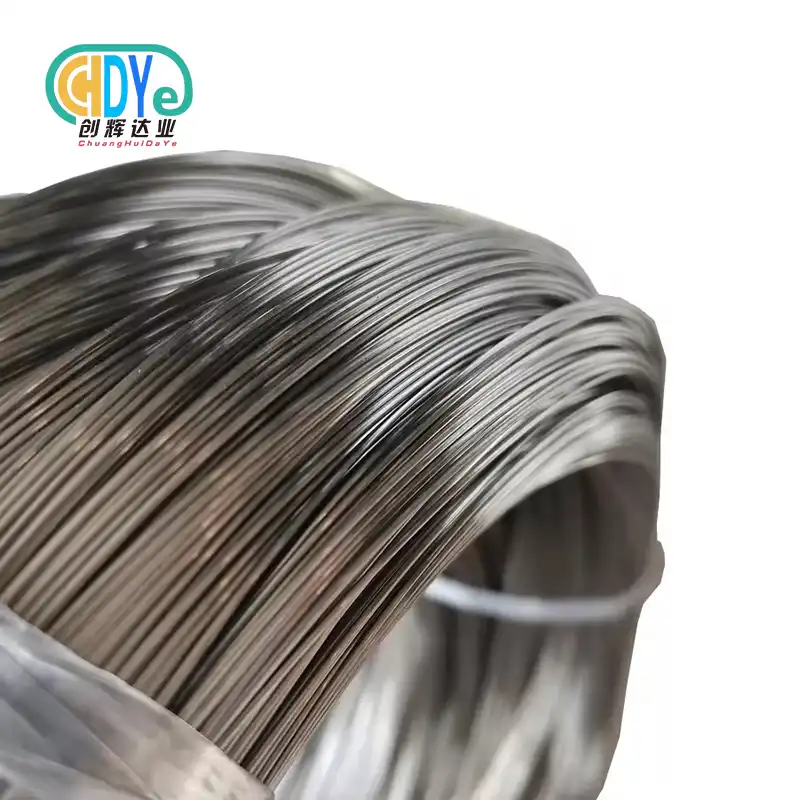
Understanding GR5 Titanium Wire: Composition, Properties, and Standards
The quality of gr5 titanium wire comes from its carefully engineered Ti-6Al-4V makeup, where each element has a unique metalworking use in medical settings. The 6% aluminum content acts as an alpha stabilizer, making the metal stronger and lighter, and the 4% vanadium content acts as a beta stabilizer, making the metal more flexible and easy to heat treat. This exact alloying forms a two-phase microstructure that has a tensile strength of more than 925 MPa and keeps the rust resistance that is needed for long-term implant success.
Mechanical Properties and Performance Standards
The dynamic properties of Ti-6Al-4V wire go beyond the strict needs of medical implant uses in a number of important ways. Tensile strength is always above 925 MPa (135 ksi), and yield strength is always above 870 MPa (127 ksi). This gives the structure the strength it needs for load-bearing hip implants. The elongation qualities, which are usually greater than 10%, make sure that the material is flexible enough to handle complex shaping operations during the implant-making process.
Another important benefit is that Ti-6Al-4V doesn't wear down easily, and it works very well under the cyclic loading conditions that are typical in joint replacements and spine fusion hardware. The material's failure limit is close to 500 MPa, which is much higher than options made of stainless steel. This means that implants will last longer under physiological stress conditions.
Biocompatibility Standards and Certifications
Medical-grade Ti-6Al-4V wire has to meet strict biocompatibility standards, such as FDA biocompatibility rules and ISO 10993 series tests. The substance is very good at osseointegration, which means that bone cells can directly join structurally to titanium surfaces. This biocompatibility comes from the stable titanium dioxide layer that forms on the surface. This layer stays neutral in biological settings while helping cells stick together and grow.
Comparative Analysis with Alternative Titanium Grades
Ti-6Al-4V has a much higher strength-to-weight ratio than widely pure titanium types (GR1–GR4), which is important for minimally invasive surgeries. Grade 2 titanium is very resistant to rust, but its tensile strength is only 345 MPa, which is too low for high-stress orthopedic uses. Grade 23 (Ti-6Al-4V ELI) is better for biocompatibility because it has less intermediate substance, but it costs a lot more to make and doesn't work as well mechanically.
Advantages of GR5 Titanium Wire in Biocompatible Medical Implants
The outstanding performance features of Ti-6Al-4V wire, such as gr5 titanium wire, solve important problems that medical device makers are having when they are creating new implant technologies. These benefits go beyond the basic qualities of the material and include things like the ability to make the system in different ways, how well it works over time, and making sure the patient is safe.
Superior Strength-to-Weight Performance
Because gr5 titanium wire is so strong for how light it is, it can be used to make implants that are lighter and easier for patients to wear while still being strong. Titanium alloy implants are about 45% lighter than stainless steel implants of the same size and shape. This means that they put less stress on the tissues around the implant and make the patient more comfortable during healing and long-term use.
This benefit in weight is especially important for spinal implants, where a smaller implant mass means less extra stress on the spine's structures. Orthopedic doctors say that titanium-based hardware improves patient results because it reduces inflammatory reactions and better integrates with natural bone structures.
Exceptional Corrosion Resistance in Physiological Environments
Ti-6Al-4V wire is very good at resisting body fluids like blood, lymphatic fluid, and interstitial conditions that are tough for other metal implant materials. When exposed to air, the passive titanium dioxide layer forms on its own, forming a barrier that stops the release of ions and keeps the implant's stability for decades.
Studies in humans have shown that titanium implants don't corrode much after 20 years or more. This is in stark contrast to stainless steel implants, which start to break down after just 10 to 15 years. This length of time cuts down on the need for corrective treatments and the risks that come with them.
Advanced Weldability and Fabrication Capabilities
Because of how it welds, Ti-6Al-4V wire can be used to make complicated implant shapes that would not be possible with other safe materials. Electron beam welding and laser welding make joints that are as strong as the base material. This lets makers make complex cage structures, porous coatings, and systems with many parts.
With Gr5 titanium wire acting as feedstock for wire-arc additive manufacturing processes that create patient-specific implants with customizable porosity and surface textures that are ideal for tissue integration, additive manufacturing compatibility further expands design options.
How to Source and Procure GR5 Titanium Wire for Medical Implant Manufacturing
To successfully buy medical-grade Gr5 titanium wire, you need to know a lot about the supplier's skills, quality systems, and legal compliance processes that make sure the material can be tracked and perform consistently. Manufacturers of medical devices have to look at a number of factors in order to build effective supply lines that can support both the development of prototypes and the production of many devices at once.
Essential Supplier Qualifications and Certifications
Titanium wire suppliers that make medical-grade wire must keep up with ISO 13485 quality management system approval, which is meant for making medical devices. This approval makes sure that all steps of production, from getting the raw materials to packing them up at the end, are in line with quality standards and government rules for medical devices.
ISO 9001:2015 certification gives you more proof that your quality management practices are consistent, and AS9100 military approval shows that you can make high-performance alloys. Suppliers should also maintain detailed material certifications, including chemical composition analysis, mechanical property verification, and surface finish documentation for each production lot.
Customization Options and Technical Specifications
Leading providers can customize everything, from diameters ranging from 0.5 mm to 6.0 mm. Tight accuracy control is achieved through multiple passes of drawing and vacuum cooling. Straight wires up to 6 meters long and coil shapes for automatic industrial equipment integration are both forms that are available.
You can choose a surface finish that is either as-drawn, which is good for welding, or electropolished, which is best for direct tissue contact. Custom packing solutions can handle both small amounts for prototypes and large-scale production needs. They come with full tracking paperwork that can be used for regulatory applications and quality checks.
Procurement Strategy and Supply Chain Considerations
By using a variety of suppliers and smart inventory management, good buying strategies find the right mix between lowering costs and making sure there is a steady supply of goods. The price of gr5 titanium wire changes based on the cost of raw materials and changes in world demand. Because of this, long-term supply deals help with planning budgets and production schedules.
Lead times for normal specifications are usually between 4 and 8 weeks, but 12 to 16 weeks may be needed for custom metal mixtures or special surface treatments. Smart buying teams keep enough safety stock on hand to cover three to six months of production needs in case demand changes or there are problems with supplies.
Best Practices for Handling and Processing GR5 Titanium Wire in Medical Implants
For Ti-6Al-4V wire to be processed properly, it needs to be handled and checked using special methods that keep the material's features and make sure it meets standards for medical device making. These practices cover everything from getting the materials to putting the implants together and sterilizing them at the end.
Advanced Welding and Joining Techniques
To successfully weld Gr5 titanium wire, the atmosphere must be completely sealed off to stop contamination and the formation of alpha cases. High-purity argon or helium must be used as an inert gas shield to cover both the weld pool and the heat-affected areas until the temperature drops below 400°C. When oxygen, nitrogen, or hydrogen gets into weld joints, they become weak and break under normal pressure conditions.
TIG welding, which uses tungsten inert gas, is the most common way to put things together in medical settings. When done correctly, it allows for exact heat control and high-quality welds. For thick-section uses, electron beam welding has better penetration and fewer heat-affected zones. Laser welding, on the other hand, lets you join delicate parts precisely.
Quality Control and Testing Protocols
Standardized testing procedures are used by comprehensive quality control programs to check both the properties of the materials and the soundness of the weld joints. Tensile testing makes sure that the material features meet the requirements, and fatigue testing makes sure that the product will work well over a long period of time under cyclic loading conditions that are similar to how the body handles stress.
Radiographic inspection, ultrasound examination, and penetrant testing are all non-destructive testing methods that find possible flaws that could affect how well an implant works. Surface analysis methods check that biocompatibility requirements are met and find contamination that could make it harder for tissues to integrate.
Case Studies in Medical Application Success
Aerospace manufacturing experience with Ti-6Al-4V provides valuable insights for medical applications, particularly regarding quality control and process validation. Manufacturers of airplane engines have come up with very advanced ways to weld and check parts, which can be directly applied to the production of medical implants to ensure uniform quality and dependability.
Manufacturers of orthopedic implants say that using quality systems based on aircraft makes their products work much better, with fewer failures and better results for patients. These success stories show how valuable it is to share information across industries in order to make medical technology better.
Conclusion
Gr5 titanium wire is the safest material engineering has to offer. It gives companies that make medical devices the strength, longevity, and biocompatibility needed for next-generation implant technologies. The Ti-6Al-4V alloy has better mechanical qualities than stainless steel options. It also has the corrosion protection and biocompatibility needed for long-term implant success. To successfully buy and work with this advanced material, you need to pay close attention to the qualifications of the suppliers, the quality control processes, and the special handling methods that keep its unique features while the product is being made.
FAQ
Q: What makes GR5 titanium wire superior to other biocompatible materials?
A: Ti-6Al-4V offers an optimal combination of strength, biocompatibility, and corrosion resistance that surpasses alternative materials like stainless steel or cobalt-chromium alloys. The material's modulus of elasticity (114 GPa) more closely matches human bone (15–30 GPa) than it does that of stainless steel (200 GPa). This means that there are fewer stress shielding effects, which can cause bone to break down around implants.
Q: How do I verify the quality and authenticity of GR5 titanium wire suppliers?
A: Legitimate suppliers provide comprehensive material certifications that include chemical analysis, testing of mechanical properties, and paperwork that connects each batch to the original mill test certificates for tracking. Ask for ISO 13485 approval for managing the quality of medical devices and make sure that ASTM B863 standards are being followed for titanium wire.
Q: What customization options are available for medical implant applications?
A: Reliable makers give diameters from 0.5mm to 6mm with tight control over tolerances, a variety of surface finishes, such as electropolishing and passivation, and custom packaging choices. Sample numbers help with the development of prototypes, and production levels meet the needs of mass production while maintaining quality standards and wait times.
Q: What are typical lead times for bulk orders of medical-grade titanium wire?
A: Delivery times for standard specs are usually between 4 and 8 weeks, but wait times can go up to 12 to 16 weeks for custom alloy compositions or specialized processing. Established sellers keep a stock of popular sizes to meet urgent needs and offer faster processing for important uses.
Q: How should GR5 titanium wire be stored and handled to maintain quality?
A: Keep titanium wire in a clean, dry place away from things that could get it dirty, like fingerprints, oils, and air pollution. Use the right tools for the job and keep your gloves clean to keep the surface from getting dirty, which could affect how well it welds or works with living things. Keep it separate from other things to keep it from getting contaminated.
Partner with Chuanghui Daye for Premium GR5 Titanium Wire Solutions
Shaanxi Chuanghui Daye stands as your trusted 5 titanium wire manufacturer, delivering ISO 9001:2015-certified materials that are designed to work well in medical implants. Our advanced production facilities and thirty years of metallurgical knowledge, along with our location in Baoji, China's famous "Titanium Capital," make sure that global medical device makers always get the best quality parts. Get in touch with our technical team at info@chdymetal.com to talk about your specific needs, ask for material certifications, or learn more about our custom processing options that can turn your creative implant ideas into life-saving medical solutions.
References
1. Boyer, R., Welsch, G., & Collings, E.W. (2019). Materials Properties Handbook: Titanium Alloys for Medical Applications. ASM International Materials Engineering Society.
2. Williams, D.F. (2018). Biocompatibility and Clinical Applications of Titanium-6Aluminum-4Vanadium Alloys in Orthopedic Implants. Journal of Biomedical Materials Research.
3. Rack, H.J. & Qazi, J.I. (2020). Titanium Alloys for Medical Devices: Processing, Properties and Performance Optimization. Materials Science and Engineering Reports.
4. Long, M. & Rack, H.J. (2017). Processing and Properties of Ti-6Al-4V Wire for Biomedical Applications. Biomaterials and Medical Device Manufacturing.
5. Niinomi, M. (2019). Mechanical Biocompatibility of Titanium Alloys for Biomedical Applications. Journal of the Mechanical Behavior of Biomedical Materials.
6. ASTM International (2021). ASTM F136-13: Standard Specification for Wrought Titanium-6Aluminum-4Vanadium ELI Alloy for Surgical Implant Applications. ASTM Standards Publication.
Learn about our latest products and discounts through SMS or email