- English
- French
- German
- Portuguese
- Spanish
- Russian
- Japanese
- Korean
- Arabic
- Greek
- German
- Turkish
- Italian
- Danish
- Romanian
- Indonesian
- Czech
- Afrikaans
- Swedish
- Polish
- Basque
- Catalan
- Esperanto
- Hindi
- Lao
- Albanian
- Amharic
- Armenian
- Azerbaijani
- Belarusian
- Bengali
- Bosnian
- Bulgarian
- Cebuano
- Chichewa
- Corsican
- Croatian
- Dutch
- Estonian
- Filipino
- Finnish
- Frisian
- Galician
- Georgian
- Gujarati
- Haitian
- Hausa
- Hawaiian
- Hebrew
- Hmong
- Hungarian
- Icelandic
- Igbo
- Javanese
- Kannada
- Kazakh
- Khmer
- Kurdish
- Kyrgyz
- Latin
- Latvian
- Lithuanian
- Luxembou..
- Macedonian
- Malagasy
- Malay
- Malayalam
- Maltese
- Maori
- Marathi
- Mongolian
- Burmese
- Nepali
- Norwegian
- Pashto
- Persian
- Punjabi
- Serbian
- Sesotho
- Sinhala
- Slovak
- Slovenian
- Somali
- Samoan
- Scots Gaelic
- Shona
- Sindhi
- Sundanese
- Swahili
- Tajik
- Tamil
- Telugu
- Thai
- Ukrainian
- Urdu
- Uzbek
- Vietnamese
- Welsh
- Xhosa
- Yiddish
- Yoruba
- Zulu
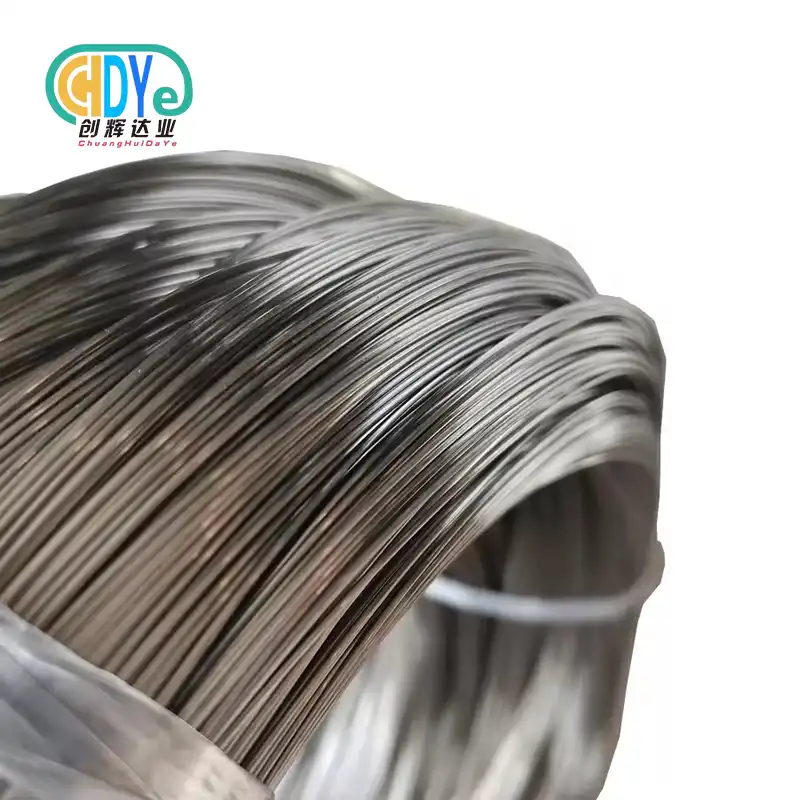
GR5 Titanium Wire for Custom OEM Manufacturing
The success of your project will depend on the materials you choose for custom OEM making. GR5 titanium wire, which is also called Ti-6Al-4V wire, is a high-quality titanium metal product that has changed the way many businesses make things today. This amazing material is the best choice for aircraft fasteners, medical implants, chemical equipment, and naval parts because it has a great strength-to-weight ratio, is resistant to corrosion, and is biocompatible.This titanium alloy wire has become a popular material for global business-to-business purchases, especially in fields that need accuracy and sturdiness. It is known for being reliable and flexible. It's important to know what Ti-6Al-4V wire can and can't do before you buy it, whether you're a buying manager looking at different material choices, an engineer creating important parts, or a wholesaler looking for reliable supply sources. This detailed guide helps professionals find their way through the complicated world of buying titanium, making sure they choose the best material for their specific industrial needs.
Understanding GR5 Titanium Wire: Properties and Composition
Understanding the basic properties of the material is the first step in making a good buying choice. Ti-6Al-4V wire is the workhorse of the titanium business. It is mostly made up of titanium (90%), aluminum (6%), and vanadium (4%). This mix makes an alpha-beta titanium metal that meets strict industry standards like ASTM B863, AWS A5.16, and ISO certifications. This makes sure that quality and dependability are maintained across global supply chains.
Chemical Composition and Microstructure
The exact chemical balance of this titanium material has a direct effect on how well it works. The aluminum presence makes the metal stronger and less dense, and the vanadium stabilizes the beta phase, which makes it easier to work with and heat treat. Strict control of intermediate elements, such as oxygen (maximum 0.20%) and iron (maximum 0.40%), keeps the material's high mechanical qualities and stops it from becoming weak.
Mechanical Properties Excellence
GR5 titanium wire has amazing dynamic properties that make it stand out from other materials. The wire usually has a tensile strength of at least 925 MPa (135 ksi) and a yield strength of at least 870 MPa (127 ksi). It also stretches more than 10%. This mix gives engineers the confidence they need to work on difficult projects where failure is not a choice.
Manufacturing Process Impact
Advanced production methods, such as extrusion, drawing, and vacuum annealing, have a big effect on the composition and function of the wire. Multi-pass drawing methods make sure that the thickness error is controlled precisely, and vacuum annealing improves the balance between the alpha and beta phases. When procurement workers understand these production details, they can better judge the quality and usefulness of products, making sure that materials meet the needs of specific applications.
GR5 Titanium Wire vs Other Materials: Comparison for OEM Manufacturing
To make smart purchasing choices, you need to compare a lot of different materials and think about both their short-term and long-term benefits. GR5 titanium wire, also known as Ti-6Al-4V wire, regularly performs better than traditional materials across several performance measures. This makes it a more appealing choice for manufacturers who want to keep up with the times.
Performance Advantages Over Stainless Steel
This titanium alloy wire has a strength-to-weight ratio that is almost twice as good as 316L stainless steel. It also resists corrosion better in chemical and sea settings. The starting cost of the materials is higher, but the longer service life and lower upkeep needs often lead to a lower total cost of ownership over the lifecycle of the product.
Superior Performance Compared to Pure Titanium Grades
In terms of mechanical strength and heat treatability, GR5 titanium wire is much better than commercially pure titanium grades (GR1, GR2). Titanium that has been alloyed gives it the extra strength needed for structural uses and situations with changing loads. Pure titanium is very resistant to corrosion. Because Ti-6Al-4V can be heated and shaped, it can be made even stronger by solution treating and aging it.
Alternative Material Considerations
The comparison includes more than just standard materials; it also includes other high-performance metals. Materials like Inconel and Hastelloy work very well at high temperatures, but they are not biocompatible and are heavier than titanium. In the same way, aluminum alloys might be cheaper, but they don't have the strength and rust protection that are needed for important uses.
Selecting the Right GR5 Titanium Wire for Your Custom OEM Needs
When choosing materials, it's important to think about a lot of things that affect how well they are made and how good the finished product is. When procurement teams know these selection factors, they can make choices that are better for both performance and cost-effectiveness.
Critical Specification Parameters
You can choose from diameters ranging from 0.5mm to 6.0mm, and you can also get lengths that are just right for your business needs. You can get the wire in both straight wire and coil forms, which makes it easy to use in a variety of industrial methods. There are different types of surface finishes, such as pickled, polished, and "as-drawn." Each has its own benefits for different uses.
Customization Capabilities and Lead Times
Material standards need to be flexible for modern OEM manufacturing. Leading providers offer a range of customization choices, such as exact diameter standards, unique surface treatments, and unique ways to package your order. When procurement teams know about wait times, minimum order amounts, and how prices change over time, they can plan supplies in the best way possible, balancing low costs with reliable delivery.
Quality Assurance and Traceability
Suppliers who are ISO 9001:2015 qualified give a lot of quality information, like material certificates, measurement records, and data from chemical analyses for GR5 titanium wire. This paperwork makes sure that everything can be tracked, from the raw materials to the final review. It meets the strict requirements of the medical, military, and other regulated industries.
Trusted GR5 Titanium Wire Suppliers and Brands for Global B2B Clients
Finding the right supplier relationship is about a lot more than just price. It's also about quality assurance, professional help, and long-term dependability. Both well-known companies have been making titanium for a long time and new companies that are starting up and giving competitive options.
Supplier Evaluation Criteria
Procurement workers should put technical skills, ISO certifications, and quality management systems at the top of their list when looking at possible suppliers. It is called the "Titanium Capital" of China, and Shaanxi Chuanghui Daye Metal Material Co., Ltd. is an example of the kind of specialized supplier that blends decades of experience in the rare metals business with modern production skills. Their ISO 9001:2015 approval and thorough quality control measures make sure that materials work the same way all the way through global supply chains.
Regional Supply Considerations
North American suppliers usually have faster wait times and make logistics easier for buyers in the United States. Asian manufacturers, on the other hand, usually have low prices and a lot of ways to customize their products. A lot of the time, European suppliers focus on high-precision applications and provide great expert help. The key is to find the right balance between these factors based on the needs of the project and the amount of risk that can be tolerated.
Value-Added Partnership Benefits
Leading providers set themselves apart by offering full technical help, unique logistics solutions, and ways for people to work together to solve problems. These relationships keep supply lines running smoothly and often lead to better products that are good for everyone. GR5 titanium wire suppliers who want to keep customers for a long time usually offer better service and more flexible terms.
Practical Applications and Case Studies of GR5 Titanium Wire in OEM Manufacturing
Utilizing Ti-6Al-4V wire in the real world shows how it can completely change many different businesses. These case studies teach us a lot about best practices and ways to make things better, which we can then use on new projects.
Aerospace Industry Applications
In the aircraft industry, this titanium alloy wire is very important for making fasteners, filling metal for welding (ERTi-5), and building structural parts. A major airplane maker said that switching from steel to titanium fasteners cut the weight of wing sections by 15%. This made the planes use less fuel and carry more cargo. Because the wire is very resistant to fatigue, the part will work well even when it is loaded and unloaded many times, which is typical in aircraft uses.
Medical Device Manufacturing Success
Manufacturers of medical devices use Ti-6Al-4V wire for implants and surgery tools because it is biocompatible and doesn't rust. A major orthopedic business found that adding titanium alloy parts to hip replacement systems led to better patient results and a lower rate of revisions. Because it can osseointegrate with bone tissue and keep its mechanical strength, the material is very important for the long-term success of implants.
Processing Best Practices and Optimization
For the application to go well, handling and working details that keep the integrity of the materials must be paid attention to. Proper storage in controlled settings keeps the surface from getting dirty, and using the right welding methods with inert gas shielding stops the formation of alpha-cases. These methods improve the performance of materials and make parts last longer, giving OEM makers the best return on their investment.
Conclusion
Custom OEM manufacturing projects depend on choosing the right materials more than anything else. Ti-6Al-4V wire, also known as GR5 titanium wire, is a tried-and-true option that has great mechanical properties and can be processed in a variety of ways. This makes it an ideal choice for businesses that demand the highest quality and performance. When you carefully look at the properties of the material, the skills of the provider, and the needs of the application, you can make the best purchasing decisions that will last for a long time. As the needs for manufacturing change, working with skilled providers becomes more important to stay ahead of the competition and meet the high-quality standards in global markets.
FAQ
Q: What are the key differences between GR5 and GR2 titanium wire?
A: GR2 stands for commercially pure titanium that is very resistant to rust but not very strong. The alpha-beta combination in GR5 titanium wire gives it much higher tensile and yield strengths while still being resistant to rust. The alloyed form can also be heat-treated, which can improve its mechanical qualities even more for tough uses.
Q: How does heat treatment affect the mechanical properties of Ti-6Al-4V wire?
A: The tensile strength of GR5 wire can go from about 925 MPa to over 1100 MPa with heat treatment, especially solution treating and aging (STA). The alpha-beta phase balance and precipitation stiffening effects are improved by this process. But the exact heat treatment cycle needs to be carefully managed to keep the flexibility and hardness properties that are wanted.
Q: What factors influence lead times for bulk orders?
A: Lead times vary on a number of things, such as the thickness of the wire, the amount needed, the surface finish standards, and the supplier's capacity. Lead times for standard widths are usually shorter than those for special sizes. Delivery times are also affected by the supply of raw materials and the schedule for manufacturing. For this reason, it is important to communicate with providers early on in the planning process.
Q: Is GR5 titanium wire suitable for medical implant applications?
A: Ti-6Al-4V is very biocompatible, but GR23 (Extra Low Interstitial) titanium is better for many medical uses because it is more flexible and harder to break. GR5 titanium wire can still be used for surgical tools, and some implant uses that need higher strength. However, companies that make medical devices should check the specific regulatory standards for the use they want to make.
Partner with Chuanghui Daye for Premium GR5 Titanium Wire Solutions
Partner with the best GR5 titanium wire providers in the business who understand your specific needs to improve your custom OEM manufacturing. Shaanxi Chuanghui Daye Metal Material Co., Ltd. has been in the rare metal business for 30 years and is ISO 9001:2015 certified. This means that we can guarantee steady quality and on-time delivery for your important projects. We are located in China's Titanium Capital and offer a wide range of customization choices, low factory-direct prices, and expert support to help you make your manufacturing processes more efficient. Get in touch with our skilled staff at info@chdymetal.com to talk about custom solutions, get detailed quotes, and get the high-performance materials that will help your goods stand out in tough markets.
References
1. Boyer, R., Welsch, G., & Collings, E.W. (2019). Materials Properties Handbook: Titanium Alloys. ASM International Press.
2. American Welding Society. (2018). AWS A5.16 Specification for Titanium and Titanium Alloy Welding Electrodes and Rods. Miami: AWS Publications.
3. ASTM International. (2020). ASTM B863-17 Standard Specification for Titanium and Titanium Alloy Wire. West Conshohocken: ASTM Standards.
4. Leyens, C., & Peters, M. (2021). Titanium and Titanium Alloys: Fundamentals and Applications in Aerospace and Industrial Manufacturing. Wiley-VCH Publishers.
5. Donachie, M.J. (2019). Titanium: A Technical Guide for OEM Manufacturing Applications. Advanced Materials Research Institute.
6. International Organization for Standardization. (2020). ISO 5832-3 Implants for Surgery - Metallic Materials - Part 3: Wrought Titanium 6-Aluminum 4-Vanadium Alloy. Geneva: ISO Publications.
Learn about our latest products and discounts through SMS or email