- English
- French
- German
- Portuguese
- Spanish
- Russian
- Japanese
- Korean
- Arabic
- Greek
- German
- Turkish
- Italian
- Danish
- Romanian
- Indonesian
- Czech
- Afrikaans
- Swedish
- Polish
- Basque
- Catalan
- Esperanto
- Hindi
- Lao
- Albanian
- Amharic
- Armenian
- Azerbaijani
- Belarusian
- Bengali
- Bosnian
- Bulgarian
- Cebuano
- Chichewa
- Corsican
- Croatian
- Dutch
- Estonian
- Filipino
- Finnish
- Frisian
- Galician
- Georgian
- Gujarati
- Haitian
- Hausa
- Hawaiian
- Hebrew
- Hmong
- Hungarian
- Icelandic
- Igbo
- Javanese
- Kannada
- Kazakh
- Khmer
- Kurdish
- Kyrgyz
- Latin
- Latvian
- Lithuanian
- Luxembou..
- Macedonian
- Malagasy
- Malay
- Malayalam
- Maltese
- Maori
- Marathi
- Mongolian
- Burmese
- Nepali
- Norwegian
- Pashto
- Persian
- Punjabi
- Serbian
- Sesotho
- Sinhala
- Slovak
- Slovenian
- Somali
- Samoan
- Scots Gaelic
- Shona
- Sindhi
- Sundanese
- Swahili
- Tajik
- Tamil
- Telugu
- Thai
- Ukrainian
- Urdu
- Uzbek
- Vietnamese
- Welsh
- Xhosa
- Yiddish
- Yoruba
- Zulu
How Is pure niobium rod Used in Advanced Manufacturing?
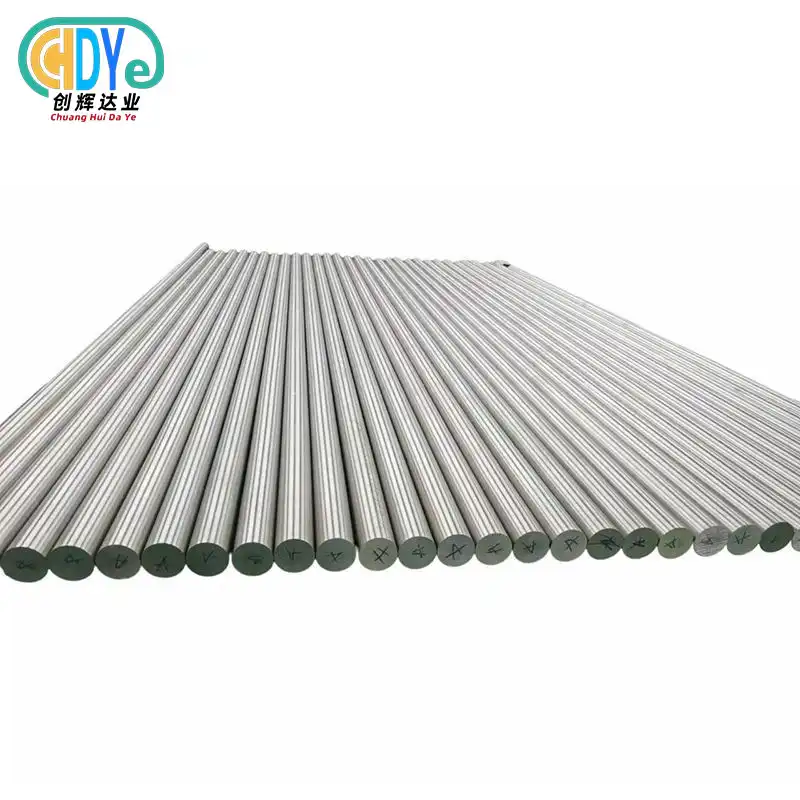
Advanced manufacturing depends on materials that stay stable under heat, chemical attack, and demanding electrical conditions, and pure niobium rod is one of the few metals that meet all three requirements. With a melting point of 2477°C, excellent corrosion resistance, and a soft, ductile nature that makes it easy to machine, pure niobium rod appears in vacuum furnaces, reaction vessels, superconducting devices, aerospace hardware, and medical tools. This article explains how pure niobium rod is used across modern industry, what specifications buyers should look for, and how careful production keeps quality consistent from one batch to the next.
Core Industrial Roles of Pure Niobium Rod
High-Temperature Equipment and Vacuum Furnaces
Refractory metals must be used to construct the internal fixtures of vacuum furnaces. This requirement is because regular steels are rapidly rendered useless by the extremely high temperatures maintained by these furnaces. Many attachments and high-temperature supports in these furnaces are made of pure niobium rod due to its strength and ability to retain its shape in environments where other materials become more pliable. This is due to its remarkable ability to maintain both its shape and strength. Its low reactivity in a vacuum has the added benefit of shielding the heated components from further damage. One quality that engineers who build furnaces appreciate is that a pure niobium rod can be threaded, chopped, and shaped into specific holders without breaking. The time needed for fabrication is also decreased, and the amount of scrap created during production is decreased as a result of this.
Reaction Vessels and Corrosion-Resistant Equipment
Equipment used in the oil and chemical industries is frequently exposed to hydrochloric, nitric, and sulfuric acids over much longer durations than other types of equipment. Reaction vessels and other corrosion-resistant components benefit greatly from rods made of puFor one thing, it can develop a thick, durable oxide layer that is impervious to various media.and durable. Utilizing pure niobium rod can assist save downtime and replacement costs when a component must remain reliable while being exposed to corrosive fluids. Engineers also appreciate the decreased risk of contamination because fewer metal ions are able to enter the process stream. This safeguards the final chemical product's purity, which is an important advantage.
Superalloys and Electron-Beam Melting
An additional use for pure niobium rod is in the manufacture of other complex materials. It is an essential component of corrosion-resistant alloy systems and high-temperature alloys such as Ta-Nb alloys. In addition to its use in electron beam melting, it is a byproduct of superalloy manufacturing. Adding niobium to an alloy serves two purposes: it strengthens the alloy at higher temperatures and also improves its internal structure. Purified niobium rod with a well-controlled composition is required by manufacturers for these applications because of the susceptibility to contaminants. In this way, we know that the outcomes of each melt will be consistent and easy to replicate.
The table below summarizes the core uses described above.
| Application | Role of Pure Niobium Rod | Key Benefit |
|---|---|---|
| Vacuum furnaces | Attachments and high-temperature supports | Strength retention at extreme heat |
| Reaction vessels | Corrosion-resistant components | Resistance to nitric, sulfuric, hydrochloric acids |
| Superalloys | Alloying additive | Improved high-temperature performance |
| Electron-beam melting | Feed material | Clean, consistent melts |
| Chemical and oil industry | Corrosion-resistant equipment | Longer service life |
Pure Niobium Rod Across Key Industries
Aerospace and Defense Programs
Procurement for aerospace and defense projects needs materials with constant performance characteristics under high temperatures and heavy structural loads. These specifications must be met by these materials. Pure niobium rod has many uses, including structural components, magnets that carry electricity, and applications involving high temperatures. Components used in applications subjected to high temperatures are among its further uses. This material gives designers the assurance they need to make decisions when weight, safety, and durability are paramount because of its high melting point and consistent behavior under thermal stress. Aerospace buyers find it much easier to meet stringent certification requirements and keep complex programs running on schedule when they can find providers of pure niobium rod with proven purity and manufacturing records that can be tracked back to their source. Suppliers can supply the rod, which is why this is the case.
Electronics, Semiconductors, and Medical Devices
Rods of pure niobium are transformed into electrodes, conductive elements, and connectors as part of the semiconductor and electronic component manufacturing process. In each of these cases, it is crucial to keep the electrical current stable and pure. Because of its biocompatibility, this material can be used to build surgical instruments, implants, and other medical equipment that is meant to be safe for human interaction. For small, intricate parts, ductility is not only useful for machinists but also makes it easy to finish things precisely. Thanks to a carefully managed pure niobium rod, two separate industries now have access to a reliable base material for components that cannot accept fluctuation.
Energy and Environmental Engineering
Using a single unit that includes heat, pressure, and corrosive substances is sometimes necessary during the installation of energy systems. Heat exchangers, renewable energy systems, and certain machinery that needs to operate for years with little maintenance are some examples of applications that utilize pure niobium rod. The rod's condition is critical for each of these functions. Its thermal stability allows it to promote effective heat conduction, and its resistance to corrosion makes it a good material to employ for shielding machinery from aggressive process fluids. An alternative that will last a long time and help reach performance and sustainability targets is the use of a pure niobium rod. Environmental engineering projects that prioritize less waste and extended equipment life will find this particularly useful.
The following table lists typical industry uses.
| Industry | Typical Components |
|---|---|
| Aerospace & Defense | High-temperature parts, superconducting magnets, structural components |
| Electronics & Semiconductors | Electrodes, conductive elements, connectors |
| Medical Equipment | Surgical tools, implants, biocompatible devices |
| Chemical Processing | Piping, reactors, storage tanks |
| Energy & Environment | Heat exchangers, renewable energy systems |
Specifications, Manufacturing, and Quality of Pure Niobium Rod
Standard Specifications and Available Sizes
With the assistance of very specific needs, purchasers are able to steer clear of pricey mismatches. Our pure niobium rod, made from niobium that is approximately 99.95% pure, meets the ASTM B 392 standard. In order to fulfill your requirements, we are able to provide you with lengths of up to two meters and diameters that can range anywhere from three millimeters to one hundred and twenty millimeters. Because it enables producers to place orders for the precise dimensions they require, this flexibility contributes to a reduction in the quantity of waste generated by cutting and the amount of time spent on machining. In the event that you specify the diameter, length, and surface finish of the pure niobium rod in your purchase order, it will be delivered to your production line in a state that is ready to be utilized in an efficient manner.
Step-by-Step Manufacturing Process
It is the production process that decides the product's quality. A vacuum melting method is used to remove impurities and make sure the niobium ingots are uniform after they are chosen as being of the highest quality. The ingots are transformed into bars and rods by the processes of hot forging and rolling. To achieve precisely measured dimensions and flawless surfaces, precision machining is employed. The ductility and mechanical characteristics of a material are improved during the annealing process. In order to ensure that the end product is flawless, surface inspection and finishing are then performed. Material developed with fewer limits cannot compare to the consistent performance of a perfectly constructed pure niobium rod. This is due to the fact that because each stage is critical to the subsequent stage, each stage is also required for the subsequent level.
Quality Control and Supplier Selection
In addition to price, buyers should consider certification, testing, and the equipment that the supplier already possesses. A quality management system that is certified to ISO 9001:2015 is utilized by our organization. This system incorporates inspection into the process of checking raw materials, melting and forging, machining and forming, and final packing. It is possible to maintain control over each step of the process by having annealing furnaces, electron beam furnaces, lathes, and rolling machines, as well as sawing and shearing equipment, in-house. If you choose a provider with this level of skill, you will obtain a pure niobium rod that is accurate, consistent, and ready for demanding applications.
Conclusion
The ductility, heat resistance, corrosion resistance, and consistent purity of pure niobium rod make it a perfect material for use in advanced production facilities. Niobium rod is also resistant to corrosion. This metal is able to solve problems that other metals are unable to, and it is utilized in vacuum furnaces and reaction vessels, in addition to being utilized in applications in the fields of aerospace, electronics, and medicine. Every single order is taken care of by Shaanxi Chuanghui Daye Metal Material Co., Ltd., which is situated in Baoji, China, which is commonly referred to as the "Titanium Capital." Working with rare metals and utilizing procedures that are certified to ISO 9001:2015 is something that the company has been doing for more than thirty years. In order to acquire information regarding the dependable and cost-effective niobium materials that are now being manufactured for your forthcoming project, please get in contact with our specialists as soon as possible.
FAQ
Q: What purity does your pure niobium rod have?
A: Our standard pure niobium rod has a purity of 99.95% and is produced to ASTM B 392.
Q: What sizes are available?
A: Diameters range from 3 mm to 120 mm, and lengths up to 2 meters can be customized.
Q: Which acids can niobium resist?
A: Niobium offers strong resistance to nitric, sulfuric, and hydrochloric acids, which is why it is common in chemical and oil industry equipment.
Q: How is the rod manufactured?
A: We use premium niobium ingots, vacuum melting, hot forging and rolling, precision machining, annealing, and final surface inspection and finishing.
Q: Do you supply other rare metals?
A: Yes. We also supply titanium, tantalum, tungsten, and molybdenum products, including plates, rods, tubes, crucibles, and machined parts.
Ready to Source Pure Niobium Rods? Contact Us Today
If your next manufacturing project needs a dependable material, Shaanxi Chuanghui Daye Metal Material Co., Ltd. is ready to help. We supply pure niobium rod in the diameters, lengths, and finishes you need, backed by more than three decades of rare metal experience and ISO 9001:2015-certified quality control. Share your drawings or specifications, and our team will respond with technical advice and a clear quotation. Email us at info@chdymetal.com and start the conversation today.
References
1. ASTM International. (1995). ASTM B392: Standard Specification for Niobium and Niobium Alloy Bars, Rods, and Wire. West Conshohocken, PA: ASTM International.
2. Cardarelli, F. (2008). Materials Handbook: A Concise Desktop Reference (2nd ed.). London: Springer.
3. Nico, C., Monteiro, T., & Graça, M. P. F. (2016). Niobium oxides and niobates physical properties: Review and prospects. Progress in Materials Science, 80, 1–37.
4. Schweitzer, P. A. (2010). Fundamentals of Corrosion: Mechanisms, Causes, and Preventative Methods. Boca Raton, FL: CRC Press.
5. Haynes, W. M. (Ed.). (2016). CRC Handbook of Chemistry and Physics (97th ed.). Boca Raton, FL: CRC Press.
6. Davis, J. R. (Ed.). (2000). ASM Specialty Handbook: Heat-Resistant Materials. Materials Park, OH: ASM International.
Learn about our latest products and discounts through SMS or email