- English
- French
- German
- Portuguese
- Spanish
- Russian
- Japanese
- Korean
- Arabic
- Greek
- German
- Turkish
- Italian
- Danish
- Romanian
- Indonesian
- Czech
- Afrikaans
- Swedish
- Polish
- Basque
- Catalan
- Esperanto
- Hindi
- Lao
- Albanian
- Amharic
- Armenian
- Azerbaijani
- Belarusian
- Bengali
- Bosnian
- Bulgarian
- Cebuano
- Chichewa
- Corsican
- Croatian
- Dutch
- Estonian
- Filipino
- Finnish
- Frisian
- Galician
- Georgian
- Gujarati
- Haitian
- Hausa
- Hawaiian
- Hebrew
- Hmong
- Hungarian
- Icelandic
- Igbo
- Javanese
- Kannada
- Kazakh
- Khmer
- Kurdish
- Kyrgyz
- Latin
- Latvian
- Lithuanian
- Luxembou..
- Macedonian
- Malagasy
- Malay
- Malayalam
- Maltese
- Maori
- Marathi
- Mongolian
- Burmese
- Nepali
- Norwegian
- Pashto
- Persian
- Punjabi
- Serbian
- Sesotho
- Sinhala
- Slovak
- Slovenian
- Somali
- Samoan
- Scots Gaelic
- Shona
- Sindhi
- Sundanese
- Swahili
- Tajik
- Tamil
- Telugu
- Thai
- Ukrainian
- Urdu
- Uzbek
- Vietnamese
- Welsh
- Xhosa
- Yiddish
- Yoruba
- Zulu
How is titanium alloy tube manufactured in modern factories?
Modern factories use complex methods to turn raw titanium into high-performance tubing parts that are used to make titanium alloy tubes. Usually, the process starts with vacuum melting titanium ingots. Next, flat billets are made through hot extrusion or drilling. To get the right mechanical qualities, these billets go through controlled cold pilgering or rotating piercing and then go through precise heat treatment processes. Our ISO 9001:2015-certified factory uses electron beam ovens and advanced annealing systems to make tubes that are seamless or welded and meet ASTM B338, B337, and B861 standards for types Gr1, Gr2, Gr7, Gr9, and Gr12.
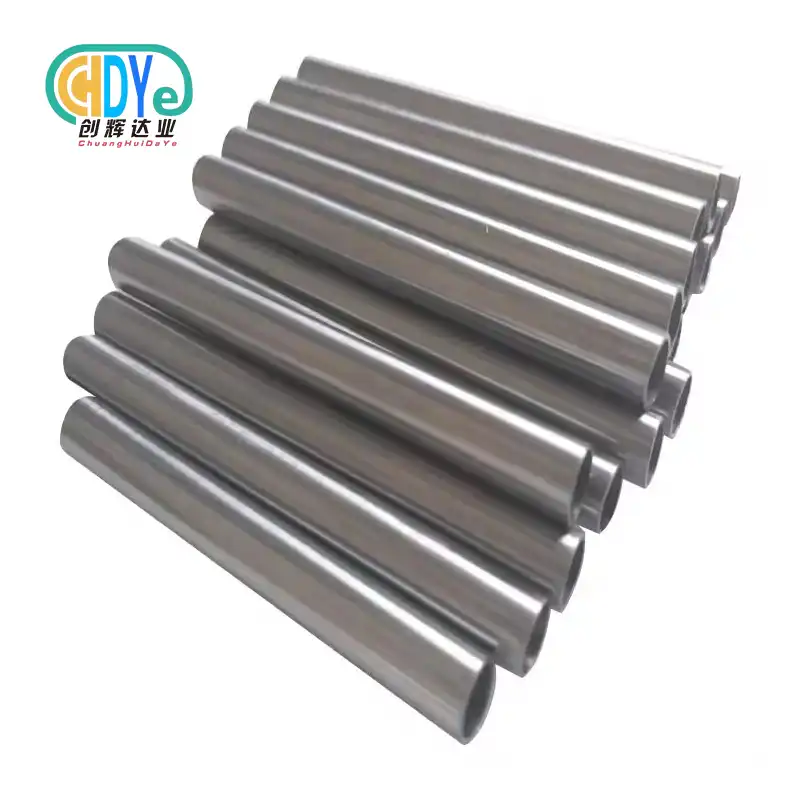
Understanding Titanium Alloy Tubes: Properties and Specifications
Precision-engineered tubes made from titanium mixed with alloying elements like aluminum, vanadium, molybdenum, or palladium are called titanium alloy tubes. The choice of material has a direct effect on how well it works in harsh manufacturing settings.
Industry-Standard Titanium Grades and Their Applications
Grade 2 titanium is very easy to shape and weld, but it's not very strong. This makes it perfect for chemical handling equipment where resistance to rust is more important than strength. Grade 9 (Ti-3Al-2.5V) has a higher tensile strength and is still easy to work with when it's cold. It is often used in aircraft hydraulic systems that work at pressures above 3,000 PSI. Grade 12 has molybdenum and nickel added to it, which makes it more resistant to crevice corrosion in the reducing acid conditions that are common in oil processing.
Critical Material Properties Driving Procurement Decisions
Tensile strengths change a lot between classes. For example, Grade 2, which is commercially pure, has a minimum yield strength of 275 MPa, while Grade 9 has a minimum yield strength of 620 MPa. Titanium alloys still have a mass of about 4.5 g/cm³, which is about 60% lighter than steel. This means that aircraft structures can be made much lighter without losing their ability to hold weight.
Mechanisms that stop corrosion depend on solid layers of titanium dioxide being formed instantly when exposed to oxidizing surroundings. This passive film heals itself if it gets broken, so it can be used in chloride-filled seas, acidic industrial environments, and areas where very pure drugs are made. Because some types are biocompatible, they can be used for surgical implants and other medical devices where tissue integration can happen without any bad biological effects.
Compliance with International Manufacturing Standards
ASTM B338 sets rules for chemical composition limits, mechanical qualities, and size tolerances for both seamless and welded tubes used in condensers and heat exchanges. ASTM B861 covers applications that need to contain pressure in smooth pipes, and ASTM B862 covers applications that need to contain pressure in soldered pipes. Following these standards ensures that goods can be swapped between global supply chains and that materials can be tracked from the raw ingot to the final inspection.
Traditional vs. Modern Manufacturing Processes of Titanium Alloy Tubes
Manufacturing titanium alloy tubes in the past relied on methods that required a lot of work, produced uneven quality, and took a long time, often several months. Integrated technology and precision control systems in modern buildings have changed these ways of doing things.
Raw Material Preparation and Melting Technologies
Electron beam melting or vacuum arc remelting of titanium sponge with master alloy added is the first step in modern production. At our plant, we use electron beam furnaces that can reach melt temperatures higher than 1,668°C when the vacuum level is below 10⁻³ torr. This gets rid of any pollution from the air and lets you precisely control the amounts of oxygen, nitrogen, and hydrogen between the layers, which are important factors that affect how flexible and weldable the metal is.
Multiple remelting processes even out the alloy's chemical makeup and improve the structure of its grains, making lumps with even chemical distribution. Before moving on to the main working processes, spectroscopic analysis makes sure that the grade standards are met.
Hot Working and Tube Forming Operations
Hot extrusion changes solid or hollow billets into the first tube profiles at temperatures ranging from 850°C to 1050°C, based on the type of metal used. Up to 5,000 tons of force are applied by hydraulic presses to hot billets as they are forced through precise dies. This reduces the cross-sectional area while increasing the length. This thermomechanical processing lines up the grain structure and creates crystallographic shapes that are desired.
In rotary piercing mills, slanted rolls and mandrels are used to cut solid round stock into uniform hollow shells that are uniform. When compared to drilling, this process produces much less trash while keeping better structural integrity without any longitudinal weld seams. Precision-rolled strip is welded in either a longitudinal or helical seam, and then it is heated lengthwise to smooth the microstructures in the weld zone.
Cold Working and Precision Sizing
When cold pilgering is done at room temperature, the tube gets smaller and smaller as it deforms over tapered mandrels over and over again. This process of work-hardening raises the yield strength and reduces the size errors to ±0.05mm for wall thickness and ±0.1mm for outer diameter. Multiple pilgering passes are broken up by intermediate heating processes to keep the metal from getting too hard from work, which could make it less flexible.
Rotary swaging and drawing boards are two different ways to size things for certain circle ranges. Drawing processes push tubes through carbide dies, resulting in a surface finish with Ra values below 0.8 micrometers. This is very important for medicinal and semiconductor fluid handling systems.
Heat Treatment and Annealing Protocols
Performing annealing processes in controlled atmosphere furnaces reduces residual stresses, recrystallizes microstructures that have been work-hardened, and improves the mechanical qualities. Temperature curves for each grade usually fall between 650°C and 800°C, and hold times are figured out by how thick the walls are and how fast they heat up. Rapid cooling in neutral gas atmospheres stops surface rust that would need to be fixed by cleaning or mechanical removal later on.
Our facility keeps an eye on the furnace atmosphere all the time to make sure that the oxygen level stays below 50 ppm during thermal processing. This stops the formation of alpha-case, which weakens the surface layers and lowers the wear performance.
Comprehensive Quality Control and Non-Destructive Testing
Instead of just testing the finished product, modern quality assurance methods use several different inspection tools at different stages of the production process. Ultrasonic testing devices can find internal flaws like laminations, inclusions, and porosity, and they can do this with enough accuracy to find flaws as small as 0.5 mm in diameter. At speeds of more than 30 meters per minute, eddy current analysis can find surface and near-surface problems along the entire length of the tube.
Every tube is put through 1.5 times the recommended working pressure during hydrostatic testing, which makes sure that they are leak-proof. Flare and flattening tests check the flexibility and quality of the weld seam by deforming the ends of the tubes. Samples must be able to handle a certain amount of distortion without breaking. Metallographic study proves the size of the grains, the distribution of the phases, and the lack of any harmful microstructural features.
Advantages of Modern Manufacturing Techniques for Titanium Alloy Tubes
Modern ways of making things offer measurable performance gains and business benefits that meet important procurement goals across industries that need unwavering dependability.
Enhanced Mechanical Performance and Longevity
Due to improved microstructures and controlled thermomechanical processing, modern production methods make tubes with tensile strengths that are 15 to 20 percent higher than similarly graded goods made using traditional methods. Improvements in fatigue resistance make things last longer in uses that are loaded and unloaded repeatedly, like airplane hydraulic systems, where parts are put through millions of pressure cycles over the course of their useful lives.
When properly treated, Grade 9 tubes have a fatigue strength of 520 MPa at 10⁷ cycles, which is much higher than stainless steel options and 40% lighter. This strength-to-weight edge lets designers cut down on wall thickness, which improves heat transfer efficiency in heat exchangers or lowers structural weight in aircraft assemblies, where every kilogram saved means better fuel economy.
Precision Customization and Engineering Flexibility
Custom specs, such as non-standard sizes, special surface finishes, and heat processes that are specific to an application, can be met by advanced manufacturing. Our factory makes U-bend shapes for heat exchangers, curved sections for custom fittings, and ultra-thin wall tubes (with a thickness of less than 0.5 mm) for aircraft parts that need to be light.
Some surface treatments are mechanical polishing to a mirror finish, electrochemical polishing for use in pharmaceutical cleanrooms, and controlled rusting to make medical equipment more biocompatible. The operations of thread rolling, flaring, and end forming fit perfectly into the production sequences. This makes it possible to deliver installation-ready parts that save customers time and money on assembly.
Supply Chain Optimization and Responsive Delivery
Modern factories have shorter lead times because they have integrated production planning systems and flexible manufacturing cells that can quickly switch between different product specs. Small-batch production runs can be done without having to meet minimum order quantities that put a strain on procurement funds. This lets prototypes be made and tested without having to meet those minimum order numbers.
Our factory-direct model gets rid of markups for middlemen and keeps traceability high with detailed records of measurement inspections, material test reports (MTR), and certificates of compliance. Digital quality management systems let buying teams see the state of production in real time, which lets them match delivery dates with project goals.
Sustainable Manufacturing and Cost Efficiency
Titanium recycling programs get process waste like extruder butts, machining chips, and material that doesn't meet specifications, so that it can be melted down again and made into new bars. This closed-loop method cuts down on the use of raw materials by up to 30% while also lowering the cost of buying them for end users. Induction heating systems that use less energy and waste heat recovery setups lower the carbon footprint of production, which is becoming a more important issue for businesses that have to be environmentally friendly.
Lifecycle cost research shows that titanium alloy tubes often have lower total ownership costs than cheaper options that were bought at first. Corrosion resistance gets rid of the need to replace systems, shortens maintenance downtime, and keeps you from having to pay for cleaning up failed stainless steel or copper-nickel systems in chemical processing and naval settings.
Applications and Industry Use Cases for Titanium Alloy Tubes
Titanium alloy tubes' unique properties are used by many different industries to solve technical problems where regular materials aren't good enough or are too expensive for long-term use.
Aerospace and Defense Critical Systems
High pressures, vibrations, temperature changes from -55°C at high altitude to 150°C near engines, and exposure to flight fluids are just some of the harsh conditions that aircraft hydraulic systems have to work in. These harsh environments can handle Grade 9 seamless tubes, which also make planes lighter—a 100-kilogram drop in structure mass can cut business jetliners' fuel use by about 3,000 liters per year.
Titanium alloy tubes can be used in fuel systems because it is compatible with jet fuel and don't crack under stress like aluminum metals do in contaminated fuel settings. Landing gear hydraulic lines handle impact loads during landing cycles and keep the pressure stable even when temperatures change a lot during flight paths.
Chemical Processing and Industrial Equipment
Heat exchanger tubes made from Grade 2 or Grade 12 can stand up to harsh chemicals like sulfuric acid, hydrochloric acid, and cold water that contains chloride, which quickly eat away at stainless steel options. In coastal areas where seawater cooling systems would destroy regular materials in 5–10 years, power plants use titanium condenser tubes instead. Titanium alloy tube systems work steadily for 30 years or more with little upkeep.
In sour gas conditions with hydrogen sulfide, where sulfide stress cracking kills carbon steel pipes, petroleum processing uses Grade 12 tubes. Offshore platforms and underwater equipment use titanium because it doesn't rust or corrode in crevices or from microbes in areas of still water in the ocean, where inspection and repair would be too expensive.
Medical and Pharmaceutical Industries
For biomedical uses, materials must be completely resistant to rust, able to be sterilized, and compatible with tissue. Thin-wall titanium alloy tubes are used in surgical tool parts like endoscopic tubes, arthroscopic equipment, and dental handpiece systems because they don't break down when put through multiple autoclaving processes. In spinal fixation systems and intramedullary nails, orthopedic devices use tube parts to help the bone fuse together. This happens through osseointegration processes.
Pharmaceutical making systems need to handle fluids in a way that doesn't let any metal ions get into them. When titanium alloy tubes are electropolished, the surface roughness is less than 0.4 micrometers, and there aren't many cracks where germs could grow. This makes the tubes meet the strict FDA and EU GMP standards for sterile production settings.
Marine and Offshore Applications
Seawater exposure causes a lot of damage to shipboard systems, like the pipes that carry ballast water, the networks that put out fires, and the desalination plants. Titanium alloy tubes don't have the galvanic corrosion, biofouling, or erosion-corrosion problems that copper-nickel tubing does in high-velocity flow situations. Titanium is used on navy ships in seawater-cooled heat exchangers and parts of the propulsion system where dependability has a direct effect on the operational readiness.
Subsea umbilical systems use thin titanium alloy tubes for chemical input and hydraulic control lines at depths greater than 3,000 meters, where water pressure can hit 300 bar. The strength of the material keeps it from falling apart, and its resistance to rust means it will last for decades in places where upkeep isn't possible.
How to Choose the Right Titanium Alloy Tube Supplier
To find the right manufacturing partner, you need to look at their professional skills, quality systems, and business terms that fit with your risk management and buying goals.
Certification, Credentials, and Quality Management Systems
The ISO 9001:2015 approval shows that the design, production, inspection, and shipping processes are all managed in a systematic way. Suppliers should write down how to track down materials, deal with nonconformances, and put corrective actions into action. Look at audit records and past customer complaints to figure out how well the quality system works beyond the validity of the certificate.
ASTM compliance means not only meeting the requirements of the standard, but also keeping testing tools calibrated, hiring qualified inspectors, and keeping records that show compliance. Ask for sample material test reports to make sure that the testing was thorough and that all the data was included—MTRs that are missing or generally show that quality control is not being done well.
Production Capabilities and Technical Expertise
Check the collection of production equipment for titanium alloy tube, such as extrusion presses, melting furnaces, cold working machines, and heat treatment facilities. Integrated operations controlled from a single building make it easier to track and ensure quality than when providers outsource important processing steps. Our Baoji plant, which is in China's titanium capital, is fully integrated from melting the ingots to inspecting the finished products.
When dealing with application-specific needs, technical help skills are very important. Suppliers with a lot of experience can help with materials engineering, finite element analysis for unique designs, and failure analysis. Our team has worked with rare metals for over 30 years, so they can suggest the best grades, heat treatment processes, and manufacturing methods for tough jobs.
Commercial Terms and Supply Chain Reliability
Minimum order numbers have a big effect on the costs of buying, especially when it comes to making prototypes or using low-volume specialty products. Flexible suppliers can take smaller original orders and offer price breaks for large production amounts. Being clear about lead times lets you make accurate production schedules. Typical manufacturing cycles last between 4 and 8 weeks, based on the complexity of the specifications and the amount of the order.
By buying directly from the factory, you avoid the markups that distributors add on top of the price, and you can talk directly with production staff who can answer technical questions and make changes to specifications. Our price system shows how much it really costs to make the product, without any markups for middlemen. This saves you 15 to 25 percent compared to buying through multiple channels.
Conclusion
Modern titanium alloy tube production combines complex mechanical science with precise engineering to make parts that meet the strict performance requirements of many industries. Knowing how things are made, how they are checked for quality, and the traits of materials helps you make smart purchasing choices that balance cost, performance, and supply chain dependability. If you choose certified manufacturers with proven technical skills, full testing facilities, and clear quality documentation, you can be sure that the materials they send you will last for a long time and provide long-term value through better corrosion resistance, mechanical performance, and operational longevity. Investing in titanium alloy tubes that are properly made pays off in a measured way: longer service life, lower upkeep costs, and more reliable systems.
FAQ
Q: What factors influence titanium alloy tube pricing?
A: The price depends on a number of factors that are all linked, such as the difficulty of the alloy grade, the size requirements, the production volume, and the testing needs. Due to the higher prices of alloying elements and stricter processing requirements, Grades 9 and 12 are more expensive than widely pure grades. When measurements aren't standard, and custom tools need to be made, setup costs apply and are spread out over the order amounts. More thorough testing methods, like 100% acoustic inspection or mechanical testing at high temperatures, cost more but are needed for important uses. The price of titanium sponge changes yearly by about 10 to 15 percent because of changes in the world supply and demand of raw materials.
Q: Can manufacturers accommodate custom specifications?
A: Modern facilities allow for a lot of customizing, such as non-standard sizes, special metallurgical conditions, custom end preparations, and surface processes that are made to work with a certain application. Our engineering team works with customers to find the best options that balance performance needs with the ability to make the product and low cost. To make sure that standards meet practical goals, custom development usually needs dimension plans, material property targets, and the conditions under which the product will be used.
Q: What are typical delivery lead times?
A: Standard store things that are already in stock usually ship within two to three weeks. Custom specs that need special melting or non-standard processing usually take 2 to 3 weeks from the time the order is placed until it is shipped. Expedited production can meet the needs of urgent projects with tight deadlines. Please call our sales team to talk about your timing needs and the possibility of accelerated delivery.
Partner with Chuanghui Daye for Reliable Titanium Alloy Tube Supply
Shaanxi Chuanghui Daye Metal Material Co., Ltd. has been working with rare metals for 30 years and is ISO 9001:2015 approved. They make precision-engineered tubes that meet ASTM B338, B337, and B861 standards. Our Baoji plant uses electron beam melting, modern extrusion systems, and thorough NDT procedures to make parts that are seamless and welded that meet Gr1, Gr2, Gr7, Gr9, and Gr12 standards. We make titanium alloy tubes for the marine, aerospace, chemical processing, and medical device businesses around the world. We offer factory-direct prices, flexible minimum quantities, and expert support to help you with your most important projects. Contact us today at info@chdymetal.com to talk about your needs, get full quotes, or set up material testing samples that show how committed we are to quality.
References
1. American Society for Testing and Materials. (2021). ASTM B338-21: Standard Specification for Seamless and Welded Titanium and Titanium Alloy Tubes for Condensers and Heat Exchangers. ASTM International.
2. Boyer, R., Welsch, G., & Collings, E.W. (2019). Materials Properties Handbook: Titanium Alloys. ASM International.
3. Donachie, M.J. (2020). Titanium: A Technical Guide, 3rd Edition. ASM International.
4. Lütjering, G. & Williams, J.C. (2018). Engineering Materials and Processes: Titanium, 2nd Edition. Springer-Verlag Berlin Heidelberg.
5. Peters, M., Kumpfert, J., Ward, C.H., & Leyens, C. (2019). Titanium and Titanium Alloys: Fundamentals and Applications. Wiley-VCH Verlag GmbH.
6. Veiga, C., Davim, J.P., & Loureiro, A.J.R. (2017). "Review on Machinability of Titanium Alloys: The Process Perspective." Reviews on Advanced Materials Science, Volume 34, 148-164.
Learn about our latest products and discounts through SMS or email