- English
- French
- German
- Portuguese
- Spanish
- Russian
- Japanese
- Korean
- Arabic
- Greek
- German
- Turkish
- Italian
- Danish
- Romanian
- Indonesian
- Czech
- Afrikaans
- Swedish
- Polish
- Basque
- Catalan
- Esperanto
- Hindi
- Lao
- Albanian
- Amharic
- Armenian
- Azerbaijani
- Belarusian
- Bengali
- Bosnian
- Bulgarian
- Cebuano
- Chichewa
- Corsican
- Croatian
- Dutch
- Estonian
- Filipino
- Finnish
- Frisian
- Galician
- Georgian
- Gujarati
- Haitian
- Hausa
- Hawaiian
- Hebrew
- Hmong
- Hungarian
- Icelandic
- Igbo
- Javanese
- Kannada
- Kazakh
- Khmer
- Kurdish
- Kyrgyz
- Latin
- Latvian
- Lithuanian
- Luxembou..
- Macedonian
- Malagasy
- Malay
- Malayalam
- Maltese
- Maori
- Marathi
- Mongolian
- Burmese
- Nepali
- Norwegian
- Pashto
- Persian
- Punjabi
- Serbian
- Sesotho
- Sinhala
- Slovak
- Slovenian
- Somali
- Samoan
- Scots Gaelic
- Shona
- Sindhi
- Sundanese
- Swahili
- Tajik
- Tamil
- Telugu
- Thai
- Ukrainian
- Urdu
- Uzbek
- Vietnamese
- Welsh
- Xhosa
- Yiddish
- Yoruba
- Zulu
How Strong Is GR4 Titanium Bar Compared to Steel?
When evaluating materials for critical industrial applications, procurement managers consistently gr4 titanium bar ask: how does gr4 titanium bar stack up against traditional steel? The answer lies in understanding the fundamental differences in performance. Grade 4 titanium bars deliver a minimum tensile strength of 550 MPa—comparable to many carbon steels—while maintaining exceptional corrosion resistance and weighing 45% less than steel equivalents. This commercially pure titanium grade achieves its superior mechanical properties through controlled oxygen and iron content, making it the strongest unalloyed titanium option available. While steel may offer higher absolute strength in certain alloys, Grade 4 titanium's strength-to-weight ratio and environmental durability frequently outperform steel in demanding operational conditions, particularly where corrosion, weight reduction, or biocompatibility matter.
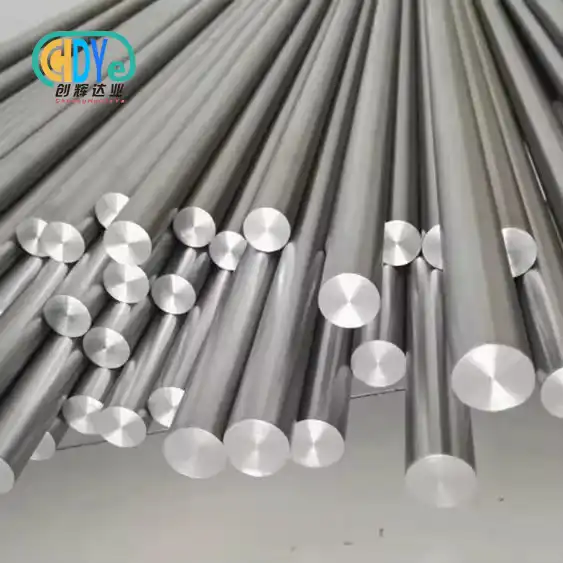
Understanding GR4 Titanium Bar – Properties and Composition
Chemical Composition and Metallurgical Structure
The metallurgical distinction of Grade 4 titanium stems from its precisely controlled chemistry. Unlike titanium alloys that achieve strength through multiple alloying elements, this commercially pure grade relies on interstitial strengthening. Oxygen serves as the primary strengthening agent, carefully balanced to enhance mechanical properties without compromising ductility or weldability. Our manufacturing process at Chuanghui Daye's facility in Baoji ensures strict adherence to ASTM B348 and ASME SB348 specifications, with each production batch undergoing rigorous chemical analysis to verify composition compliance with UNS R50700 standards. The alpha-phase crystal structure provides inherent corrosion resistance that steel cannot match. This single-phase microstructure maintains stability across a wide temperature range, preventing the phase transformations that can compromise mechanical integrity in steel components exposed to thermal cycling. Our electron beam melting equipment produces exceptionally homogeneous ingots, eliminating segregation issues that plague lower-quality titanium production.
Mechanical Performance Specifications
Our Grade 4 titanium bars deliver consistent mechanical properties that meet the stringent demands of aerospace, chemical processing, and medical device manufacturing:
- Tensile Strength: Minimum 550 MPa ensures structural integrity under high-stress conditions, addressing scenarios where Grade 2 titanium's 345 MPa proves insufficient, yet Grade 5 alloy's cost or biocompatibility concerns create procurement barriers.
- Yield Strength: At 480 MPa minimum, the material resists permanent deformation in applications subjected to repeated loading cycles. This yield point positions Grade 4 between structural steels and high-strength alloys, offering an optimal balance for components requiring elastic behavior under operational stress.
- Elongation: The 15% minimum elongation specification of the Gr4 titanium bar confirms the adequate ductility of the Gr4 titanium bar for forming operations, cold working, and fabrication processes. This property distinguishes commercially pure titanium from brittle materials, enabling custom machining services that our facility provides—from precision turning on our advanced lathes to complex geometries requiring multi-axis processing.
We maintain full traceability documentation for every titanium bar that leaves our facility, with mill test certificates detailing mechanical test results, chemical composition analysis, and heat treatment records. This documentation supports our customers' quality management systems and regulatory compliance requirements, particularly critical for medical device manufacturers requiring ASTM F-67 certification and aerospace suppliers demanding a complete material pedigree.
Comparing the GR4 Titanium Bar with Steel in Terms of Strength
Tensile Strength and Yield Point Analysis
Grade 4 titanium bars achieve a tensile strength of 550 MPa, positioning them competitively against common structural steels. Carbon steel grades like AISI 1045 reach approximately 565-620 MPa, while 316 stainless steel typically measures 515-620 MPa. The similarity in absolute tensile values might suggest equivalency, but yield behavior tells a more nuanced story. Our Grade 4 material demonstrates a yield strength of 480 MPa with predictable elastic behavior, whereas many steels exhibit lower yield-to-tensile ratios, potentially allowing plastic deformation before ultimate failure. The critical distinction emerges when considering density. Steel's 7.85 g/cm³ density contrasts sharply with titanium's 4.51 g/cm³. This fundamental physical difference means that for equivalent strength, Grade 4 titanium components weigh nearly half their steel counterparts. Aerospace manufacturers consistently specify our titanium bars for structural applications where weight savings translate directly to fuel efficiency and payload capacity. A recent component substitution project we supported demonstrated a 42% weight reduction compared to 316 stainless steel while maintaining identical load-bearing capacity.
Fatigue Resistance and Durability Factors
Fatigue performance separates Grade 4 titanium from many steel alternatives in cyclic loading environments. Titanium's excellent fatigue strength—approximately 290-330 MPa at 10^7 cycles—exceeds many carbon steels on a specific strength basis. The material's resistance to crack propagation stems from its microstructural characteristics and the absence of grain boundary carbides that create stress concentrations in steel. Our manufacturing process includes controlled annealing in our specialized furnaces, optimizing grain structure to maximize fatigue life. This heat treatment eliminates residual stresses from rolling gr4 titanium bar and forging operations, producing bars with uniform mechanical properties throughout the cross-section. Chemical processing equipment manufacturers particularly value this consistency, as pump shafts and agitator components experience millions of stress reversals over operational lifetimes. The superior fatigue characteristics reduce unexpected failures and extend maintenance intervals, lowering total ownership costs despite the higher initial material investment. Corrosion fatigue represents another critical consideration. Steel components in chloride environments or acidic conditions experience accelerated crack growth, severely limiting service life. Grade 4 titanium's passive oxide layer reforms instantaneously when damaged, preventing corrosion-assisted crack propagation.
Practical Use Cases and Industry Applications
Aerospace and Defense Components
Aerospace manufacturers specify our titanium bars for applications demanding high strength-to-weight ratios and corrosion resistance. Landing gear components, hydraulic system fittings, and fasteners benefit from the material's mechanical properties and environmental durability. A defense contractor recently utilized our custom-machined Grade 4 bars for helicopter rotor hub components, achieving weight reductions that improved payload capacity while maintaining structural integrity under high-stress flight conditions. Aircraft engine components operating in salt-laden marine environments particularly benefit from titanium's corrosion resistance. Traditional steel fasteners in these applications require frequent inspection and replacement due to corrosion-induced stress concentrations. Our ISO 9001:2015 certified production ensures consistent material properties across production batches, supporting the aerospace industry's stringent quality requirements and traceability standards.
Medical Device Manufacturing
The biocompatibility of Grade 4 titanium makes it invaluable for surgical instruments and implantable devices. Our bars meet ASTM F-67 specifications for surgical implants, providing the strength necessary for orthopedic applications while ensuring biological compatibility. Instrument manufacturers machine our material into surgical tools requiring sterilization resistance and corrosion immunity to bodily fluids and cleaning chemicals. A medical device client produces bone fixation plates from our Grade 4 bars, selecting this grade over Grade 2 for applications requiring higher load-bearing capacity. The material's moderate strength allows surgeons to contour plates during procedures while providing sufficient mechanical support during healing. Our custom cutting services deliver blanks optimized for their machining operations, reducing waste and improving production efficiency.
Factors Influencing Procurement Decisions for GR4 Titanium Bars vs Steel
Total Cost of Ownership Analysis
Initial material cost comparisons favor steel, with prices typically one-tenth those of Grade 4 titanium. However, lifecycle cost analysis often reverses this economic equation. Components requiring frequent replacement due to corrosion, those where weight reduction provides operational savings, or applications involving expensive downtime frequently justify titanium's premium. Our factory-direct pricing from Baoji—China's titanium manufacturing hub—provides competitive rates that reduce the cost differential. The region's integrated supply chain, from sponge production through final processing, enables cost advantages unavailable from distributors or regions without established titanium infrastructure. We offer flexible minimum order quantities supporting both prototype gr4 titanium bar development and production volume requirements, allowing customers to evaluate material performance before committing to large inventories. Maintenance cost reductions represent substantial savings over equipment lifetimes. A chemical processing client calculated that eliminating annual pump shaft replacements offset the higher titanium material cost within three years. The subsequent years of operation represented pure savings compared to the steel baseline. Weight savings in aerospace applications translate to fuel cost reductions that accumulate over aircraft service lives, justifying higher component costs.
Quality Certification and Traceability Requirements
The steps for qualifying suppliers take a lot of time and money. Our ISO 9001:2015 certification shows that we have a method for managing quality that includes checking the raw materials, keeping an eye on the production process, and checking the finished product. This certification speeds up the approval process for suppliers for businesses that need recorded quality systems. This cuts down on the time it takes to buy things. From the time we receive the raw materials to the time we ship the finished products, we can track all of them. Each bar is given a unique number that connects it to a specific batch of production, a record of its heat treatment, and test findings. This paperwork meets industry standards and government rules. It is especially important for aerospace uses that need to follow AS9100 rules and medical devices that need to follow FDA quality system rules. Verification testing by a third party adds to our internal quality control. When a customer's requirements call for external approval, we work with independent labs to do validation testing. This way, we can make sure that all requirements are met without any problems with procurement.
Making the Right Choice: When to Opt for the GR4 Titanium Bar over Steel
Application-Specific Decision Criteria
The main thing that determines the choice is how bad the corrosion environment is. When steel needs protected coatings or expensive alloy upgrades because of chlorides, acids, or oxidising conditions, titanium is a better choice from an economic point of view. The material's passive oxide layer protects against corrosion without any upkeep, so there are no costs for coating application, inspection, or re-coating in the future. Titanium is used in weight-sensitive areas like aerospace, car performance parts, and portable electronics because it improves performance, not just because it's cheaper. The 45% lighter weight compared to steel makes designs possible that would not be possible with heavy materials, giving companies a competitive edge through better performance or lower costs by making operations more efficient. Biocompatibility rules in medical uses limit the types of materials that can be used. Grade 4 titanium is commonly used for surgical tools and implant parts because it has a history of being safe for implantable devices and is recognised by the FDA as a biocompatible material. Steel alternatives can't match the mix of good strength and lack of biological activity.
Hybrid Material Strategies
Some applications benefit from selective material use, employing titanium components in corrosive zones while utilizing steel for less demanding areas. This approach optimizes costs while solving critical performance limitations. We support such strategies through custom component fabrication and technical consultation, helping customers identify which elements benefit most from titanium's properties.
Conclusion
The gr4 titanium bar delivers mechanical strength comparable to many steels—with a minimum tensile strength of 550 MPa—while providing superior corrosion resistance and weighing 45% less. This combination positions the material advantageously for aerospace components, chemical processing equipment, medical devices, and marine applications where corrosion, weight, or biocompatibility critically impact performance. While initial material costs exceed steel, lifecycle analysis frequently demonstrates economic advantage through extended service life, reduced maintenance, and operational efficiency improvements. Chuanghui Daye manufactures Grade 4 titanium bars meeting ASTM B348 specifications at our ISO 9001:2015 certified facility in Baoji, providing reliable material quality, comprehensive traceability documentation, and responsive supply chain support for demanding industrial applications worldwide.
FAQ
1. Does heat treatment significantly increase GR4 titanium bar strength?
Annealing—the standard heat treatment for commercially pure titanium—relieves internal stresses from forming operations but does not substantially increase strength. Unlike steel, titanium does not respond to hardening heat treatments like quenching and tempering. Our Grade 4 bars receive controlled annealing to optimize ductility and stress relief while maintaining the strength inherent to the material's composition. Precipitation hardening, applicable to certain titanium alloys, does not apply to commercially pure grades.
2. How does GR4 compare to GR5 titanium for high-strength applications?
Grade 5 (Ti-6Al-4V) provides significantly higher strength—approximately 900 MPa tensile strength—through aluminum and vanadium alloying. However, Grade 4 offers superior corrosion resistance and better biocompatibility, making it preferable for medical implants and chemical processing despite lower absolute strength. Procurement decisions should weigh whether the additional strength justifies Grade 5's higher cost and potential restrictions in biological applications.
3. What are typical delivery timelines for bulk orders?
Our standard lead time ranges from 4-6 weeks for common diameters in stock dimensions, with 6-8 weeks for custom specifications requiring special rolling or extensive machining. We maintain raw material inventory, enabling responsive production scheduling. Rush orders receive priority processing when production capacity allows, supporting urgent project requirements.
Partner with Chuanghui Daye for Reliable GR4 Titanium Bar Solutions
Material performance directly impacts your operational success, maintenance costs, gr4 titanium bar and competitive position. Chuanghui Daye manufactures premium-grade titanium bar products at our ISO 9001:2015 certified facility in Baoji—the heart of China's titanium industry. Our three decades of rare metal expertise ensure consistent quality, complete traceability, and responsive technical support. We serve as your reliable gr4 titanium bar supplier, offering custom cutting services, flexible order quantities, and factory-direct pricing. Contact our team at info@chdymetal.com to discuss your specific requirements, request technical data sheets, or obtain a detailed quotation. We deliver material solutions that enhance your product performance and operational efficiency.
References
1. Lütjering, G. and Williams, J.C. (2007). "Titanium: Engineering Materials and Processes," 2nd Edition. Springer-Verlag Berlin Heidelberg.
2. Schutz, R.W. and Watkins, H.B. (1998). "Recent Developments in Titanium Alloy Application in the Energy Industry." Materials Science and Engineering: A, Volume 243, Issues 1-2.
3. ASM International Handbook Committee (1990). "Properties and Selection: Nonferrous Alloys and Special-Purpose Materials," ASM Handbook Volume 2. ASM International.
4. Donachie, Matthew J. (2000). "Titanium: A Technical Guide," 2nd Edition. ASM International.
5. Boyer, R., Welsch, G., and Collings, E.W. (1994). "Materials Properties Handbook: Titanium Alloys." ASM International.
6. Veiga, C., Davim, J.P., and Loureiro, A.J.R. (2012). "Properties and Applications of Titanium Alloys: A Brief Review." Reviews on Advanced Materials Science, Volume 32, Number 2.
Learn about our latest products and discounts through SMS or email