- English
- French
- German
- Portuguese
- Spanish
- Russian
- Japanese
- Korean
- Arabic
- Greek
- German
- Turkish
- Italian
- Danish
- Romanian
- Indonesian
- Czech
- Afrikaans
- Swedish
- Polish
- Basque
- Catalan
- Esperanto
- Hindi
- Lao
- Albanian
- Amharic
- Armenian
- Azerbaijani
- Belarusian
- Bengali
- Bosnian
- Bulgarian
- Cebuano
- Chichewa
- Corsican
- Croatian
- Dutch
- Estonian
- Filipino
- Finnish
- Frisian
- Galician
- Georgian
- Gujarati
- Haitian
- Hausa
- Hawaiian
- Hebrew
- Hmong
- Hungarian
- Icelandic
- Igbo
- Javanese
- Kannada
- Kazakh
- Khmer
- Kurdish
- Kyrgyz
- Latin
- Latvian
- Lithuanian
- Luxembou..
- Macedonian
- Malagasy
- Malay
- Malayalam
- Maltese
- Maori
- Marathi
- Mongolian
- Burmese
- Nepali
- Norwegian
- Pashto
- Persian
- Punjabi
- Serbian
- Sesotho
- Sinhala
- Slovak
- Slovenian
- Somali
- Samoan
- Scots Gaelic
- Shona
- Sindhi
- Sundanese
- Swahili
- Tajik
- Tamil
- Telugu
- Thai
- Ukrainian
- Urdu
- Uzbek
- Vietnamese
- Welsh
- Xhosa
- Yiddish
- Yoruba
- Zulu
How to Choose Pure Niobium Bar from Top Factories?
How to choose the appropriate pure niobium bar? Consider its purity grade, dimensional tolerances, certification compliance, and the dependability of the provider. Whether your application is in aerospace, chemical processing, or semiconductor manufacturing, the grade you select—R04200 reactor grade or R04210 commercial grade—will have a direct impact on performance and lifetime cost. Mandatory measures are: Inert Gas Fusion (IGF) analysis for verification of chemical composition, conformance to ASTM B392, and factory credential audits. This guide takes you through each decision stage, so your procurement team can get from assessment to confident purchase with the least amount of risk.
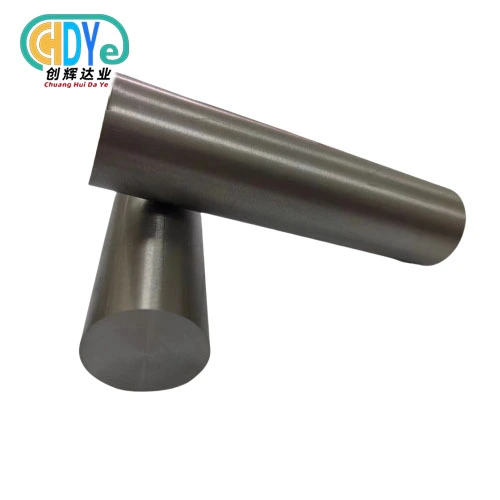
Understanding Pure Niobium Bar: Key Properties and Benefits
Niobium has a density of 8.57 g/cm3 and a BCC crystal structure, which provides it with good ductility even at room temperature. Its melting point is 2,468°C, making it one of the most thermally stable refractory metals accessible. Tungsten or Molybdenum does not break during cold working (rolling, drawing, and stamping). Pure niobium does, which significantly decreases downstream manufacturing costs.
Corrosion Resistance and Chemical Stability
Niobium develops a thick Nb₂O₅ passivation layer spontaneously on contact with air or moisture. Because of this self-healing oxide barrier, the metal resists most organic and inorganic acids below 100°C. This property is highly valued by chemical and petrochemical equipment manufacturers when selecting material for heat exchangers, reaction tanks, and corrosion-resistant pipe applications where the use of tantalum would be cost-prohibitive.
Superconducting and Electronic Performance
Pure niobium becomes superconducting at 9.25 K, one of the highest critical temperatures of elemental metals. This feature is very relevant for electronics and semiconductor industries, particularly for RF cavity resonators and cryogenic components. The Residual Resistance Ratio (RRR) is a measure of purity based on electron scattering at cryogenic temperatures; a high RRR—typically more than 300 for superconducting grades—indicates a lower level of interstitial impurities and higher thermal conductivity at low temperatures.
Comparison With Titanium and Stainless Steel
Niobium is a stronger reducing agent than titanium in severely acidic media. It is better than stainless steel in resistance to corrosion in halide-rich media. Pure niobium bars such as C-103 or Nb-1Zr are stronger under tension but with reduced ductility and machinability. Unalloyed niobium stock is the material of choice for applications where chemical inertness is more important than structural load capability.
Core Criteria for Selecting the Right Pure Niobium Bar
Procurement decisions hinge on matching material specification to application demand. A mismatch in purity grade or dimensional tolerance can compromise component performance and trigger costly rework.
Grade and Purity Specification
Reactor Grade R04200 requires strict control of tantalum impurities and low concentrations of interstitial elements, oxygen, nitrogen, hydrogen, and carbon, usually less than 100 ppm each. R04210 (Commercial Grade) has a slightly greater allowable impurity level, which results in a cheaper unit price. It is appropriate for general industrial corrosion resistance. Universities and research institutions commonly ask for R04200 to ensure the repeatability of experiments, whereas chemical equipment manufacturers are often content with R04210.
Dimensional Tolerances and ASTM Compliance
Cross-section specifications of bar stock should be in accordance with ASTM B392, Unalloyed Niobium Rod and Bar. Check that the mill test certificate is for the actual measured dimensions, not the nominal dimensions. Tight tolerances are particularly critical for precision-machined assemblies used in aerospace and medical device applications.
The vendor's claims cannot be verified with a datasheet alone. Ask for third-party chemical analysis results from recognized labs and track the heat number on the mill cert back to the original melt batch. Traceability documentation (raw material origin, melting records, mechanical test results, dimensional inspection) safeguards your supply chain against counterfeit or off-spec material.
Comparing Pure Niobium Bar with Alternative Materials
Understanding how niobium compares to rival materials helps procurement teams justify material selection to engineering stakeholders.
Pure niobium has a niche for its own performance. Here’s how it compares to the most popular alternatives:
- Niobium has about half the density of tantalum (8.57 g/cm3 vs. 16.6 g/cm3 for tantalum rods ) . Niobium is thus much less expensive per kilogram than tantalum. The corrosion resistance of niobium is similar to that of stainless steels in moderate-temperature hydrochloric acid conditions. Niobium is a smart choice for designs when weight or cost is an issue, although tantalum is still better in concentrated acid service over 150°C.
- Compared to Titanium Bar: Titanium has advantages in oxidizing acid environments and biomedical implants because of its reduced density and the availability of biocompatibility data. Niobium is preferable over titanium in acid media and high-temperature vacuum settings and is thus used for the internals of chemical reactors and components of vacuum furnaces.
- Versus Pure niobium bar: Alloys like Nb-1Zr or C-103 provide tensile strength and creep resistance at high temperatures, which is helpful for rocket nozzle applications. The trade-off is worse cold workability and a higher price. If the design calls for shaping, deep drawing, or heavy machining rather than high-temperature structural load bearing, unalloyed material is the feasible option.
These differences mean that engineering teams may make application-driven choices and not just choose the materials they are most comfortable with, and that can result in both cost savings and performance benefits.
How to Source Pure Niobium Bar from Top Factories
Sourcing from reputable manufacturers protects quality consistency across production batches—a concern that resonates strongly with aerospace and defense procurement teams who operate under strict traceability requirements.
Evaluating Supplier Credentials
Look for ISO 9001:2015 certified producers, meaning they have documented quality control of raw material inspection, melting, forming, and final inspection. Additional proof of operational dependability is provided by factory audits, B2B platform assessments, and industry references from current customers. Make sure the supplier has electron beam furnaces or vacuum arc remelting equipment, required to produce high RRR grades.
Customization, MOQ, and Logistics
Leading pure niobium bar suppliers quickly provide bespoke cross-sections, lengths, and surface treatments for small-batch R&D requirements as well as for large industrial contracts. Before you commit, be sure to confirm minimum order quantities, lead times, and package specs. Established suppliers with freight agreements may aggregate shipments to reduce logistics cost per unit for customers worldwide. Long-term partners differentiate themselves from transactional suppliers by providing after-sales assistance, such as technical consulting and warranty coverage.
Best Practices for Ensuring Quality and Performance Post-Purchase
Getting good-grade niobium bar stock is just half the issue. Proper management and testing of that investment will keep performance up throughout the component lifespan.
Store niobium bars in a dry, temperature-stable area away from chloride-carrying atmospheres. While the Nb2O5 passivation layer offers good ambient protection, extended exposure to moisture or surface contaminants may interfere with future welding or bonding processes. Welding must be performed in a high-vacuum electron beam chamber or in a rigorously purged argon glove box. Niobium readily absorbs oxygen and nitrogen at temperatures over 200°C, and welding in an atmosphere would cause quick embrittlement.
The machining of niobium needs sharp high-speed steel tools, water-soluble coolants free from chlorides, and cautious cutting rates. The sticky nature of the metal tends to gall against carbide inserts. After excessive cold working (more than around 90% reduction), recrystallization annealing at 1000°C-1200°C in vacuum (10⁻⁴ Torr or better) recovers ductility. For essential aerospace or electronic applications, each incoming batch should be tested for application mechanical testing under ASTM E8 and grain size verification per ASTM E112.
Conclusion
Selecting pure niobium bar stock from a credible source entails trading off purity grade, dimensional specification, supplier certification, and after-purchase discipline. R04200 and R04210 each have their own application profile. Whether you choose the pure unalloyed material or the niobium alloy variations, the decision should always be based on technical needs and not just on pricing. For demanding sectors, the lowest procurement risk is offered by suppliers with electron beam furnaces, ISO 9001:2015 certification, and solid traceability documentation.
FAQ
1. How do I verify niobium purity before purchase?
Request a mill certificate that includes chemical composition data measured by Inert Gas Fusion (IGF) for interstitial elements (O, N, H, C) and ICP-OES for metallic impurities. Cross-reference the heat number on the certificate with the physical bar. For superconducting or nuclear grades, also request the RRR measurement report.
2. What is the practical difference between R04200 and R04210?
R04200 controls tantalum content and interstitial impurity levels stringently for nuclear and superconducting applications. R04210 allows slightly higher impurity thresholds at a lower cost, making it suitable for chemical equipment and general industrial use.
3. What lead times should I expect for custom-sized orders?
Standard commercial sizes typically ship within two to four weeks. Custom cross-sections or reactor-grade specifications may require four to eight weeks depending on melt scheduling and inspection requirements. Discuss lead time expectations with your supplier before placing a purchase order.
4. Can pure niobium be welded on-site?
No. Niobium must be welded in a high-vacuum environment or inside an inert-gas glove box. Atmospheric welding causes severe embrittlement due to rapid gas absorption above 200°C.
Source Your Pure Niobium Bar Through Chuanghui Daye
Shaanxi Chuanghui Daye, based in China's Titanium Capital—Baoji, Shaanxi—has served global industrial clients for over 30 years with ISO 9001:2015-certified niobium products. As a trusted pure niobium bar manufacturer, we supply R04200 and R04210 grades with full mill certifications, flexible batch sizes, and competitive factory-direct pricing. Reach our technical team at info@chdymetal.com to request a quote.
References
1. ASTM International. ASTM B392: Standard Specification for Niobium and Niobium Alloy Bar, Rod, and Wire. ASTM International, 2022.
2. Savitzky, B. H., et al. "Superconducting Properties of High-Purity Niobium for Accelerator Cavities." Journal of Applied Physics, 2019.
3. Hebda, J. "Niobium Alloys and High Temperature Applications." Proceedings of the International Symposium on Niobium, TMS, 2001.
4. Wurster, S., et al. "Refractory Metals: Niobium, Tantalum, Molybdenum and Tungsten." Advanced Engineering Materials, 2020.
5. Hampel, C. A. Rare Metals Handbook, 2nd ed. Reinhold Publishing Corporation, 1961.
6. International Organization for Standardization. ISO 9001:2015 Quality Management Systems—Requirements. ISO, 2015.
Learn about our latest products and discounts through SMS or email