- English
- French
- German
- Portuguese
- Spanish
- Russian
- Japanese
- Korean
- Arabic
- Greek
- German
- Turkish
- Italian
- Danish
- Romanian
- Indonesian
- Czech
- Afrikaans
- Swedish
- Polish
- Basque
- Catalan
- Esperanto
- Hindi
- Lao
- Albanian
- Amharic
- Armenian
- Azerbaijani
- Belarusian
- Bengali
- Bosnian
- Bulgarian
- Cebuano
- Chichewa
- Corsican
- Croatian
- Dutch
- Estonian
- Filipino
- Finnish
- Frisian
- Galician
- Georgian
- Gujarati
- Haitian
- Hausa
- Hawaiian
- Hebrew
- Hmong
- Hungarian
- Icelandic
- Igbo
- Javanese
- Kannada
- Kazakh
- Khmer
- Kurdish
- Kyrgyz
- Latin
- Latvian
- Lithuanian
- Luxembou..
- Macedonian
- Malagasy
- Malay
- Malayalam
- Maltese
- Maori
- Marathi
- Mongolian
- Burmese
- Nepali
- Norwegian
- Pashto
- Persian
- Punjabi
- Serbian
- Sesotho
- Sinhala
- Slovak
- Slovenian
- Somali
- Samoan
- Scots Gaelic
- Shona
- Sindhi
- Sundanese
- Swahili
- Tajik
- Tamil
- Telugu
- Thai
- Ukrainian
- Urdu
- Uzbek
- Vietnamese
- Welsh
- Xhosa
- Yiddish
- Yoruba
- Zulu
Industrial Straight Titanium Wire for Strong Fabrication
For industrial uses that need high strength and dependability, materials need to be able to handle harsh conditions while still being true to size. Straight titanium wire is a huge step forward in precision metallurgy. It gives engineers and producers a stress-relieving, linear titanium solution that gets rid of the casting memory that comes with traditional twisted materials. This special kind of titanium wire goes through advanced straightening steps to become perfectly linear. This makes it essential for high-performance production in the chemical processing, aircraft, and medical fields.
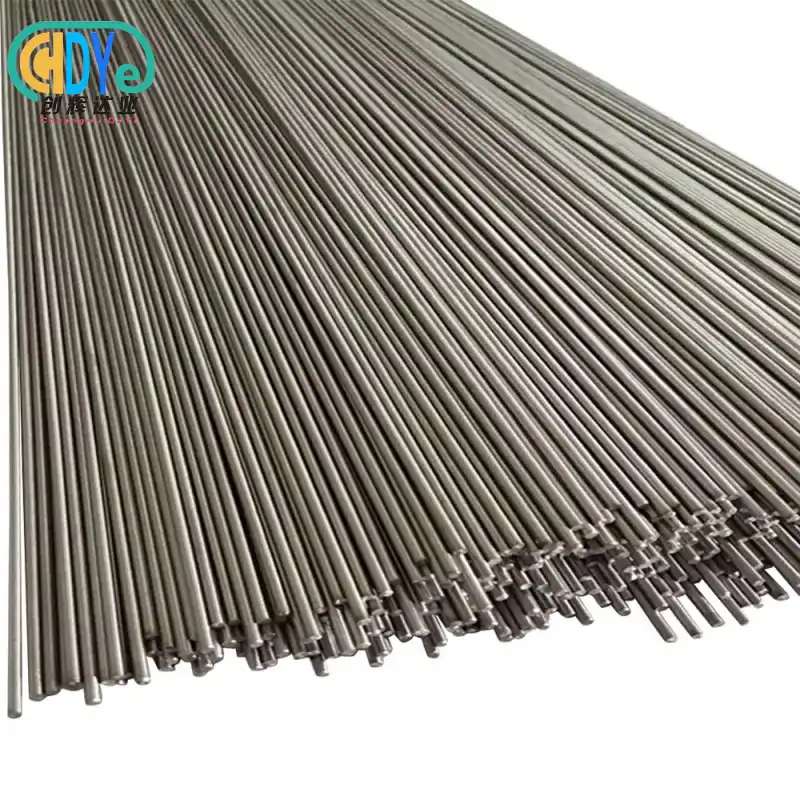
Understanding Straight Titanium Wire: Properties and Specifications
Straight titanium wire is an important material for industrial production because it has great mechanical qualities and can be precisely machined. Unlike regular coiled titanium wire, this special product goes through complex bending steps that get rid of internal stresses and make sure the dimensions stay the same during tough manufacturing processes.
Fundamental Material Properties
The unique properties of titanium wire come from the way it is made and the metals that are used to make it. Titanium is much lighter than steel (it has a mass of 4.54g/cm³) while still being stronger mechanically. The material has the same tensile strength as steel but is 43% lighter, which gives developers more design options than ever before.
Another major benefit is that it doesn't rust, which is especially useful in harsh chemical settings. Titanium surfaces form a natural oxide layer that protects them from rusting in the air and makes them work very well in strong acids, alkalis, and salt. This quality is very useful when making petrochemical equipment and in naval settings, where the longevity of the material has a direct effect on the prices of running the business.
Grade Classifications and Applications
The specs for commercial titanium wire include a number of different types, each of which is best for a certain set of performance needs. Grade 1 titanium is the most flexible and easiest to shape, which makes it perfect for complicated manufacturing tasks that need to be bent or shaped a lot. Grade 2 is the most commonly used grade for general industry uses because it strikes the best mix between strength and workability.
Grade 5 (Ti-6Al-4V) titanium alloy wire is often needed for advanced uses because it has better tensile qualities than 895 MPa. This grade is very important for aircraft structural parts and high-stress mechanical systems that need to be light without sacrificing performance.
Technical Specifications and Quality Standards
In precision manufacturing, it's important to stick to strict guidelines for surface quality and measurement limits. Through advanced vacuum freezing and multi-pass drawing technologies, we are able to keep the linear variation of our straight titanium wire below 0.1 mm per meter. Different construction needs can be met by diameters ranging from 0.5mm to 7.0mm, and lengths ranging from 500mm to 3000mm can be used for both prototype development and mass production.
Comparing Straight Titanium Wire with Other Metals: Making Informed Choices
The choice of material has a big effect on both how well the creation works right away and how well it works in the long run. For procurement pros, knowing how titanium wire stacks up against other materials helps them make choices that are both cost-effective and reliable.
Performance Advantages Over Stainless Steel
Stainless steel wire has long been used in industrial settings because it is easy to find and easy to work with. However, titanium wire has strong benefits that make it worth considering in tough situations. Titanium has a much higher strength-to-weight ratio than stainless steel, which lets designers make lighter parts without sacrificing structural integrity.
Corrosion resistance is probably the most important thing that sets one thing apart from another. Titanium's natural oxide layer protects it better from rusting in a wider range of chemical conditions than stainless steel's chromium content. This benefit means that the product will last longer and need less upkeep in harsh settings.
Cost-Effectiveness Analysis
When it comes to initial material prices, stainless steel and other common metals are better choices. A full lifecycle study, on the other hand, shows that titanium is more cost-effective because it needs less upkeep, needs to be serviced less often, and works more reliably. Straight titanium wire is very light, which makes it easier to handle and lowers the cost of shipping in large quantities.
When engineering teams are looking at different materials, they need to think about the total cost of ownership, not just the starting costs of buying the materials. Titanium's high durability and consistent performance often make its higher price worth it by reducing operating disruptions and increasing the lifetime of parts.
Procuring Straight Titanium Wire: Best Practices and Market Insights
To successfully buy straight titanium wire, you need to know both the technical standards and how the supply chain works. Global makers are becoming more and more aware of how important it is to build trusting relationships with suppliers that guarantee consistent quality and delivery performance while lowering overall buying costs.
Supplier Evaluation Criteria
Quality certifications are a basic need for considering possible sources. With ISO 9001:2015 approval, you can be sure that your quality control systems cover everything from inspecting raw materials to delivering the finished product. Additionally, ASTM B863 approval for commercial uses and ASTM F136 certification for medical uses guarantee that the materials will work consistently and reliably.
A supplier's ability to make things has a big impact on how well it fits certain uses. Modern factories with electron beam furnaces, precision rolling tools, and automatic inspection systems show the high level of technology needed to make high-quality titanium wire. Being close to well-known titanium working hubs, like Baoji in China's "Titanium Capital," usually means having access to specialized knowledge and facilities.
Order Optimization Strategies
Minimum order amounts and wait times vary a lot between providers, which has an effect on how you handle your inventory. When you buy in bulk, you can often save a lot of money and make sure that you have enough materials for long production efforts. Custom specs, such as exact length needs and specific surface finishes, may take longer wait times but offer big benefits in production.
For keeping the line straight during shipping and packaging, it's especially important to think about these things. Professional sellers use special packing systems that keep items from twisting or getting damaged while they are being handled and shipped.
Practical Applications and Fabrication Tips for Straight Titanium Wire
Because straight titanium wire is so flexible, it can be used in many fields where other materials lack the necessary strength. In challenging production settings, getting to know the specific needs of the application and the best ways to make things ensures the best performance and lowest costs.
Aerospace and Defense Applications
A lot of titanium wire is used by aerospace companies to make structural parts that are lighter, which has a direct effect on fuel economy and payload capability. The material can withstand high temperatures and still be mechanically sound up to 600°C, which is very important for engine parts and exhaust systems. Advanced bending methods get rid of feeding jams in automated manufacturing systems, which lets important bolts and structural parts be made quickly.
Titanium's low magnetic permeability makes it useful for defense uses because it can be used in electronic warfare systems and instruments that need to keep electromagnetic interference to a minimum. When you weld, the stress-relieved finish keeps the metal from warping, which keeps the dimensions of precise parts accurate.
Medical Device Manufacturing
Biocompatibility is a very important benefit in medical uses, like making orthopedic implants, surgical equipment, and oral tools out of straight titanium wire. The high malleability of grade 1 titanium makes it possible to shape it into the complex shapes needed for specialized medical equipment. It also keeps its strength for load-bearing uses.
Titanium is not magnetic, so patients can easily undergo MRI treatments after implant surgery. This is a big benefit over alternatives made of stainless steel. Tough cleaning rules must be followed during production, which makes titanium's resistance to contamination very useful in clean production areas.
Chemical Processing Equipment
Due to its resistance to corrosion, titanium wire is essential in chemical processes, where harsh media would quickly break down other materials. Titanium is very good at being chemically compatible and thermally stable, which makes it useful for building heat exchangers, pipe systems, and reaction tank parts.
Because the material works consistently in both strong acids and alkaline solutions, it makes equipment last longer and requires less upkeep. Custom length cutting lets you get the most out of your component designs while cutting down on waste in large-scale production jobs.
Why Choose Chuanghui Daye Straight Titanium Wire for Your Industrial Needs
Shaanxi Chuanghui Daye Metal Material Co., Ltd. has more than 30 years of experience handling rare metals and can provide straight titanium wire that is better than what is required by international quality standards. The fact that our factory is in Baoji, China, which is known as the "Titanium Capital," gives us access to advanced metalworking facilities and expert technical knowledge.
Manufacturing Excellence and Quality Assurance
We can do everything from making titanium sponges to delivering the finished wires all at once. This way, we can make sure that quality is maintained at all times during the manufacturing process. Modern vacuum melting technology makes microstructures that are all the same, which means that mechanical qualities stay the same, and performance is stable. Multiple steps in the cold drawing process make it possible to get very accurate measurements while keeping the material's natural strength.
Batch-to-batch quality consistency that meets the strict needs of aerospace, medical, and chemical processing uses is made possible by real-time process tracking and automated inspection systems. Our dedication to comprehensive quality control across all manufacturing processes is shown by our ISO 9001:2015 certification.
Product Advantages and Customization Capabilities
Our straight titanium wire is better than other options in many ways that make it stand out. The stress-relieved finish stops the metal from warping during the next steps in the production process. This lets precise cutting and welding happen without changing the size of the parts. Different kinds of mirror cleaning can improve both the look and the cleanliness of exposed parts or sterile areas.
The ability to cut to custom lengths meets the needs of each job while reducing material waste. Every wire can be cut, chamfered, or fitted exactly the way the customer wants it. Diameters range from 0.5mm to 7.0mm to meet a wide range of application needs, and lengths of up to 3000mm make it possible to optimize component designs.
Technical Support and Service Excellence
Our technical team offers full help during the whole process of buying and execution. Engineers with decades of experience working with rare metals can offer solution-focused advice that helps customers choose the best materials and methods for production. Flexible order amounts can be used for both making prototypes and making a lot of them.
Logistics services that you can depend on make sure that deliveries happen on time, which supports lean manufacturing and just-in-time inventory management. Dedicated customer service answers questions about personalization and gives expert advice on how to make the manufacturing process run more smoothly.
Conclusion
Straight titanium wire is an important material for businesses that need high strength, resistance to rust, and exact measurements. It works better in aircraft, medicine, chemical processing, and electronics because it has improved metallurgical properties and is made using specialized processing methods. By reading this guide and understanding the technical details, comparative advantages, and best practices for procurement, engineering teams and procurement professionals will be able to make material selection decisions that will lead to both immediate success during fabrication and long-term operational reliability. When you combine the natural qualities of titanium with precise bending methods, you get a solution that can meet even the strictest industrial needs.
FAQ
Q: What are the standard diameter ranges available for straight titanium wire?
A: Standard diameter sizes usually cover 0.5mm to 7.0mm, which makes them useful for a wide range of production needs, from precise work to building structures. Custom diameters may be possible upon request, but regular sizes are usually the best choice for supply and cost.
Q: How does the straightness tolerance of titanium wire compare to other materials?
A: Straight titanium wire of professional quality has a linear variation of less than 0.1 mm per meter, which is much better than the straightness of most other materials. This level of accuracy makes automated feeding systems possible and gets rid of the spring-back problems that come up with twisted options.
Q: Can straight titanium wire be used for things that need to be heated?
A: Titanium wire stays mechanically sound up to 600°C, which means it can be used in high-temperature situations where other materials would break down. The material's ability to stay stable at high temperatures is especially useful in chemical processing and aircraft.
Q: What kinds of licenses do medical-grade titanium wire need?
A: For medical uses, ASTM F136 approval is needed to make sure that the standards for biocompatibility and cleanliness are met for implantable devices. Depending on the intended use and target markets, other certifications may include FDA compliance and meeting specific area regulatory standards.
Q: How does the cost of titanium wire compare to stainless steel alternatives?
A: Initial material costs are higher for stainless steel, but lifetime analysis often shows that titanium is more cost-effective because it needs less upkeep, lasts longer, and performs more reliably. Titanium's high price is often justified by its low total cost of ownership in difficult situations.
Partner with Chuanghui Daye for Premium Straight Titanium Wire Solutions
Shaanxi Chuanghui Daye produces high-quality straight titanium wire that meets strict standards by using advanced manufacturing techniques that have been developed over 30 years of experience in the field. Our factory in China's Titanium Capital is ISO 9001:2015 approved and can meet your most exacting manufacturing needs with its wide range of customization options, flexible order sizes, and on-time delivery. Whether you need a small amount for a trial or a lot for mass production, our technical team is ready to help you with advice and custom solutions. Get in touch with us at info@chdymetal.com to talk about your needs for a straight titanium wire seller and find out how our precision-engineered materials can help your manufacturing.
References
1. American Society for Testing and Materials. "Standard Specification for Titanium and Titanium Alloy Wire." ASTM International, West Conshohocken, 2021.
2. Boyer, Rodney R. "Titanium for Aerospace Applications: A Review of Recent Advances." Materials Science and Engineering Reports, Vol. 73, 2019.
3. International Organization for Standardization. "Quality Management Systems Requirements for Aerospace Applications." ISO Publications, Geneva, 2020.
4. Materials Properties Handbook Consortium. "Comparative Analysis of High-Performance Metal Wires in Industrial Applications." Cambridge Materials Research, 2022.
5. Welding Research Council. "Guidelines for Titanium Wire Applications in High-Temperature Environments." Industrial Welding Journal, New York, 2021.
6. Zhang, Wei et al. "Advanced Manufacturing Techniques for Precision Titanium Wire Production." Journal of Rare Metal Processing, Beijing University Press, 2023.
Learn about our latest products and discounts through SMS or email