- English
- French
- German
- Portuguese
- Spanish
- Russian
- Japanese
- Korean
- Arabic
- Greek
- German
- Turkish
- Italian
- Danish
- Romanian
- Indonesian
- Czech
- Afrikaans
- Swedish
- Polish
- Basque
- Catalan
- Esperanto
- Hindi
- Lao
- Albanian
- Amharic
- Armenian
- Azerbaijani
- Belarusian
- Bengali
- Bosnian
- Bulgarian
- Cebuano
- Chichewa
- Corsican
- Croatian
- Dutch
- Estonian
- Filipino
- Finnish
- Frisian
- Galician
- Georgian
- Gujarati
- Haitian
- Hausa
- Hawaiian
- Hebrew
- Hmong
- Hungarian
- Icelandic
- Igbo
- Javanese
- Kannada
- Kazakh
- Khmer
- Kurdish
- Kyrgyz
- Latin
- Latvian
- Lithuanian
- Luxembou..
- Macedonian
- Malagasy
- Malay
- Malayalam
- Maltese
- Maori
- Marathi
- Mongolian
- Burmese
- Nepali
- Norwegian
- Pashto
- Persian
- Punjabi
- Serbian
- Sesotho
- Sinhala
- Slovak
- Slovenian
- Somali
- Samoan
- Scots Gaelic
- Shona
- Sindhi
- Sundanese
- Swahili
- Tajik
- Tamil
- Telugu
- Thai
- Ukrainian
- Urdu
- Uzbek
- Vietnamese
- Welsh
- Xhosa
- Yiddish
- Yoruba
- Zulu
Lightweight Titanium Coil Tubes for Aerospace Applications
Lightweight titanium coil tubes represent a transformative solution for aerospace applications, delivering exceptional strength-to-weight ratios that modern aviation demands. These precision-engineered components utilize advanced titanium alloys to achieve remarkable performance in heat transfer systems, hydraulic networks, and structural applications. The aerospace industry's relentless pursuit of fuel efficiency and enhanced performance has positioned titanium coil tube technology as an essential component for next-generation aircraft design. Their superior corrosion resistance and thermal conductivity make them indispensable for mission-critical aerospace systems where reliability cannot be compromised.
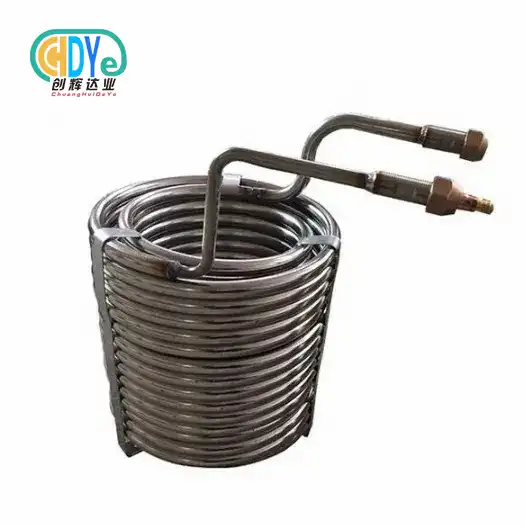
Understanding Titanium Coil Tubes and Their Aerospace Advantages
Titanium coil tubes are precision-manufactured tubing items designed through modern cold rolling and toughening forms, particularly planned for aviation applications. These components overwhelmingly utilize aerospace-grade materials such as Review 5 (Ti-6Al-4V) and Review 9 (Ti-3Al-2.5V) amalgams, which give ideal mechanical properties for demanding flight situations. The fabrication process includes cautious temperature control and exact shaping procedures to accomplish uniform ebb and flow and fabulous roundness characteristics fundamental for aviation execution standards.
Superior Material Properties for Aviation Excellence
The extraordinary properties of titanium coil tubes render them interestingly suited for the demanding aviation situations where ordinary materials like aluminum or stainless steel frequently fail. Their central advantage lies in a natural, prevalent erosion resistance, which is determined by a steady, self-regenerating oxide layer. This guarantees dependable, long-term execution over different and forceful climatic conditions, from coastal salt splash to mechanical poisons, without corrosion. Similarly basic is their exceptional warm resistance; titanium combinations hold remarkable quality and stand up to crawl at hoisted temperatures, keeping up basic keenness beneath the serious warm cycling and extraordinary temperature varieties experienced amid high-speed flight operations, from sub-zero cruising elevations to engine-bay warm. Besides, the crucial trait of a surprisingly tall strength-to-weight proportion specifically translates to upgraded airship effectiveness. By empowering critical diminishments in the weight of liquid movement frameworks, basic components, and warm administration units without compromising security or execution, titanium coil tubes contribute considerably to progressed fuel economy, more prominent payload capacity, and expanded operational range, which are vital targets in advanced flying design.
Diverse Aerospace Applications
The specialized characteristics of titanium coil tubes encourage their broad application over a wide range of basic aviation frameworks. In airframe structures and assistant frameworks, their tall quality and lightweight nature are foremost for accomplishing forceful weight reduction targets, specifically improving fuel productivity and execution. Inside pressure-driven and pneumatic frameworks, the tubes' remarkable erosion resistance and compatibility with different liquids guarantee the long-term stability and security of components controlling flight surfaces and landing equipment, where failure is not an choice. Maybe most outstandingly, they are crucial in advanced natural control frameworks and warm exchangers, counting those for motor oil cooling and aeronautics warm administration, where prevalent thermal conductivity and resistance to both thermal weakness and destructive powers or coolants are required. This fabric flexibility engages engineers to execute imaginative, coordinated designs—such as compact, high-efficiency warm exchange units or lightweight, basically coordinated liquid lines—that optimize generally framework execution, reliability, and productivity in next-generation commercial aircraft, military flying, and shuttle systems.
Titanium Coil Tubes vs. Competing Materials: Making the Optimal Choice
When aviation engineers assess fabric alternatives, titanium coil tubes reliably illustrate considerable focal points over conventional choices such as stainless steel and aluminum tubing frameworks. The weight lessening accomplished through titanium usage straightforwardly impacts airship effectiveness and fuel utilization designs, making quantifiable operational benefits throughout the aircraft's service life. Whereas stainless steel offers satisfactory erosion resistance, it carries critical weight penalties that affect, by and large, airplane execution metrics.
Performance Comparison Analysis
Aluminum tubing, in spite of the fact that lightweight, needs the warmth and erosion resistance required for demanding aviation applications, especially in high-temperature situations or destructive climatic conditions. Titanium coil tubes exceed expectations in both erosion and warm resistance, amplifying component life expectancies beneath extraordinary operational conditions while maintaining reliable execution characteristics. The predominant weakness resistance of titanium guarantees dependable operation beneath cyclic stacking conditions common in aviation applications.
Cost-Benefit Considerations
Although starting obtainment costs for titanium coil tubes may surpass those of customary materials, the lifecycle cost recommendation frequently results in decreased support requirements and expanded substitution intervals. This financial advantage becomes especially critical when considering the add up to fetched of proprietorship, including upkeep downtime, replacement costs, and execution corruption components related with elective materials.
Procurement Guide for Titanium Coil Tubes in Aerospace
Effective obtainment of aerospace-grade titanium coil tubes requires cautious provider assessment and adherence to exacting quality measures established by flying specialists around the world. Certified providers must illustrate compliance with ISO 9001:2015 quality administration frameworks, AMS (Aviation Fabric Details) benchmarks, and other significant aviation certifications that guarantee fabric traceability and execution consistency. The obtainment handle includes exhaustive documentation necessities, counting fabric certificates, test reports, and fabricating handle verification.
Supplier Evaluation Criteria
Successful acquisition methodologies center on surveying provider fabricating capabilities, customization adaptability, and quality confirmation conventions. Key assessment variables incorporate generation capacity adaptability, least arrangement amount adaptability, lead time unwavering quality, and specialized back accessibility. Providers with comprehensive testing offices and certified quality frameworks give extra confirmation for basic aviation applications where fabric execution straightforwardly impacts security and operational efficiency.
Strategic Sourcing Considerations
Bulk obtaining methodologies require an understanding of discount estimating structures and volume markdown openings whereas keeping up with venture planning requirements. Viable provider connections include collaborative arrangement forms that oblige both standard details and custom requirements, guaranteeing ideal fabric arrangements for particular aviation applications.
Company Introduction and Our Aerospace-Grade Titanium Coil Tube Solutions
Shaanxi Chuanghui Daye Metal Material Co., Ltd. brings over three decades of specialized expertise in titanium manufacturing, strategically located in Baoji High-tech Development Zone, widely recognized as China's "Titanium Capital." Our company specializes in precision-engineered titanium coil tubes designed specifically for aerospace applications, utilizing advanced manufacturing processes including precision coiling and controlled annealing to achieve uniform curvature and exceptional roundness characteristics.
Manufacturing Excellence and Quality Assurance
Our state-of-the-art manufacturing facility incorporates advanced equipment, including electron beam furnaces, precision lathes, and sophisticated annealing systems that ensure consistent product quality and performance. We maintain ISO 9001:2015 certification, implementing rigorous quality control protocols throughout the entire production process from raw material inspection through final packaging and shipment. Each titanium coil tube undergoes comprehensive testing to verify mechanical properties, dimensional accuracy, and surface quality standards.
Comprehensive Product Offerings
We offer fully customizable titanium coil tube solutions with flexible design options, including various coil diameters, lengths, and winding configurations to meet specific aerospace system requirements. Our engineering team provides technical support for material selection, specification optimization, and application-specific recommendations that ensure optimal performance in demanding aerospace environments. The combination of advanced manufacturing capabilities and extensive industry expertise enables us to deliver premium solutions that meet evolving aerospace market requirements.
Conclusion
Lightweight titanium coil tubes represent a critical advancement in aerospace materials technology, offering unmatched performance characteristics that directly address industry demands for weight reduction, enhanced efficiency, and superior reliability. The combination of exceptional strength-to-weight ratios, outstanding corrosion resistance, and superior thermal properties positions these components as essential elements in modern aerospace design strategies. As the aviation industry continues evolving toward more sustainable and efficient operations, titanium coil tubes provide the material foundation necessary for achieving ambitious performance targets while maintaining the safety standards that define aerospace excellence.
FAQ
Q: What factors determine the best titanium grade for aerospace applications?
A: Selecting optimal titanium grades involves evaluating specific aerospace requirements, including mechanical strength demands, operating temperature ranges, corrosion resistance needs, and fatigue performance requirements. Grade 5 (Ti-6Al-4V) offers excellent strength and versatility for structural applications, while Grade 9 (Ti-3Al-2.5V) provides enhanced formability for complex coil configurations. Environmental factors such as exposure to salt spray, hydraulic fluids, and temperature cycling also influence grade selection decisions.
Q: How do titanium coil tubes improve aircraft fuel efficiency?
A: Titanium coil tubes contribute to fuel efficiency through significant weight reduction compared to traditional materials, directly decreasing aircraft operating weight and reducing fuel consumption. The smooth internal surface characteristics enhance fluid flow efficiency in hydraulic and heat transfer systems, reducing pumping energy requirements. Additionally, the superior thermal conductivity improves heat exchanger performance, enabling more efficient thermal management systems that optimize overall aircraft energy utilization.
Q: What certifications should aerospace suppliers provide?
A: Reliable aerospace suppliers must provide comprehensive certifications, including ISO 9001:2015 quality management system compliance, AMS material specification conformance, and relevant aerospace industry standards. Material certificates should include complete chemical composition analysis, mechanical property test results, and traceability documentation linking products to specific production batches. Additional certifications, such as AS9100 aerospace quality management and NADCAP special process approval, demonstrate enhanced capability for critical aerospace applications.
Partner with Chuanghui Daye for Superior Titanium Coil Tube Solutions
Aerospace procurement professionals seeking reliable titanium coil tube suppliers can access comprehensive product catalogs and expert technical consultation through Chuanghui Daye's specialized aerospace division. Our engineering team provides detailed specifications, performance data, and application-specific recommendations that ensure optimal material selection for demanding aerospace projects. Contact our technical specialists at info@chdymetal.com to discuss custom requirements, request product samples, and explore volume pricing options that deliver exceptional value for aerospace manufacturing operations.
References
1. Boyer, R., Welsch, G., & Collings, E.W. (2021). Materials Properties Handbook: Titanium Alloys in Aerospace Applications. ASM International Press.
2. Peters, M., Kumpfert, J., Ward, C.H., & Leyens, C. (2020). Titanium and Titanium Alloys: Fundamentals and Applications in Aerospace Engineering. Wiley-VCH.
3. Lutjering, G., Williams, J.C., & Gysler, A. (2019). Microstructure and Mechanical Properties of Titanium Components for Aerospace Systems. Materials Science and Engineering Review.
4. Banerjee, D., Williams, J.C., & Froes, F.H. (2022). Titanium Heat Exchanger Technology: Applications in Aircraft Thermal Management Systems. Aerospace Materials Quarterly.
5. Rack, H.J., Qazi, J.I., & Boyer, R.R. (2021). Processing and Properties of Beta Titanium Alloys for Aerospace Heat Transfer Applications. Journal of Materials Engineering and Performance.
6. Cotton, J.D., Briggs, R.D., & Boyer, R.R. (2020). State of the Art in Beta Titanium Alloys for Airframe Applications: Development and Certification Considerations. Metallurgical and Materials Transactions.

Learn about our latest products and discounts through SMS or email