- English
- French
- German
- Portuguese
- Spanish
- Russian
- Japanese
- Korean
- Arabic
- Greek
- German
- Turkish
- Italian
- Danish
- Romanian
- Indonesian
- Czech
- Afrikaans
- Swedish
- Polish
- Basque
- Catalan
- Esperanto
- Hindi
- Lao
- Albanian
- Amharic
- Armenian
- Azerbaijani
- Belarusian
- Bengali
- Bosnian
- Bulgarian
- Cebuano
- Chichewa
- Corsican
- Croatian
- Dutch
- Estonian
- Filipino
- Finnish
- Frisian
- Galician
- Georgian
- Gujarati
- Haitian
- Hausa
- Hawaiian
- Hebrew
- Hmong
- Hungarian
- Icelandic
- Igbo
- Javanese
- Kannada
- Kazakh
- Khmer
- Kurdish
- Kyrgyz
- Latin
- Latvian
- Lithuanian
- Luxembou..
- Macedonian
- Malagasy
- Malay
- Malayalam
- Maltese
- Maori
- Marathi
- Mongolian
- Burmese
- Nepali
- Norwegian
- Pashto
- Persian
- Punjabi
- Serbian
- Sesotho
- Sinhala
- Slovak
- Slovenian
- Somali
- Samoan
- Scots Gaelic
- Shona
- Sindhi
- Sundanese
- Swahili
- Tajik
- Tamil
- Telugu
- Thai
- Ukrainian
- Urdu
- Uzbek
- Vietnamese
- Welsh
- Xhosa
- Yiddish
- Yoruba
- Zulu
Niobium Wire Benefits for High-Temperature Applications
Niobium wire provides thermal stability, corrosion resistance, and mechanical endurance that very few refractory metals can match. This unique filament is dependable where normal wire does not, with purity levels of more than 99.9% (Nb), tensile strength of 200 to 350 MPa, and a density of 8.57 g/cm3. Whether you’re creating aircraft components, electronic assemblies, or sophisticated industrial systems, knowing what high-purity niobium wire brings to the table in extreme-temperature situations helps you make wiser material selections from the outset.
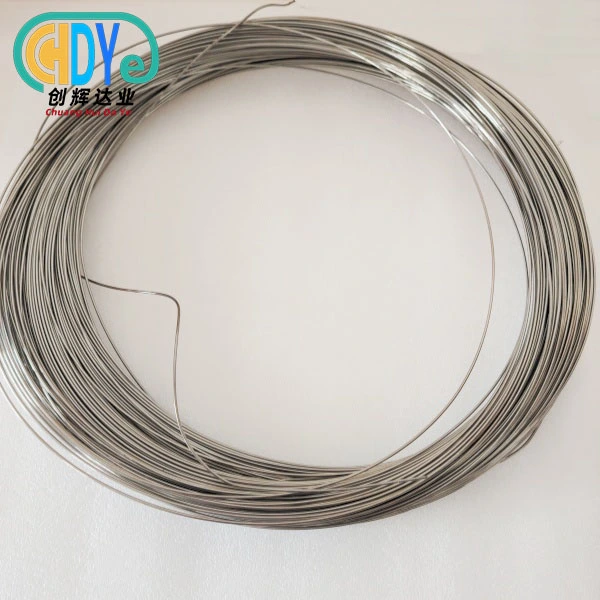
Niobium Wire vs. Alternative Materials for High-Temperature Applications
Selecting the proper wire material for high-temperature duty is a compromise of thermal performance, chemical resistance, fabricability, and total cost of ownership. The comparison of niobium with the most often considered substitutes is as follows:
- Tungsten wire has a higher melting point (3422 °C) but is brittle at ambient temperature, difficult to draw below 0.1 mm without specific equipment, and oxidizes at 400 °C in air. Tungsten is more expensive to machine and needs a more regulated processing environment.
- Molybdenum wire has strong high-temperature strength but oxidizes fast over 600 °C and needs protective atmospheres in most service settings. It is less ductile than niobium, and hence more prone to fracture during fabrication.
- Titanium wire has better corrosion resistance and biocompatibility, but it softens dramatically above 600°C, making it unsuitable for structural applications at extreme temperatures for extended periods. Niobium preserves more tensile strength at temperatures when titanium falls apart.
- Stainless steel and nichrome are cheaper at low temperatures, but begin to creep and corrode in harsh chemical conditions above 800 °C, ranges where niobium wire continues to behave reliably.
These comparisons demonstrate that niobium is a feasible compromise: better thermal capability than titanium or stainless steel, more ductile than tungsten or molybdenum, and competitive long-term durability for thermal cycle regimes. This posture means real savings for procurement teams who focus on lifetime cost, not just unit pricing, in terms of maintenance and replacement cycles.
How Niobium Wire Meets the Challenges of High-Temperature Applications
Thermal and Chemical Resilience Mechanisms
The principal failure mechanisms for wire in high-temperature usage are oxidation embrittlement, creep deformation, and localized corrosion. Niobium’s self-passivating oxide layer directly tackles the corrosion route. It maintains its tensile range of 200-350 MPa throughout long temperature cycles and does not oxidatively degrade at all in vacuum or inert atmospheres, which are normal conditions in semiconductor furnaces, electron beam equipment, and aerospace testing chambers.
Its alloying flexibility is also important. Niobium alloys readily with elements like zirconium and hafnium that further increase service temperature limits and creep resistance, offering design engineers the liberty to expand performance envelopes without changing material families.
Handling and Integration Guidance
Proper treatment maintains the wire’s performance qualities from manufacturer to final assembly. Above 200°C, niobium starts to absorb oxygen and nitrogen and will be embrittled by processing in open air at extreme temperatures. Welding or high-temperature joining must be done under a high-quality argon or helium shield or in a vacuum. Sealed spools are stored in dry, desiccant-equipped facilities to avoid surface oxidation and cross-contamination with ferrous metals. Organic residues from fingerprints may carbonate with successive heat treatments, compromising the surface integrity; thus, handling with clean hands is required.
Once in place, these handling procedures are uncomplicated, and our technical support staff may provide application-specific advice to assist clients in incorporating the wire effortlessly into current production processes.
Procuring High-Quality Niobium Wire: What B2B Buyers Need to Know
Supplier Evaluation Criteria
“A foundation of reliable sourcing is a quality infrastructure that can be verified. Buyers should check that their potential niobium wire provider is ISO 9001:2015 certified and can offer complete traceability paperwork, encompassing raw material inspection, melting records, dimensional verification, and final packing. Purity certifications, based on the ASTM B392 standard, give an objective point of comparison between offers from different vendors.
Flexibility of custom orders is equally vital. Standard catalog items do not address the exact diameter tolerances, surface conditions, or coil configurations commonly required by procurement teams for customized assemblies. A good manufacturer should be able to provide diameter customization in the 0.05–5 mm range with repeatable accuracy.
Pricing Dynamics and Order Planning
Niobium wire price depends on raw material market circumstances, purity grade, and manufacturing complexity. Higher purity grades are more expensive but have lower rejection rates and longer service life – features that reduce overall cost per unit of production, not just landing material cost. Large orders lower the cost per item, whereas small batches or prototypes enable engineering teams to test requirements before committing to large production runs. By planning ahead and dealing with suppliers that have standing inventory of popular diameters, you may reduce the procurement cycle for urgent projects.
Future Trends and Strategic Advantages of Niobium Wire in High-Temperature Industries
The worldwide refractory metal wire market is expected to grow steadily with investments in next-generation aircraft propulsion, solid-state electronics and less invasive medical devices. Across all of these industries, the need for materials that can sustain thermal stability and dimensional accuracy at small scales is increasing – and these are precisely the performance attributes of niobium wire.
For OEMs and distributors, supplying or specifying niobium wire offers a distinct competitive advantage. Products made with superior performance materials are better positioned in markets where dependability and lifespan are key buying factors. Another crucial aspect is supply chain resilience: engaging with a qualified, experienced manufacturer early on eliminates the risk of price fluctuations on the spot market and guarantees constant material quality across production batches.
Developing additive manufacturing and micro-fabrication processes is another path to extend the geometric possibilities of niobium-based components. This opens the way to applications for quantum computing hardware, satellite systems, and high-frequency electronic packaging where the controlled resistivity of fine-diameter wire is a fundamental component.
Conclusion
Niobium wire exhibits a unique combination of features: thermal durability, chemical passivity, mechanical ductility, and bio-inertness, which makes it irreplaceable for demanding applications. This alloy has a purity of over 99.9% Nb, a tensile strength of 200-350 MPa, and diameters of 0.05 to 5 mm, and aims to meet the practical performance limitations engineers confront in aerospace, electronics, chemical processing, and medical device manufacture. Choosing the correct supplier, with proven quality processes, extensive processing knowledge, and timely technical assistance, is just as critical as the material choice itself.
FAQ
1. Why does niobium wire outperform titanium in sustained high-temperature service?
Titanium softens and loses structural integrity above approximately 600°C. Niobium maintains its tensile range of 200–350 MPa at significantly higher temperatures when processed in vacuum or inert atmospheres, making it the preferred choice for applications that require both mechanical load-bearing and thermal endurance simultaneously.
2. How can buyers verify purity before placing a large order?
Request a Certificate of Analysis referencing ASTM B392 alongside third-party spectrometric test reports. Reputable manufacturers provide full traceability from ingot to finished wire, including electron beam melting records and dimensional inspection data.
3. What are typical lead times for custom-diameter orders?
Standard diameters within the 0.05–5 mm range are often available from standing inventory. Custom diameters or special surface conditions typically require two to four weeks depending on order volume and specification complexity. Discussing requirements early with your supplier minimizes schedule risk.
4. Can niobium wire be used in open-air high-temperature processes?
It should not be used in open air above 200°C. Oxygen and nitrogen absorption above that threshold causes embrittlement. Vacuum or inert-gas environments are required for any elevated-temperature application.
5. Is small-batch ordering available for R&D projects?
Yes. Suppliers with flexible manufacturing infrastructure accommodate prototype and small-batch orders, allowing research teams to validate material performance before committing to full production quantities.
Partner with Chuanghui Daye — Your Trusted Niobium Wire Supplier
Shaanxi Chuanghui Daye, based in China's recognized Titanium Capital, brings over 30 years of rare metal manufacturing expertise to every order. Our niobium wire—available at >99.9% purity, 0.05–5 mm diameters, and lengths up to 1,000 mm—is backed by ISO 9001:2015 certification and full traceability documentation. We support custom specifications, competitive factory-direct pricing, and responsive technical guidance. Reach our team at info@chdymetal.com to request a quote today.
References
1. Savitskii, E. M., & Burkhanov, G. S. — Physical Metallurgy of Refractory Metals and Alloys, Consultants Bureau, 1970.
2. ASTM International — ASTM B392: Standard Specification for Niobium and Niobium Alloy Bar, Rod, and Wire, ASTM International, 2022.
3. Lide, D. R. (Ed.) — CRC Handbook of Chemistry and Physics, 97th Edition, CRC Press, 2016.
4. Buckman, R. W. — "New Applications for Niobium Alloys," JOM: Journal of the Minerals, Metals & Materials Society, 2000.
5. Carlen, J. C., & Bryskin, B. D. — "Niobium — A Future Material of Choice," Materials & Manufacturing Processes, Taylor & Francis, 1994.
6. ASM International — ASM Handbook Volume 2: Properties and Selection: Nonferrous Alloys and Special-Purpose Materials, ASM International, 1990.
Learn about our latest products and discounts through SMS or email