- English
- French
- German
- Portuguese
- Spanish
- Russian
- Japanese
- Korean
- Arabic
- Greek
- German
- Turkish
- Italian
- Danish
- Romanian
- Indonesian
- Czech
- Afrikaans
- Swedish
- Polish
- Basque
- Catalan
- Esperanto
- Hindi
- Lao
- Albanian
- Amharic
- Armenian
- Azerbaijani
- Belarusian
- Bengali
- Bosnian
- Bulgarian
- Cebuano
- Chichewa
- Corsican
- Croatian
- Dutch
- Estonian
- Filipino
- Finnish
- Frisian
- Galician
- Georgian
- Gujarati
- Haitian
- Hausa
- Hawaiian
- Hebrew
- Hmong
- Hungarian
- Icelandic
- Igbo
- Javanese
- Kannada
- Kazakh
- Khmer
- Kurdish
- Kyrgyz
- Latin
- Latvian
- Lithuanian
- Luxembou..
- Macedonian
- Malagasy
- Malay
- Malayalam
- Maltese
- Maori
- Marathi
- Mongolian
- Burmese
- Nepali
- Norwegian
- Pashto
- Persian
- Punjabi
- Serbian
- Sesotho
- Sinhala
- Slovak
- Slovenian
- Somali
- Samoan
- Scots Gaelic
- Shona
- Sindhi
- Sundanese
- Swahili
- Tajik
- Tamil
- Telugu
- Thai
- Ukrainian
- Urdu
- Uzbek
- Vietnamese
- Welsh
- Xhosa
- Yiddish
- Yoruba
- Zulu
Can a niobium titanium tube Reduce Maintenance Costs?
A niobium titanium tube may substantially save maintenance costs in harsh industrial situations. The Nb-Ti alloy has superior corrosion resistance, high tensile strength, and excellent structural integrity, increasing component service life and reducing unplanned downtime. Properly specified niobium titanium tubing resists degradation from thermal cycling, chemical exposure, and mechanical stress – the factors that typically drive up repair frequency and replacement budgets in aerospace, medical, and chemical processing applications versus conventional stainless steel or copper tubing.
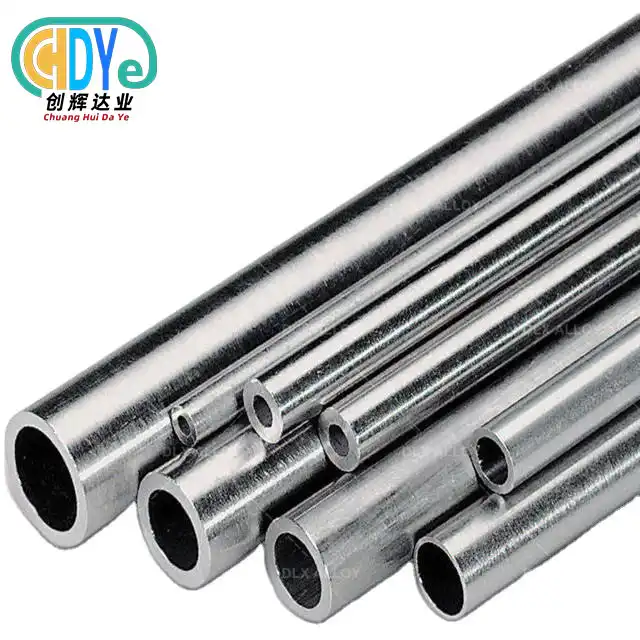
What Exactly Is a Niobium Titanium Tube?
Before we get into the pricing aspect, it’s good to understand what makes this alloy different. Niobium titanium tube is a seamless product made from Nb-Ti alloy, often Nb-47Ti or Nb-50Ti, melted by a vacuum electrode arc furnace or electron-beam furnace for metallurgical uniformity and the removal of hazardous interstitial impurities.
Physical and Mechanical Characteristics
The density of the alloy is 8.6–8.7 g/cm³, and its superconducting transition temperature is 8–10 K. We provide tubes with an outer diameter (OD) of 1 to 200 mm, wall thickness of 0.2 to 10 mm, and lengths of up to 3,000 mm. The seamless structure gives an even wall thickness all around. This immediately decreases the stress concentration sites – the main source of premature fatigue failures in pressurized/cryogenic systems.
Why Composition Matters for Longevity
The titanium presence in the alloy gives rise to a stable self-renewing oxide coating on the surface of the tube. Compared to austenitic stainless steel, this passive layer is significantly more resistant to nitric acid, hydrochloric acid, and strong electrolytes. In settings where standard plumbing fails due to corrosion within months, Nb-Ti alloy tubing remains structurally sound for years—a measurable benefit when determining total lifespan cost.
How Niobium Titanium Tubes Directly Lower Maintenance Expenditure
The link between material performance and maintenance cost is simple: the more time a component functions before failure, the less money procurement and operations teams spend on replacement labor, spare inventory, and production halts. Here are the primary ways that Nb-Ti tubing achieves that result:
- Longer service life: The stable titanium oxide coating avoids pitting and crevice corrosion in chemical processing lines and heat exchangers and extends replacement cycles, which would normally be every 12-18 months with ordinary niobium titanium tube grades.
- Greater mechanical resilience: The alloy has a tensile strength greater than 480 MPa, combined with excellent ductility, allowing it to withstand pressure surges and vibration loading without micro-cracking. This drastically reduces unscheduled maintenance interventions in aerospace hydraulic lines and propulsion support structures.
- Thermal Stability Over Extremes: Nb-Ti retains its structural integrity over a wide temperature range, from cryogenic temperatures (which are critical in MRI and NMR superconducting magnet systems) to high service conditions, avoiding the thermal fatigue failures typical of copper or titanium tubing in hybrid-temperature installations.
- Seamless wall integrity: Manufactured without a weld seam, there are no fusion zones prone to stress corrosion cracking – the single most prevalent failure scenario in welded tubing in hostile media.
These qualities enable facility engineers to increase scheduled maintenance intervals, minimize spare parts inventories, and redirect maintenance manpower to higher-value activities. The net impact on yearly operating budgets is significant in asset-intensive sectors.
Comparing Nb-Ti Alloy Tubing with Conventional Alternatives
A realistic maintenance comparison requires looking at the full cost picture rather than purchase price alone.
Niobium Titanium vs. Stainless Steel
Stainless steel tubing is less expensive initially but will deteriorate to a measurable degree in chloride-containing or acid process conditions. Routine for facilities using stainless steel in chemical applications is yearly inspection and bi-annual replacement. The passive protection of the oxide on Nb-Ti alloy tubes may prolong that replacement cycle much beyond five years under similar operating circumstances – a difference that soon compensates for the greater purchase cost.
Niobium Titanium vs. Pure Titanium
Pure titanium has strong corrosion resistance but does not have the superconducting qualities and the higher tensile strength provided by the niobium element. In cryogenic and magnetic field applications — MRI production, particle accelerator assembly — pure titanium tubing cannot simply play the same structural and functional role. The use of Nb-Ti has the advantage of removing the need for parallel material systems and simplifying procurement.
Niobium Titanium vs. Copper
Copper tubing is still widely used in the manufacture of low-temperature superconductors due to its electrical conductivity. Copper is softer in a mechanical sense and is also more prone to corrosion in non-neutral situations. In superconducting billet assembly, Nb-Ti niobium-titanium tubes are used as diffusion barriers and as cladding sleeves to prevent copper contamination in multifilamentary wire topologies. Copper cannot perform this function; Nb-Ti is the sole alternative independent of cost.
What Aerospace and Medical Sectors Have Observed
The case for maintenance savings is supported by evidence from industrial applications. Analyzes of recorded service life in aerospace materials journals indicate that components fabricated from high-strength refractory alloys frequently outperform by a factor of two to three the service life of stainless steel counterparts in aircraft hydraulic systems in corrosive or high-vibration situations. In the manufacture of MRI superconducting magnet windings with Nb-Ti cladding and barrier sleeves, the critical current density is maintained for multi-decade service lifetimes, with no deterioration, which is one of the major reasons why NbTi continues to be the worldwide standard for clinical MRI systems.
The biocompatibility and dimensional stability of the alloy are especially attractive to medical device makers who use Nb-Ti tubing for implant-adjacent components and surgical tools, leading to lower instrument rejection and recalibration rates during quality audits.
Procurement Considerations Before Placing an Order
Here are the validation factors you should pay attention to if you are a procurement manager looking for a supplier of Nb-Ti alloy tubes. The material chemical composition is documented by ICP-OES or GDMS analysis, and the interstitial impurities (oxygen, nitrogen) are kept below 150 ppm to avoid embrittlement. Laser micrometer and ultrasonic testing to ASTM E213, with dimensional data, establish wall uniformity and subsurface flaw detection prior to shipping.
Customization capability is also operationally important. Standard sizes in this alloy are not common, and most applications need custom OD/wall combinations. A supplier that has electron-beam melting, rolling, and precision machining capabilities in-house may provide unique geometries without the delays of outsourcing – a substantial benefit when project schedules are constrained.
The ISO 9001:2015 certification gives independent assurance that a supplier’s quality management system has consistent controls from raw material inspection to final packing.
Conclusion
The data is consistent: niobium titanium tubes reduce maintenance costs by extending service life, resisting corrosion, and eliminating the structural weak points associated with welded or lower-performance alternatives. For aerospace, chemical processing, cryogenic, and medical applications, the lifecycle economics favor Nb-Ti alloy tubing decisively over conventional options. The higher initial procurement investment returns measurable savings across reduced downtime, fewer replacements, and lower inspection frequency — making it a strategically sound material choice for operations where reliability is non-negotiable.
FAQ
1. What maintenance problems do conventional metal tubes typically cause?
Standard stainless steel and copper tubes corrode, fatigue, and crack under cyclic thermal or mechanical stress, requiring frequent inspection and unplanned replacement. These interruptions generate both direct repair costs and indirect production losses that compound over time.
2. How does corrosion resistance in Nb-Ti tubing translate to cost savings?
The titanium-derived passive oxide layer prevents surface pitting and stress corrosion cracking, the two leading causes of premature tube failure in chemical and cryogenic environments. Extending the replacement cycle from annual to multi-year intervals reduces spare inventory spend and maintenance labor substantially.
3. Can Nb-Ti tubes be customized to specific dimensional requirements?
Yes. OD ranges from 1 to 200 mm, wall thickness from 0.2 to 10 mm, and lengths up to 3,000 mm are achievable through precision seamless manufacturing. Custom alloy compositions beyond standard Nb-47Ti and Nb-50Ti grades are also available for specialized performance requirements.
4. What certifications should I request from a supplier?
Request ISO 9001:2015 certification, full chemical composition test reports, ultrasonic inspection records per ASTM E213, and dimensional inspection documentation for every production lot.
Partner with Chuanghui Daye for Reliable Niobium Titanium Tube Supply
Shaanxi Chuanghui Daye, based in China's Titanium Capital — Baoji, Shaanxi — manufactures ISO 9001:2015-certified niobium titanium tubes using electron-beam furnace technology and seamless forming processes. As a trusted niobium titanium tube supplier, we offer competitive factory-direct pricing, full traceability documentation, and custom dimensions for global B2B orders. Contact our technical team at info@chdymetal.com to request specifications, samples, or a quotation.
References
1. Journal of Superconductivity and Novel Magnetism — "Critical Current Density and Microstructure in NbTi Alloys," 2019.
2. Materials Science and Engineering: A — "Corrosion Behavior of Titanium-Based Alloys in Acidic Environments," 2020.
3. Cryogenics — "Performance Degradation and Maintenance Analysis of Superconducting Magnet Systems," 2018.
4. Aerospace Science and Technology — "Lifecycle Cost Assessment of Refractory Metal Tubing in Hydraulic Systems," 2021.
5. ASTM International — ASTM E213: Standard Practice for Ultrasonic Testing of Metal Pipe and Tubing, 2022.
6. International Journal of Pressure Vessels and Piping — "Stress Corrosion Cracking in Welded vs. Seamless Tubing Under Cyclic Loading," 2017.
Learn about our latest products and discounts through SMS or email