- English
- French
- German
- Portuguese
- Spanish
- Russian
- Japanese
- Korean
- Arabic
- Greek
- German
- Turkish
- Italian
- Danish
- Romanian
- Indonesian
- Czech
- Afrikaans
- Swedish
- Polish
- Basque
- Catalan
- Esperanto
- Hindi
- Lao
- Albanian
- Amharic
- Armenian
- Azerbaijani
- Belarusian
- Bengali
- Bosnian
- Bulgarian
- Cebuano
- Chichewa
- Corsican
- Croatian
- Dutch
- Estonian
- Filipino
- Finnish
- Frisian
- Galician
- Georgian
- Gujarati
- Haitian
- Hausa
- Hawaiian
- Hebrew
- Hmong
- Hungarian
- Icelandic
- Igbo
- Javanese
- Kannada
- Kazakh
- Khmer
- Kurdish
- Kyrgyz
- Latin
- Latvian
- Lithuanian
- Luxembou..
- Macedonian
- Malagasy
- Malay
- Malayalam
- Maltese
- Maori
- Marathi
- Mongolian
- Burmese
- Nepali
- Norwegian
- Pashto
- Persian
- Punjabi
- Serbian
- Sesotho
- Sinhala
- Slovak
- Slovenian
- Somali
- Samoan
- Scots Gaelic
- Shona
- Sindhi
- Sundanese
- Swahili
- Tajik
- Tamil
- Telugu
- Thai
- Ukrainian
- Urdu
- Uzbek
- Vietnamese
- Welsh
- Xhosa
- Yiddish
- Yoruba
- Zulu
OEM Polishing Tantalum Rod: Custom Specs and Services
Buyers who order tantalum for chemical equipment, laboratory instruments, or high-temperature systems rarely want a standard catalogue item. They want a rod that matches their drawings, fits their tolerances, and arrives with a surface finish that suits the job. That is where OEM service becomes valuable. A polishing tantalum rod made to custom specifications gives engineers a pure, corrosion-resistant material with a smooth, clean surface, produced in the diameter and length their project requires. This article explains the core specifications, the customisation options, and the production and quality systems behind an OEM polishing tantalum rod, so you can order with confidence and avoid costly rework.
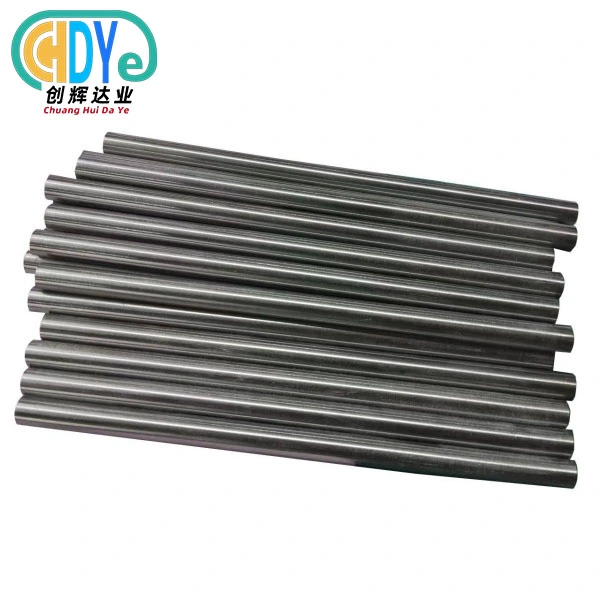
Core Specifications of a Polishing Tantalum Rod
Purity and Chemical Composition
Purity is the first consideration of any tantalum order. Shaanxi Chuanghui Daye polishing tantalum rod is made of tantalum with a purity greater than 99.95%, which possesses excellent chemical inertness. The purity of the rod makes it resistant to attack by most acids, including hot concentrated acids that will quickly damage stainless steel and many nickel alloys. Such stability is important for laboratories and chemical plants, protecting both the equipment and the process by ensuring the rod does not release contaminants into sensitive solutions. High purity also aids in consistent machining behaviour and a consistent polished surface, batch to batch.
Dimensions, Density, and Mechanical Properties
Our polished tantalum rod is available in diameters from 1 to 50 mm, with length made as you request. The density is 16.65 g/cm³, and the tensile strength is in the range of 200-300 MPa, which reflects the soft, ductile character of pure tantalum. The ductility is a plus if you need to cut, turn, bend, or form parts without cracking. Engineers can count on the rod to maintain dimensions during machining and to retain its structural integrity even in extreme conditions. Aligning these properties with your design early avoids over-specification and helps keep project costs down.
Polished Surface Quality and Finish Options
It’s not just cosmetics to have a nice surface on a polishing tantalum rod. A smooth, polished finish reduces the number of places where residue, particles, or corrosive media can collect, making cleaning faster and more reliable. That’s important in lab work and in chemical processing, where contamination control is key. It also improves the appearance of the finish and helps parts fit more closely into seals, holders, and fixtures. Each rod is precision machined and polished prior to final inspection, so buyers are getting a surface that meets the requirements that they have agreed to, and OEM customers can discuss the exact finish level their application requires.
The table below summarises the standard specifications of our polishing tantalum rod.
| Parameter | Specification |
|---|---|
| Material | Tantalum, purity above 99.95% |
| Diameter | 1–50 mm |
| Length | As requested by the customer |
| Density | 16.65 g/cm³ |
| Tensile strength | 200–300 MPa |
| Surface | Polished |
| Main applications | Chemical processing, laboratory use |
OEM Customisation Services for Polishing Tantalum Rod
Custom Diameters and Cut-to-Length Orders
Standard stock does not include a polishing tantalum rod in the sizes that OEM purchasers usually require. Diameters from 1 to 50 mm are available, and we can cut each rod to the length specified on your drawing, saving you the time and material involved in cutting oversize stock in your own shop. Accurate sizing also reduces handling steps and enables your team to move from material receipt to finished part more quickly. If your project requires a lot of different lengths, we can schedule production to minimise waste and package the rods carefully to protect the polished surface while shipping.
Tailored Surface Finishing and Precision Machining
Many customers ask for specific surface requirements or additional machining beyond the standard polish. In our workshop, we have lathes, rolling machines, and sawing and shearing equipment. Consequently, a polished tantalum rod can be turned, ground, and finished to your tolerances. We also manufacture deep-processed tantalum parts like sheets, crucibles and fabricated components for high-temperature and corrosion-resistant applications. At the start, we recommend sharing your drawings, roughness targets, and tolerance limits so our engineers can recommend a practical route and flag any potential problems before production starts. This way, the finished part works as intended.
Flexible Order Quantities and Technical Support
Not every project needs a big batch. Industrial buyers repeat orders for production. Research labs may need a few rods for testing. We support both, and our team answers technical questions on grade selection, machining behaviour, and handling. Our staff has more than 30 years of experience with rare metals and can help you decide whether a polished tantalum rod is the best option or if a related product such as niobium, tungsten, or molybdenum would be a better fit for you. From quote to delivery, straightforward communication means your schedule is predictable and your costs are transparent.
| Customisation Option | What You Can Specify |
|---|---|
| Diameter | Any size from 1 to 50 mm |
| Length | Cut to your requirements. |
| Surface finish | Polished, to agreed quality |
| Machining | Turning, cutting, and shaping to drawings |
| Quantity | Small trial lots to repeat production |
Manufacturing and Quality Control Behind Every Polished Tantalum Rod
From Tantalum Ingot to Finished Rod
A good polishing tantalum rod begins with high-grade tantalum ingots. These ingots are then worked by cold working methods such as forging, rolling, and drawing to shape the material and refine its structure. Annealing furnaces and electron beam furnaces ensure purity and homogeneous mechanical behaviour. Rolling machines reduce the rod to its final dimension. Tantalum is a costly and difficult metal to process, so each step is carefully controlled to avoid contamination and surface defects. The result is a rod with stable properties and a clean base for the final polishing.
Precision Machining and Polishing Process
The rod thus formed goes to precision machining and polishing. Lathe and finishing equipment will remove the surface marks and bring the diameter to the needed tolerance. Polishing will then create the smooth finish that customers expect. At this stage, the polishing tantalum rod must be handled with care, as tantalum is soft and can easily be scratched. Our operators use proven procedures to protect the surface and maintain accurate dimensions. At this point, doing this work carefully reduces rejects, reduces your lead time, and helps you make sure that every rod looks and performs as your specification says it should.
ISO 9001:2015 Inspection and Packaging
Quality is the heart of our competitiveness. Shaanxi Chuanghui Daye has obtained ISO9001:2015 Quality Management System certification, which means that the whole process is controlled from the inspection of raw materials to melting and forging, machining and forming, and final inspection and packaging. Each polishing tantalum rod is checked for dimensional accuracy and surface quality before dispatch from the factory. Protective packaging is used to maintain the finish during transit. The company is located in the Baoji High-tech Development Zone, known as China's 'Titanium Capital', with convenient transportation and a sound industrial base, which can guarantee stable delivery.
| Production Stage | Purpose |
|---|---|
| Ingot selection | Start with high-grade tantalum. |
| Cold working | Forge, roll, and draw to shape |
| Machining and polishing | Reach tolerance and surface requirements |
| Final inspection | Confirm dimensions and surface quality. |
| Packaging | Protect the finish during shipping. |
Conclusion
An OEM polishing tantalum rod gives chemical, laboratory, and high-temperature users a pure, corrosion-resistant material in the exact size and finish they need. With purity above 99.95%, flexible diameters and lengths, and a carefully polished surface, it helps reduce contamination and extend equipment life. Shaanxi Chuanghui Daye backs every order with over 30 years of experience, modern forging, rolling, and machining equipment, and ISO 9001:2015 quality control. Share your requirements with our team and receive reliable, cost-effective material built to your specifications.
FAQ
Q: What purity does your polishing tantalum rod have?
A: Our rods are made from tantalum with a purity above 99.95%, which provides excellent corrosion resistance and chemical inertness.
Q: What sizes can I order?
A: Diameters range from 1 to 50 mm, and the length is made as you request, so you can order exactly what your drawing requires.
Q: Where is a polishing tantalum rod typically used?
A: It is commonly used in chemical processing, laboratory equipment, and high-temperature environments where corrosion resistance and a clean, smooth surface matter.
Q: Can you produce rods to my own drawings?
A: Yes. We offer OEM service, including custom diameters, cut-to-length orders, and machining to your tolerances. Send us your drawings, and we will recommend a practical production route.
Q: How do you ensure quality?
A: We operate under ISO 9001:2015 certification and inspect each stage, from raw material and forging to machining, final inspection, and packaging.
Get Your Custom Polishing Tantalum Rod Quote Now
Do you need a polishing tantalum rod made to your exact diameter, length, and surface requirements? Shaanxi Chuanghui Daye Metal Material Co., Ltd. is ready to help with high-purity material, advanced equipment, and more than 30 years of rare metal experience. Send us your drawings, quantities, and application details, and our team will respond with a clear proposal and a competitive quote. Contact us today at info@chdymetal.com to request samples, technical data, or OEM support, and let us help you get dependable tantalum parts delivered on time.
References
1. Cardarelli, F. Materials Handbook: A Concise Desktop Reference. Springer, 2018.
2. Cardonne, S. M., Kumar, P., Michaluk, C. A., and Schwartz, H. D. "Tantalum and Its Alloys. "International Journal of Refractory Metals and Hard Materials, 1995.
3. Black, J. "Biological Performance of Tantalum. "Clinical Materials, 1994.
4. Levine, B. R., Sporer, S., Poggie, R. A., Della Valle, C. J., and Jacobs, J. J. "Experimental and Clinical Performance of Porous Tantalum in Orthopaedic Surgery." Biomaterials, 2006.
5. Balla, V. K., Bodhak, S., Bose, S., and Bandyopadhyay, A. "Porous Tantalum Structures for Bone Implants: Fabrication, Mechanical, and In Vitro Biological Properties." Acta Biomaterialia, 2010.
6. ASTM International. ASTM B365: Standard Specification for Tantalum and Tantalum Alloy Rod and Wire.
Learn about our latest products and discounts through SMS or email