- English
- French
- German
- Portuguese
- Spanish
- Russian
- Japanese
- Korean
- Arabic
- Greek
- German
- Turkish
- Italian
- Danish
- Romanian
- Indonesian
- Czech
- Afrikaans
- Swedish
- Polish
- Basque
- Catalan
- Esperanto
- Hindi
- Lao
- Albanian
- Amharic
- Armenian
- Azerbaijani
- Belarusian
- Bengali
- Bosnian
- Bulgarian
- Cebuano
- Chichewa
- Corsican
- Croatian
- Dutch
- Estonian
- Filipino
- Finnish
- Frisian
- Galician
- Georgian
- Gujarati
- Haitian
- Hausa
- Hawaiian
- Hebrew
- Hmong
- Hungarian
- Icelandic
- Igbo
- Javanese
- Kannada
- Kazakh
- Khmer
- Kurdish
- Kyrgyz
- Latin
- Latvian
- Lithuanian
- Luxembou..
- Macedonian
- Malagasy
- Malay
- Malayalam
- Maltese
- Maori
- Marathi
- Mongolian
- Burmese
- Nepali
- Norwegian
- Pashto
- Persian
- Punjabi
- Serbian
- Sesotho
- Sinhala
- Slovak
- Slovenian
- Somali
- Samoan
- Scots Gaelic
- Shona
- Sindhi
- Sundanese
- Swahili
- Tajik
- Tamil
- Telugu
- Thai
- Ukrainian
- Urdu
- Uzbek
- Vietnamese
- Welsh
- Xhosa
- Yiddish
- Yoruba
- Zulu
Polishing Tantalum Rod Process Explained Step by Step
To achieve a perfect mirror finish on polishing tantalum rod, they need to go through an organized grinding process that turns raw materials into precise parts that are used in important industrial processes. This complete process starts with carefully preparing the material, then moves on to mechanical and chemical finishing steps, and ends with a thorough check of the quality. Every step builds on the one before it to get rid of surface flaws while keeping the rod's exact dimensions and chemical purity. Knowing how this process works helps purchasing teams figure out what suppliers can do and make sure they obtain tantalum bars that meet strict requirements for making semiconductors, chemicals, and medical devices.
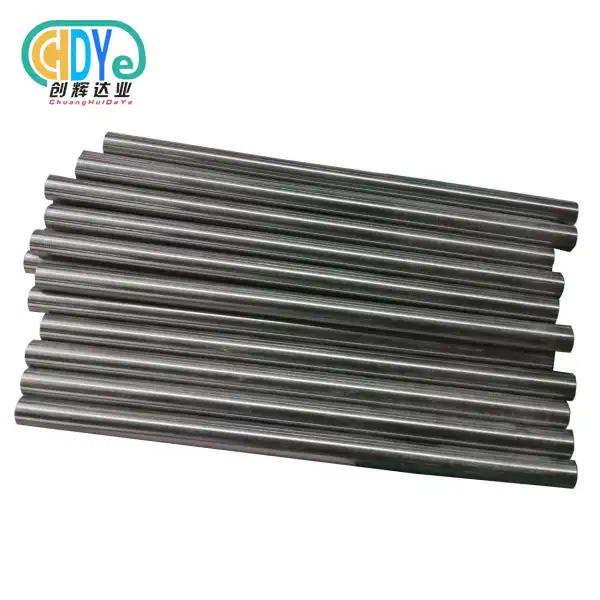
Understanding Polishing of Tantalum Rods
Tantalum is hard to clean because it has special properties that make it difficult, but necessary. Tantalum is used in high-stress industries where surface quality affects performance directly because it has a melting point higher than 3000°C and is very resistant to rust in harsh chemical conditions. Polishing tantalum rods gets rid of tiny flaws, rust layers, and machine lines that were there from earlier stages of the manufacturing process. This leaves a smooth surface that improves both the function and appearance of the item.
Why Does Surface Quality Matter for Tantalum Components?
The shine on the surface of tantalum parts has a direct effect on how well they work in harsh circumstances. In acidic conditions, tiny scratches and rough spots on the surface can cause stress corrosion cracks to start. In semiconductor uses, rough surfaces cause dust pollution in vacuum tanks, which lowers the rate of production. Medical implants need clean surfaces so that bacteria don't stick to them and the tissue can grow into them. Tantalum is malleable, which means it doesn't crack when finely polished, but its density of 16.65 g/cm³ means that you need to use special tools and methods to work with it.
Benefits Beyond Appearance
You can measure how polished tantalum rods function better in a number of ways. Getting rid of surface flaws increases fatigue life by 30-40% compared to areas that are only ground. When polished surfaces get more uniform passive oxide layers, corrosion resistance goes up. When used in high-temperature situations, smooth surfaces spread out heat stress better. Chemical manufacturing equipment made from polished bars breaks down less often and requires less frequent servicing. The total cost of ownership for end users goes down because of these benefits.
Material Properties Influencing Polishing Approaches
Because tantalum hardens when it is worked on, the conditions for cleaning must be carefully managed. When mechanically cleaning, too much pressure can heat the surface, which can change the grain. Because the metal reacts strongly with air at high temperatures, controlled atmospheres are needed for some finishing steps. Because tantalum doesn't react with most acids, chemical cleaning is easier, but there aren't as many media choices. Understanding these features of the material helps makers come up with cleaning methods that improve the quality of the surface while keeping the dimensions of rods, from 1 mm to 50 mm in diameter, within ±0.02 mm.
Step-by-Step Polishing Tantalum Rod Process
Polishing tantalum rod from its as-drawn state to a mirror-polished surface takes more than one step, and each step focuses on a different aspect of the surface. The whole process includes mechanical, chemical, and quality control steps that work together to keep the material's high purity (over 99.95%) and get surface roughness values below Ra 0.8 μm.
Preparation and Initial Inspection
The process starts with a full evaluation of the object. Precision micrometers check the diameters of incoming tantalum bars to ensure they are the same size. Visual inspection with a magnifying glass finds surface flaws that were there before, like die marks, spots, or rust coloring. Ultrasonic cleaning gets rid of leftovers from production and handling. This step sets the starting point and helps the operators choose the right sandpaper grades for the first cleaning steps.
Each batch comes with material tracking paperwork, and spectroscopic analysis confirms the alloy's makeup. Sorting rods by diameter range and length makes it easier to set up machines and cuts down on switching time. Any rods with cracks, deep scratches, or strange chemical patterns are separated and sent back to be processed again or thrown away. With this upfront quality check, flawed material can't get to the more expensive finishing steps.
Mechanical Polishing Methods
Centerless grinding starts the mechanical finishing process by making the width uniform and getting rid of larger surface flaws. The rod moves between a grinding wheel and an adjusting wheel while being held up by a work plate. This removes stock evenly without the need to center it. Operators move on to finer and finer grit silicon carbide or aluminum oxide abrasives, usually starting with 120 grit and going through 220-, 400-, and 600-grit steps.
Each pass of the grinding wheel takes between 0.05 and 0.15 mm of material and smooths out the surface. The flow of coolant stops damage from heat and gets rid of swarf. Ultrasonic cleaning is done on rods between grit changes to get rid of any gritty bits that might be stuck in the surface and scratch it during later finer-grit operations. Periodically rotating the object's position stops directional grain formation and makes sure that the surface has properties that are the same in all directions.
Belt polishing comes after grinding. It uses flexible rough belts that fit the rod's cylindrical shape. This stage goes from 800 grit to 1200 grit, which makes the surface roughness even smoother. To keep the temperature from building up in one area, the belt speed, contact pressure, and rotation rate are all carefully managed. Skilled workers constantly check the surface's look and make changes to the settings to keep the finish the same along the whole length of the rod.
Chemical and Electrochemical Polishing Techniques
Chemical cleaning uses controlled amounts of acid mixes to break down surface material, smoothing out tiny bumps that were left behind by mechanical processes. The amounts of hydrofluoric acid, sulfuric acid, and nitric acid in a standard tantalum chemical polish solution are carefully controlled. Rods are submerged for exact amounts of time, and the temperature of the solution is kept within narrow ranges. This method takes away 0.01-0.03mm of material, leaving a surface that is very rough, close to Ra 0.4μm.
The chemical attack gets rid of high points and flaws more efficiently, leaving a surface that is very smooth. But dimensional control needs close attention because breakdown rates change depending on how old the solution is, how the temperature changes, and how dirty the bath is. Throughout the process, operators measure the width more than once, taking out the rods when the goal measurements are reached.
Electrochemical cleaning gives you better control for important tasks. The tantalum stick is the anode in an electrolytic cell, and a controlled current dissolves the stuff on the surface. Surface grades below Ra 0.2μm can be made with this method, and tight limits on dimensions are kept. The process makes a thin, even layer of inactive oxide that makes the metal more resistant to rust. Environmental controls keep acid mist and hydrogen gas from being made, which keeps people and equipment safe.
Quality Assurance Protocols and Measurement Criteria
A final check makes sure that the cleaned bars meet the standards in a number of different ways. Using contact profilometers to measure surface roughness confirms Ra values at certain points along the length of the rod. An optical microscope at 50–100x resolution can find scratches, pits, or pollution that is still embedded. Measuring the diameter every 300mm makes sure that the sizes stay the same within the error bands. Polishing tantalum rods requires these rigorous verification steps to ensure consistency.
Non-destructive testing finds flaws below the surface that could affect performance. Ultrasonic testing finds holes or other problems inside something. In some situations, dye penetrant testing is needed to find flaws that break through the surface that can't be seen. Each package comes with material proof papers that include spectroscopic analysis results, data on size inspections, and measures of the surface finish.
Traceability systems connect each finished rod to its original ingot, which lets problems in the field be looked into. According to statistical process control charts, key factors are tracked across production batches. These charts find trends that could mean that equipment is breaking down or the process is moving off track. This complete quality system makes sure that the result always meets the standards of the aircraft, electronics, and medical device industries.
Comparison of Polishing Methods and Alternatives
To choose the best way to finish something, you need to know how the different methods affect the surface, the cost of processing, and the qualities of the material. Depending on the needs of the application and the amount of product being made, each method has its own pros and cons.
Tantalum Versus Tungsten and Titanium Polishing
Finishing methods are greatly affected by the qualities of the materials used. Because tantalum is flexible, it can be used to make better surface finishes than tungsten, which is hard to clean because it is rigid. Tantalum can get finishes as thin as Ra 0.2 μm, while tungsten usually gets finishes between Ra 1.0 and 1.5 μm. On the other hand, titanium's lower density makes it easier to work with, but its reactive surface chemistry makes chemical cleaning more difficult. It needs controlled atmospheres to keep it from oxidizing while it's being worked on.
The costs of processing these products are very different. The hardness of tungsten speeds up abrasion wear, which raises the cost of consumables. Because titanium tends to gall when it is machined, it needs special cutting fluids and tools. Tantalum is in the middle. It has a medium level of tool wear and is easy to work with, but the higher cost of its raw materials affects the total price of its parts.
Chemical Versus Mechanical Polishing Approaches
Because mechanical methods are so good at controlling dimensions and forming grains in a certain way, they can be used to make parts that need to be very precise. The process is pretty easy to manage, and it doesn't make a lot of dangerous trash. But mechanical cleaning changes the subsurface and can insert gritty particles, which could cause stress peaks in high-cycle wear situations.
Chemical cleaning gets rid of mechanical damage below the surface and makes surfaces that are very regular and don't have any directional features. This method can get into cracks and complicated shapes that motorized tools can't. Still, chemical processing needs to be done with care because it involves handling dangerous materials, keeping the temperature and makeup just right, and creating acidic waste streams that need to be treated. Controlling dimensions is not as accurate as using machines.
Combining the two ways into a hybrid approach often gets the best results. It is easy to get rid of heavy stock and get accurate measurements with mechanical polishing. After that, chemical polishing gets rid of any remaining mechanical damage and improves the surface finish. This mix finds a good balance for polishing the tantalum rod between how quickly the work is done and how good the surface needs to be.
Analysis of Long-Term Durability and Cost-Efficiency
Compared to other finishes, polished surfaces last longer and look better over time. Physical vapor deposition and other coating technologies can improve the qualities of surfaces, but they make processing more difficult and may separate when heated and cooled many times. Surfaces that have only been ground keep machine marks that speed up the start of localized rusting.
A life cycle cost study indicates that a bigger original investment in cleaning often leads to lower total ownership costs. Equipment made from polished tantalum bars lasts longer between repair visits, which lowers the cost of downtime. Better resistance to rust makes parts last longer, which delays the need to buy new ones. In electronics and pharmaceutical uses, smooth surfaces that don't shed particles as easily increase product rates. This makes up for higher material costs by increasing efficiency.
Procurement Considerations for Polished Tantalum Rods
To find high-quality polished tantalum rods, you need to look at sources in more than just terms of price. To make sure that materials always work well, people who work in procurement have to look at expert skills, quality processes, and the dependability of the supply chain.
Selecting Trustworthy Suppliers and Certifications
ISO 9001:2015 approval is a basic way to make sure that sellers keep their quality management systems well-documented. Critical applications, on the other hand, need more checks. Third-party registers should check the facilities of your suppliers and make notes of any problems or actions that need to be taken to fix them. Ask for proof of industry-specific approvals, like AS9100 for aircraft uses or ISO 13485 for medical equipment.
Customer recommendations about polishing tantalum rod can tell you a lot about how well a seller does their job. Talk to businesses in the same line of work to find out how often they deliver on time, how quickly they answer expert questions, and how well they solve problems. Check the abilities of the supplier's expert staff. Experienced metallurgists and process engineers show that the company has more skills than sales-focused companies.
Cost and wait time are affected by where the factory is located. The Shaanxi Chuanghui Daye Metal Material Co., Ltd. is based in Baoji, which is known as China's Titanium Capital. It has access to skilled workers, an established system for handling rare metals, and supply lines that work together. This knowledge of the area, along with more than 30 years of experience in the field, makes production efficient and allows factory-direct prices to be low without lowering quality standards.
Order Processes and Supply Chain Optimization
Economically, the size of a production batch usually determines the minimum order quantity. Standard polished tantalum rods come in sizes from 1mm to 50mm, are more than 99.95% pure, and have a tensile strength of 200 to 300 MPa. The minimum order quantity is usually 10 to 20 pieces per diameter. For setup costs to be worth it, higher minimums may be needed for custom sizes or specialized tests. Talk about possibilities for merging where multiple sizes can be handled at the same time to lower costs per unit.
Lead times depend on how quickly materials can be sourced and how busy the factory is. Standard specs using stock bars usually take three to four weeks from the time an order is confirmed until it is shipped. It could take 6 to 8 weeks for custom combinations or sizes. Setting up blanket purchase orders with planned releases helps sellers plan production more efficiently and makes sure you have the materials you need on time for your projects.
Logistics issues have a big effect on the total landing costs. Tantalum's high density makes it heavier to ship—a meter-long rod with a 50mm diameter weighs about 130kg. Combine packages to get the most out of each container. Make sure that the suppliers you work with properly package rods with protected covers and moisture shields to keep them from getting damaged during transport and handling.
Pricing Factors and Negotiation Strategies
The price of raw tantalum changes depending on how supply and demand change around the world. Keep an eye on metal product prices to see how changes in the market affect the cost of base materials. Processing costs are affected by how hard it is to polish. For example, finishes below Ra 0.4 μm cost 15–25% more to process than normal Ra 0.8 μm finishes because they need more work and quality control.
There are several ways that customization affects prices. For non-standard sizes, special machine setups are needed. When end-squaring, lengths that are longer than usual production runs may result in more scrap. Adding more paperwork for testing or licensing raises the cost of running the lab and managing the tests. When you ask for quotes, be sure to spell out all of your needs, such as the size and shape limits, surface finish specifications, testing procedures, and paperwork that you need.
Making promises about volumes strengthens bargaining positions. Suppliers can make the best use of production plans and raw material purchases with the help of annual purchase deals that let them release payments every three months. This lowers costs that they can share by offering price cuts. Flexibility in payment terms, like half fees for long-lead custom orders, shows commitment and makes it easier to talk about prices in a good way.
Troubleshooting Common Issues in Polishing Tantalum Rods
Even when cleaning is done carefully, sometimes bad parts are made. When you know about common failure modes and what causes them, you can take effective steps to fix them and raise yield rates and product consistency.
Identifying Defects and Root Causes
Scratches that show up after the final cleaning are usually caused by dirty polishing media, worn-out equipment parts, or damage from handling. Deep scratches that go in a certain direction are a sign of a damaged abrasive belt or grinding wheel that needs to be replaced. Random, small scratches are often caused by breathing particles being contaminated at work or not cleaning well enough between steps in the process.
Pitting shows up on a smooth surface as small holes or depressions. This flaw usually comes from things that aren't part of the base material but pull out when it's polished, showing holes below the surface. Chemical cleaning can also leave pits if the solution gets contaminated and attacks in one area too hard. Metallographic cross-sectioning helps tell the difference between cracking caused by the material and flaws caused by the process.
Surface roughness or look changes along the length of an unevenly finished stick. These differences happen because the rough contact pressure changes when the belt is polished. Problems with how the machine is set up, like work supports that aren't lined up right or old adjusting wheels in centerless grinders, also make it worse. A differential cleaning reaction can happen when the properties of the material vary within a single ingot, but this doesn't happen very often with high-purity tantalum.
Best Practices for Prevention
Wear parts must be included in equipment repair plans before they affect quality. When the width decrease hits a certain point, or when the surface state gets worse, it's time to replace the grinding wheels. Check and change the rough belts on a regular basis based on the amount of linear tape that has been handled. To make sure of accurate process control, clean and adjust measuring tools once a month.
Process limits need to be written down and checked on a regular basis. Keep accurate records of all the cleaning parameters for each production batch, such as the types of abrasives used, the speeds of the belts, the contact pressures, and the chemicals that were used in the baths. When mistakes happen, these records make it easy to find where the process went wrong. Statistical process control charts that keep track of measurements of surface roughness across runs can spot trends before they lead to nonconforming product.
Operator training tools make sure that complicated cleaning routines are always done the same way. Technicians with a lot of experience can pick up on small visual and physical signs of problems in the process before they cause scrap. Training stresses the right way to handle things so they don't get damaged, the right choice of abrasives for different types of materials, and the right way to use measuring tools. Cross-training more than one person on each step of the process gives the workforce freedom while keeping skill levels high.
Conclusion
Through carefully controlled chemical and mechanical finishing steps, the grinding process turns polishing tantalum rod bars into precise parts. When purchasing, teams look at different providers; they should give more weight to those that show they have complete quality systems, technical know-how, and a history of controlling processes. An investment in properly polished tantalum rods pays off in a number of ways, including longer service life, better rust resistance, and better performance in demanding uses such as chemical processing, healthcare devices, and making semiconductors. To get the best technical performance and lowest cost, the application must match the material requirements, surface finish needs, and provider skills.
FAQ
Q: How long does the complete polishing process typically require?
A: Processing time depends on how things start and how they are supposed to be finished. Standardly polished tantalum rods with a surface finish of Ra 0.8μm usually take 6 to 8 hours to make each batch. This includes grinding, polishing with a machine, and checking for quality. For ultra-fine results below Ra 0.4μm, more electrolytic cleaning steps are needed, which makes the whole process take 10–12 hours. These times are based on material that is properly prepared and do not include the time it takes to wait in line between processes.
Q: Can polished tantalum bars be customized for specific dimensions?
A: Custom sizes are easily attainable within the limits of processing. Tolerances of ±0.02 mm can be used to make diameters from 1 mm to 50 mm. Customers can choose the lengths they want, but for smaller sizes, the realistic limit is around 3000mm to keep them from getting damaged during transport. With enough time for process development and proof, special surface finish requirements can be met, such as ultra-smooth finishes or specific grain orientations.
Q: Which certifications should buyers verify when selecting suppliers?
A: Getting ISO 9001:2015 approval shows that you follow basic quality management system rules. Certifications that are specific to an industry, like AS9100 for aircraft or ISO 13485 for medical uses, show that the company has certain skills. Ask for test results on the material that lists its chemical makeup, mechanical qualities, and measures of the surface finish. Suppliers should provide full tracking, connecting finished pieces to source ingot certifications to make sure the material's history is all the way through the supply chain.
Partner with Chuanghui Daye for Premium Polished Tantalum Rod Solutions
Shaanxi Chuanghui Daye Metal Material Co., Ltd. delivers exceptional polished tantalum rods engineered for critical industrial applications. Our ISO 9001:2015-certified production methods guarantee uniform surface quality, with Ra 0.8 μm values below 0.8 μm on rods with diameters from 1 to 50 mm and purity levels above 99.95%. High-volume production and flexible small-batch development are both possible in modern factories that have electron beam ovens and precise cutting tools. As a reliable company in China's Titanium Capital that makes polished tantalum rods, we can offer low factory-direct prices without lowering the quality or dependability of our products. You can email our expert team at info@chdymetal.com to get quotes, material specs, or samples that are specifically made for your needs in chemical processing, semiconductors, or lab equipment.
References
1. Cardonne, S.M., Kumar, P., Michaluk, C.A., and Schwartz, H.D. (1995). "Tantalum and Its Alloys," International Journal of Refractory Metals and Hard Materials, Vol. 13, pp. 187-194.
2. Klopp, W.D. (1971). "A Review of Chromium, Molybdenum, and Tungsten Alloys," Journal of the Less Common Metals, Vol. 42, No. 3, pp. 261-278.
3. Moller, H.J. (1994). "Surface Preparation and Analysis of Tantalum for Vacuum Applications," Vacuum Technology and Coating, pp. 45-52.
4. Schmidt, F.A. and Warner, J.C. (1970). "Production and Characterization of High Purity Tantalum," Metallurgical Transactions, Vol. 1, pp. 1371-1377.
5. Tietz, T.E. and Wilson, J.W. (1965). "Behavior and Properties of Refractory Metals," Stanford University Press, pp. 234-267.
6. Zhang, L. and Chen, Y. (2018). "Advanced Polishing Technologies for Refractory Metal Components in Semiconductor Manufacturing," Materials Processing Technology, Vol. 254, pp. 112-125.
Learn about our latest products and discounts through SMS or email