- English
- French
- German
- Portuguese
- Spanish
- Russian
- Japanese
- Korean
- Arabic
- Greek
- German
- Turkish
- Italian
- Danish
- Romanian
- Indonesian
- Czech
- Afrikaans
- Swedish
- Polish
- Basque
- Catalan
- Esperanto
- Hindi
- Lao
- Albanian
- Amharic
- Armenian
- Azerbaijani
- Belarusian
- Bengali
- Bosnian
- Bulgarian
- Cebuano
- Chichewa
- Corsican
- Croatian
- Dutch
- Estonian
- Filipino
- Finnish
- Frisian
- Galician
- Georgian
- Gujarati
- Haitian
- Hausa
- Hawaiian
- Hebrew
- Hmong
- Hungarian
- Icelandic
- Igbo
- Javanese
- Kannada
- Kazakh
- Khmer
- Kurdish
- Kyrgyz
- Latin
- Latvian
- Lithuanian
- Luxembou..
- Macedonian
- Malagasy
- Malay
- Malayalam
- Maltese
- Maori
- Marathi
- Mongolian
- Burmese
- Nepali
- Norwegian
- Pashto
- Persian
- Punjabi
- Serbian
- Sesotho
- Sinhala
- Slovak
- Slovenian
- Somali
- Samoan
- Scots Gaelic
- Shona
- Sindhi
- Sundanese
- Swahili
- Tajik
- Tamil
- Telugu
- Thai
- Ukrainian
- Urdu
- Uzbek
- Vietnamese
- Welsh
- Xhosa
- Yiddish
- Yoruba
- Zulu
Titanium Anode Basket mesh size selection explained
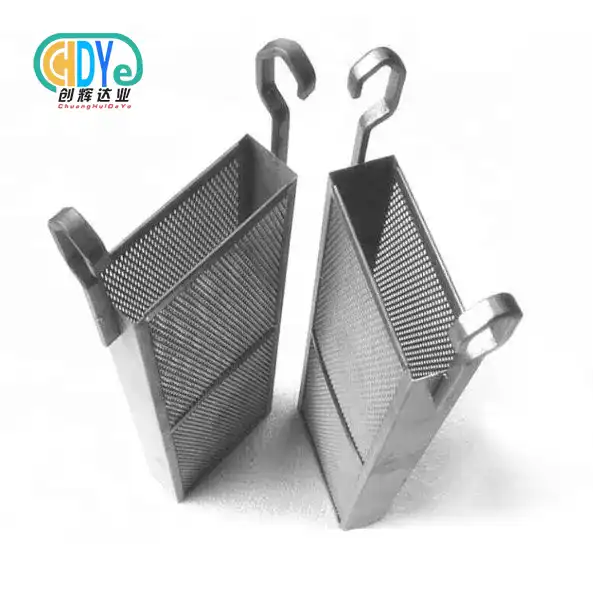
Choosing the right mesh size for a Titanium Anode Basket is a technical choice that has a direct impact on how well electroplating and electrolysis work and how long they last. The mesh aperture, which is usually given as a length x width measurement (10 mm x 5 mm or 12.7 mm x 6.35 mm), decides how well the electrolyte flows around the anode material, affects the even distribution of current, and keeps anode nuggets or balls from falling through the basket while the machine is running. If procurement managers and engineers know about mesh sizing factors, they can avoid problems like anode passivation, uneven plating thickness, and premature basket failure. This will improve the quality of production and lower running costs in the long run.
Understanding Titanium Anode Basket Mesh Size
When it comes to anode baskets, mesh size refers to the shape of the holes in the titanium sheet that make up the basket structure. These holes are measured in millimeters, and the most common sizes are 10mm x 5mm and 12.7mm x 6.35mm. Other sizes can be made to order based on the needs of the application. The size of the mesh has a direct effect on the flow of electrolyte, the holding of anode material, and the electrochemical efficiency of the plating process.
How Mesh Size Is Measured and Standardized
For expanded mesh designs, mesh measurements are given as LWD x SWD, where LWD and SWD are the longest and smallest distances across the diamond-shaped openings. For perforated sheet baskets, you need to know the hole width and spacing. As an example, ASTM B265 is used by industry standards to describe the specs for titanium substrates. However, mesh aperture standards vary by area and maker. By knowing these measures, procurement teams can make sure that the sizes they request are right for the particle size of the anode material and the process needs.
Impact on Current Distribution and Plating Uniformity
How electricity moves from the busbar hook to the anode material and into the plating bath is affected by the shape of the mesh. Larger openings in coarser mesh patterns help the electrolyte move more easily, but if the anode material sets unevenly, the current may not flow equally. A finer mesh makes the current more even and stops small anode particles from leaving, but it can also slow down the flow of fluid and raise the risk of solution loss in one area. To get the best coating consistency, you need to find the right balance between these factors based on the anode material, the bath chemistry, and the current density.
Material Properties Influencing Mesh Size Selection
Titanium Grade 1 and Grade 2 materials are often used to make Titanium Anode Basket products because they don't rust in acidic electroplating settings like sulfuric acid, chromic acid, and fluoroboric acid washes. A steady passive oxide layer forms on top of the titanium base, keeping it from breaking down while still letting electrons move through it. This oxide layer can cause passivation, though, if the voltage goes above certain breakdown limits, which are usually above 10–12V in some bath chemistries. When choosing the mesh size, these electrochemical behaviors must be taken into account. For example, bigger holes lower the risk of localized voltage buildup while keeping the structure strong under high amperage loads.
Critical Factors in Selecting the Right Mesh Size
To pick the best mesh opening, you have to look at both the electrical environment and the basket assembly's physical design needs. Different plating operations put different requirements on mesh design, so process factors and material compatibility need to be carefully looked at.
Plating Solution Chemistry and Current Density Requirements
The type of coating bath has a big effect on the choice of mesh size. Copper sulfate baths with mild current densities (2–5 A/dm²) usually work well with standard 10mm x 5mm mesh, which lets enough electrolyte flow through while keeping the copper anode pieces. In nickel plating baths with higher current densities, you might need a smaller mesh to keep the nickel coating rates steady and stop the anode from becoming polarized. There are extra problems with chromium plating because some versions contain fluoride, which can damage titanium. In these situations, material choice, like moving to zirconium baskets, becomes more important than mesh size.
Basket Thickness and Structural Integrity Considerations
The mechanical strength of the basket is based on both the mesh pattern shape and the thickness of the titanium sheet, which is usually between 0.8mm and 2.0mm. Heavier anode loads, which are common in high-volume production lines, need a thicker base material and maybe smaller mesh openings to keep the basket from deforming or the mesh from breaking under the weight. When making baskets, TIG welding is used to make joints that are as strong as the parent material. However, the weld's integrity must be checked visually by looking for the right coloration (silver or straw-colored means proper inert gas shielding; blue or purple means oxidation and possible embrittlement).
Coating Types and Their Relationship to Mesh Configuration
A lot of anode baskets have their surfaces treated to make them work better in certain situations. Depending on the current density and bath conditions, Mixed Metal Oxide (MMO) layers can last anywhere from one to five years and allow the basket to act as an insoluble anode in some electrolysis processes. Platinum-clad baskets are more resistant to rust and last longer, but they cost more at first. The size of the mesh affects how well the coating sticks and how evenly it covers. A smaller mesh gives the coating more surface area, but it may also cause stress points that speed up the coating's breakdown. Based on the expected working conditions, procurement teams should define mesh sizes that balance the performance of the coating with the longevity of the structure.
Comparing Titanium Anode Basket Mesh Sizes with Alternative Materials
Titanium is the most common material used in anode baskets because it is resistant to corrosion and has good mechanical qualities. However, knowing how it compares to other materials can help you feel more confident about your purchase choices and find niche uses where other materials might be better.
Performance Attributes Versus Graphite and Lead Alternatives
Graphite baskets are very resistant to chemicals and don't cost as much to make, but they are fragile and easily broken when being handled or maintained. Chrome coating used to be used a lot with lead baskets, but that's less popular now because of safety issues and government rules. Titanium Anode Baskets last longer (usually 10 years or more with proper care), are more resistant to damage than graphite, and don't contain any of the environmental dangers that come with lead. Titanium manufacturing gives you more control over the mesh design, including the ability to make unique aperture sizes. This lets you get the best results for certain anode material sizes and bath chemicals, which isn't possible with rigid graphite or cast lead designs.
Cost-Benefit Analysis Across Mesh Size Variations
Standard mesh designs (10mm x 5mm or 12.7mm x 6.35mm) are the most cost-effective because they are the easiest to make and use the least amount of material. It costs more to make custom mesh sizes, like micro-mesh inserts for small anode particles or oversized apertures for big anode chunks, but they often pay for themselves in terms of practical benefits. Instead of just looking at the initial purchase price, a buying study should figure out the total cost of ownership, which includes how long the basket lasts, how often it needs to be maintained, how the plating quality can be improved, and how much less production downtime there is.
Real-World Applications in Electroplating Operations
A big company that makes aerospace parts changed its nickel plating line from 12mm x 6mm mesh to 10mm x 5mm. This cut the amount of anode material that was lost through the basket by 18% and made the coating thickness more even by 12%. The smaller mesh opening kept partly broken-down anode nuggets from getting out, so the concentration of nickel ions stayed the same during production runs. In a different case, a company that made copper wire used modified 8mm x 4mm mesh for their electrolytic refining cells. This made the baskets last 15% longer by stopping the buildup of fine copper particles in the mesh intersections, which used to cause localized rust.
Maintenance, Lifespan, and Practical Considerations
Following the right repair steps will increase the service life of the basket and keep the electrical performance high throughout the equipment's lifetime. To make accurate lifetime cost estimates, buying teams need to know how mesh size affects the amount of upkeep that needs to be done.
Routine Inspection and Cleaning Protocols
The integrity of the mesh, the state of the weld joints, and the hook contact areas should all be checked regularly. Unexpected failures can be avoided by checking every three months for mesh warping, cracks appearing at weld seams, and oxide growth on surfaces carrying current. Cleaning methods depend on the size of the mesh. For a coarser mesh, mechanical agitation or ultrasonic cleaning can easily remove accumulated anode sludge and metallic salts. On the other hand, chemical pickling with diluted acid solutions may be needed for a finer mesh to dissolve trapped deposits without harming the titanium substrate.
Preventing Mesh Clogging and Structural Degradation
Mesh blocking happens when tiny particles or solidified bath salts build up in the holes. This stops the flow of electrolyte and makes the anode polarize. Some ways to stop this from happening are to choose mesh openings that are at least 2 mm bigger than the smallest measurement of the anode material, keep the bath filtered properly to get rid of any solids that are suspended, and rotate the basket on a regular basis to even out the wear patterns. Usually, structural degradation shows up as the mesh coming off the basket frame or the hook connection breaking. Both of these problems can be avoided by following the current rating specs and being careful not to hit the structure when handling it.
Expected Lifespan Benchmarks Across Different Mesh Types
Titanium Anode Baskets that aren't coated and work in nickel or copper sulfate baths that are properly managed usually last between 5 and 10 years before they break. This is usually due to mechanical issues (hook breaking, weld joint separation), not chemical corrosion. The coating on MMO-coated baskets that work as dimensionally stable anodes lasts between 1 and 5 years, based on the current density and bath temperature. After that time, the basket can be cleaned, pickled, and coated again. Mesh size has a secondary effect on lifespan. A smaller mesh has more stress concentrated at the aperture edges, which could speed up the formation of fatigue cracks in settings with a lot of shaking. A coarser mesh, on the other hand, spreads mechanical loads more evenly across the structure.
How to Make the Final Mesh Size Selection for Your Procurement Needs
As long as procurement professionals know about mesh features and practical needs, they can systematically weigh their choices and choose the best design for their needs.
Industry-Specific Application Scenarios
Different industries have different needs when it comes to the shape of the Titanium Anode Basket anode box. Electronics and semiconductor companies that work with very pure materials often need micro-mesh designs that are 6mm x 3mm or smaller to keep anode particles from escaping and contaminating the material while still being able to precisely control the current density. Large electrolysis cells used in chemical processing may choose larger mesh (15 mm x 8 mm) to improve electrolyte flow and reduce pressure drop across the basket structure. When medical device companies plate surgical tools, they usually ask for a standard 10mm x 5mm mesh that strikes a balance between operating efficiency and the need to follow regulations for process consistency.
Core Decision Criteria: Current Density, Solution Chemistry, and Throughput
Quantifying practical factors should be the first step in the evaluation process. Current density requirements directly affect hook design. For operations with currents greater than 100 amperes, titanium-clad copper hooks are usually needed. These combine the better conductivity of copper (58 MS/m) with the rust resistance of titanium, which stops dangerous overheating and energy wasting. The chemistry of the bath determines how well the materials work together; liquids that contain fluoride require zirconium to be used instead, no matter what the mesh says. Production flow affects both the size and number of baskets used. For example, high-volume operations benefit from bigger baskets with better mesh that reduce the number of times they need to be changed out while keeping the quality of the plating.
Evaluating Supplier Capabilities and Customization Options
At Shaanxi Chuanghui Daye Metal Material Co., we make anode baskets from commercially pure Titanium Grade 1 and Grade 2 bases that are purer than 99.5%. This gives them great resistance to rust and mechanical stability. Precision mechanical processing (cutting, drilling, and bending), TIG welding in an argon atmosphere to stop oxidation, and a thorough quality inspection that includes chemical composition analysis, mechanical performance testing, and corrosion resistance verification according to ASTM B265 standards are all parts of the fabrication process. Customization can be done for any mesh setup shown in CAD or PDF files, and hook designs can be changed to meet specific power needs. We have ISO 9001:2015 approval, which means that all of our production batches are of the same high standard and can be tracked. This meets the needs of procurement teams who need to make sure that the supply chain is reliable and that all regulations are followed.
Conclusion
To choose the right mesh size for Titanium Anode Baskets, you have to weigh a number of technical factors, such as the need for current distribution, the properties of the anode material, the compatibility of the bath chemistry, and the expected operating lifespan. Standard sizes like 10mm x 5mm mesh work well for many general electroplating tasks, but for more specific tasks, custom opening sizes that improve electrolyte flow, stop material loss, and extend service life are better. When buying something, you should look at the total cost of ownership instead of just the original price. This means thinking about things like how long the basket will last, how often it needs to be maintained, what kind of coating it needs, and what the seller can do. Working with skilled makers who offer customization services, uphold strict quality standards, and offer expert support will help you choose the right mesh size for your short- and long-term production needs.
FAQ
Q: What mesh size works best for copper electroplating applications?
A: Most of the time, 10mm x 5mm mesh designs work best for copper electroplating. This opening size keeps copper anode nuggets (which are usually 15–25 mm in diameter) from dropping through as they dissolve. At the same time, it lets enough electrolyte flow through to keep the copper ion concentration steady throughout the bath. For activities with a higher current density, an 8mm x 4mm mesh that is a little smaller might help make the current spread more even.
Q: How does mesh size affect basket lifespan?
A: Mesh size affects lifespan by affecting how mechanical stress is distributed and how likely it is to get clogged. Coarser mesh spreads out loads more widely, which stops wear cracks from forming and usually gives 10 years or more of service life with proper handling. Finer mesh focuses stress at the edges of the holes and makes it easier for particles to build up, which could shorten its life by 15 to 20 percent if it isn't regularly cleaned and sludge removed as part of preventative maintenance.
Q: Can mesh size be customized for specialized industrial requirements?
A: Manufacturers with a lot of knowledge make customization easy. With CAD or PDF models that show the specifications, any mesh arrangement can be made, from micro-mesh (6mm x 3mm) for small particles to oversized openings (15mm x 8mm) for big anode chunks. Custom designs should take into account the need for structural integrity. For example, smaller holes might need bigger substrate material (1.5–2.0mm vs. the normal 0.8–1.2mm) to keep its mechanical strength under working loads.
Partner with Chuanghui Daye for Your Titanium Anode Basket Needs
If you need precision-engineered anode baskets with the best mesh designs for electroplating or electrolysis,Shaanxi Chuanghui Daye has 30 years of experience in the rare metal business and can help you. As a top Titanium Anode Basket maker in Baoji, China's Titanium Capital, we use advanced manufacturing skills and quality management that is ISO 9001:2015 approved to make baskets from Grade 1 and Grade 2 titanium substrates that meet all of your exact requirements. Our team can help you figure out the best mesh size for your bath chemistry, current density, and throughput needs. After that, we can do fast testing and variable production scaling from single units to bulk sales. Get in touch with our engineering team at info@chdymetal.com to talk about your needs and get a full quote with low factory-direct prices and faster delivery times.
References
1. American Society for Testing and Materials. (2020). ASTM B265-20: Standard Specification for Titanium and Titanium Alloy Strip, Sheet, and Plate. West Conshohocken, PA: ASTM International.
2. Bard, A.J. & Faulkner, L.R. (2019). Electrochemical Methods: Fundamentals and Applications, 3rd Edition. New York: John Wiley & Sons.
3. Chen, G. & Lasia, A. (2021). Study of the Kinetics of Hydrogen Evolution Reaction on Nickel-Zinc Alloy Electrodes. Journal of The Electrochemical Society, 168(4), 044504.
4. Mohanty, U.S. (2018). Electrodeposition: A Versatile and Inexpensive Tool for the Synthesis of Nanoparticles, Nanorods, Nanowires, and Nanoclusters of Metals. Journal of Applied Electrochemistry, 41(3), 257-270.
5. Schlesinger, M. & Paunovic, M. (2022). Modern Electroplating, 6th Edition. Hoboken, NJ: John Wiley & Sons.
6. Zhang, Q. & Hua, Y. (2020). Corrosion Behavior of Titanium Anode Materials in Electrochemical Systems: A Comprehensive Review. Materials and Corrosion, 71(8), 1256-1273.
Learn about our latest products and discounts through SMS or email