- English
- French
- German
- Portuguese
- Spanish
- Russian
- Japanese
- Korean
- Arabic
- Greek
- German
- Turkish
- Italian
- Danish
- Romanian
- Indonesian
- Czech
- Afrikaans
- Swedish
- Polish
- Basque
- Catalan
- Esperanto
- Hindi
- Lao
- Albanian
- Amharic
- Armenian
- Azerbaijani
- Belarusian
- Bengali
- Bosnian
- Bulgarian
- Cebuano
- Chichewa
- Corsican
- Croatian
- Dutch
- Estonian
- Filipino
- Finnish
- Frisian
- Galician
- Georgian
- Gujarati
- Haitian
- Hausa
- Hawaiian
- Hebrew
- Hmong
- Hungarian
- Icelandic
- Igbo
- Javanese
- Kannada
- Kazakh
- Khmer
- Kurdish
- Kyrgyz
- Latin
- Latvian
- Lithuanian
- Luxembou..
- Macedonian
- Malagasy
- Malay
- Malayalam
- Maltese
- Maori
- Marathi
- Mongolian
- Burmese
- Nepali
- Norwegian
- Pashto
- Persian
- Punjabi
- Serbian
- Sesotho
- Sinhala
- Slovak
- Slovenian
- Somali
- Samoan
- Scots Gaelic
- Shona
- Sindhi
- Sundanese
- Swahili
- Tajik
- Tamil
- Telugu
- Thai
- Ukrainian
- Urdu
- Uzbek
- Vietnamese
- Welsh
- Xhosa
- Yiddish
- Yoruba
- Zulu
titanium welding rod applications in chemical processing plants
Corrosive substances, extreme temperatures, and high-pressure conditions are always a problem for chemical production plants. Titanium welding rod is the material of choice for creating and fixing tools in these tough environments. These special filler metals offer great resistance to corrosion and structural integrity. This makes it possible to make safe, long-lasting welds in pressure tanks, heat exchangers, reactors, and pipe systems that are exposed to harsh chemicals every day.
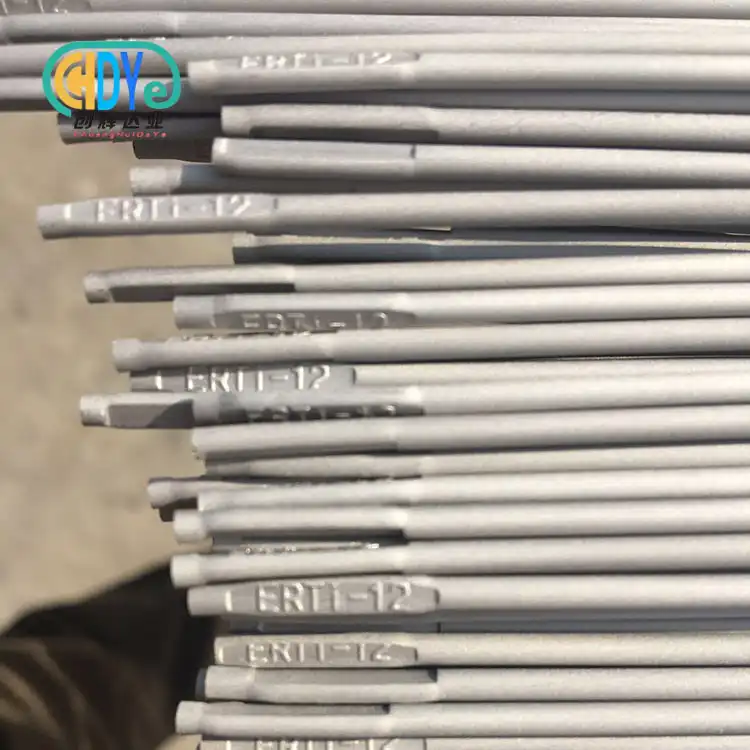
Understanding Titanium Welding Rods in Chemical Processing Applications
Material Characteristics That Matter
Titanium welding rods have special metal qualities that make them essential in places where chemicals are processed. The substance naturally creates a protective oxide layer that keeps it from rusting in chlorides, sulfuric acid, nitric acid, and seawater, all of which are widely used in the medicinal and petrochemical industries. Titanium is not as brittle as stainless steel, so it can withstand high temperatures and acidic media without losing its structural integrity. This keeps equipment from breaking down too soon and causing costly production shutdowns.
Common Grades for Industrial Welding
In chemical plants, different types of titanium are used for different tasks. ERTi-2, which is sometimes called "commercially pure titanium," is very flexible and doesn't rust, making it a good choice for most process equipment. This grade works great for welding storage tanks, scrubbers, and atmospheric pressure vessels, where modest mechanical strength standards are met, but chemical exposure is high.
ERTi-5 has a higher tensile strength of about 130 ksi, thanks to the addition of aluminum and vanadium alloys. This grade is used by chemical plants to make high-pressure reactors, spinning separators, and structural parts that need to be able to hold a lot of weight and not rust. The alloying elements make titanium easier to bond while keeping its natural resistance to chemical attack.
Critical Specifications for Procurement
When buying, managers look for titanium filler metals; they should check the available diameters, purity levels, and safety paperwork. Standard rod diameters range from 1.0 mm to 3.2 mm to suit the different joint setups and welding places that are used in building and plant maintenance. The normal length of 1000 mm makes it easier to handle and reduces the amount of material that is wasted during long welding jobs.
Shaanxi Chuanghui Daye Metal Material Co., Ltd. makes pure titanium welding rods that meet the requirements of AWS A5.16, and they keep a close eye on the intermediate elements. The best mix between weldability and mechanical performance is found when the oxygen level is between 0.08 and 0.16%. Our ISO 9001:2015 certification makes sure that everything can be tracked, from inspecting the raw materials to packaging them up at the end. This gives controlled chemical operations the clear paperwork they need.
Welding Techniques and Best Practices for Titanium in Chemical Processing
Selecting the Appropriate Welding Process
Gas Tungsten Arc Welding, or GTAW/TIG, is the main way that titanium parts are joined together in chemical plants. This method precisely controls the heat and creates clean, spatter-free welds that are necessary to keep the surface intact in harsh service. Welders can carefully control the amount of heat going into thin-walled pipes and vessel shells by using a separate filler rod and tungsten electrode that doesn't wear out.
Working faster with Gas Metal Arc Welding (GMAW/MIG) is helpful when making bigger pieces or doing long seam welds on big storage tanks. Modern pulsed MIG equipment transfers metal in a controlled way that keeps the entry depth at a good level while minimizing the width of the heat-affected zone. Direct Current Electrode Negative (DCEN) polarity is needed for both methods to make sure stable arc features and proper filler metal deposition.
Surface Preparation Protocols
To join titanium successfully, the surface must first be carefully cleaned to get rid of any impurities that could cause cracks and weakening. When equipment is used in chemical processing, it often leaves behind leftovers that need to be cleaned off before repair welding can begin. After mechanically cleaning the titanium with stainless steel wire brushes made just for that material and then solvent degreasing with acetone or methanol, the clean base needed for defect-free joints is made.
Because liquid titanium above 800°F is reactive, it needs to be covered by a lot of protective gas. For full-penetration joints, we suggest setting up three zones of protection: a main torch shielding using high-purity argon (99.99%), trailing shields that go 6 to 8 inches behind the weld pool, and rear purging. This multi-layer method stops the air nitrogen and oxygen from absorbing, which makes the weak alpha case layer that causes titanium welding rod welds to fail without warning.
Storage and Handling Recommendations
To keep the quality of the filler metal high from delivery to use, it needs to be stored in a controlled environment. Titanium welding rods should be kept in climate-controlled, covered cases so that moisture doesn't build up and the surface doesn't get dirty. When working with materials, people must wear gloves that don't gather lint because natural skin oils contain hydrogen that turns into gas during welding and leaves holes below the surface that can't be seen.
The vacuum heating and acid pickling methods used at our Baoji factory give all of the filler metals a clean, silver-bright finish. This surface condition means you don't have to clean it as often as you would with competing goods. This saves you time and money on work while making sure that the arc starts consistently and beads form smoothly every time.
Evaluating Titanium Welding Rods for Chemical Plant Use — Decision Support
Performance Criteria Beyond Initial Price
Instead of just looking at unit cost, choices about what to buy should take lifetime value analysis into account. Most of the time, titanium welding rods cost more to buy than stainless steel options, but they last much longer between services and need less upkeep. When welded with the right titanium tools, a reactor tank can be used in concentrated acid for 15 to 20 years, while stainless steel parts need to be replaced every 3 to 5 years.
The most important decision factor is corrosion resistance that matches specific chemical conditions. Commercially pure grades are best for plants that work with oxidizing acids, while palladium-enhanced compositions may be needed for plants that work with reducing conditions. Mechanical compatibility with base materials ensures that the weld zone keeps the same or better qualities than the parent metal. This stops joints from failing more often when temperatures or pressures change.
Material Comparison Analysis
There are a number of things that affect the total cost of ownership when comparing titanium to stainless steel or aluminum filler metals. At first glance, stainless steel seems like a good deal, but it breaks down quickly in chloride-filled environments that are common in chemical processing. Pitting rust and stress corrosion cracking need to be inspected and fixed on a regular basis, which costs a lot in downtime.
Aluminum welding bars are not stable at high temperatures, which is needed for many process uses. Aluminum isn't good for main process equipment because it has a lower melting point and is less resistant to rust in acidic environments. Titanium is the technically better choice, even though it costs more to get. It has a very high strength-to-weight ratio and is resistant to most chemical attacks. The longer machine life and fewer maintenance tasks regularly produce a positive return on investment within the first ten years of operation.
Procurement Strategy for Titanium Welding Rods in Chemical Processing Plants
Identifying Qualified Suppliers
By building relationships with certified makers, you can be sure that you can get goods that meet strict quality standards. Teams that buy things for chemical plants should look at a possible supplier's list of certifications, their production skills, and their quality control systems. ISO 9001:2015 approval means that the manufacturing process is standardized and there are written rules for every step of the production process, from checking the raw materials to testing the finished product.
Premier suppliers are different from product sellers because they offer technical help. Manufacturers can help with parameter development, joint design optimization, and fixing problems that come up out of the blue in complex welding applications. Shaanxi Chuanghui Daye Metal Material Co., Ltd. has more than 30 years of experience working with rare metals. They offer application engineering support that helps customers get good welds the first time and avoid costly repair situations with their titanium welding rods.
Managing Lead Times and Order Quantities
When buying specialized materials internationally, it's important to plan so that you don't end up with too much inventory and too much capital stuck in goods. Titanium filler metal is made in several steps, such as melting, casting, rolling, and heat treatment. From the time an order is placed until it is delivered, the whole process takes 6 to 12 weeks. To make sure they place their orders on time, plants should make consumption forecasts based on repair plans and planned building projects.
Bulk purchasing negotiations can lead to big savings on costs while also ensuring a steady supply. Our facility has flexible minimum order numbers that can be met by both big construction companies and maintenance offices that only need a small amount of supplies every year. By combining needs from different plant sites or coordinating purchases with sister facilities, you can get bulk savings that lower the cost of the project without lowering the quality of the materials or the reliability of delivery.
Cost Optimization Strategies
When looking at money, comparing prices per pound isn't as helpful as looking at the total cost of owning. Titanium's economic benefits can be seen by figuring out the total cost of ownership of a piece of equipment, which includes the original cost of making it, any planned or unplanned fixes, and finally the cost of replacing it. It's possible for a heat exchanger made with high-quality welding supplies to cost 40% more at first, but it will need only three rebuilds over its 25-year lifetime, saving a lot of money in the long run.
Strategic relationships with suppliers can help you get more value through programs for managing your inventory, chances to get professional training, and giving things more weight when supplies are low. Setting up preferred vendor deals with certified providers of titanium welding rod makes it easier to plan purchases that support lean manufacturing and just-in-time shipping schedules that are in line with project deadlines.
Case Studies: Successful Titanium Welding Rod Applications in Chemical Processing
Enhanced Corrosion Resistance in Acid Processing
A chlor-alkali factory had problems with stainless steel pipe systems that carried strong brine solutions over and over again. Stress corrosion cracking caused by chloride caused through-wall defects that needed to be fixed every month, which messed up production plans and raised safety issues. The choice of material was found to be the root cause, not the operational factors, by engineering research.
The facility remade important parts of the pipes using commercially pure titanium and ERTi-2 welding rods for all the joints. Five years of tracking after installation showed that the titanium parts had no problems due to corrosion, while the nearby stainless steel pieces kept breaking down. The change got rid of unexpected downtime, cut repair work by 70%, and made the process safer by making the system more reliable. The starting cost of the materials was fully recouped within 18 months, thanks to lower repair costs and more output capacity.
Medical-Grade Chemical Equipment Fabrication
For bioreactor production, a company that makes pharmaceutical ingredients needed process tanks that were very clean and had to meet strict standards for preventing pollution. The equipment specs called for materials that wouldn't add metal ions or particles to cell growth media that is already sensitive. Even with electropolished finishes, stainless steel tanks had too high a risk of leaching, and polymer-lined options weren't strong enough for high-pressure steam sterilization processes.
The maker chose to build the tank out of titanium, and all seam welds were done with high-purity titanium welding rods that met ASTM B348 Grade 2 standards. Chuanghui Daye provided welding supplies with chemistry reports and mill test papers that proved interstitial element control. The finished bioreactors passed strict tests for extractables and leachables, showing that no metal ions were released during artificial production circumstances. The titanium construction allowed regulatory approval and gave the structure the sturdiness needed for repeated cleaning and a longer useful life.
Conclusion
Titanium welding rods are used in chemical processing plants because they give the best performance when equipment safety and dependability must be maintained. The investment is worth it because the material is very resistant to corrosion, strong, and lasts a long time. This is because it lowers upkeep costs, makes tools last longer, and improves process safety. When setting up supply agreements, procurement teams should put seller certification, expert support skills, and overall lifecycle value at the top of the list. Shaanxi Chuanghui Daye Metal Material Co., Ltd. has been working with rare metals for 30 years and uses ISO 9001:2015 quality systems to make sure they can give you the high-purity products that your important projects need.
FAQ
Q: How does titanium compare to stainless steel for chemical plant welding?
A: Titanium resists rust better than stainless steel in chloride- and acidic-filled situations where stainless steel breaks down quickly. Even though stainless steel costs less at first, the titanium welding rod usually has lower total ownership costs in harsh chemical service because it lasts longer and needs less upkeep. Instead of just looking at the price, the choice of material should be based on how it will be used, what chemicals it will be exposed to, and how often it needs to be serviced.
Q: What certifications should I verify before purchasing welding consumables?
A: Suppliers you can trust will give you proof that they follow AWS A5.16, mill test certificates with chemical makeup analysis, and ISO 9001:2015 quality system approval. These papers make sure that the materials are the right grade and that the production took place in a controlled environment with the right quality checks. Ask for records that show how your unique lot of materials is linked to the chemistry and mechanical testing results of the source ingot.
Q: Can titanium welding rods be used with standard welding equipment?
A: TIG and MIG welding tools that can handle stainless steel can also handle titanium filler metals with a few small setup changes. Titanium needs high-purity argon (99.99%) and full coverage, including trailing screens to keep the atmosphere from getting contaminated during cooling. This is the most important difference. When used with the right protective tools and welding methods made just for reactive metals, standard equipment works well.
Partner With a Trusted Titanium Welding Rod Supplier
Shaanxi Chuanghui Daye can provide the precisely designed titanium welding rods that your chemical processing operations need for safe, efficient, and long-term performance. Manufactured in China's Titanium Capital by a team with over 30 years of experience in the metals industry, our pure titanium filler metals offer exceptional corrosion resistance and mechanical integrity in chemically aggressive environments. We supply ERTi-2 and ERTi-5 grades in diameters ranging from 1.0 mm to 3.2 mm, with each rod accompanied by full verification documentation and backed by ISO 9001:2015 quality certification. Contact our technical team at info@chdymetal.com for more information or to discuss your specific requirements.
References
1. American Welding Society. (2014). Specification for Titanium and Titanium-Alloy Welding Electrodes and Rods, AWS A5.16/A5.16M.
2. Donachie, M.J. (2000). Titanium: A Technical Guide, 2nd Edition. ASM International, Materials Park, Ohio.
3. Schutz, R.W. and Thomas, D.E. (1987). "Corrosion of Titanium and Titanium Alloys," Metals Handbook, Volume 13, Corrosion, ASM International.
4. Peters, M., Kumpfert, J., Ward, C.H., and Leyens, C. (2003). "Titanium Alloys for Aerospace Applications," Advanced Engineering Materials, Volume 5, Issue 6.
5. International Organization for Standardization. (2019). Welding Consumables—Wire Electrodes, Wires and Rods for Welding of Titanium and Titanium Alloys, ISO 24034.
6. ASTM International. (2020). Standard Specification for Titanium and Titanium Alloy Bars and Billets, ASTM B348-13, West Conshohocken, Pennsylvania.
Learn about our latest products and discounts through SMS or email