- English
- French
- German
- Portuguese
- Spanish
- Russian
- Japanese
- Korean
- Arabic
- Greek
- German
- Turkish
- Italian
- Danish
- Romanian
- Indonesian
- Czech
- Afrikaans
- Swedish
- Polish
- Basque
- Catalan
- Esperanto
- Hindi
- Lao
- Albanian
- Amharic
- Armenian
- Azerbaijani
- Belarusian
- Bengali
- Bosnian
- Bulgarian
- Cebuano
- Chichewa
- Corsican
- Croatian
- Dutch
- Estonian
- Filipino
- Finnish
- Frisian
- Galician
- Georgian
- Gujarati
- Haitian
- Hausa
- Hawaiian
- Hebrew
- Hmong
- Hungarian
- Icelandic
- Igbo
- Javanese
- Kannada
- Kazakh
- Khmer
- Kurdish
- Kyrgyz
- Latin
- Latvian
- Lithuanian
- Luxembou..
- Macedonian
- Malagasy
- Malay
- Malayalam
- Maltese
- Maori
- Marathi
- Mongolian
- Burmese
- Nepali
- Norwegian
- Pashto
- Persian
- Punjabi
- Serbian
- Sesotho
- Sinhala
- Slovak
- Slovenian
- Somali
- Samoan
- Scots Gaelic
- Shona
- Sindhi
- Sundanese
- Swahili
- Tajik
- Tamil
- Telugu
- Thai
- Ukrainian
- Urdu
- Uzbek
- Vietnamese
- Welsh
- Xhosa
- Yiddish
- Yoruba
- Zulu
Why Choose ASTM B 348 Titanium Rods for High-Performance Needs?
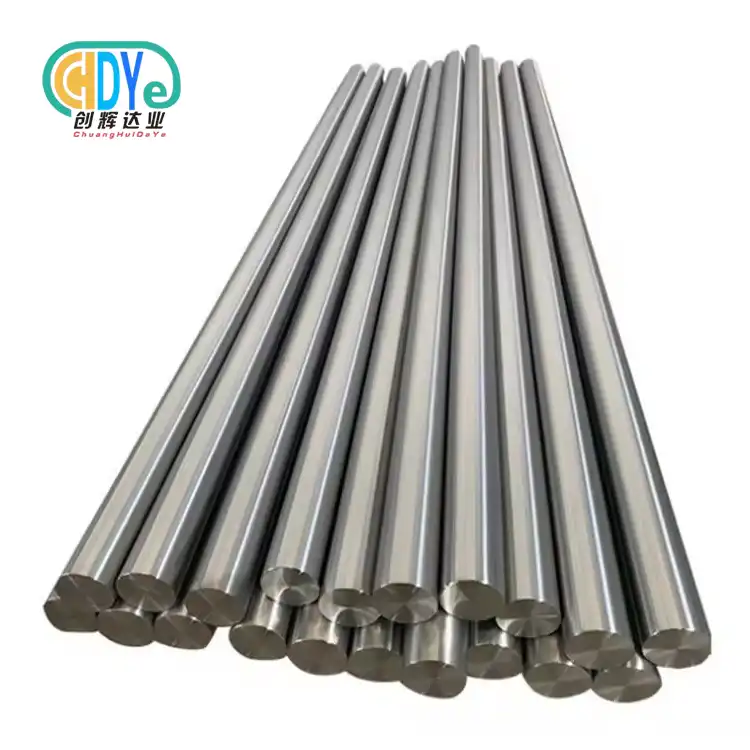
ASTM B 348 industrial titanium rod is the best material for important uses because it is very strong, doesn't rust, and is reliable. The performance of these precisely engineered rods can't be beat, which is why they are essential in the marine, chemical processing, aircraft, and medical device making industries. Titanium rods that meet ASTM B348 standards have excellent mechanical properties, strict quality standards, and a track record of working well in harsh settings. This makes them the perfect choice for high-stakes industrial uses where failure is not an option.
Understanding ASTM B 348 Titanium Rods: Composition and Mechanical Properties
The ASTM B348 standard is the most complete set of rules for titanium and titanium alloy bars. It covers grades 1 through 39 and is very specific about their chemical makeup and how well they work mechanically. This standard makes sure that every ASTM B 348 industrial titanium rod passes strict requirements for use in factories.
Chemical Composition and Purity Standards
The chemicals that make up ASTM B348 titanium rods are different for each grade, and each mixture is best for a certain set of performance qualities. This grade of titanium, also called "commercially pure titanium," is made up of 99.2% titanium and a limited amount of oxygen (0.25% maximum), iron (0.30% maximum), and nitrogen (0.03% maximum). 6% aluminum and 4% vanadium are mixed into Grade 5 (Ti-6Al-4V), which makes a metal that is stronger and more resistant to rust. Controlling the intermediate parts very carefully is important for how well the material works. The amount of hydrogen in the material stays below 0.015 percent to keep it from becoming weak, and the amount of carbon stays below 0.08% to keep it flexible. With these exact ratios, the material will always have the same qualities and behave in the same way when it's stressed.
Mechanical Properties Breakdown
For engineers, knowing the material qualities helps them choose the right grade for their needs. Grade 2 titanium has a minimum tensile strength of 345 MPa and a yield strength of 275 MPa. This makes it perfect for uses that need a reasonable amount of strength and good formability. With a minimum tensile strength of 895 MPa and a yield strength of 828 MPa, Grade 5 performs much better and is ideal for structural parts that will be used in harsh conditions. The stretch properties range from 10% for high-strength alloys to over 20% for commercially pure types. These properties give the metal the flexibility needed for shaping and resistance to impact. When you mix these mechanical properties with titanium's low mass of about 4.5 g/cm³, you get a strength-to-weight ratio that is better than most other materials.
Heat Treatment and Microstructure Control
The microstructure and function of titanium rods are greatly affected by the heat treatment methods. Between 704°C and 788°C for Grade 2 and 704°C to 760°C for Grade 5 are the best temperatures for annealing because they improve the structure of the grains and ease stresses inside the metal that came from shaping it. Controlling the rate of cooling changes the final mechanical qualities and ensures that the dimensions stay the same. Advanced factories use vacuum arc remelting (VAR) methods to make microstructures that are all the same and get rid of segregation. This mechanical control makes sure that the properties of the bar are the same across its cross-section and gives it the dependability needed for important uses.
Comparing ASTM B 348 Titanium Rods with Other Standards and Materials
To get the best performance and value for money, choosing the right material means carefully comparing different standards and other materials, such as ASTM B348 industrial titanium rod. By understanding these similarities, you can make smart choices about what to buy that fit the needs of the project and your budget.
ASTM B348 vs. Other Titanium Standards
ASTM B348 is not the same as other titanium standards in terms of what it covers and how it is used. While ASTM F67 is more focused on medical implants and has tighter purity standards, ASTM B348 is more general and focuses on mechanical properties and corrosion protection in industrial settings. As the name suggests, ASTM F136 is for medical implants that need to be more biocompatible, while ASTM B348 is for general engineering performance. Different standards also have different needs for surface finish and limits on sizes. ASTM B348 specifies business tolerances that are good for most industry uses. Medical-grade standards, on the other hand, need tighter tolerances and better surface finishes. Knowing these differences helps people who work in buying choose the right standard for their needs.
Titanium vs. Stainless Steel Comparison
When you compare titanium rods to stainless steel options, you can see that the titanium rods work much better, which is why they were chosen. In chloride settings, titanium is more resistant to rust than high-grade stainless steel, which can cause pitting and crevice corrosion. The inactive oxide layer that forms naturally on titanium surfaces protects very well against harsh chemicals and saltwater. In aircraft and marine uses, choosing a material is often based on how much it weighs. With a mass of only 4.5 g/cm³ compared to 8.0 g/cm³ for stainless steel, titanium can be used to make much lighter things without losing any strength. This edge in weight means better fuel economy in aircraft uses and less stress on structures in marine systems. Titanium is better than most stainless steels at resisting wear, which makes it better for parts that are loaded and unloaded many times. Even though the materials cost more at first, the longer service life and less upkeep often lead to a lower total cost of ownership over the lifecycle of the part.
Procurement Guide: Where and How to Source ASTM B 348 Titanium Rods
To successfully buy high-quality titanium rods, you need to know what the seller can do, what certifications are needed, and how to handle shipping. Building ties with certified makers guarantees a steady supply of materials and high quality for ongoing projects.
Supplier Selection and Certification
When you buy from qualified sellers with ISO 9001:2015 quality management systems, you can be sure that they will follow international quality standards. Reputable makers keep full tracking paperwork from where the raw materials come from to the final review. This gives customers the quality guarantee they need for important uses. It is best to find sources that have a lot of experience working with non-ferrous metals and a track record of success in your business. Equipment for melting, casting, and machining are all looked at as part of the manufacturing capability review. Superior surface finish and accuracy in measurements are achieved in modern facilities that have electron beam furnaces, precise rolling mills, and CNC machine centers. Being able to do both ultrasonic and eddy-current tests makes it possible to find internal flaws and confirm the structure's stability.
Customization Options and Order Requirements
Modern companies that make titanium rods give customers a lot of ways to customize their products to meet the needs of particular applications. Cross-sections that are standard come in round, square, and hexagonal shapes, with widths from 4mm to 350mm and lengths up to 3000mm. Custom sizes and specs allow for specific design needs while still meeting material performance standards. Minimum order amounts depend on the seller and the configuration of the product. Buying in bulk can often save you money. To help with lean inventory management, ASTM B 348 industrial titanium rod manufacturers usually offer flexible buying terms, such as partial shipments and scheduled deliveries. Payment terms usually include paying 30% up front and the remaining 70% before the shipment. This protects both parties.
Logistics and Quality Assurance
When you package and ship things the right way, they stay intact during transport. For safe shipping by express, air freight, or ocean, professional providers use moisture-proof cloth, foam cotton for the inside, and wooden cases. For quality control and legal compliance, documentation packages contain material certificates, test results, and records of where the materials came from. International shipping makes it possible to get goods from all over the world while still meeting arrival dates. Experienced providers handle clearing customs and giving tracking information to make sure deliveries happen on time. Quality hold points and inbound inspection processes make sure that materials are in good shape when they arrive.
Application Areas and Benefits of ASTM B 348 Titanium Rods in High-Performance Industries
Titanium rods are very useful in many high-performance industries because they can be used in many ways and have many great qualities. Reliability of the material directly affects operating success and safety.
Aerospace and Defense Applications
ASTM B 348 industrial titanium rod is used by aerospace makers for important structural parts like landing gear systems, wing spars, and engine parts. The high ratio of strength to weight lets aircraft builders cut down on total weight while keeping the structure strong under heavy loads. The fatigue resistance qualities of an airplane ensure that it will work reliably through millions of stress cycles over its service life. Titanium is used in defense because it doesn't rust and is strong in hard settings. Titanium parts are used on naval ships in seawater systems where resistance to rust is important for being ready for duty. Because titanium is not magnetic, it can be used in defense applications where reducing magnetic signatures is important.
Chemical and Petrochemical Industries
Titanium is very resistant to rust, so equipment in chemical processing plants that is exposed to harsh chemicals and high temperatures can count on it. Titanium bars are used to make heat exchangers, pump shafts, and valve parts that can last in conditions that quickly wear down other materials. Titanium is an important metal for offshore oil and gas activities because it doesn't rust or pit in chloride-containing fluids. Titanium parts are used in petrochemical plants in processes that use sulfuric acid, hydrochloric acid, and other corrosive materials. Because titanium parts last a long time and don't need as much upkeep, plants are more reliable, and costs for downtime are lower.
Medical Device Manufacturing
Titanium is used to make surgical tools and external fixation devices because it is biocompatible and doesn't break down when it's sterilized. Titanium is great for making reusable surgery tools because it is non-toxic and can stand up to many autoclave cycles. MRI compatibility makes sure that patients are safe in magnetic resonance imaging (MRI) rooms where ferromagnetic materials could be harmful. ASTM B 348 industrial titanium rod can be machined with great accuracy, which lets it be used to make complicated shapes needed for specialized medical tools. Medical uses need surfaces that are very clean, so polishing and passivation are two choices for finishing the surface.
Why ASTM B 348 Titanium Rods Are the Preferred Choice for Your High-Performance Projects
ASTM B348 titanium rods are the best choice for demanding uses where performance and dependability are very important because of the properties of the material, the quality standards, and the supplier's abilities.
Compliance and Quality Assurance
ASTM B348 compliance makes sure that chemical composition, mechanical qualities, and size limits are met according to standards that are known around the world. Standardization gives people faith in the performance of materials and lets them be bought from anywhere in the world while keeping quality standards. Tough testing methods, like tension testing, chemical analysis, and non-destructive examination, make sure that the product meets the requirements of the standard. ISO 9001:2015-certified quality management systems make sure that industrial methods are always the same and that there is a lot of paperwork. Full traceability from where the raw materials come from to the end inspection makes it possible to quickly fix quality problems and meet legal requirements in many fields.
Lifecycle Cost Advantages
Even though the starting cost of the material is higher than that of other materials, titanium rods have very low lifetime costs because they last a very long time and don't rust. Longer service lives mean that parts don't need to be replaced as often, which saves money on downtime costs. Because they don't need much upkeep, they don't need protective coats or the regular checks that less resistant materials do. When used in serious situations, ASTM B 348 industrial titanium rods' dependability lowers the chance of unexpected breakdowns and the costs that come with them. Insurance benefits and lower liability exposure often make up for higher original material costs, especially in situations where failure would have serious effects.
Partnership Benefits and Support Services
By teaming up with experienced titanium providers, you can get access to professional advice and engineering help at all stages of a project. Suppliers who know their stuff can help you choose the right materials, make suggestions for processing, and find solutions that work best for your needs and won't break the bank. Lean production and just-in-time delivery are both supported by flexible ordering choices and inventory control services. Custom processing services, such as precision cutting, surface cleaning, and quality checking, make buying things easier and make sure that the materials are ready to use right away. Full sets of technical paperwork and certifications make getting inspections easier and speed up production schedules.
Conclusion
ASTM B 348 industrial titanium rods are the best choice for high-performance uses that need extreme strength, resistance to rust, and dependability. Because of their high quality standards, proven success in many industries, and superior material properties, they are the best choice for important uses. Investing in high-quality titanium materials pays off in the long run by increasing operating dependability, extending service life, and lowering upkeep costs. When the success of a project depends on how well the materials work, ASTM B348 titanium bars give you the confidence and power to meet tough performance goals.
FAQ
Q: What grades of ASTM B348 titanium rods are available?
A: A standard called ASTM B348 talks about different types of titanium. It talks about Grade 1 (commercially pure), Grade 2 (most common commercially pure), Grade 5 (Ti-6Al-4V alloy), Grade 7 (palladium-containing), Grade 9 (Ti-3Al-2.5V), and Grade 12 (molybdenum-containing). Each grade has a different mix of strength, resistance to rust, and shapeability that makes it useful for different tasks.
Q: How do I determine the correct titanium grade for my application?
A: The grade you choose will depend on your needs for strength, resistance to rust, and the climate in which the material will be used. Grade 2 is good for uses that need it to be easy to shape and have middling strength, while Grade 5 is the strongest and is used for structural uses. When choosing the right grade, you should think about things like weather, chemical exposure, stress levels, and weight needs.
Q: What quality certifications should I expect with ASTM B348 titanium rods?
A: Reliable providers give a lot of paperwork, like material test papers, chemical analysis reports, mechanical property test results, and records of dimensional inspections. Look for providers that are certified by ISO 9001:2015 and have full paperwork that shows where the raw materials came from and how they were processed.
Q: Can ASTM B348 titanium rods be customized for specific applications?
A: Yes, experienced makers do offer a wide range of customization choices, such as custom surface finishes, non-standard sizes, and precise machining services. If you need it, we can make custom cross-sections, use special heat treatments, and work the metal in a way that is best for your needs.
Q: What are the typical lead times for ASTM B348 titanium rod orders?
A: There are different lead times for each grade, size, number, and level of personalization. Standard sizes in popular grades usually ship in two to four weeks, but special specs could take six to eight weeks. Making plans ahead of time and keeping good inventory relationships with sellers are two ways to make sure that important projects can get the materials they need.
Partner with Chuanghui Daye for Premium ASTM B348 Titanium Solutions
Shaanxi Chuanghui Daye Metal Material Co., Ltd. stands as your trusted ASTM B 348 industrial titanium rod manufacturer with over 30 years of expertise in non-ferrous metal processing. Located in China's renowned "Titanium Capital," our ISO 9001:2015-certified factory makes high-quality titanium rods in grades Gr1, Gr2, Gr5, Gr7, Gr9, and Gr12, with sizes ranging from 4mm to 350mm. Our modern manufacturing tools, such as electron beam ovens and precise CNC machining, make sure that the quality and accuracy of our products are unmatched. Talk to our technical team at info@chdymetal.com to discuss your unique needs and enjoy the peace of mind that comes from working with a top titanium provider that is dedicated to doing the best job possible.
References
1. American Society for Testing and Materials. "Standard Specification for Titanium and Titanium Alloy Bars and Billets." ASTM B348-19, Annual Book of ASTM Standards, Volume 02.04, West Conshohocken, PA, 2019.
2. Boyer, Rodney R., Gerhard Welsch, and E.W. Collings. "Materials Properties Handbook: Titanium Alloys." Second Edition, 2007. ASM International Handbook Committee, Materials Park, OH.
3. Donachie, Matthew J. ASM International Materials Engineering Series, Materials Park, OH, Second Edition, 2000. "Titanium: A Technical Guide."
4. Peters, Manfred, Joachim Kumpfert, Christoph H. Ward und Christoph Leyens. "Titanium Alloys for Aerospace Applications." Advanced Engineering Materials, Volume 5, Issue 6, 2003.
5. Schutz, Richard W. and Henry B. Watkins. "Recent Developments in Titanium Alloy Application in the Energy Industry." Materials Science and Engineering A, Volume 243, Issues 1-2, 1998.
6. Veiga, Carmem, Jorge P. Davim e António J.R. Loureiro. "Properties and Applications of Titanium Alloys: A Brief Review." Reviews on Advanced Materials Science, Volume 32, Number 2, 2012.
Learn about our latest products and discounts through SMS or email