- English
- French
- German
- Portuguese
- Spanish
- Russian
- Japanese
- Korean
- Arabic
- Greek
- German
- Turkish
- Italian
- Danish
- Romanian
- Indonesian
- Czech
- Afrikaans
- Swedish
- Polish
- Basque
- Catalan
- Esperanto
- Hindi
- Lao
- Albanian
- Amharic
- Armenian
- Azerbaijani
- Belarusian
- Bengali
- Bosnian
- Bulgarian
- Cebuano
- Chichewa
- Corsican
- Croatian
- Dutch
- Estonian
- Filipino
- Finnish
- Frisian
- Galician
- Georgian
- Gujarati
- Haitian
- Hausa
- Hawaiian
- Hebrew
- Hmong
- Hungarian
- Icelandic
- Igbo
- Javanese
- Kannada
- Kazakh
- Khmer
- Kurdish
- Kyrgyz
- Latin
- Latvian
- Lithuanian
- Luxembou..
- Macedonian
- Malagasy
- Malay
- Malayalam
- Maltese
- Maori
- Marathi
- Mongolian
- Burmese
- Nepali
- Norwegian
- Pashto
- Persian
- Punjabi
- Serbian
- Sesotho
- Sinhala
- Slovak
- Slovenian
- Somali
- Samoan
- Scots Gaelic
- Shona
- Sindhi
- Sundanese
- Swahili
- Tajik
- Tamil
- Telugu
- Thai
- Ukrainian
- Urdu
- Uzbek
- Vietnamese
- Welsh
- Xhosa
- Yiddish
- Yoruba
- Zulu
Why is high purity niobium bar rod important for research labs?
For study labs performing sophisticated tests in superconductivity, particle physics, and materials science, high purity niobium bar rod is an essential component. With levels of purity higher than 99.99%, these precisely made rods provide the steady performance and dependability needed for scientific study. High purity niobium has fewer impurities like oxygen, nitrogen, and carbon in its structure than commercial-grade options. These impurities can affect the results of experiments and lower the efficiency of superconducting materials. When the accuracy of the study relies on the uniformity of the materials, labs all over the world use approved sources that know how to strike the right balance between production precision and purity standards.
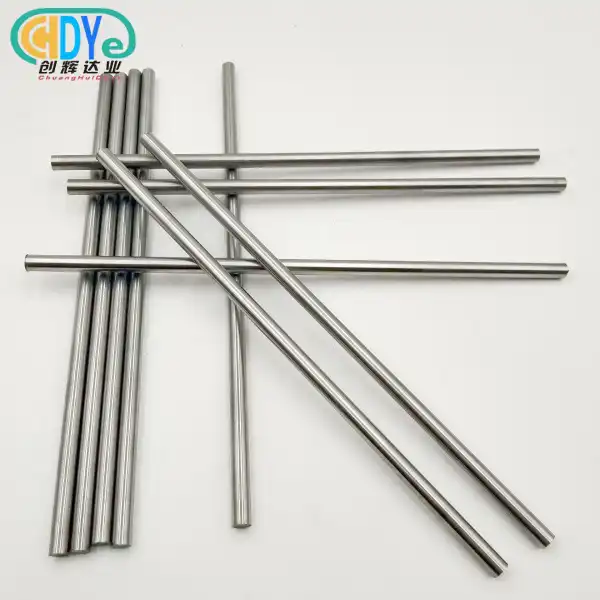
Understanding High Purity Niobium Bar Rods and Their Key Properties
Material Purity and Grade Classifications
When you look at the chemical makeup details, you can tell the difference right away between normal and high purity niobium bar rods. Our niobium bar rods meet ASTM B392-95 standards. We offer types RO4200 and RO4210, which have been checked and proven to be 99.99% pure. This level is higher than what is usually needed in industry, and it meets the needs of study settings where even small amounts of toxins can change the results of experiments.
The RO4200 grade is commercially pure niobium that can be used in general study projects. The RO4210 grade, on the other hand, has a controlled oxygen content for places that need better heat conductivity. Both types are put through strict tests to check their Residual Resistivity Ratio (RRR), which is a key indicator of material quality at very low temperatures.
Physical and Mechanical Characteristics
Knowing about niobium's physical features helps people who work in buying choose the right materials for different study projects. The density of the material is 8.57 g/cm³, and it stays structurally sound at temperatures close to 2,477°C. Its body-centered cubic crystal structure makes it very flexible at room temperature. This means that researchers can machine and shape parts without causing stress cracks or microstructural damage.
Very pure Niobium behaves mechanically very differently from other hard metals. It keeps its tensile strength well and has a low work-hardening rate, which makes it perfect for manufacturing processes that need to do a lot of shaping. This quality is especially useful when study labs need parts with specific shapes or geometries for testing equipment.
Chemical Stability in Research Environments
Materials are often put through harsh acids and pH conditions in research labs. High purity niobium bar rod is very resistant to nitric, hydrochloric, and sulfuric acids. Even after being exposed for a long time, the surface stays intact. This resistance to corrosion keeps expensive testing equipment safe and ensures that it works the same way throughout long research projects.
Niobium is still sensitive to hydrofluoric acid, though, and it is very good at being absorbed between cells when the temperature is above 200°C. When lab managers know about these limits, they can put in place the right working processes and environmental controls that maintain materials' qualities and make parts last longer.
Critical Applications of High Purity Niobium Bar Rods in Research Labs
Superconducting Radio Frequency Cavity Fabrication
Facilities that accelerate particles are one of the most difficult places to use high purity niobium bar rods. Our niobium bar rods can be used to make superconducting radio frequency (SRF) holes that help researchers all over the world do ground-breaking work. When working with liquid helium temperatures between 2K and 4K, the material's high RRR value (usually more than 300) reduces surface resistance and boosts energy efficiency.
Because these holes speed up charged particles almost as fast as light, they need materials that can keep their superconducting qualities without breaking down or losing energy. Every imperfect atom in niobium can make resistance spikes that hurt performance or even cause the structure to fail. By keeping purity levels above 99.99%, we get rid of these failure modes and make sure that the conditions for experiments can be repeated.
Major physics labs have done research that shows that the purity of niobium is directly related to how well cavities work. Higher RRR numbers lower running costs by lowering the need for cryogenics and making the beam quality better. Because of this connection, high purity niobium bar rod is the only material that can be used for next-generation accelerator projects.
Semiconductor and Thin Film Deposition
Sputtering targets made from high purity niobium bar rods are very important to the electronics business. These materials can be turned into rotating or flat targets that allow defect-free thin film formation for advanced sensor technologies, microelectronic capacitors, and optical waveguides. Even flaws at the parts-per-billion level can make finished electronics short-circuit or lose their signals.
When research labs are making new transistor designs, they need materials that can be tracked and are consistent from batch to batch. Electron beam melting and vacuum arc remelting are parts of our production process that get rid of sources of contamination and make microstructures that are all the same. Researchers can be sure that the material specs are correct because each bar rod comes with a full chemical analysis certificate and a mechanical property proof.
The controlled grain size we get from our heat treatment methods—usually ASTM No. 5 or finer—keeps the surface from being uneven during later grinding steps. This focus on microstructural details makes sure that sputtering targets maintain the same film qualities and formation rates over the course of their useful life.
Low-Temperature Physics and Cryogenic Applications
For studies of quantum events and superconducting materials, parts need to be able to keep working at very low temperatures. RRR values serve as a clear indicator of low-temperature performance, and high purity niobium bar rod exhibits exceptional thermal conductivity at cryogenic temperatures. Materials with higher RRR scores have better heat transfer properties, which lets designers make more efficient cooling systems and shortens the time it takes to run an experiment.
Niobium's ability to work with living things also makes it useful in medical study tools, especially MRI systems and specialized diagnosis tools. Because it is physiologically neutral and doesn't react with body fluids, it can be used for parts that need to be in contact with biological samples or patient settings for a long time.
How High Purity Niobium Bar Rods Are Manufactured and Quality Verified
Raw Material Selection and Refinement
Quality starts with picking the right places to get niobium rock and stays high at every step of the manufacturing process. As China's "Titanium Capital" and location in Baoji, Shaanxi Province, Chuanghui Daye has easy access to high-quality raw materials and a well-established metalworking infrastructure. Our founder has worked in the rare metals business for 30 years, which helps him choose materials that are pure and consistent.
Vacuum melting methods are used in the polishing process to keep the air as clean as possible. We get the very low amounts of impurities needed for study purposes by carefully managing the furnace's atmosphere and temperature patterns. High purity goods are different from normal business grades because they pay more attention to process control.
Precision Forming and Heat Treatment
Niobium goes through controlled casting and rolling processes that give it the right mechanical qualities while keeping its chemical purity. Our building has high-tech tools like electron beam ovens, melting systems, and precision machining centers that allow us to make things with very tight tolerances and great surface finishes.
The steps of heat treatment are carefully set up to get the best grain structure and stress release without adding any contamination. As a result, the microstructure has qualities that are the same across all bar rods. This means that there are no weak spots or flaws that could affect the results of the experiment. This level of accuracy in making ensures that researchers get materials that work exactly as planned.
Comprehensive Testing and Certification
Quality control goes beyond simple measurements and includes full chemistry analysis and testing of mechanical properties. With the help of advanced scientific methods, each output batch is checked for purity, tensile strength, and surface finish. Our ISO 9001:2015 certification shows that we are dedicated to managing quality in a planned way throughout the whole production process.
Every shipment comes with documentation packages that make it possible to track everything from the source of the raw materials to the final review. This approval trail is very important for study centers that need to make sure that the properties of the materials they use are confirmed and that they meet international standards. Procurement teams can safely order our high purity niobium bar rods because all performance claims are backed up by proof.
Comparing Niobium Bar Rods with Alternative Materials for Research Use
Niobium Versus Titanium in Research Applications
Titanium has a good strength-to-weight ratio for construction uses, but it can't compete with niobium when it comes to superconductivity or cold performance. In order to study quantum events, research labs need materials that can change from a normal state to a superconducting state at normal temperatures. Niobium is a much easier material to get than other superconductors because it doesn't need to be cooled to very low temperatures.
These metals also have different types of corrosion protection. Titanium creates a protected oxide layer that is very good at resisting acids, but this oxide can get in the way of superconducting uses. High purity niobium keeps surfaces clean, which is necessary for making cavities, and it also protects against rust in most lab settings.
Molybdenum Compared to Niobium for High-Temperature Research
Molybdenum can be used in very high-temperature situations because its melting point is higher than 2,600°C. However, molybdenum is not good enough for study projects that need it to work at low temperatures or be superconducting. The material is harder to work with because it is denser and more rigid than niobium, which is better at being flexible.
Cost factors change based on the needs of the product and the number of orders. Molybdenum may be cheaper per kilogram, but niobium is usually the better choice when you look at how easy it is to make, how long it lasts, and how well it works in specialized study settings. When making purchases, people should look at the total costs of ownership instead of just the initial cost of the goods.
High Purity Versus Standard Grade Niobium
In difficult study tasks, the difference in ability between standard niobium and high purity niobium becomes clear. Higher amounts of impurities in standard grades cause lower RRR numbers and lower superconducting efficiency. These restrictions directly lead to less accurate results in experiments, higher costs, and the chance that tools will break down.
Laboratories that are making precise measurements or working on new technologies can't have lower-quality materials messing things up. Investing in high purity niobium bar rod pays off with results that can be repeated, parts that last longer, and study results that can stand up to scrutiny from peers. Material purity is a must when the image of scientists rests on the quality of the data they collect.
Procurement Considerations: How to Choose the Right High Purity Niobium Bar Rod Supplier
Certification and Quality Standards Verification
Before you choose a high purity niobium bar rod supplier, you should check their quality control methods and industry certifications. Chuanghui Daye's ISO 9001:2015 approval shows that we have a structured way of controlling quality, from checking the raw materials to delivering the finished product. This standard is known all over the world and makes sure that every step of the production process follows written steps that are meant to keep things consistent and stop mistakes.
Ask for specific certifications of the materials you're interested in, such as chemical composition analyses, mechanical property test results, and RRR measures if they apply. Suppliers with a good reputation will gladly give you this information because they know that study applications need full transparency about material specs. Watch out for sellers who won't give you full test data or information on how to track their products.
Custom Processing Capabilities and Lead Times
A lot of the time, research projects need non-standard sizes or surface styles that aren't available in catalogs. Check out possible sources to see if they can do custom processing and are ready to work with your specific needs. With our facility's wide range of cutting tools, we can make bars, rods, and other parts that are exactly what our customers want.
When planning a project's schedule and budget, lead times play a role. To find a good balance between speed and quality, you need sellers who keep enough stock on hand and are flexible for rush orders. We keep popular sizes and grades in stock and can speed up production for research projects with tight dates. This way, we can make sure that the lack of materials never slows down a project.
Pricing Structure and Long-Term Partnership Value
It's important to have reasonable prices, but the cheapest quote isn't always the best deal for important study materials. Look at the total cost, which should include shipping, documentation, technical help, and the chance that quality problems will cause the job to be late. With factory-direct prices from well-known brands like Chuanghui Daye, you can avoid the markups that come from buying through distributors and still get the same high-quality goods that you can't get from foreign goods from unknown sources.
Building ties with suppliers who understand the goals of your study is worth more than just one transaction. As study programs change and needs shift, technical advice, suggestions for materials, and quick customer service become more and more important. Instead of sellers who are only interested in making quick sales, choose partners who care about your long-term success.
Conclusion
High purity niobium bar rod is used as a building block for cutting-edge studies in many fields of science. It can't be replaced in uses ranging from particle accelerators to chip development because it has superconducting qualities, can work in cryogenic temperatures, and is chemically stable. Material purity has a direct effect on the results of experiments. This makes choosing a seller an important choice that affects the success of research and the trustworthiness of science. Research institutions can safely choose niobium materials that meet strict performance standards if they know about important properties, manufacturing methods, and buying issues. Buying certified, high-purity materials from reputable suppliers pays off in the long run by allowing results to be repeated, tools to last longer, and study results that help advance science.
FAQ
Q: What purity level should research labs specify for superconducting applications?
A: For most superconducting uses, niobium needs to be more than 99.95% pure and have an RRR number of more than 300. Our normal high purity niobium bar rod, which is 99.99% pure, meets and goes beyond these requirements for most research lab uses, such as making SRF cavities and doing physics tests at low temperatures.
Q: How long does custom processing take for specialized dimensions?
A: Lead times for handmade niobium bar rods depend on the size requirements and the number of rods ordered. Standard changes usually take two to three weeks, but complicated custom designs can take up to four to six weeks. We keep popular grades in stock so that we can speed up handling when project deadlines call for it.
Q: What quality testing accompanies each shipment?
A: Each package comes with a lot of paperwork, like reports on the material's dimensions and makeup, its mechanical properties, and its ability to be tracked back to its source. Our quality system is ISO 9001:2015 certified, which means that the testing protocols are always the same. These protocols meet international research standards and provide the paperwork needed for grant reporting and release.
Partner with Chuanghui Daye for Your Research-Grade Niobium Requirements
Every high purity niobium bar rod that Shaanxi Chuanghui Daye makes is based on our more than 30 years of experience working with rare metals. We are a reliable niobium seller based in China's Titanium Capital. Our advanced metalworking skills are paired with strict quality control systems that are approved to ISO 9001:2015 standards. Our grades RO4200 and RO4210 materials meet ASTM B392-95 standards and are 99.99% pure, which is what challenging study uses need. Whether your lab needs standard sizes or parts that have been handled in a way that fits its needs, our technical team is quick to respond and offers low factory-direct prices that are kind to research budgets. Email us at info@chdymetal.com to talk about your unique needs and find out how our materials can help you make your next big step forward. Universities, study centers, and labs from all over the world that are looking for solid materials that can be fully tracked and documented are welcome to contact us.
References
1. Knobloch, J., & Padamsee, H. (1994). "Microscopy of Superconducting Niobium Surfaces: Studies on the Material Quality Requirements for Radio Frequency Cavities." Journal of Applied Physics, Vol. 76, Issue 3.
2. Ciovati, G. (2006). "Effect of Low-Temperature Baking on the Radio Frequency Properties of Niobium Superconducting Cavities for Particle Accelerators." Applied Physics Letters, Vol. 89, Article 022507.
3. Singer, W., & Singer, X. (2010). "Developments in Fabrication Techniques for High-Purity Niobium SRF Cavities." Physical Review Special Topics - Accelerators and Beams, Vol. 13, Issue 071001.
4. Trenikhina, Y., & Romanenko, A. (2015). "Performance-Defining Properties of Nb Superconducting RF Cavities: A Comparison Study." Superconductor Science and Technology, Vol. 28, No. 8.
5. Posen, S., & Hall, D. L. (2017). "Nb₃Sn Superconducting Radiofrequency Cavities: Fabrication, Results, Properties, and Prospects." Superconductor Science and Technology, Vol. 30, No. 3.
6. Antoine, C. Z. (2012). "Materials and Surface Aspects in the Development of SRF Niobium Cavities." European Organization for Nuclear Research Technical Report Series, CERN-ATS-2012-006.
Learn about our latest products and discounts through SMS or email