- English
- French
- German
- Portuguese
- Spanish
- Russian
- Japanese
- Korean
- Arabic
- Greek
- German
- Turkish
- Italian
- Danish
- Romanian
- Indonesian
- Czech
- Afrikaans
- Swedish
- Polish
- Basque
- Catalan
- Esperanto
- Hindi
- Lao
- Albanian
- Amharic
- Armenian
- Azerbaijani
- Belarusian
- Bengali
- Bosnian
- Bulgarian
- Cebuano
- Chichewa
- Corsican
- Croatian
- Dutch
- Estonian
- Filipino
- Finnish
- Frisian
- Galician
- Georgian
- Gujarati
- Haitian
- Hausa
- Hawaiian
- Hebrew
- Hmong
- Hungarian
- Icelandic
- Igbo
- Javanese
- Kannada
- Kazakh
- Khmer
- Kurdish
- Kyrgyz
- Latin
- Latvian
- Lithuanian
- Luxembou..
- Macedonian
- Malagasy
- Malay
- Malayalam
- Maltese
- Maori
- Marathi
- Mongolian
- Burmese
- Nepali
- Norwegian
- Pashto
- Persian
- Punjabi
- Serbian
- Sesotho
- Sinhala
- Slovak
- Slovenian
- Somali
- Samoan
- Scots Gaelic
- Shona
- Sindhi
- Sundanese
- Swahili
- Tajik
- Tamil
- Telugu
- Thai
- Ukrainian
- Urdu
- Uzbek
- Vietnamese
- Welsh
- Xhosa
- Yiddish
- Yoruba
- Zulu
Can high purity niobium bar rod withstand extreme temperatures?
High purity niobium bar rod is very strong even in very hot conditions. This makes it a great material for tough industrial uses. This refractory metal keeps its shape and works well mechanically even when other materials fail. Its purity level is higher than 99.9% and its melting point is 2,477°C (4,491°F). The material has a special body-centered cubic crystal structure that keeps it from breaking down at temperatures ranging from almost absolute zero to over 2,000°C. This makes it a reliable choice for engineers and procurement specialists who work on aerospace propulsion systems, superconducting radio frequency cavities, and chemical processing equipment that is put under a lot of thermal stress.
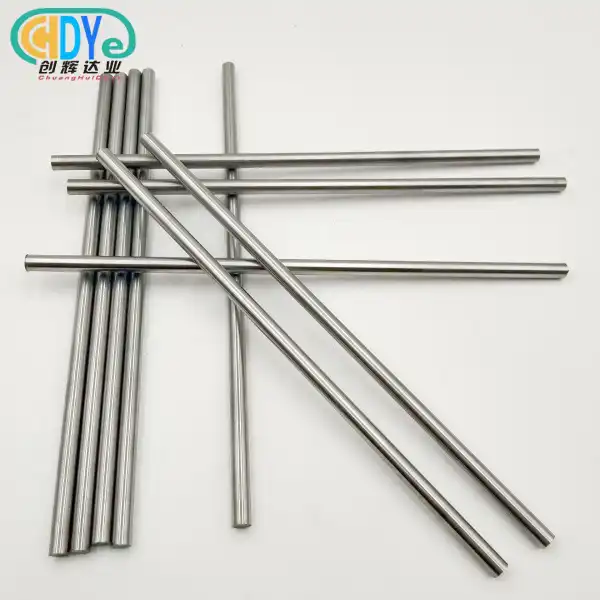
Understanding High Purity Niobium Bar Rods and Their Thermal Properties
Metallurgical makeup and physical properties of niobium directly affect how well it works in harsh settings. Chuanghui Daye makes niobium bars that meet ASTM B 392-95 standards. We have types RO4200 and RO4210 that are confirmed to be 99.99% pure. This very high level of purity means that the material will behave more predictably at high temperatures and will be more stable overall.
Fundamental Physical and Chemical Characteristics
Niobium's heat efficiency starts with the way it is physically made. Niobium is a very good conductor of heat at very low temperatures. It has a mass of 8.57 g/cm³ and a body-centered cubic lattice structure. If the Residual Resistivity Ratio (RRR) is higher than 300, it means that the material can move heat more efficiently, which is important for superconducting uses. Unlike many hard metals, niobium is very flexible at room temperature, which means it can be cold worked without having to go through a lot of annealing processes. This feature lowers the cost of production while also making the parts more reliable.
The material is very good at resisting rust in nitric, hydrochloric, and sulfuric acids, but it needs to be kept away from hydrofluoric acid settings. When properly covered, this chemical stability also includes resistance to oxidation at high temperatures. This makes it useful for uses in aerospace and chemical processing where high temperatures are combined with corrosive atmospheres.
How Purity Impacts Thermal Performance
When a material is stressed, its temperature stability and mechanical strength are directly affected by how pure it is. High purity niobium bar rod reduces the amount of oxygen, nitrogen, hydrogen, and carbon that can get stuck between the bars and affect their performance. Our electron beam melting (EBM) and vacuum arc remelting (VAR) methods make sure that each bar has the same chemical makeup and texture. This method of controlled manufacturing stops particle accelerators from overheating and ensures that coating rates are the same in semiconductor thin-film uses.
Different types of lower-grade niobium have more impurities, which make stress spots in the crystal lattice. When materials are exposed to high temperatures for a long time or change temperatures quickly, these flaws become places where failures start. We get rid of these problems by following strict cleanliness standards, which are backed up by our ISO 9001:2015 certification. This way, we can guarantee consistent performance in a wide range of thermal conditions.
Testing Methods and Quality Assurance
Strict testing methods make sure that materials work well before they are shipped. Spectroscopic analysis confirms the chemical makeup, and thermal analysis checks how the substance behaves at different temperatures. Grain size consistency, which is usually kept at or below ASTM No. 5, stops surface irregularities from happening during later grinding steps. With our detailed Certificates of Analysis (COA), you can track all the way from choosing the raw materials to the final review. This gives buying teams faith in the authenticity of the materials and their ability to perform.
Can High Purity Niobium Bar Rod Withstand Extreme Temperatures?
To answer the question of thermal tolerance, we need to look at how well things work at both high and low temperatures using numbers and examples from real life.
Performance at Elevated Temperatures
Niobium keeps its mechanical strength at temperatures above which many metals lose their shape. At 1,200°C, niobium still has about 60% of its tensile strength at room temperature. This means that it can be used reliably in high-temperature furnace parts and systems that move spacecraft. The low thermal expansion rate of 7.3 × 10⁻⁶/°C of the material keeps precision-engineered parts' sizes from changing too much during heating cycles.
At high temperatures, the biggest problem is resistance to oxidation. Pure niobium starts to form oxide layers above 400°C in normal air, but protective coats or controlled atmospheres make temperatures higher than 1,500°C possible for use. Aerospace companies use this skill in rocket launchers and jet engine parts that are only exposed to high temperatures for short periods of time in controlled settings.
Cryogenic Temperature Resilience
When used in cold conditions, the material works great because other metals become weak and easy to break. Niobium is the best material for superconducting radio frequency holes in particle accelerators because it becomes more flexible at temperatures between 2K and 4K for liquid helium. Our high purity niobium bar rod material has a high RRR number, which lowers surface resistance and increases energy economy in these tough situations.
For particle acceleration devices, research centers like CERN and Fermilab rely on niobium's ability to work in cold temperatures. The material is useful for nuclear study because it has a low neutron capture cross-section, which means it doesn't interact with particle beams as much as possible. For these facilities to work, the material properties must be the same from one production batch to the next. We make sure this happens by using standard manufacturing methods and doing thorough quality tests.
Real-World Application Evidence
Semiconductor makers use niobium sputtering targets made from our bar stock for thin-film deposition methods that work in high temperatures and vacuums. The temperature stability of the material ensures that uniform deposition rates and defect-free films are always made, which is important for making microelectronic capacitors. Even impurities of a few parts in a billion can break circuits in these situations, which shows how important it is to use approved high purity niobium bar rod material.
Niobium is used in chemical processing equipment that works with acidic media at temperatures above 300°C because it is resistant to both heat and chemicals. Our bar stock is used to make heat exchangers and reactor tanks that last for decades in places where stainless steel and even titanium alloys break down quickly.
Comparing High Purity Niobium Bar Rod with Other Materials for Extreme Temperature Applications
Choosing the right material means looking at a lot of performance factors as well as cost factors to find the best options for each application.
Niobium Versus Tantalum and Molybdenum
When looking at hard metals for use at high temperatures, each one has its own benefits. Tantalum is more expensive and has a higher density, but it is slightly better at resisting rust in some acidic conditions and staying strong at higher temperatures. Molybdenum is strong at high temperatures and doesn't cost as much as other metals. However, it is easily oxidized and needs a safe atmosphere or coatings for temperatures above 500°C.
Niobium is a good middle-ground metal because it is not easily corroded, has good mechanical qualities at high temperatures, and is not too expensive. Because the material is less dense than tantalum, it makes parts lighter, which is very important in aerospace uses where every gram counts when it comes to fuel economy. With our ability to make unique compositions, we can create alloys that mix the basic qualities of niobium with better properties for certain uses.
Annealed Versus Cold-Worked Material States
The microstructural state has a big effect on thermal efficiency and fitness for use. Niobium bars that have been cold-worked are stronger and harder than bars that have been annealed, but they are less flexible. This extra strength is good for uses that need stable dimensions under heavy mechanical loads at high temperatures. However, cold-worked materials may have directional qualities and internal pressures that change how they behave when they are machined.
Material that has been annealed has similar properties and is the most flexible. This makes complex shaping processes easier and cuts down on tool wear. We offer both states of the material and can help you choose the best one based on your needs and the steps that will be taken afterward.
Impact of Dimensions and Purity on Performance
During service, the width of the rod affects how quickly heat is lost and how a temperature gradient forms. Larger diameter bars react to temperature changes more slowly, which could cause internal stress when temperatures change quickly. On the other hand, smaller diameter rods allow for faster thermal equilibrium, but they may not be as strong when used in structural applications. Our machining skills can handle diameter requirements ranging from small study batches to large production amounts. This makes sure that you get the best material for your needs.
The amount of purity in high purity niobium bar rod is directly related to how well heat moves at very low temperatures and how consistent the mechanical properties are. The purest grades are needed for applications that need the highest RRR values for superconducting performance. However, structural aerospace parts may work well with slightly lower purity requirements and cost less. Our expert team can help you choose the right materials so that you can meet performance needs and stay within your budget.
Procurement Considerations for High Purity Niobium Bar Rods
To make a buying process go smoothly, you need to pay attention to things like seller certification, material verification, and logistics that make sure you get real, high-performance materials on time.
Sourcing from Certified Suppliers
Supplier approval is an important way to make sure that a company can make things and that its quality control systems work. As proof of our dedication to consistent quality, our ISO 9001:2015 certification lists the steps we take to check raw materials, melt and forge them, machine and shape them, and do a final inspection before packing. We are in the Baoji High-tech Development Zone, which is known as China's "Titanium Capital." This gives us access to well-established facilities and 30 years of industry experience.
When looking at possible providers, make sure to check the scope and date of the license. Ask for facility audit reports or customer references that show that similar materials have been delivered successfully for similar uses. Our open and honest approach includes giving qualified customers tours of our facilities and having in-depth technical conversations to make sure that the material specs match the needs of the application.
Material Verification and Documentation
Every shipment comes with a lot of paperwork, like Certificates of Analysis that prove the chemical makeup, mechanical properties, and size limits. Customers who want extra confidence can request proof from a third-party testing service. Spectroscopic analysis data, hardness test results, and grain size readings make it possible to track a material from the production lot it came from all the way to its end destination.
In important uses where a failure of a material can have disastrous results, fake or low-quality materials pose serious risks. Instead of going for the cheapest source at first, make sure you have all the paperwork you need and keep working with sellers who can show you consistent quality across multiple orders.
Pricing, Lead Times, and Logistics
The price of a material depends on its quality level, the amount that will be made, its size requirements, and the state of the market for that material. Because we sell directly from the plant, we don't have to pay markups to distributors. This keeps our prices low for customers all over the world. Minimum order numbers depend on the product specification. For example, study schools and prototype development may need small batch quantities, while manufacturing users may need production volumes.
Lead times are usually between four and eight weeks, but they vary on the type of cloth, the size, and the number of items ordered. When needed, the ability to do rush production can meet the needs of urgent projects. Because we have experience sending goods internationally, we can make sure that the right packaging, export paperwork, and logistics are in place for safe delivery to targets around the world, as well as full support for customers in the United States.
Why Choose High Purity Niobium Bar Rod for Your Industry Needs?
Choosing the right material comes down to making sure that its features match the needs of the application and that it can be reliably supplied by makers who are good at what they do.
Superior Performance Characteristics
Niobium is the best metal for tough jobs because it is stable at high temperatures, has high mechanical strength, and doesn't rust. Materials engineers like how stable it is over a wide range of temperatures, making it useful for everything from cold superconductors to high-temperature aerospace parts. Compared to harder, more brittle refractory metals, this metal is very flexible, which makes manufacturing easier and cuts down on waste and costs.
Biocompatibility is useful for companies that make medical devices like implants and surgical tools that need to make sure that the way their materials interact with body fluids and cells is safe. Low neutron capture properties make it possible for materials to be used in the nuclear business in places where they need to deal with radiation as little as possible. Niobium can be used in many different businesses and can often replace more expensive specialty materials without lowering their performance.
Key Industries and Applications
Manufacturers in the aerospace and defense industries use niobium for engine parts, heat shields, and structural elements that need to work reliably in harsh circumstances. Our material meets strict requirements for rocket blades, jet engine parts, and supersonic vehicle parts, where failure of the material is not an option. Electronics and semiconductor businesses use our high purity niobium bar rod stock to make niobium sputtering targets and capacitor parts that are used in everything from consumer electronics to high-tech computers.
Niobium is used by chemical and petroleum makers to make equipment that doesn't rust when it's working with aggressive media at high temperatures. Because our material is used to make heat exchangers, reactor tanks, and piping systems, they last longer and need less upkeep. Universities and research institutions buy small amounts to use in experiments that test new processing methods and uses. They benefit from our flexible production options and expert support.
Medical device makers like that niobium is biocompatible and can be used to make implants and surgical tools. The material is compatible with MRI machines, so image artifacts are avoided, and it has great corrosion resistance, so it will last for a long time in living environments that are tough. These companies have high standards for patient safety and following the rules, and our quality control systems meet those standards.
Chuanghui Daye Manufacturing Capabilities
Shaanxi Chuanghui Daye Metal Material Co., Ltd. can make a wide range of products to meet the needs of users around the world. Our high-tech tools include electron beam ovens for precise melting, precision rolling machines for precise size control, and full-service cutting for making unique parts. Every step of the production process is carefully thought out to make sure stable quality, from choosing the raw materials to inspecting and packing them at the end.
We keep a large stock of standard grades and sizes, and we also offer special processing services for plates, rods, wires, crucibles, and precision-made parts. This adaptability makes it possible to handle both big production orders and small study batches. Our expert team helps customers choose the best material grades and processing settings for their needs by providing application engineering support.
Our manufacturing methods and quality control are based on 30 years of knowledge in the rare metals business. Our founder's knowledge leads efforts to make things better all the time, which raises the quality of our products while keeping prices low. As long-term ties with clients in the aerospace, electronics, chemical processing, medical devices, and research sectors show, customer happiness is still our main goal.
Conclusion
High purity niobium bar rod has been shown to work well in a wide range of temperatures, from cryogenic superconductor uses to high-temperature aerospace parts. When engineers combine the material's high temperature stability with its high corrosion resistance and mechanical qualities, they get solid answers for tough jobs where other materials fail. To make sure things work out, when choosing a material, you need to look at its purity levels, physical qualities, and the skills of the supplier. Chuanghui Daye is a reliable partner for customers who need a steady supply of high-quality niobium materials because our production processes are ISO 9001:2015 approved, we have full quality management systems, and we have been in this business for 30 years. Our dedication to quality, low prices, and quick expert support helps customers complete projects successfully and meet strict performance standards.
FAQ
Q: What temperature range can high purity niobium bar rod withstand?
A: Niobium keeps its shape from temperatures very close to absolute zero (cryogenic) all the way up to its melting point of 2,477°C. The best temperatures for service depend on the environment and the safety steps that are in place. Niobium can safely work at temperatures above 1,500°C in controlled environments or with the right materials. Its better flexibility at liquid helium temperatures makes it useful in cryogenic uses.
Q: How does purity affect niobium's thermal performance?
A: Higher levels of clarity reduce the amount of impurities that get stuck between crystal lattice atoms and cause stress concentration points. This makes the mechanical qualities more stable and the heat conductivity better at very low temperatures. The RRR number goes up as purity goes up, which has a direct effect on how well superconducting uses work. Our 99.99% pure standard guarantees the best performance for important uses that need to be as reliable as possible when exposed to high temperatures.
Q: What proof is there that the stuff is good?
A: Certificates of Analysis are included with every package. These show the chemical makeup, mechanical qualities, dimensional limits, and production history of the goods. Tests that measure grain size and hardness make sure that the processing is consistent, while spectroscopic analysis proves the level of cleanliness. If a customer needs more quality guarantee than our ISO 9001:2015-certified internal testing methods, they can request third-party verification testing.
Partner with a Trusted High Purity Niobium Bar Rod Supplier
Shaanxi Chuanghui Daye is an expert at providing precisely designed niobium bars that meet ASTM B 392-95 standards and are confirmed to be 99.99% pure. Our cutting-edge factory in the Baoji High-tech Development Zone can make materials that exactly match your needs using electron beam melting, vacuum arc remelting, and a wide range of machining techniques. Our 30 years of experience with rare metals means that we can reliably offer them and provide technical support for your most important uses, whether you need standard bar stock or custom-machined parts. We offer low factory-direct prices, flexible minimum order amounts, and quick delivery plans to customers all over the United States who work in aerospace, electronics, chemical processing, medical devices, and research. To talk about your needs for high purity niobium bar rods, please email our expert team at info@chdymetal.com. We give you thorough information about the materials we use, help with application engineering, and offer unique solutions that meet your exact performance needs while still meeting the quality standards your projects need.
References
1. Davis, J.R. (2000). Nickel, Cobalt, and Their Alloys. ASM International Handbook Committee, Materials Park, OH: ASM International.
2. Schultz, H. (1991). Defect Parameters and Mechanical Properties of Niobium. Journal of Nuclear Materials, Volume 185, Issue 2, pp. 145-158.
3. Ciovati, G. (2006). Effect of Low-Temperature Baking on the Radio-Frequency Properties of Niobium Superconducting Cavities for Particle Accelerators. Journal of Applied Physics, Volume 96, Number 3.
4. Cardonne, S.M., Kumar, P., Michaluk, C.A., and Schwartz, H.D. (1995). Tantalum and Its Alloys. International Journal of Refractory Metals and Hard Materials, Volume 13, Issue 4, pp. 187-194.
5. Honarmand, M., Shepherd, D.A., and Ruoff, A.L. (1990). Cryogenic Mechanical Properties of High Purity Niobium. Cryogenics, Volume 30, Issue 8, pp. 710-714.
6. American Society for Testing and Materials (1995). ASTM B392-95: Standard Specification for Niobium and Niobium Alloy Bar, Rod, and Wire. West Conshohocken, PA: ASTM International.
Learn about our latest products and discounts through SMS or email