- English
- French
- German
- Portuguese
- Spanish
- Russian
- Japanese
- Korean
- Arabic
- Greek
- German
- Turkish
- Italian
- Danish
- Romanian
- Indonesian
- Czech
- Afrikaans
- Swedish
- Polish
- Basque
- Catalan
- Esperanto
- Hindi
- Lao
- Albanian
- Amharic
- Armenian
- Azerbaijani
- Belarusian
- Bengali
- Bosnian
- Bulgarian
- Cebuano
- Chichewa
- Corsican
- Croatian
- Dutch
- Estonian
- Filipino
- Finnish
- Frisian
- Galician
- Georgian
- Gujarati
- Haitian
- Hausa
- Hawaiian
- Hebrew
- Hmong
- Hungarian
- Icelandic
- Igbo
- Javanese
- Kannada
- Kazakh
- Khmer
- Kurdish
- Kyrgyz
- Latin
- Latvian
- Lithuanian
- Luxembou..
- Macedonian
- Malagasy
- Malay
- Malayalam
- Maltese
- Maori
- Marathi
- Mongolian
- Burmese
- Nepali
- Norwegian
- Pashto
- Persian
- Punjabi
- Serbian
- Sesotho
- Sinhala
- Slovak
- Slovenian
- Somali
- Samoan
- Scots Gaelic
- Shona
- Sindhi
- Sundanese
- Swahili
- Tajik
- Tamil
- Telugu
- Thai
- Ukrainian
- Urdu
- Uzbek
- Vietnamese
- Welsh
- Xhosa
- Yiddish
- Yoruba
- Zulu
Can pure niobium round bars withstand extreme environments?
In actuality, pure niobium round bars are incredibly strong and resilient under difficult circumstances. Because they are made of more than 99.9% niobium, these high-purity metal parts stay strong at temperatures ranging from very cold (almost 0°C) to very hot (up to 2400°C). In strong acids, alkalis, or saltwater, they don't rust. They're also very stable at high temperatures and easy to shape at low ones. Because of this, they work great in high-stress areas like superconducting technologies, chemical processing equipment, and aircraft power systems, where normal materials break down quickly.
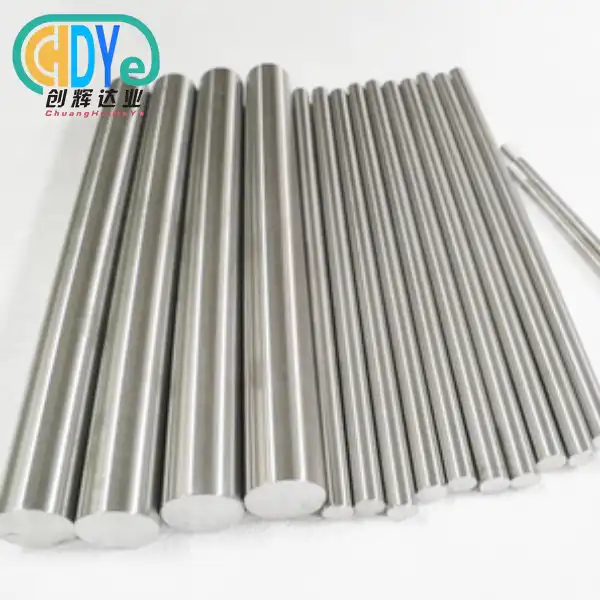
Understanding Pure Niobium Round Bars and Their Properties
Chemical Composition and Purity Standards
Pure niobium bars that meet ASTM B392 standards have flaws that are carefully managed and have at least 99.9% niobium in them. Oxygen, nitrogen, hydrogen, and carbon amounts must stay below 400 ppm for products that are used in business. The limits have to be even tighter for better materials. This high amount of cleanliness has a direct effect on how well it works and how well it doesn't rust. At Shaanxi Chuanghui Daye Metal Material Co., Ltd., we make niobium bars that are more than 99.9% pure. We can show this with Glow Discharge Mass Spectrometry and our ISO 9001:2015-approved strict quality standards.
Core Physical and Mechanical Properties
Because of how it is made, niobium has a unique set of properties. Niobium is about half as heavy as tantalum (8.57 g/cm³), but it is just as resistant to weathering in many conditions. It can be used at temperatures where most metals fail to keep their shape, up to 2468°C, where it melts. When heated and treated in different ways, the tensile strength can range from 200 to 350 MPa, which is strong enough for building purposes. Being able to keep the thermal stress low as the temperature changes is possible because the thermal expansion rate stays low and steady. Niobium is the best material for use in tough settings because of all the other things it can do.
Available Specifications and Surface Finishes
Pure niobium round bars can be made with widths from 1 mm to 350 mm, and their lengths can be changed to 1000 mm or longer, based on the need. Its surface can be as-rolled for general industrial use, or it can be centerless ground or polished (Ra < 0.8µm) for vacuum uses where the rate of gas release is affected by how rough the surface is. In Baoji, China, which is known as the "Titanium Capital," our plant has cutting-edge machines like electron beam furnaces and precise lathes for melting, casting, rolling, and machining. In this way, we can make bars that are exactly the right size and have the right surface for your job.
Performance of Pure Niobium Round Bars in Extreme Environments
Exceptional Corrosion Resistance in Aggressive Media
A lot of acids can break down stainless steel and nickel metals very quickly, but they can't hurt niobium. Nitric acid, hydrochloric acid, sulfuric acid, and phosphoric acid can't hurt the material in a lot of different amounts. Although reducing acids are bad for titanium, niobium's passive film stays stable in both oxidizing and reducing situations. Neither alkaline liquids nor saltwater changes the chemical makeup of pure niobium round bars. Because of this, they work great in heat exchangers, bayonet heaters, and valve stems in factories where downtime due to rust costs a lot of money.
Thermal Performance from Cryogenic to Elevated Temperatures
Niobium isn't like other hard metals because it can work well when it's cold. Normal structural steels break below -40°C, but niobium stays flexible and doesn't easily break when it gets close to 0°C. This trait is very important for superconducting applications and systems that deal with gases in liquid form. Nickel-based alloys are stronger and less likely to creep when heated up than titanium-based metals. At temperatures above 400°C, they need to be sealed off from the air so oxygen doesn't get in and weaken them. Parts made of niobium always work at temperatures above 1200°C in neutral or vacuum conditions.
Real-World Application Evidence
Manufacturers of aircraft parts have successfully used niobium alloys in rocket thrust chambers and nozzle extensions. These parts have to be able to handle quick changes in temperature and fast-moving exhaust gases. Niobium sputtering targets are used in the semiconductor business to cast thin films evenly. This is done to avoid the problems with particles that come up with lower-quality coatings. Chemical companies say that niobium equipment can last for years in places with a lot of acid, while rare stainless steels break down in just a few weeks. These tests show that the substance can last a long time and work well in conditions that would normally make it difficult for it to do so.
Pure Niobium Round Bars vs Alternative Materials: Comparative Analysis
Niobium Compared to Stainless Steel
In places where chemicals are likely to attack, pure niobium round bars are much better materials for defense than austenitic and duplex stainless steels. A lot of chemical equipment is made of stainless steel 316L, but acids with chloride and high-temperature solutions can rust the steel and cause it to pit and crack. These events don't cause corrosion to break down the inactive film because niobium keeps it whole. But stainless steel is much cheaper and has a higher tensile strength. This makes it better for building structures at room temperature, where rust is less likely to happen. The choice rests on whether the chemicals in the work environment are too strong for stainless steel to handle.
Niobium Versus Titanium
There are some important ways in which these two materials don't work the same, even though they both don't rust and are strong for their weight. Because it has a higher tensile strength, titanium is better for parts of structures that are under a lot of stress. Titanium becomes less resistant to touch when it gets too cold, but niobium stays flexible even when it's very cold. People can get more titanium because supply lines are better set up, and more of it is made around the world. The type of material used depends on whether the product needs to be strong mechanically, resistant to chemicals in certain media, or able to work at low temperatures.
Niobium in Relation to Tantalum
In the toughest chemical environments, like those with very hot sulfuric acid and hydrofluoric acid that are very concentrated, tantalum is the standard for protecting against rust. Niobium is almost always chemically neutral, but not quite. Tantalum is always chemically neutral: an ideal metal. It is much better than tantalum because it is less dense (8.57 g/cm³ vs. 16.6 g/cm³) and less expensive (about one-third the price of tantalum). If the rust protection of niobium is good enough for the job, moving to a different material can save you a lot of money and weight. Niobium is often chosen for projects with clear chemical exposure limits based on life-cycle cost analysis, which looks at how much it costs to make and place the material.
Procurement Insights for Pure Niobium Round Bars
Grade Selection Based on Application Requirements
When picking the right grade of pure niobium round bars, you need to make sure that the product requires that amount of clarity and the way it works. An electron beam is used to heat niobium (R04200) to make the cleanest and most flexible reactor-grade niobium. This makes it great for superconducting and deep-drawing. The commercial-grade material (R04210) can handle a little more air and impurities than the other grades. It works well for normal chemical processing equipment that doesn't need to be very flexible. When you know these differences, you don't have to list too many types of materials, which saves you money and makes sure the job is done right.
Evaluating Supplier Capabilities and Certifications
Suppliers you can trust have the most up-to-date tools for production, are certified for their quality control systems, and can try a lot of different things. When something is approved by ISO 9001:2015, the whole process is organized and controlled, from checking the raw materials to putting them up at the end. Suppliers with electron beam furnaces, vacuum melting systems, and metallographic labs can check the metal's purity levels, grain structure, and mechanical properties. For 30 years, Chuanghui Daye has been working with rare metals. Our buildings in Baoji's specialized industrial zone are the most up-to-date in the world. It lets us make materials that can be fully tracked and are all the same quality from one lot to the next.
Understanding Lead Times and Order Logistics
To order niobium bars in normal sizes, you usually need to order at least 50 to 100 kilograms. For different sizes, bigger funds are needed to pay for the tools and bars that need to be set up. Standard wait times for stock sizes are 4 to 8 weeks, and for custom orders with strict size or surface finish limits, they are 10 to 14 weeks. For things that need to be done quickly, there are ways to speed up production, but they cost more. The freezing and finishing methods work better when you order a lot of them at once. This means you save money. The buying process goes faster and there is less risk in the supply chain when you know about providers that offer shipping all over the world and expert customer service.
Best Practices for Using Pure Niobium Round Bars in Extreme Applications
Proper Handling and Storage Protocols
The first thing that needs to be done to keep pure niobium round bars pure is to handle them in the right way. Niobium is soft and likes to gall, so it needs to be moved and kept with care so that the surface doesn't get damaged. If it does, it would be less useful for precise tasks. Places that store things should keep the humidity low and put safety materials between the bars to keep them from scratching. This will keep the surface from rusting. Clean hands should be worn by people who touch things because skin oils and other dirt make surfaces less clean, which is important for cleaning. These easy steps keep the item in the same condition as when it was shipped, so you won't have to pay a lot of money to fix it.
Machining and Fabrication Techniques
Niobium is one of a kind when it comes to cutting because it doesn't harden quickly and can be bent. Because they don't chip as easily, high-speed steel tools work better than carbide tools most of the time. But because the steel likes to weld to the cutting edges, you need to use coolants that don't dissolve in water and rake angles that are positive. The workpiece doesn't get too hot because of high chip loads and slow speeds. This stops the surface from getting hard. A layer of a neutral gas (like argon or helium) with oxygen levels below 50 ppm is needed for welding to work. This keeps the metal from getting weak. At 800-1100°C in a vacuum or an inert environment, you can get the grain patterns you want and get rid of any pressures that are still there. To make sure that the parts are made properly, you need to know how these things work.
Inspection and Maintenance Guidelines
Testing on a regular basis finds early signs of wear and tear before they make the system work less well. Oxidation has changed the color of the surface, and measuring it shows that it has been worn down or distorted by workloads. When materials are heated and cooled, they form holes or cracks that can be found with ultrasound. Metal parts that work at high temperatures need to be checked for grain growth and phase changes on a regular basis. These signs show that the part is almost at the end of its useful life. Using these check times that are in line with how things are used and what the manufacturer suggests will make parts last longer while still allowing enough room for error.
Conclusion
It has been shown that pure niobium round bars work well in difficult conditions such as very cold or hot places, strong chemical environments, and high-vacuum systems. Because they don't rust, are safe at high temperatures, and work well under stress, they are perfect for use in nuclear power, airplanes, chemical processing, and electronics. To pick the right material, you need to know how niobium compares to titanium, stainless steel, and tantalum. You should also think about your budget and the needs of the job. The key to successful procurement is working with approved providers who offer consistent quality, expert understanding, and on-time delivery. To get the most use out of things for as long as possible, they need to be handled, built, and maintained properly.
FAQ
Q: Can niobium bars perform reliably in cryogenic environments?
A: Niobium stays very flexible and doesn't break easily at very low temperatures, even when they are very close to zero. This isn't like many structural metals, which get weak below -40°C. Because of this, niobium is very important for making low-temperature study tools, systems for liquefied gases, and holes that carry electricity very well.
Q: What certifications should I verify when procuring niobium round bars?
A: It is important to ask for proof that the product meets ASTM B392 or a similar international standard, material test results that show pure levels through GD-MS or IGA analysis, and certificates for measurement inspection. These papers make sure that supplies can be tracked and that the level of work is always the same.
Q: How do lead times vary for custom versus standard niobium bar orders?
A: It normally takes 4 to 8 weeks to ship standard diameter bars that are finished or left as rolled. Custom orders, on the other hand, that need specific measures, strict standards, or different surface processes can have wait times of up to 10 to 14 weeks. With prices having changed, faster production options can fit into tight schedules for jobs that need to be done quickly.
Partner with Chuanghui Daye for High-Performance Niobium Round Bar Solutions
You can trust Shaanxi Chuanghui Daye Metal Material Co., Ltd. to make pure niobium round bars. They have quality methods that are approved by ISO 9001:2015 and have worked with rare metals for more than 30 years. The materials from our Baoji plant are more than 99.9% pure and come in sizes ranging from 3 mm to 350 mm. The widths can also be changed. You can clean the surfaces or leave them as they are, based on what you need. We help you with everything, give you full paperwork for tracking, and offer low factory-direct prices so you can get the most for your money when you buy from us. No matter if you need a few samples for a study project or a lot of them for an airplane, a chemical plant, or an electronics factory, our team will make sure you get what you need. Get in touch with info@chdymetal.com right away to talk about your project and get a full price on pure niobium round bars that are made just the way you want them.
References
1. Davis, J.R. (Ed.). (2000). ASM Specialty Handbook: Nickel, Cobalt, and Their Alloys. ASM International, Materials Park, Ohio.
2. Cardonne, S.M., Kumar, P., Michaluk, C.A., & Schwartz, H.D. (1995). Tantalum and its alloys. International Journal of Refractory Metals and Hard Materials, 13(4), 187-194.
3. American Society for Testing and Materials. (2018). ASTM B392-18: Standard Specification for Niobium and Niobium Alloy Ingots. ASTM International, West Conshohocken, Pennsylvania.
4. Pollock, T.M., & Tin, S. (2006). Nickel-based superalloys for advanced turbine engines: Chemistry, microstructure and properties. Journal of Propulsion and Power, 22(2), 361-374.
5. Schultz, J.M. (1999). The manufacture, characteristics, and applications of tantalum, niobium, and their alloys. JOM Journal of the Minerals, Metals and Materials Society, 51(5), 21-24.
6. Gupta, C.K. (1992). Extractive Metallurgy of Niobium. CRC Press, Boca Raton, Florida.
Learn about our latest products and discounts through SMS or email