- English
- French
- German
- Portuguese
- Spanish
- Russian
- Japanese
- Korean
- Arabic
- Greek
- German
- Turkish
- Italian
- Danish
- Romanian
- Indonesian
- Czech
- Afrikaans
- Swedish
- Polish
- Basque
- Catalan
- Esperanto
- Hindi
- Lao
- Albanian
- Amharic
- Armenian
- Azerbaijani
- Belarusian
- Bengali
- Bosnian
- Bulgarian
- Cebuano
- Chichewa
- Corsican
- Croatian
- Dutch
- Estonian
- Filipino
- Finnish
- Frisian
- Galician
- Georgian
- Gujarati
- Haitian
- Hausa
- Hawaiian
- Hebrew
- Hmong
- Hungarian
- Icelandic
- Igbo
- Javanese
- Kannada
- Kazakh
- Khmer
- Kurdish
- Kyrgyz
- Latin
- Latvian
- Lithuanian
- Luxembou..
- Macedonian
- Malagasy
- Malay
- Malayalam
- Maltese
- Maori
- Marathi
- Mongolian
- Burmese
- Nepali
- Norwegian
- Pashto
- Persian
- Punjabi
- Serbian
- Sesotho
- Sinhala
- Slovak
- Slovenian
- Somali
- Samoan
- Scots Gaelic
- Shona
- Sindhi
- Sundanese
- Swahili
- Tajik
- Tamil
- Telugu
- Thai
- Ukrainian
- Urdu
- Uzbek
- Vietnamese
- Welsh
- Xhosa
- Yiddish
- Yoruba
- Zulu
Is a Titanium Anode Basket suitable for acid plating solutions?
A Titanium Anode Basket works very well with acid plating solutions and is very compatible with sulfuric, chromic, and most halide-free acidic conditions. These baskets are made from commercially pure titanium (Grade 1 or Grade 2). They create a steady passive oxide layer that can withstand harsh electrolyte chemicals while still keeping their structural integrity. Titanium Anode Baskets are the best choice for copper, nickel, zinc, and chrome plating processes that need parts that will last and work well. They are electrochemically stable, have low breakdown rates, and distribute current evenly.
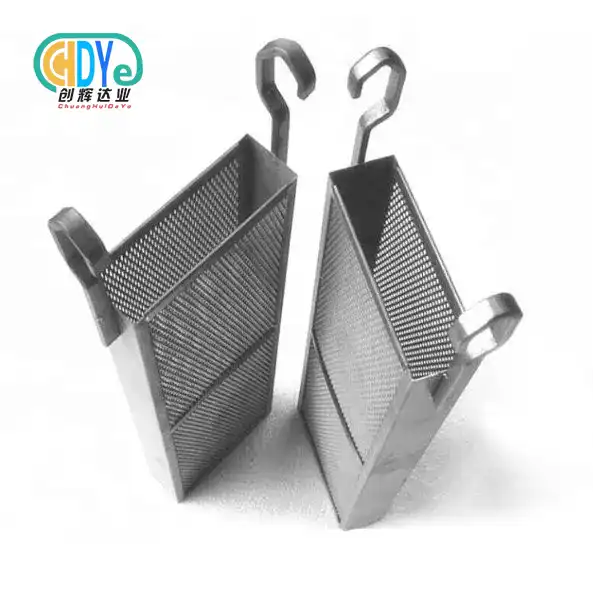
Understanding Titanium Anode Baskets: Properties and Functions
Core Design and Material Composition
Titanium Anode Baskets hold anode materials that dissolve, like nickel balls, copper bits, or zinc slugs, inside electroplating cells. They are insoluble electrical carriers. These basket systems keep the anode surface area the same during the plating cycle, unlike solid slab anodes that change shape as they dissolve. We only use high-purity titanium substrates—specifically Grade 1 and Grade 2 titanium that is more than 99.5% pure—to make these parts at Chuanghui Daye. This material choice has three important qualities: it resists rusting well across a wide range of pH levels; it is lightweight and durable, which makes it easier to handle; and it forms a stable titanium dioxide (TiO₂) passive film that keeps the basket from melting into the electrolyte.
Electrochemical Behavior in Acidic Environments
Titanium's surface chemistry in acid coating baths makes a way for it to protect itself. When titanium is introduced to sulfuric acid (often used for copper plating) or chromic acid (often used for chrome uses), a thin, stick-on oxide layer about 5 to 10 nanometers thick forms on the surface. This dormant film works as a semiconductor, letting electrons move to the anode material inside the basket while stopping the breakdown of metals. The basket sends electricity to the anode material through high-amperage hooks that are often made stronger with titanium-clad copper to make them more conductive. This makes sure that the current density is the same across the plating tank. This electrochemical stability works well in anodic voltage bands below 10–12V, which makes these systems perfect for normal acid plating conditions.
Structural Engineering for Optimal Flow Dynamics
When we make these baskets, we use either expanded mesh or pierced plates. The diamond-shaped mesh diameters are usually between 6x3mm and 12x4mm. This design theory tries to meet two different needs: keeping anode particles even as they break down into smaller pieces, while also making sure that electrolyte flows as freely as possible around each anode piece. The right flow dynamics stop concentrated depletion zones and anode passivation, which keeps the metal ion concentration steady during the plating cycle. We use TIG (Tungsten Inert Gas) welding with argon shielding to stop oxidation during the manufacturing process. This makes weld parts that are as strong as the parent material. Custom shapes, like circular, rectangular, or application-specific forms, can fit a wide range of tank layouts and amperage needs, from small-batch R&D to high-volume production lines.
Performance Evaluation: Titanium Anode Basket vs. Alternatives in Acid Plating
Corrosion Resistance and Chemical Stability
When considering different materials that can be used for acid plating, the Titanium Anode Basket is more resistant to the chemical attack that breaks down other materials. Even though graphite baskets are cheap at first, they can be damaged by electrolytic erosion in very acidic environments. This causes particles to get into the plating, which lowers the quality of the plating. Options made of stainless steel rust quickly in chloride-containing pools, so they need to be replaced often and iron gets into the solution. Platinum-coated alternatives are very harmless, but they have very high initial costs that make them economically unviable for all but the most specialized uses. The costs are often 10 to 15 times higher than titanium alternatives. Titanium's structure stays strong in sulfuric acid baths with concentrations up to 70%, chromic acid baths, and most organic acid mixtures. Titanium's degradation rate is measured in micrometers per year instead of millimeters.
Operational Lifespan and Total Cost Analysis
Copper electrorefining companies have collected data that shows uncoated titanium baskets last 5–10 years with little upkeep, while graphite options need to be replaced every 18–24 months. This long life directly turns into less downtime, lower costs for keeping inventory, and lower work costs for changing baskets. When you look at how often replacements are needed and the hidden costs of plating line interruptions, the initial investment in titanium equipment pays for itself within the second working year. Titanium's resistance to hydrogen absorption keeps its mechanical qualities over a long period of time in zinc plating settings, where hydrogen evolution can weaken some materials. Mixed Metal Oxide (MMO) coated versions work better in tough chemicals, but the coating life varies from one to five years, based on the current density and the makeup of the bath.
Application-Specific Performance Characteristics
Titanium is stable in sulfuric acid solutions, which is helpful for copper plating because keeping the concentration of copper ions stable affects the quality of the surface finish and the consistency of the deposit thickness. Nickel plating lines have less anode polarization problems than basket-free systems because titanium frames support the best anode spacing and current distribution. Because hexavalent chromium is a very strong oxidizer, chrome coating is very difficult. However, economically pure titanium can handle these conditions for months, while most other materials fail within months. Zinc and brass polishing processes, like that of titanium, don't react with cyanide-free alkaline solutions. This is becoming an increasingly important property as environmental rules force manufacturers to change their formulas.
Selecting the Right Titanium Anode Basket for Your Acid Plating Needs
Material Grade Selection and Coating Options
Choosing the right titanium grade for your application is the first step in making a purchase choice for a Titanium Anode Basket. Grade 1 is the most flexible and has a slightly higher resistance to corrosion, so it is perfect for settings with a lot of aggression and complicated shapes. Grade 2 has better mechanical strength and the same level of resistance to corrosion. It is best for high-amperage uses where the structure's stiffness keeps it from bending under the load of current. Both grades work very well in baths of non-fluoride acid, but when fluoroboric acid or other fluoride-containing fluids are used, zirconium replacements are needed because fluoride ions attack titanium's protective oxide very quickly. If your process needs an insoluble anode, MMO coatings might be a good option. These catalyst layers, which are usually made of iridium or ruthenium oxide, let the basket drive electrochemical reactions instead of just carrying current.
Dimensional Customization and Design Considerations
Each design of a plating tank has its own space limitations and current delivery needs. You can send us CAD or PDF models, and we'll make baskets that exactly fit your needs, whether you need them to be round for barrel plating or rectangular for rack plating. Important design factors include the size of the mesh aperture, which should be about 2 mm smaller than the smallest width of your anode material to avoid fall-through, and the total basket capacity, which is found by figuring out how fast the anodes are used up and how often they need to be reloaded. Hook construction changes based on the amperage needed. Solid titanium hooks work best for low to middling current needs, while titanium-clad copper hooks are needed for currents above 50 to 100A to avoid resistive heating and wasted energy. The difference in conductivity is very important; titanium's conductivity is about 3% that of copper. This is why composite hook construction is necessary for high-throughput lines where energy economy affects costs.
Supplier Evaluation and Quality Assurance
When looking for a reputable maker, you need to look at more than just the unit price. Our ISO 9001:2015 approval at Chuanghui Daye shows that we have a method for controlling quality at every stage of production, from checking the raw materials to packaging them up at the end. Because we are in Baoji, China's "Titanium Capital," we have easy access to sources of high-purity titanium and specialized processing tools like electron beam furnaces, precise rolling mills, and advanced TIG welding stations. Make sure that the company you're thinking about doing business with has strict testing procedures in place. These should include a chemical makeup analysis to make sure the titanium is pure, mechanical performance testing to make sure the weld is solid, and rust resistance testing that mimics the conditions you will be using the titanium in. Ask for paperwork that shows how finished goods are linked to certified mill test records. This will make sure that they meet ASTM B265 standards and allow quality audits to happen if production problems arise.
Maintenance and Longevity: Maximizing Titanium Anode Basket Lifespan in Acid Plating
Routine Inspection and Preventive Care Protocols
To get the most out of your Titanium Anode Baskets' service life, you need to set up regular repair plans that work with how much you're producing. Every month, you should look at the mesh to see if it's broken, the hooks to see if there are signs of contact resistance building, and the general shape to see if it's warped, which could mean the mesh is too hot. Taking them out every three months for a thorough cleaning keeps sludge from building up. Sulfates and metallic hydroxides form crystals at the bottoms of the baskets, which stop the flow of electrolyte and cause changes in localized current density that speed up rusting. To clean the baskets, use a weak acid cleaning solution (5–10% sulfuric or hydrochloric acid) and then rinse them with deionized water. Do not use rough mechanical methods that can damage the passive oxide layer. After two to three years of regular use, you might want to get the basket professionally refurbished and have the hooks replaced. This is a typical fix that can add another three to five years to its life at a fraction of the cost of buying new equipment.
Chemistry-Specific Degradation Mechanisms
Different acid coating chemicals put different kinds of stress on titanium structures. Most of the time, sulfuric acid baths don't cause too many problems. Basket degradation is mostly mechanical, not chemical. When chromic acid is present, passivation effects need to be watched more closely. If working voltages rise above 10V, the protective oxide can spread too much, raising electrical resistance and creating hotspots in certain areas. When chloride baths are used, they need extra care to prevent pocket rust at welded joints. TIG welds, on the other hand, make this risk less likely. Commercially pure titanium isn't usually affected by hydrogen embrittlement at plating temperatures below 60°C. However, companies that use high-temperature baths should do regular mechanical tests to find any changes in properties before they become fatal.
Recognizing Replacement Indicators
Knowing when baskets need to be retired instead of being fixed up stops unexpected line failures and quality problems before they happen. Mesh perforation or noticeable thinning with the human eye is a sign of advanced rust that needs to be replaced right away. However, this rarely happens in well-kept settings without fluoride acid. Attention must be paid right away to hook connection points that have obvious cracks, a lot of oxidation, or measured increases in contact resistance (tested using millivolt drop measures). This is because bad electrical contact leads to efficiency losses and could cause arc damage. Any warping or changes in size that are more than 5 mm from the original measurements could be caused by thermal stress from bad current distribution design or too many running currents. To stop this from happening again, the basket needs to be replaced, and the process parameters need to be looked at.
Procurement Strategies: Finding and Partnering with Trusted Titanium Anode Basket Suppliers
Global Sourcing Landscape and Regional Considerations
The places that make Titanium Anode Baskets are mostly in places that already have a lot of experience working with rare metals. Chinese makers, especially those in the Baoji area of Shaanxi Province, can offer reasonable prices and a wide range of customization options. They are close to titanium smelting facilities and have decades of experience making specialized items. North American suppliers offer faster lead times for pressing local orders and easier regulatory compliance for customers in the defense or aerospace sectors who need to source goods that are ITAR-compliant. European makers put a lot of emphasis on precise engineering and lots of paperwork, which works well for pharmaceutical and medical device uses where validation requirements are higher than usual in the industrial world. Instead of just comparing FOB prices, you should look at the total landing cost, which includes taxes, shipping costs, and the time it takes to clear customs.
Certification Standards and Quality Documentation
Manufacturers with a good reputation have complete quality management systems that are checked by outside auditors. ISO 9001:2015 certification is the basic level of quality security. It shows that there are written rules for the production, review, and corrective action processes. Ask for copies of material certificates that prove the grade and purity levels of the titanium. These can usually be tracked back to the original mill test reports that titanium makers sent. Welder credentials are very important. Find out if the fabrication workers have the right certifications, like American Welding Society (AWS) credentials for titanium welding, which is a specific set of skills that is different from general metal fabrication. For some uses, you need extra proof of compliance, like RoHS certificates for users in the electronics industry, FDA material compliance statements for medical uses, or specific dimensional inspection reports made with calibrated coordinate measuring tools.
Building Strategic Supplier Relationships
Transactional ways of buying miss out on chances to improve processes and lower costs that come with working together with suppliers. Share your production plans and any changes you think will need to be made to the process. This will help your maker keep the right amount of raw materials on hand and plan production runs that work best for them. Talk about new problems, like plate quality going down, baskets breaking down unexpectedly, or chemistry needs changing. These talks often lead to easy design changes that make a big difference in performance. Because Chuanghui Daye has been in the rare metals business for more than 30 years, we've probably seen and solved problems that are similar to yours. For example, we've probably optimized mesh geometry for better flow, made custom hook configurations for tanks with odd shapes, or suggested coating options for changing environmental rules. Set up clear lines of communication with specialized account managers and technical support contacts to make sure you can get help quickly when production problems arise.
Conclusion
Titanium Anode Baskets are the best choice for acid plating jobs that need uniform coating quality, reliable performance, and long service life. Titanium is the best material for copper, nickel, zinc, and chrome plating because it’s very resistant to rust, has stable electrical behavior, and lasts a long time mechanically. Even though the original investment is higher than options like graphite, total cost analysis constantly shows that it is a better value because it reduces the number of times it needs to be replaced, reduces downtime, and gets rid of contamination problems. For implementation to go well, you need to choose the right grade, make sure the dimensions are right for your tank, and work with makers who have quality processes and technical know-how that have been proven. These systems are some of the most cost-effective ways to invest in electroplating infrastructure because they last longer than ten years in most acidic environments with regular upkeep.
FAQ
Q: Can titanium anode baskets function in all acid plating chemistries?
A: Does a Titanium Anode Basket work with all acid plating chemicals? These baskets work really well in sulfuric acid, chromic acid, phosphoric acid, and most other organic acid mixtures that are popular in metal plating. But ions that contain fluoride, like fluoroboric acid, attack titanium's protective oxide layer very strongly, breaking down the material very quickly. When fluoride chemistry is used, zirconium basket replacements are needed because they stay stable in these conditions. Before using titanium in a new application, you should always make sure that it is compatible with the solution.
Q: How do operating costs compare between titanium and graphite baskets?
A: Graphite baskets are 40–60% cheaper at first, but they need to be replaced every 18–24 months because of electrolytic erosion. Titanium systems, on the other hand, last 5–10 years. Taking into account the costs of substitute labor, downtime, and the fact that titanium reduces contamination so that solution cleaning is needed less often, it usually pays for itself in two operating years and has a 30–40% lower total cost of ownership over a five-year planning window.
Q: What maintenance schedule should we implement for titanium baskets?
A: Visual inspections once a month to check for mechanical damage and hook state can help find problems early. Sludge buildup that affects electrolyte flow and current distribution can be avoided by removing the filter every three months for thorough cleaning. Chemical makeup testing of the plating bath once a year helps find any titanium pollution, even though baskets that work properly don't dissolve much. In high-amperage situations, hook replacement is usually needed every two to three years. This is a simple service action that greatly extends the total basket life.
Partner with Chuanghui Daye for Premium Titanium Anode Basket Solutions
Shaanxi Chuanghui Daye offers Titanium Anode Basket solutions that come straight from the plant. These are made to work in harsh acid plating conditions in industries like aircraft, electronics, chemical processing, and metal finishing. Our factory in China's Titanium Capital is ISO 9001:2015 approved and uses advanced TIG welding technology and strict quality control to make unique basket shapes from Grade 1 and Grade 2 titanium substrates. We can precisely match dimensions from CAD and PDF models, provide fast prototyping for R&D purposes, and give you full material tracking paperwork to back up your quality checks. We are a reliable Titanium Anode Basket maker with more than 30 years of experience working with rare metals. We can help you improve your electroplating processes by providing you with reliable, cost-effective solutions and quick technical support. Email our team at info@chdymetal.com to talk about your unique needs and get quotes that are tailored to your procurement deadline and performance standards.
References
1. Shreir, L.L., Jarman, R.A., and Burstein, G.T. (2000). Corrosion: Metal/Environment Reactions, 3rd Edition. Butterworth-Heinemann, Oxford.
2. Dini, J.W. (1993). Electrodeposition: The Materials Science of Coatings and Substrates. Noyes Publications, Park Ridge, New Jersey.
3. Schlesinger, M. and Paunovic, M. (2010). Modern Electroplating, 5th Edition. John Wiley & Sons, Hoboken, New Jersey.
4. Schutz, R.W. and Thomas, D.E. (1987). "Corrosion of Titanium and Titanium Alloys," ASM Handbook Volume 13: Corrosion. ASM International, Materials Park, Ohio.
5. Kanani, N. (2004). Electroplating: Basic Principles, Processes and Practice. Elsevier Advanced Technology, Oxford.
6. Pourbaix, M. (1974). Atlas of Electrochemical Equilibria in Aqueous Solutions, 2nd English Edition. National Association of Corrosion Engineers, Houston, Texas.
Learn about our latest products and discounts through SMS or email