- English
- French
- German
- Portuguese
- Spanish
- Russian
- Japanese
- Korean
- Arabic
- Greek
- German
- Turkish
- Italian
- Danish
- Romanian
- Indonesian
- Czech
- Afrikaans
- Swedish
- Polish
- Basque
- Catalan
- Esperanto
- Hindi
- Lao
- Albanian
- Amharic
- Armenian
- Azerbaijani
- Belarusian
- Bengali
- Bosnian
- Bulgarian
- Cebuano
- Chichewa
- Corsican
- Croatian
- Dutch
- Estonian
- Filipino
- Finnish
- Frisian
- Galician
- Georgian
- Gujarati
- Haitian
- Hausa
- Hawaiian
- Hebrew
- Hmong
- Hungarian
- Icelandic
- Igbo
- Javanese
- Kannada
- Kazakh
- Khmer
- Kurdish
- Kyrgyz
- Latin
- Latvian
- Lithuanian
- Luxembou..
- Macedonian
- Malagasy
- Malay
- Malayalam
- Maltese
- Maori
- Marathi
- Mongolian
- Burmese
- Nepali
- Norwegian
- Pashto
- Persian
- Punjabi
- Serbian
- Sesotho
- Sinhala
- Slovak
- Slovenian
- Somali
- Samoan
- Scots Gaelic
- Shona
- Sindhi
- Sundanese
- Swahili
- Tajik
- Tamil
- Telugu
- Thai
- Ukrainian
- Urdu
- Uzbek
- Vietnamese
- Welsh
- Xhosa
- Yiddish
- Yoruba
- Zulu
Custom Titanium Alloy Wire – Cuts to Length Available
Customized titanium alloy wire is the pinnacle of precision engineering, and it works amazingly well in tough industrial settings. At Chuanghui Daye, we make high-quality titanium alloy wire that can be cut to different lengths on request. This cuts down on waste and increases the speed of production. Our high-tech metalworking methods make sure that every wire meets strict quality standards. These wires have high strength-to-weight ratios and don't rust, which is important for uses in aircraft, medicine, and chemical processing.
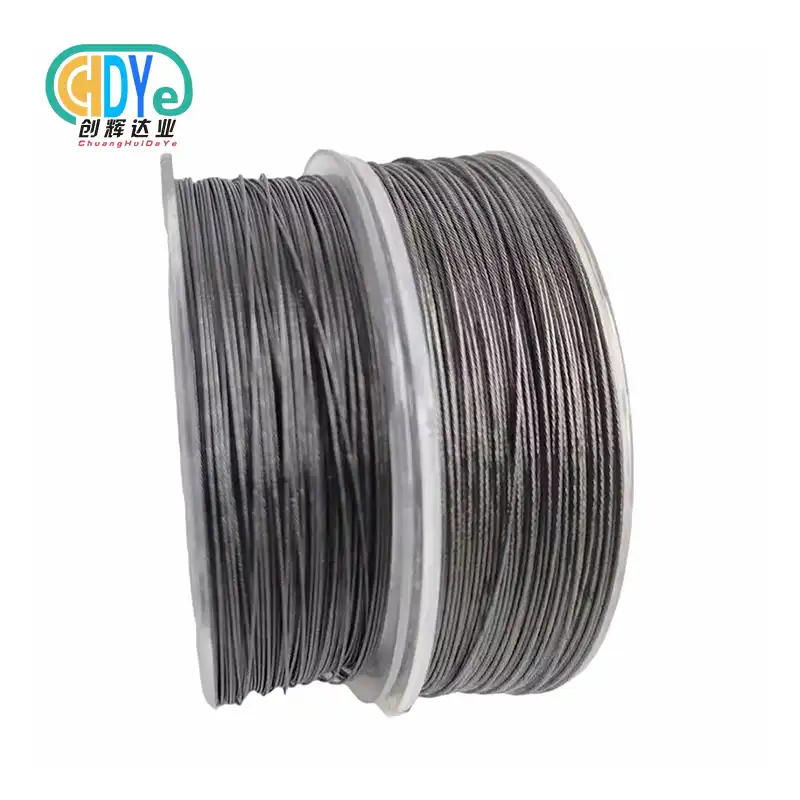
Understanding Titanium Alloy Wire: Properties and Applications
Chemical Composition and Enhanced Mechanical Properties
Within our titanium alloy wire, there are carefully balanced mixtures of elements that make it work much better than pure titanium. Ti-6Al-4V is one of the most popular titanium alloys we make. It is made by mixing titanium with aluminum and vanadium to get the best balance of strength, flexibility, and weldability. The aluminum content makes it stronger and lighter, and the vanadium content makes it harder to work with and more stable at high temperatures.
The Ti-6Al-7Nb grade is another specialty grade that is very useful for medical uses. Some studies show that vanadium may cause bad biological reactions. This biocompatible alloy gets rid of vanadium while keeping its great mechanical properties by adding niobium. This finished product is very well compatible with living things and is also very resistant to rust in physiological settings.
Diverse Industrial Applications and Performance Benefits
Steel wire made from titanium has a special set of qualities that make it useful in many fields. In the aircraft industry, our wire is used to weld turbine parts, engine casings, and structural repairs that need to be light and resistant to high temperatures. Our ASTM B863 and AMS 4954 certified wire is used in the aerospace business for a wide range of tasks, from maintaining commercial aircraft to making parts for satellites.
Our biocompatible grades are used by companies that make medical devices to make surgical instruments, dental implants, and orthopedic gear. Titanium wire is great for MRI-compatible devices because it isn't magnetic. It's also very resistant to fatigue, which means it will last for a long time in cyclic loading uses like heart stents and bone fixation systems.
Precision Manufacturing and Quality Assurance
The first step in our manufacturing process is getting certified titanium sponge or recycled alloy ingots from trustworthy sources. We use vacuum arc remelting and electron beam melting to make the alloy's makeup uniform and reduce the amount of impurities it contains. Multi-pass wire drawing through precise carbide dies makes sure that the dimensions are accurate to within ±0.01mm, which meets the strictest OEM requirements.
When controlled atmospheres are used for intermediate heating processes, internal stresses are relieved while the best grain structure is maintained. This careful balance between cycles of work hardening and annealing makes sure that the mechanical traits of each coil of wire are the same. To make sure it meets foreign standards, every batch goes through a lot of tests, such as checking the tensile strength, doing a chemical analysis, and looking at the surface quality.
Titanium Alloy Wire vs. Competing Metals: Making the Informed Choice
Strength-to-Weight Performance Comparison
When choosing a material for important tasks, titanium wire always does better than other options when looking at strength-to-weight ratios. When compared to stainless steel wire of the same thickness, titanium alloy has a density that is about 40% lower while still having the same or higher tensile strength. This weight loss directly leads to less fuel use in aerospace applications and more patient comfort in medical implants.
Even though nickel-based superalloys work very well at high temperatures, they usually weigh 60–80% more than titanium alloys of the same type. When reducing weight has an effect on the general performance of the system, like in rotating machinery parts or portable medical devices, the density advantage becomes very important.
Corrosion Resistance and Environmental Durability
Titanium's natural oxide layer makes it very resistant to rust in a wide range of settings. In contrast to copper wire, which breaks down quickly in salt water, titanium stays structurally sound in salt water forever. This corrosion resistance is especially useful in chemical handling equipment that is exposed to acids, alkalis, and high temperatures, where other materials would quickly break down.
In chloride-rich settings, stainless steel can still rust in pits and cracks, even though it is generally resistant to corrosion. Titanium is the best material for long-lasting stability in chemical processing, offshore platforms, desalination equipment, and other places where corrosion from chloride is not a problem.
Cost-Effectiveness Analysis and Total Ownership Benefits
To begin with, titanium wire costs more than other options, but when you look at the total cost of ownership, titanium is often the better choice. Getting rid of protective coatings, making the product last longer, and needing less upkeep can save you a lot of money in the long run.
By using titanium wire, aerospace uses can reduce weight, which saves fuel and usually covers the higher costs of the materials within the first year of use. Titanium is biocompatible, which means it doesn't need safe coatings or other materials that might need to be replaced because they don't work with living things.
Custom Titanium Alloy Wire Solutions: Cuts to Length and Ordering Flexibility
Precision Cutting Services and Waste Reduction
Our custom cutting services let you specify exact lengths, which cuts down on material waste and the need for extra processing. When you buy wire from a traditional provider, they usually give you standard lengths that you have to cut yourself. This leaves you with useless scraps and costs more to handle. We can cut with accuracy within ±1mm for lengths from 100mm to 6000mm, so we can meet the needs of a wide range of customers.
This precise cutting service is especially helpful for companies that make parts that need wires of a certain length. For example, companies that make exhaust systems for cars can tell welders exactly what lengths to use. This means that no cutting has to be done on-site, which speeds up production. In the same way, companies that make medical devices benefit from pre-cut lengths that meet the specifications of surgical instruments. This increases the efficiency of production and lowers the risk of contamination.
Flexible Ordering Quantities and Supply Chain Reliability
Because we know that our customers around the world have different needs, we keep enough supplies to meet both prototype development and high-volume production needs. Our minimum order numbers work for research institutions that need small amounts for experiments, and our production capacity helps aerospace companies that need to buy a lot of things.
We have popular grades like GR1, GR2, GR5, and GR7 in a range of diameters from 0.5mm to 4.0mm in stock. With this way of managing inventory, normal specifications can be delivered within one to three days. Custom alloy compositions, on the other hand, usually take seven to fifteen days to make and ship.
OEM Customization and Technical Support
Our research team works closely with customers to create custom alloy mixtures that meet the needs of each application. This partnership goes beyond choosing standard grades and includes making custom compositions that work best in certain settings or meet certain performance standards. For example, customers in the chemical processing business have worked with our metallurgists to create better compositions that don't rust in certain acidic environments.
We offer a wide range of technical documents, such as certifications of mechanical properties, chemical analysis reports, and records of traceability, that meet the quality standards of the aircraft and medical industries. This package of documents helps with the selection of customers and following the rules in many places.
Why Choose Chuanghui Daye: Trusted Manufacturer and Supplier of Certified Titanium Alloy Wire?
Established Expertise and Geographic Advantages
It is located in Baoji, which is known as China's "Titanium Capital," and Chuanghui Daye has been handling rare metals for 30 years. Because our founder has a lot of experience in titanium metallurgy and has access to area supplier networks and scientific know-how, we can offer consistent quality at a reasonable price.
The large number of titanium processing centers in the Baoji region supports an ecosystem of specialized suppliers, research institutions, and technical talent. This grouping of companies in the same area makes it easy to get raw materials quickly, share resources for research and development, and keep up with technological progress that helps our customers by making goods and processes better.
Quality Certifications and Industry Compliance
Our ISO 9001:2015 certification shows that we are committed to managing quality in a structured way in every part of our business. Customers can be sure that our processes always meet foreign standards and help with efforts to keep getting better because of this certification. Regular checks by a third party make sure that rules are being followed and look for ways to improve operations.
Our company is certified to meet many industry standards, such as ASTM B863 for titanium alloy wire, AMS 4954 for aircraft uses, and ASTM F67 for medical grade materials. To make sure they stay valid, these licenses are renewed every year through a process that includes testing the materials, checking the process, and going over the paperwork.
Comprehensive Service Approach and Customer Support
Our mindset on customer service goes beyond just supplying materials. It also includes technical advice, application support, and help after the goods have been delivered. We know that choosing the right materials, using the right working methods, and managing the supply chain well are all important for our customers to get good results.
Our technical team gives advice based on the application, such as suggestions for welding parameters, forming standards, and checks for compatibility. This consultative method helps customers get the most out of their processes while avoiding common mistakes that can lower the quality of the product or make it cost more to make.
Conclusion
Custom titanium alloy wire that can be cut precisely is a strategic benefit for companies in the electronics, aerospace, medical, and chemical industries. When you combine great material properties with a variety of ordering choices and dependable supply chain management, you get value that goes far beyond the cost of the materials themselves. Because Chuanghui Daye cares about quality, technical know-how, and customer service, your needs for titanium wire will be met professionally from the time you contact them until delivery and even after that.
FAQ
Q: What advantages does titanium wire offer compared to stainless steel alternatives?
A: Titanium wire provides superior corrosion resistance, approximately 40% weight reduction, and excellent biocompatibility compared to stainless steel. While stainless steel remains susceptible to chloride-induced corrosion, titanium maintains structural integrity in marine and chemical environments indefinitely.
Q: Which industry standards and certifications apply to your titanium wire products?
A: Our titanium wire meets multiple international standards, including ASTM B863, AMS 4954, ASTM F67, and ASTM F136. We maintain ISO 9001:2015 certification and provide complete traceability documentation with each shipment, including mechanical properties, chemical analysis, and compliance certificates.
Q: What are typical lead times and minimum order quantities for custom lengths?
A: Standard grades with custom cutting require 1-3 days for delivery, while specialized alloy compositions typically need 7-15 days. Minimum order quantities vary by diameter and grade, accommodating both research applications requiring small amounts and high-volume production needs.
Q: Can you provide free samples for material evaluation and testing purposes?
A: Yes, we offer free samples to qualified customers for material evaluation and compatibility testing. Sample requests can include multiple grades and diameters to support comprehensive evaluation processes.
Contact Chuanghui Daye Today – Your Titanium Alloy Wire Manufacturer Partner
Ready to optimize your manufacturing processes with precision-cut titanium alloy wire? Shaanxi Chuanghui Daye combines three decades of metallurgical expertise with modern production capabilities to deliver materials that exceed performance expectations. Our custom cutting services, flexible ordering options, and comprehensive technical support ensure your project's success from prototype through production. Contact our technical team at info@chdymetal.com to discuss your specific requirements and receive personalized recommendations. Experience the advantages of partnering with a trusted titanium alloy wire supplier committed to quality, reliability, and customer success.
References
1. Boyer, R.R. "Attributes, characteristics, and applications of titanium and its alloys." Journal of Materials Engineering and Performance, Vol. 23, 2014.
2. American Society for Testing and Materials. "ASTM B863-14 Standard Specification for Titanium and Titanium Alloy Wire." ASTM International, 2014.
3. Lutjering, G. and Williams, J.C. "Titanium: Engineering Materials and Processes." Springer-Verlag Berlin Heidelberg, 2007.
4. Aerospace Material Specification. "AMS 4954: Titanium Alloy Wire 6Al-4V Solution Heat Treated." SAE International, 2019.
5. Rack, H.J. and Qazi, J.I. "Titanium alloys for biomedical applications." Materials Science and Engineering C, Vol. 26, 2006.
6. International Organization for Standardization. "ISO 5832-2:2018 Implants for surgery — Metallic materials — Part 2: Unalloyed titanium." ISO, 2018.
Learn about our latest products and discounts through SMS or email