- English
- French
- German
- Portuguese
- Spanish
- Russian
- Japanese
- Korean
- Arabic
- Greek
- German
- Turkish
- Italian
- Danish
- Romanian
- Indonesian
- Czech
- Afrikaans
- Swedish
- Polish
- Basque
- Catalan
- Esperanto
- Hindi
- Lao
- Albanian
- Amharic
- Armenian
- Azerbaijani
- Belarusian
- Bengali
- Bosnian
- Bulgarian
- Cebuano
- Chichewa
- Corsican
- Croatian
- Dutch
- Estonian
- Filipino
- Finnish
- Frisian
- Galician
- Georgian
- Gujarati
- Haitian
- Hausa
- Hawaiian
- Hebrew
- Hmong
- Hungarian
- Icelandic
- Igbo
- Javanese
- Kannada
- Kazakh
- Khmer
- Kurdish
- Kyrgyz
- Latin
- Latvian
- Lithuanian
- Luxembou..
- Macedonian
- Malagasy
- Malay
- Malayalam
- Maltese
- Maori
- Marathi
- Mongolian
- Burmese
- Nepali
- Norwegian
- Pashto
- Persian
- Punjabi
- Serbian
- Sesotho
- Sinhala
- Slovak
- Slovenian
- Somali
- Samoan
- Scots Gaelic
- Shona
- Sindhi
- Sundanese
- Swahili
- Tajik
- Tamil
- Telugu
- Thai
- Ukrainian
- Urdu
- Uzbek
- Vietnamese
- Welsh
- Xhosa
- Yiddish
- Yoruba
- Zulu
GR5 Titanium Wire for Oil and Gas Industry Applications
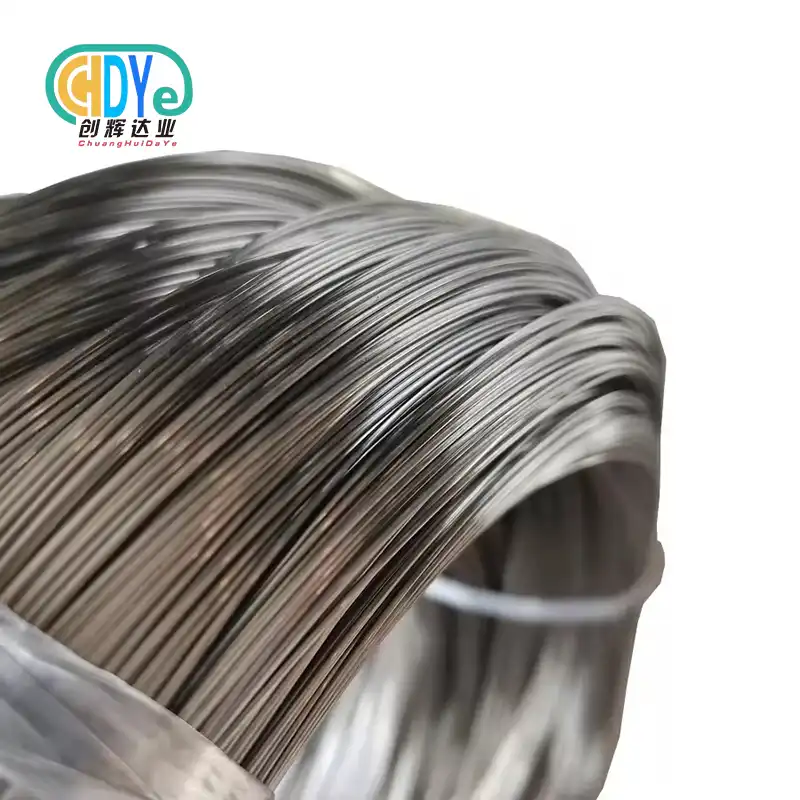
GR5 titanium wire represents a critical material solution for oil and gas industry applications, combining the superior strength-to-weight ratio of Ti-6Al-4V alloy with exceptional corrosion resistance. This premium-grade Gr5 titanium wire delivers outstanding performance in challenging offshore environments, chemical processing facilities, and high-pressure systems where traditional materials fail. Composed of titanium, aluminum, and vanadium, this advanced alloy addresses the demanding requirements of modern petroleum infrastructure while offering significant cost advantages through extended service life and reduced maintenance intervals.
Understanding GR5 Titanium Wire: Properties and Manufacturing
Chemical Composition and Alloy Fundamentals
Alpha-beta titanium alloy GR5 titanium wire is mostly made up of titanium, with about 6% aluminum and 4% vanadium added for good measure. This particular mix, which is called Ti-6Al-4V in international standards, makes a special nanoscale that is strong, flexible, and resistant to rust. The aluminum content makes it stronger and less dense, and the vanadium content makes it stronger and easier to work with.
To keep it from becoming weak, the metal keeps tight limits on interstitial elements. The amount of iron, oxygen, and nitrogen in the soil stays below 0.40%, 0.20%, and 0.05%, respectively. These carefully chosen mixtures make sure that the mechanical features stay the same and that they work reliably in important situations. During the production process, vacuum melting methods get rid of impurities and make sure that the chemicals are spread out evenly throughout the wire structure.
Mechanical Properties and Performance Characteristics
GR5 titanium wire is better at withstanding mechanical stress than most common materials used in oil and gas applications. The wire usually has a tensile strength of more than 925 MPa (134 ksi) and a yield strength of more than 870 MPa (126 ksi), which means it can hold a lot of weight. Elongation values are usually between 10 and 15 percent, which means that the material is flexible even though it is very strong.
The material has great fatigue resistance, which is important for uses that involve repeated loading, like drilling and underwater tools. Even though biocompatibility is mostly important for medical uses, it also shows that the metal is chemically stable and doesn't combine with other things in a variety of settings. Because of these qualities, the wire can be exposed to oil products and chemicals that go with them for a long time.
Manufacturing Process and Quality Control
Several precise manufacturing steps are needed to make high-quality GR5 titanium wire. The first step is vacuum arc remelting of the raw materials to make ingots with controlled microstructure and chemistry. Forging and rolling these bars turn them into rod stock, which then goes through several steps of wire drawing to reach the final diameter requirements.
Precision tools and controlled reduction plans are used in wire drawing to keep the dimensions and quality of the surface accurate. Between drawing passes, annealing processes reduce internal stresses and improve mechanical qualities. The last wire is vacuum-annealed to get the right mix of strength and flexibility and to get rid of any surface contaminants that might affect its corrosion resistance.
Advantages of GR5 Titanium Wire in Oil and Gas Applications
Superior Corrosion Resistance in Petroleum Environments
The oil and gas business has its own problems with corrosion that are hard for standard materials to solve. Hydrogen sulfide, carbon dioxide, chlorides, and organic acids are just some of the toxic substances that are found in oil and gas activities, to which GR5 titanium wire is very resistant. It doesn't rust because it forms a stable, stick-together oxide film that fixes itself when it gets harmed.
In remote uses, the wire stays strong even after being in seawater for a long time. Seawater has high salt levels that quickly eat away at carbon steel and many types of stainless steel. In sour gas settings with hydrogen sulfide, the material works very well, while other materials have trouble with sulfide stress cracking and general rusting. In many situations, this protection means that expensive coatings and rust inhibitors are not needed.
Mechanical Strength and Fatigue Performance
Conventional materials like 316L stainless steel are not nearly as strong as GR5 titanium wire, which also resists rust much better. The advantage of having a higher strength-to-weight ratio is especially important for offshore buildings, where less weight means lower costs for designing and installing platforms.
For moving parts like drilling tools, underwater connections, and flexible pipeline parts, the high tolerance to fatigue is very important. Case studies from operations in the North Sea show that titanium parts can last longer than 20 years in situations where stainless steel parts would need to be replaced every 5 to 7 years. This longer service life lowers the cost of upkeep, cuts down on downtime, and makes the system more reliable overall.
Weight Reduction and Structural Efficiency
The fact that titanium is very light makes it very useful in oil and gas uses where weight affects design and running costs. Offshore platforms have lower structure loads, which makes designs more efficient and cuts down on the cost of installation. There are fewer stress peaks in underwater tools, and it's easier to handle.
When working in deep water, where every pound of equipment changes how to calculate buoyancy and how to place it, the weight savings become even more important. Titanium parts make it possible to make more complex subsea systems while keeping their weights doable for launch and recovery operations.
How to Choose the Right Titanium Wire Grade for Oil and Gas Procurement
Comparative Analysis of Titanium Grades
To make smart choices about materials, people who work in procurement need to know the differences between the types of titanium. GR5 titanium wire is stronger than commercially pure types like GR2, so it can be used in structural applications that need it to hold weight. The alloying elements in GR5 make it stronger without making it less resistant to rust.
GR2 titanium wire is good at resisting rust, but not as strong as other titanium wires. This makes it good for situations where corrosion resistance is more important than mechanical qualities. It is chosen for critical uses that need better fracture toughness because Grade 23 (Ti-6Al-4V ELI) is as strong as GR5 but more flexible.
Environmental Factors and Service Conditions
During the choosing process, certain environmental factors must be taken into account, such as temperature ranges, pressure levels, chemical exposure, and patterns of mechanical loading. Up to 400°C (752°F), GR5 titanium wire works well, so it can be used in most oil and gas uses except for high-temperature processing.
When used in deep water, where hydrostatic loads and internal pressures cause complicated stress states, pressure becomes an important factor. GR5 titanium wire is very strong, so it can be used to make walls that are smaller and lighter while still meeting pressure standards. When testing for chemical compatibility, the specific fuel products, cleaning chemicals, and service conditions that are expected should be taken into account.
Cost-Benefit Analysis and Total Cost of Ownership
Titanium wire is more expensive than other types of wire at first, but in difficult situations, the total cost of ownership often makes titanium the better choice. Replacement costs and downtime are cut down when a service lasts longer. Rust resistance gets rid of or lowers the need for rust tracking, the cost of inhibitors, and protective coating upkeep.
Lessening the cost of maintenance is especially important for activities that take place overseas, where the cost of mobilizing workers to do repairs can be higher than the value of the original equipment. Materials that have been proven to be reliable are also better for insurance and safety reasons. The fact that it is lightweight can lower the cost of installation and allow for more efficient building plans, which can balance out the higher cost of the materials.
Buying Guide: Procuring GR5 Titanium Wire for the Oil and Gas Industry
Product Specifications and Technical Requirements
For procurement to work well, there must be clear technical specs that include needs for diameter, length, and surface finish. You can get GR5 titanium wire in diameters from 0.5 mm to 6.0 mm, and you can also get it in any amount you need for your project. The wire can be sent in either straight lengths or coiled shapes, based on the needs of the purpose and the way it is to be handled.
The standards for the surface finish should include how clean it needs to be, any allowed size differences, and any special surface processes that are needed for the job. Aerospace-grade wire usually has a better surface quality than commercial grades, which makes the higher price worth it for important uses. As part of the certification process, you should show that you meet the requirements of ASTM standards (B863, F136), AWS guidelines (A5.16), and any other standards that are specific to your business.
Supplier Evaluation and Quality Assurance
Choosing a supplier is a big choice that affects the quality of the product, the dependability of delivery, and the long-term security of the supply chain. Quality certifications, like ISO 9001:2015, give you peace of mind about the control and quality management methods in the production process. Aerospace licenses, such as AS9100, show that a company can meet strict quality standards that are used in important oil and gas uses.
When evaluating a manufacturing center, you should look at its production skills, quality control tools, and testing facilities. Chemical research, mechanical tests, and dimensional checking are all skills that suppliers should be able to show. Traceability systems need to keep full records of everything from the raw materials to the finished product. This way, if there are any quality problems during service, they can be looked into.
Market Pricing and Cost Factors
Titanium wire prices are based on a number of important factors, such as the cost of the raw materials, the difficulty of handling, the size of the order, and the state of the market demand. Most of the time, volume price benefits become important when you buy more than 100 kilograms, and you can get even bigger discounts if you sign an annual contract. Processing costs change depending on the width needed. Because drawing smaller sizes is more difficult, they cost more.
Price changes are caused by things like the supply of titanium sponge, changes in demand in the aircraft industry, and the world economy. Price stability and supply security can come from long-term contracts. This is especially important for current projects that know exactly what materials they will need. Value-added services like cutting, spooling, and special packaging may allow providers who offer full solutions to charge more.
Future Trends and Performance Optimization of GR5 Titanium Wire in Oil and Gas
Emerging Applications and Technology Development
As the oil and gas industry changes, new uses for high-tech products like titanium wire are being found. Deepwater research pushes the limits of what can be used to make tools to deeper depths where standard materials fail. GR5 titanium wire makes it possible to make underwater systems that are stronger and can handle high pressure and corrosion.
Enhanced oil recovery methods, such as chemical flooding and steam injection, create harsh conditions that titanium's resistance to corrosion can help. Carbon capture and storage technologies open up new business possibilities. Titanium's success in CO2-rich settings makes it a much better material than other materials.
Innovation in Processing and Performance Enhancement
Titanium wire goods keep getting better in terms of performance and value for money, thanks to new ways of making them. Advanced melting methods, such as electron beam melting and plasma arc melting, make microstructures that are more uniform and have better wear performance. By optimizing heat treatment and cold working, mechanical qualities can be changed to fit the needs of a particular application.
Ion implantation and special coatings are two types of surface treatment technologies that can make things more resistant to wear and tear and extend their useful life in rough settings. These new ideas make it possible for more uses in drilling tools and production systems that have problems with erosion and wear.
Strategic Procurement and Supply Chain Considerations
Because of how the global supply chain works, buying titanium needs to be done in a planned way that makes sure the material is always available. Having providers from different parts of the world lowers the risks that come with area problems or political issues. When you have long-term relationships with qualified suppliers, you get special treatment during times when supplies are low and can join technology development programs.
Strategies for managing inventory need to weigh the costs of keeping things on hand against the safety of the supply chain. This is especially important for mission-critical tasks where a lack of materials could stop operations. Through organized planning with suppliers, just-in-time delivery programs can lower the cost of goods while keeping supplies reliable.
Conclusion
GR5 titanium wire is a great material for use in the oil and gas business because it is highly resistant to corrosion, has excellent mechanical qualities, and has been shown to be reliable over time. This advanced metal is needed for modern oil operations that have to deal with conditions that are getting tougher because it has a high strength-to-weight ratio and is chemically stable. If procurement workers know about the technical and economic benefits of gr5 titanium wire, they can make choices that improve operational safety, lower lifetime costs, and make their company more competitive in the global energy market.
FAQ
Q: What makes GR5 titanium wire superior to stainless steel for oil and gas applications?
A: When compared to stainless steel, GR5 titanium wire has a much higher strength-to-weight ratio. Its tensile strength is over 925 MPa, while 316L stainless steel's is only about 580 MPa. Titanium is better at resisting rust in oil and gas settings, especially when there is sour gas with hydrogen sulfide, where stainless steel cracks from stress corrosion.
Q: How does GR5 titanium wire perform in deepwater offshore conditions?
A : The wire works really well in depth, where severe service conditions include high pressure, exposure to salt water, and changing loads. When submerged in water deeper than 3,000 meters, the material stays structurally sound and doesn't rust in seawater or oil. Case studies from operations in the North Sea show that services can last for more than 20 years without breaking down much.
Q: What certifications should buyers require when procuring GR5 titanium wire?
A: As a general rule, procurement standards should follow ASTM B863, and for welding uses, they should follow AWS A5.16. Certifications like ISO 9001:2015 make sure that quality control systems are in place, and certifications for aircraft like AS9100 show that the system can handle important tasks. Material test papers must list the chemical makeup, mechanical qualities, and size compliance of the material.
Partner with Chuanghui Daye for Premium GR5 Titanium Wire Solutions
Leading procurement teams recognize the strategic value of partnering with established titanium specialists for critical material requirements. Shaanxi Chuanghui Daye Metal Material Co., Ltd. brings over 30 years of rare metal industry expertise to oil and gas procurement challenges, offering ISO 9001:2015 certified gr5 titanium wire manufactured to exacting standards. Our comprehensive product range includes diameters from 0.5mm to 6.0mm in both straight wire and coil forms, with custom lengths available to meet specific project requirements. Contact our technical team at info@chdymetal.com to discuss your titanium wire needs and find out how our G5 titanium wire supplier services can improve your business efficiency while lowering your total cost of ownership.
References
1. American Society for Testing and Materials. "Standard Specification for Titanium and Titanium Alloy Wire." ASTM B863-17, 2017.
2. Donachie, Matthew J. "Titanium: A Technical Guide, Second Edition." ASM International Materials Park, Ohio, 2000.
3. Lutjering, Gerd, and Williams, James C. "Titanium: Engineering Materials and Processes." Springer-Verlag Berlin Heidelberg, 2007.
4. Schutz, Robert W. "Corrosion of Titanium and Titanium Alloys in the Oil and Gas Industry." Materials Performance Magazine, NACE International, 2005.
5. Boyer, Rodney, Welsch, Gerhard, and Collings, E.W. "Materials Properties Handbook: Titanium Alloys." ASM International, 1994.
6. Craig, Bruce D. and Anderson, David S. "Handbook of Corrosion Data for Petroleum Industry Applications." Materials Technology Institute of the Chemical Process Industries, 1995.
Learn about our latest products and discounts through SMS or email