- English
- French
- German
- Portuguese
- Spanish
- Russian
- Japanese
- Korean
- Arabic
- Greek
- German
- Turkish
- Italian
- Danish
- Romanian
- Indonesian
- Czech
- Afrikaans
- Swedish
- Polish
- Basque
- Catalan
- Esperanto
- Hindi
- Lao
- Albanian
- Amharic
- Armenian
- Azerbaijani
- Belarusian
- Bengali
- Bosnian
- Bulgarian
- Cebuano
- Chichewa
- Corsican
- Croatian
- Dutch
- Estonian
- Filipino
- Finnish
- Frisian
- Galician
- Georgian
- Gujarati
- Haitian
- Hausa
- Hawaiian
- Hebrew
- Hmong
- Hungarian
- Icelandic
- Igbo
- Javanese
- Kannada
- Kazakh
- Khmer
- Kurdish
- Kyrgyz
- Latin
- Latvian
- Lithuanian
- Luxembou..
- Macedonian
- Malagasy
- Malay
- Malayalam
- Maltese
- Maori
- Marathi
- Mongolian
- Burmese
- Nepali
- Norwegian
- Pashto
- Persian
- Punjabi
- Serbian
- Sesotho
- Sinhala
- Slovak
- Slovenian
- Somali
- Samoan
- Scots Gaelic
- Shona
- Sindhi
- Sundanese
- Swahili
- Tajik
- Tamil
- Telugu
- Thai
- Ukrainian
- Urdu
- Uzbek
- Vietnamese
- Welsh
- Xhosa
- Yiddish
- Yoruba
- Zulu
Grade 2 titanium round bar Supplier with ASTM Certified Quality
When purchasing reasonably pure titanium for mission-critical uses, buyers in the chemical processing, aircraft, and medical device production industries look for sources with quality standards that can be checked and reliable delivery. Chuanghui Daye, our company, is in Baoji, which is known as China's "Titanium Capital" and makes Grade 2 titanium round bar that meets all ASTM B348, ASTM F67, and ASTM F136 standards. We offer high-purity titanium round bars with diameters from 6mm to 350mm and in round, square, and hexagon shapes. We have been working with rare metals for more than 30 years and are ISO 9001:2015 certified. Each product goes through strict mechanical tests and full tracking paperwork. This makes sure that your supply chain gets materials that meet the strictest requirements without any exceptions.
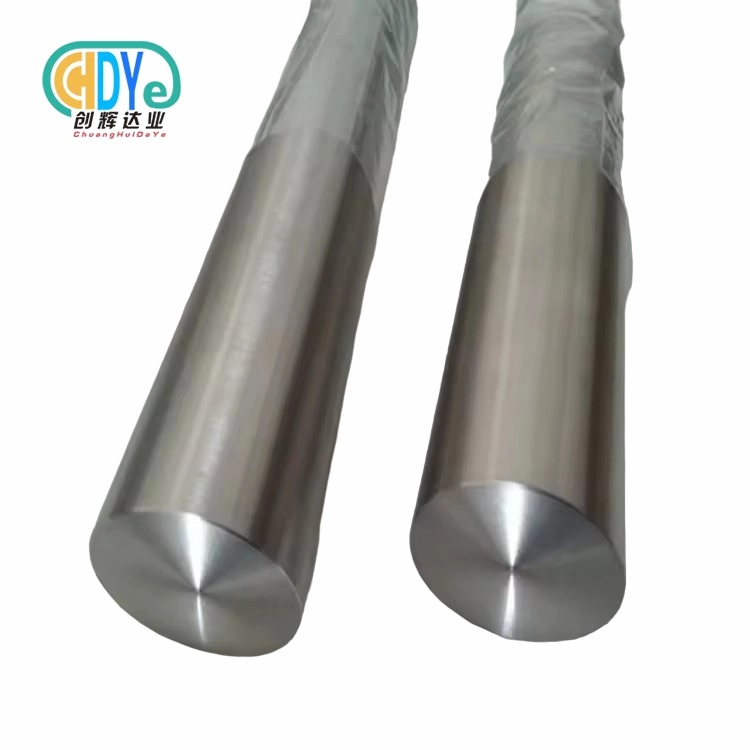
Understanding Grade 2 Titanium Round Bar: Properties and Applications
Mechanical and Chemical Composition According to ASTM Standards
Grade 2 titanium round bar is the most common unalloyed titanium grade used around the world. It has a modest level of strength and excellent formability. As per ASTM B348, the material has a minimum tensile strength of 345 MPa (50 ksi) and a minimum yield strength of 275 MPa (40 ksi). It can usually stretch more than 20%. The chemical make-up tightly controls the interstitial elements, which have a direct effect on how well the material bends and resists corrosion (up to 0.30% iron and 0.25% oxygen). With this level of accuracy, Grade 2 titanium round bars keep their ability to be welded and shape-formed even from one production batch to the next.
Compared to stainless steel, its low density of 4.51 g/cm³ makes it very strong for its weight. This lowers the structural load in aerospace assemblies and makes surgical instruments easier to handle. Some heat treatments, like annealing at temperatures between 650°C and 750°C, remove leftover stresses from rolling and casting. This makes the metal more stable and less likely to crack from stress corrosion in chloride-rich settings.
Corrosion Resistance in Demanding Environments
Titanium's passive oxide film can fix itself if it gets damaged, making it very resistant to seawater, chlorine, nitric acid, and organic acids. Chemical processing plants use Grade 2 titanium round bars for reactor shafts and stirrer parts that are in concentrated acidic media and would break stainless steel 316L in months. Desalination plants like to use titanium for condenser tube sheets because it doesn't rust or foul when it comes into contact with microbes. This means that maintenance intervals are longer and costs are lower over the life of the equipment.
Industry-Specific Applications Across Critical Sectors
When fire resistance and light weight are important, aerospace manufacturers use Grade 2 titanium round bars in non-load-bearing airframe parts, hydraulic system fittings, and fasteners. Biocompatibility and osseointegration qualities are used by companies that make medical devices to make implantable parts like bone screws, tooth implants, and surgery tools from approved Grade 2 titanium round bars that meet ASTM F67 and F136 standards.
For pump shafts, valve stems, and heat exchanger parts that work in sour gas conditions or high-chloride process streams, chemical equipment makers use Grade 2 titanium round bars. Titanium is being used more and more in the car industry for suspension parts and parts of the exhaust system because it is lighter and better at saving gas and improving handling.
Comparison with Other Titanium Grades
Grade 1 is good for deep-drawn parts because it is slightly more flexible than Grade 2 but not as strong. Grade 4 has a higher tensile strength, close to 550 MPa, but it is less malleable, which makes cold-working processes more difficult. Grade 5 (Ti-6Al-4V) is much stronger than Grade 2 titanium round bars, but it needs to be machined carefully and can't keep up with Grade 2's corrosion resistance in some acidic environments. Grade 7 has palladium added to it to make it more resistant to reducing acids, but it costs a lot more.
By comparing them, buying teams can choose the best grade for each job, taking into account things like technical needs, weather exposure, the difficulty of manufacturing, and financial limits.
Grade 2 Titanium Round Bar vs Alternative Materials: Making the Right Decision
Performance Advantages Over Stainless Steel and Aluminum
Stainless steel 316L is resistant to rust in most situations, but it can develop pits in places where salt levels are higher than 200 parts per million. Even in seawater with 19,000 ppm chloride, Grade 2 titanium round bar keeps its passive film integrity. This means that expensive corrosion allowances are not needed, and thinner-walled designs are possible. Compared to steel, it saves about 45% of its weight, which cuts down on the cost of shipping and the work needed to put together large assemblies.
Aluminium alloys are very strong for their weight, but they lose their mechanical properties above 150°C and break down quickly in acidic or alkaline environments. It is possible for grade 2 titanium round bars to keep their shape at temperatures up to 300°C in oxidising environments and in most water solutions with pH levels between 1 and 14. The fact that it isn't magnetic is very important in places like MRI equipment housings and mine detection equipment where ferrous materials could mess up sensitive equipment.
Strategic Selection for Regulated Industries
Aerospace OEMs need to be able to track materials from the melt batch to the final cutting step. This must be done with mill test records that confirm the material's chemistry, mechanical qualities, and heat treatment history. Medical device makers want more proof, like biocompatibility testing according to ISO 10993 and surface finish requirements that stop bacteria from growing. Because of these rules and regulations, companies must work together with their suppliers to keep up thorough quality control systems and strict rules for documenting everything.
Buying approved Grade 2 titanium round bars from providers that follow ASTM standards helps keep the supply chain running smoothly, keeps materials from being rejected during inspection, and speeds up the time it takes for regulators to approve new products. The final choice weighs the initial cost of the material against its total cost of ownership, taking into account how often it needs to be maintained, how often it needs to be replaced, and the amount of responsibility that comes with problems related to the material.
How to Procure Grade 2 Titanium Round Bars: A B2B Purchasing Guide
Evaluating Pricing Structure and Order Parameters
The price of grade 2 titanium round bars changes depending on how much sponge can be made around the world, the demand cycles in aerospace, and the cost of energy that affects electron beam melting operations. Buyers should ask for detailed prices that separate the costs of raw materials from the costs of processing services like casting, precise grinding, or custom cutting. For standard sizes, the minimum order quantity is usually between 100 kg and 500 kg. However, sellers who work with research institutions may be willing to accept smaller amounts at different prices.
Lead times range from four to eight weeks for standard sizes to ten to fourteen weeks for special shapes that need dedicated forging runs. There are extra costs for expedited production, but it saves money when project delays mean fines or stops in the production line. By understanding these cost drivers, procurement workers can make the best decisions about when to place orders and how much to keep on hand.
Customization Capabilities and Tolerance Requirements
Modern providers of Grade 2 titanium round bars offer precise cutting services that meet the standards for H9 grade straightness tolerances within 0.5 mm per metre and diameter tolerances. Centerless grinding makes surfaces with roughness levels below 1.6 μm that can be used on spinning shafts while reducing wear and friction. Custom cutting gets rid of wasteful material in fabrication shops, which cuts down on handling costs and speeds up the time it takes to make something.
By choosing the right tolerances, you can avoid spending too much on engineering. For example, many structural uses can get by with hot-rolled surface finishes and standard diameter tolerances, but bearing journals need precise-ground dimensions and strict concentricity control. In-depth technical talks with the engineering teams of suppliers help to define the limits of their capabilities and find cost-effective solutions that meet the needs of the application.
Certification Documentation and Quality Verification
Standardised tests, such as tensile testing, hardness measurement, and chemical analysis using optical emission spectrometry, must be done on a material in order to get ASTM certification. Reliable providers give mill test certificates that show the real test results compared to the limits set by the manufacturer and can be tracked back to the original melt batch numbers. For important purchases, third-party inspection services like SGS or TÜV can do independent checks, but this costs more and takes longer to deliver.
ISO 9001:2015 approval shows that a provider is dedicated to quality management, which includes tracking nonconformances, running testing programs, and working to make things better all the time. When looking at audit reports and customer references, you can see how consistent operations are and how quickly they respond to quality issues. These are important things to look for in long-term supply partners.
Why Choose ASTM Certified Grade 2 Titanium Round Bar from Trusted Suppliers?
Comprehensive Quality Assurance Protocols
ASTM standards set basic property requirements for materials so that they are the same all along the world's supply lines. Standardised procedures for preparing and filling specimens are used in certification testing to confirm tensile strength, yield strength, and extension. Chemical makeup analysis shows that intermediate element control keeps the resistance to rust high and stops the elements from becoming weak. A microstructure examination finds problems with grain size, inclusions, or segregation that could weaken the material's mechanical integrity.
Suppliers who follow ISO 9001:2015 standards follow written steps that cover choosing raw materials, keeping an eye on process parameters, inspecting the work as it's being done, and checking the finished product. Testing tools that have been calibrated are regularly checked against standards that can be tracked. This makes sure that measurements are accurate and can be repeated. When Grade 2 titanium round bars don't meet standards, they lead to root cause investigations and corrective actions that stop the problem from happening again. This keeps customers from getting low-quality products.
Real-World Impact on Production Reliability
Over the course of a year, a North American aerospace manufacturer and a certified Grade 2 titanium round bar supplier worked together to lower the number of rejected materials from 4.2% to 0.3%. They did this by setting up quality protocols that included joint metallurgical analysis and pre-shipment inspections. The increase in dependability got rid of the production delays that were caused by finding replacement materials. This saved about $180,000 a year in costs for faster shipping and plan changes.
Manufacturers of chemical processing equipment that work with ASTM-compliant suppliers say that parts last longer in chlor-alkali electrolysis cells. For example, Grade 2 titanium round bar anodes keep their shape and current efficiency for 24 months, while non-certified alternatives only last 16 months. This performance stability immediately leads to fewer repair shutdowns and higher plant uptime.
Building Resilient Supply Chain Partnerships
Global problems caused by pandemic-related transportation issues and other global issues show how important it is to have a wide range of suppliers and deep relationships with them. Certified sellers with well-established quality systems can easily adapt to new rules, improve the tracking of materials, and keep extra stock on hand to help customers keep their businesses running. When market volatility threatens production schedules or compliance obligations, these skills come in very handy.
Best Practices for Handling and Machining Grade 2 Titanium Round Bars
Optimizing Cutting Tool Selection and Parameters
The thermal conductivity of Grade 2 titanium round bar is low, which means that heat builds up where the tool and workpiece meet. This speeds up tool wear and increases the risk of work hardening of the polished surface. Carbide plugs with TiAlN coats work better than bare equipment and last 40% to 60% longer because they are less likely to rust and have lower friction coefficients. For turning operations, cutting speeds should stay between 30 and 45 meters per minute, and there should be a lot of coolant flow to keep temperatures below 200°C.
Cutting edges that are sharp and have positive rake angles reduce cutting forces and stop spreading, which creates harmful surface residue stresses. By cutting down on tool rubbing and chip re-cutting, climb milling methods produce better results than traditional milling. By optimising these parameters, the amount of scrap caused by galling or geometric error is cut down, and the life of replaceable tools is increased.
Heat Treatment for Enhanced Performance
When Grade 2 titanium round bars are heated to 650°C for one hour for every 25 mm of section width, the grain is evened out, and forging pressures are relieved. This makes the bars easier to work with and more stable in their shape during further processing. After machining, stress relieving at 480°C to 540°C gets rid of any remaining stresses from the cutting forces without changing the mechanical properties much. Controlled cooling rates keep the grain structures you want and stop thermal shock cracks.
Proper heat treatment protocols, which are shown on temperature charts and furnace calibration records, show that the process is under control and meets quality standards and customer acceptance criteria. Facilities with vacuum or inert atmosphere furnaces stop surface oxidation that needs pickling or mechanical removal, which are both expensive processes.
Conclusion
To find Grade 2 titanium round bars that meet ASTM B348, F67, and F136 standards, you have to carefully evaluate suppliers by looking at their technical skills, the maturity of their quality systems, and the dependability of their supply chains. For aircraft, medical, and chemical processing uses where performance must not be sacrificed, the material is essential because it is highly resistant to rust, biocompatible, and strong for its weight. Having partnerships with ISO-certified manufacturers that offer full traceability documentation, flexible customisation options, and quick technical support helps procurement teams meet tight project deadlines while keeping overall acquisition costs low. As global supply chains get more complicated, building partnerships with reliable titanium suppliers located in key production hubs is the best way to ensure continuity and stay ahead of the competition.
FAQ
Q: What documentation should accompany ASTM certified titanium bar shipments?
A: Suppliers of compliant Grade 2 titanium round bars provide mill test papers that describe the chemical makeup using optical emission spectroscopy, the tensile qualities at room temperature, such as final strength and extension, as well as measures of hardness and heat treatment parameters. The certificates list the relevant ASTM standards and have unique heat or lot numbers that can be used to find the original melt records. Third-party inspection records, material safety data sheets, and certificates of agreement signed by authorised quality staff may be needed as well.
Q: Can titanium bars be welded to dissimilar metals?
A: When Grade 2 titanium round bars are directly fused to steel or aluminium, weak intermetallic compounds are made, which causes the joint to fail right away. When Grade 2 titanium round bars need to be joined to steel, explosion-bonded bimetallic adapters or mechanically fastened joints with the right gasket materials are used to stop galvanic corrosion. Welding Grade 2 titanium round bars together using TIG processes with argon shielding makes high-integrity joins that match the strength of the base metal as long as the right steps are taken to control the heat input and keep the atmosphere from contaminating the metal.
Q: What minimum order quantities apply for custom diameter bars?
A: Standard Grade 2 titanium round bars with widths between 10 mm and 100 mm usually ship with 100 kg minimums. Custom forgings, on the other hand, may need 500 kg to 1,000 kg pledges to cover the costs of the tools and setup. Suppliers that work with research institutions often can accommodate smaller orders at different prices per kilogram because they know how important it is to be involved in a project early on. Talking to the sales and engineering teams about the specific needs of a project helps find flexible solutions that balance low-cost production runs with customer inventory limits.
Partner with Chuanghui Daye for Reliable Grade 2 Titanium Round Bar Supply
Shaanxi Chuanghui Daye stands ready to support your procurement objectives with ASTM-certified Grade 2 titanium round bars manufactured under ISO 9001:2015 quality protocols. Our facility in Baoji leverages three decades of rare metal expertise and advanced processing equipment, including electron beam furnaces and precision CNC machining centers, to deliver bars meeting your exact specifications—from 6mm to 350mm diameters in round, square, or hexagon profiles. Whether you need standard ASTM B348 material for chemical processing equipment or biomedical-grade bars conforming to ASTM F67 for implantable devices, our technical team provides responsive support throughout specification review, production, and delivery. Contact us at info@chdymetal.com to discuss your project requirements with a manufacturer committed to quality, traceability, and on-time performance.
References
1. ASTM International. (2023). ASTM B348: Standard Specification for Titanium and Titanium Alloy Bars and Billets. West Conshohocken, PA: ASTM International.
2. Boyer, R., Welsch, G., & Collings, E.W. (2022). Materials Properties Handbook: Titanium Alloys. Materials Park, OH: ASM International.
3. Donachie, M.J. (2021). Titanium: A Technical Guide, Third Edition. Materials Park, OH: ASM International.
4. Schutz, R.W. & Watkins, H.B. (2020). "Recent Developments in Titanium Alloy Application in the Energy Industry." Journal of Materials Engineering and Performance, 29(7), 4291-4305.
5. Veiga, C., Navim, J.P., & Loureiro, A.J.R. (2023). "Properties and Applications of Titanium Alloys: A Brief Review." Reviews on Advanced Materials Science, 62(1), Article 20220301.
6. Rack, H.J. & Qazi, J.I. (2021). "Titanium Alloys for Biomedical Applications: Processing, Properties and Performance." Materials Science and Engineering C, 126, Article 112178.
Learn about our latest products and discounts through SMS or email