- English
- French
- German
- Portuguese
- Spanish
- Russian
- Japanese
- Korean
- Arabic
- Greek
- German
- Turkish
- Italian
- Danish
- Romanian
- Indonesian
- Czech
- Afrikaans
- Swedish
- Polish
- Basque
- Catalan
- Esperanto
- Hindi
- Lao
- Albanian
- Amharic
- Armenian
- Azerbaijani
- Belarusian
- Bengali
- Bosnian
- Bulgarian
- Cebuano
- Chichewa
- Corsican
- Croatian
- Dutch
- Estonian
- Filipino
- Finnish
- Frisian
- Galician
- Georgian
- Gujarati
- Haitian
- Hausa
- Hawaiian
- Hebrew
- Hmong
- Hungarian
- Icelandic
- Igbo
- Javanese
- Kannada
- Kazakh
- Khmer
- Kurdish
- Kyrgyz
- Latin
- Latvian
- Lithuanian
- Luxembou..
- Macedonian
- Malagasy
- Malay
- Malayalam
- Maltese
- Maori
- Marathi
- Mongolian
- Burmese
- Nepali
- Norwegian
- Pashto
- Persian
- Punjabi
- Serbian
- Sesotho
- Sinhala
- Slovak
- Slovenian
- Somali
- Samoan
- Scots Gaelic
- Shona
- Sindhi
- Sundanese
- Swahili
- Tajik
- Tamil
- Telugu
- Thai
- Ukrainian
- Urdu
- Uzbek
- Vietnamese
- Welsh
- Xhosa
- Yiddish
- Yoruba
- Zulu
High Purity Niobium Bar Rod: Key Benefits and Properties
The success or failure of your final product when sourcing materials for demanding industrial applications is strongly affected by the purity and dependability of your metal supply. At the confluence of performance, adaptability, and long-term value is a high purity niobium bar rod, refined to 99.99% niobium content and ASTM B392-95 compliant. Whether you are in aircraft, semiconductor fabrication, nuclear power, or medical device production, knowing what makes this material so special can help you make better purchasing choices and prevent expensive material problems down the road.
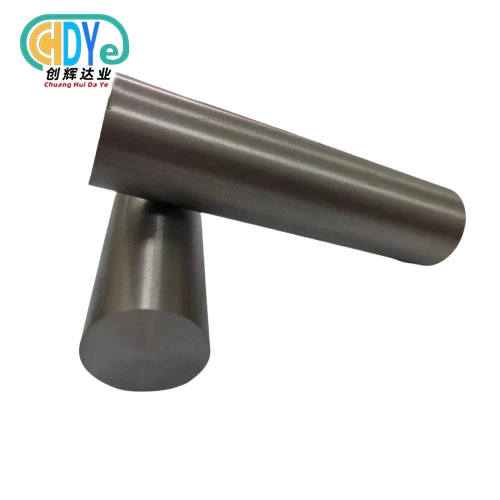
Understanding High Purity Niobium Bar Rod
Niobium is a lustrous, soft, refractory metal in group 5 of the periodic table. A niobium rod at the usual level of purity above 99.99% is an industrial material of precision grade, with interstitial impurities—particularly oxygen, nitrogen, hydrogen, and carbon—strictly regulated since they would otherwise diminish mechanical and electrical performance in important applications.
Physical and Chemical Profile
It has a density of 8.57 g/cm 3, and a melting point of 2,477 °C (4,491 °F), making it one of the most thermally stable metals in industrial manufacture. The body-centered cubic (BCC) crystal structure explains its high ductility at ambient temperature and low work-hardening rate compared to other refractory metals such as tungsten or molybdenum. Residual Resistivity Ratio (RRR) values > 300 demonstrate the extraordinary thermal conductivity of niobium at cryogenic temperatures, a hallmark for superconducting applications.
Industry Standards and Grades
Our niobium bar rods meet the ASTM B392-95 standard for chemical and mechanical properties of niobium and niobium alloy goods. We provide two main grades:
- R04200 — Commercial pure niobium provides excellent ductility, corrosion resistance, and high-temperature stability for structural and chemical processing applications.
- R04210 — Niobium with regulated oxygen concentration for applications with tighter interstitial restrictions, such as superconducting cavity manufacturing and thin-film deposition targets.
Both grades are ISO 9001:2015 certified with complete traceability documentation from raw material procurement to final delivery.
Key Benefits of Using High Purity Niobium Bar Rod
Selecting a refractory metal is never an easy choice. Tantalum has equivalent corrosion resistance but is far more expensive. Titanium is great for biomedical applications, but it doesn't have niobium's superconducting capacity. Tungsten and molybdenum are hard and brittle and difficult to process into complicated shapes, yet stiff at high temperatures. Niobium is unique in that it offers a combination of performance characteristics at a very affordable price.
Here are the major benefits that make a premium high purity niobium bar rod stand out in industrial service:
- >99.99% Purity: Fewer trace impurities mean less chance of lattice instability and thermal inefficiency. This is crucial in particle accelerator cavities and semiconductor sputtering targets, where parts per billion impurities might mean signal deterioration or device failure.
- Excellent corrosion resistance: Nitrogen resists attack by nitric, hydrochloric, and sulfuric acids across wide temperature ranges, making it a reliable material for equipment used in chemical processes, reactor vessels, and heat exchangers in hostile fluids.
- Mechanical Stability at High Temperatures: The material maintains its structural integrity when exposed to high temperatures, making it appropriate for aircraft engine parts, heat shields, and furnace components that undergo continuous heat exposure.
- Good Biocompatibility: Niobium is physiologically inert in contact with bodily fluids, making it a suitable material for use in MRI-compatible implants, pacemaker components, and surgical tools where biological safety is critical.
- Neutron Capture Cross-Section: Niobium has a very low neutron absorption cross-section (about 1.15 barns) compared to many competing metals. Thus, reactor-grade niobium components are a natural option for nuclear energy applications.
These benefits together close the performance gaps seen by procurement teams procuring goods for mission-critical, high-stakes situations. It’s a material that’s really tough to replace since it’s machinable, chemically resistant, and thermally durable.
Manufacturing Process of High Purity Niobium Bar Rod
The quality of a completed high purity niobium bar rod may be traced back to the choices taken at every step of manufacture. Before any melting is started at Chuanghui Daye, we procure only ultra-pure niobium raw materials with verified provenance and chemical verification.
Melting and Consolidation
Volatile impurities are removed, and chemical homogeneity is achieved by means of electron beam melting (EBM) and vacuum arc remelting (VAR). These vacuum-based methods exclude oxygen and nitrogen pickup, which would otherwise degrade RRR values and mechanical ductility.
Forming and Finishing
After consolidation, the ingots are hot forged and rolled into bar stock to very close dimensional specifications. The cold working and regulated heat treatment cycles that follow maximize grain refinement, producing a fine, uniform microstructure that minimizes anisotropic distortion during future machining, a recognized concern when grain size is variable.
Quality Assurance
Extensive mechanical testing (tensile strength, elongation) and chemical analysis (ICP-MS) are performed on every batch before it is sent. Material is chemically pickled, vacuum packaged in double-layer polyethylene bags, and crated to avoid surface oxidation during international shipment. All orders come with complete mill certificates.
How to Choose the Right Niobium Bar Rod for Your Business Needs
“Matching the material grade to the application requirements avoids costly mid-project substitutions. R04200 is used for general corrosion-resistant structural work, whereas R04210 is used for superconducting and high-vacuum applications requiring tighter control of interstitial elements. The electronics businesses that manufacture sputtering targets often demand the stricter purity requirements of R04210, but fabricators of chemical processing equipment commonly believe R04200 is quite enough.
Grade is one thing; dimensional specification is another. Rods are available in several diameters and lengths and may be custom machined to near-net-shape components. If your application includes complex geometry — crucibles, flanges, or finely turned pieces, dealing with a supplier who has in-house machining capacity minimizes the lead time and quality risk of secondary subcontractors.
R&D institutes and prototype developers also need flexible minimum order quantities and rapid turnaround for small batches. Practical ways to guard against concealed substitutes in the supply chain include requesting material certifications, checking recorded test results, and validating ISO 9001:2015 certification status.
Trusted Suppliers and Procurement Tips for High Purity Niobium Bar Rod
Price /kg is not the only criterion when selecting a supplier for refractory metals. Supplier production capacity, accredited quality processes, and traceability paperwork affect the supplier's ability to maintain performance on repeat orders. Chuanghui Daye is based in Baoji, Shaanxi Province, known across the world as China's "Titanium Capital", having direct access to refined rare metal feedstock and a vertically integrated manufacturing chain from melting, forging, and rolling to precision machining.
When you are considering a manufacturer of niobium bar rod, ask for mill test results for each heat number, make sure certificates are current and auditable, and find out whether the source can provide unique dimensions or alloy compositions. Long-standing suppliers such as Chuanghui Daye, with more than 30 years in the business, have the institutional expertise to handle application-specific difficulties, not just execute orders.
Conclusion
Where failure of material cannot be tolerated, high purity niobium bar rods are essential. In addition to their thermal and chemical endurance, superconducting potential and biocompatibility, their unique combination sets them apart from most competing refractory metals for particular industrial use. Procurement teams may confidently specify this material as it meets ASTM B392-95 in grades R04200 and R04210, is certified to ISO 9001:2015, and has been verified to be 99.99% pure. Choosing a supplier with extensive metallurgical experience and established quality infrastructure will turn paper performance numbers into real-world outcomes.
FAQ
1. What purity level do your niobium bar rods meet?
Our niobium rods achieve 99.99% purity, conforming to ASTM B392-95 for grades R04200 and R04210. This level of refinement controls interstitial impurities—oxygen, nitrogen, carbon, hydrogen—to concentrations that preserve RRR values above 300 and mechanical ductility across demanding service conditions.
2. What is the difference between R04200 and R04210?
R04200 is commercial pure niobium suited to structural, corrosion-resistant, and general high-temperature applications. R04210 specifies tighter oxygen content limits, making it preferable for superconducting cavities, sputtering targets, and semiconductor applications where interstitial contamination directly affects electronic performance.
3. Can you supply custom dimensions or machined components?
Yes. We offer custom rod diameters, lengths, and near-net-shape machined parts. Our in-house facilities include lathes, rolling machines, and annealing furnaces, supporting both prototype quantities and larger production runs with consistent quality.
4. How do you prevent oxidation during shipping?
After chemical pickling, bars are vacuum-packed in double-layer polyethylene bags and enclosed in reinforced wooden crates. This packaging protocol protects surface integrity during international transit.
5. Is niobium biocompatible for medical applications?
Niobium is physiologically inert and resistant to body fluids, qualifying it for MRI-compatible implants, pacemaker housings, and surgical instruments. Each batch carries full traceability documentation to support regulatory compliance requirements.
Partner with Chuanghui Daye for Your Niobium Supply
Shaanxi Chuanghui Daye delivers certified high purity niobium bar rod solutions built on three decades of rare metal expertise. As a trusted niobium bar rod supplier with ISO 9001:2015 certification, factory-direct pricing, and flexible custom processing, we support aerospace, electronics, nuclear, and medical procurement teams across the United States and globally. Reach our technical team at info@chdymetal.com to request a tailored quotation today.
References
1. ASTM International. ASTM B392-95: Standard Specification for Niobium and Niobium Alloy Bar, Rod, and Wire. ASTM International, 2010.
2. Padamsee, H., Knobloch, J., & Hays, T. RF Superconductivity for Accelerators. Wiley-VCH, 2008.
3. Donachie, M. J. Titanium: A Technical Guide (2nd ed.). ASM International, 2000.
4. Sims, C. T., Stoloff, N. S., & Hagel, W. C. Superalloys II: High-Temperature Materials for Aerospace and Industrial Power. John Wiley & Sons, 1987.
5. Lide, D. R. (Ed.). CRC Handbook of Chemistry and Physics (95th ed.). CRC Press, 2014.
6. Buckman, R. W. "New Applications for Niobium Alloys and Refractory Metals." JOM: Journal of the Minerals, Metals & Materials Society, 2000.
Learn about our latest products and discounts through SMS or email