- English
- French
- German
- Portuguese
- Spanish
- Russian
- Japanese
- Korean
- Arabic
- Greek
- German
- Turkish
- Italian
- Danish
- Romanian
- Indonesian
- Czech
- Afrikaans
- Swedish
- Polish
- Basque
- Catalan
- Esperanto
- Hindi
- Lao
- Albanian
- Amharic
- Armenian
- Azerbaijani
- Belarusian
- Bengali
- Bosnian
- Bulgarian
- Cebuano
- Chichewa
- Corsican
- Croatian
- Dutch
- Estonian
- Filipino
- Finnish
- Frisian
- Galician
- Georgian
- Gujarati
- Haitian
- Hausa
- Hawaiian
- Hebrew
- Hmong
- Hungarian
- Icelandic
- Igbo
- Javanese
- Kannada
- Kazakh
- Khmer
- Kurdish
- Kyrgyz
- Latin
- Latvian
- Lithuanian
- Luxembou..
- Macedonian
- Malagasy
- Malay
- Malayalam
- Maltese
- Maori
- Marathi
- Mongolian
- Burmese
- Nepali
- Norwegian
- Pashto
- Persian
- Punjabi
- Serbian
- Sesotho
- Sinhala
- Slovak
- Slovenian
- Somali
- Samoan
- Scots Gaelic
- Shona
- Sindhi
- Sundanese
- Swahili
- Tajik
- Tamil
- Telugu
- Thai
- Ukrainian
- Urdu
- Uzbek
- Vietnamese
- Welsh
- Xhosa
- Yiddish
- Yoruba
- Zulu
How Does a niobium titanium tube Resist Corrosion?
The corrosion resistance of a niobium titanium tube is mainly due to a self-regenerating passive oxide coating, which spontaneously develops on its surface when it is exposed to oxygen or moisture. This layer, which consists of stable titanium and niobium oxides, forms a thick molecular barrier, preventing hostile ions such as chlorides, sulfates and acidic species from accessing the base metal. The two element chemistry of the alloy complements this protection, with the titanium providing oxide stability over a broad pH range and the niobium providing resistance to reducing acid conditions. This makes the Nb-Ti tube very robust in an environment where most metals fail soon.
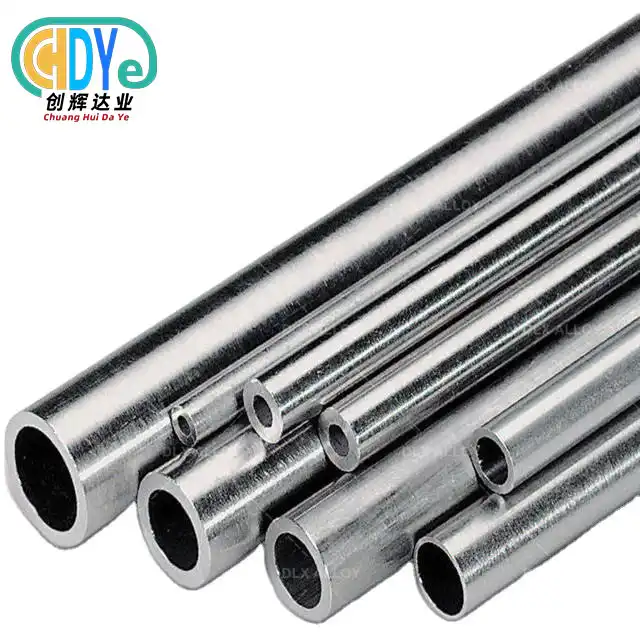
Understanding Corrosion Challenges in Metal Tubes
Corrosion is not a universal danger. Metal tubing in industrial use is subject to a number of unique forms of assault, each with dire repercussions for equipment integrity, human safety and operating cost.Three forms of corrosion are especially important in procurement decisions:
- Galvanic corrosion occurs when two different metals are in touch with one another and an electrolyte is present. In an aeronautical hydraulic assembly or chemical plant pipe this may quietly eat away at joints and fittings before damage is obvious.
- Pitting corrosion is a localized attack at the surface of a metal, which is mostly caused by chloride ions present in marine or chemical processing settings. This is particularly pernicious since pits are stress concentrators and fracture initiation sites under cyclic loads.
- Crevice corrosion occurs in confined spaces such as behind gaskets, in threaded joints or under heat exchanger tube sheets where stagnant fluid chemistry becomes hostile.
In aeronautical and medical applications, a corroded tube is not just a failed piece of equipment. It’s a liability. A damaged hydraulic line might result in structural collapse . A corroded medical implant housing can discharge metal ions into biological tissue . The first stage is to identify these hazards and then pick a material that really mitigates the threats, rather than just postponing failure.
Chemical and Physical Properties That Enhance Corrosion Resistance
The Role of Titanium Content
Titanium is one of the most corrosion-resistant elements known to metallurgists. Its oxide (TiO₂) is thermodynamically stable across wide ranges of temperature and pH. The titanium percentage of a Nb-Ti alloy such as Nb-47Ti or Nb-50Ti is commonly 45-55 wt%, which results in a chemically active surface that oxidizes and passivates promptly after exposure to the atmosphere. Such passivation remains intact even in nitric and dilute hydrochloric acid conditions, making a niobium titanium tube suitable for demanding corrosion-resistant applications.
The Contribution of Niobium
Titanium alone would be less efficient in reducing acid conditions, niobium improves performance. Its oxide layer (Nb2O5) is very stable and provides an extra electrochemical barrier. The combination forms, together, a synergistic passive film that is thermally stable and adherent mechanically (resistant to spalling under heat cycling or mechanical stress).Our seamless Nb-Ti tubes have a density of 8.6–8.7 g/cm³ and are available in outer diameters of 1 to 200 mm, wall thicknesses of 0.2 to 10 mm, and lengths up to 3,000 mm. These dimensional capabilities enable for exact fit into existing aircraft structures and medical device assembly without sacrifice of material.Controlled heat treatment during manufacturing refines the microstructure of the alloy. This improves the coherence of grain boundaries and reduces the micro-defects in which corrosion preferentially originates. The outcome is a tube with a structural, not just cosmetic, protective action.
Mechanisms Behind Corrosion Resistance in Niobium Titanium Tubes
Passive Film Formation and Self-Repair
The passive oxide coating on the surface of a Nb-Ti alloy is usually just a few nanometers thick yet surprisingly effective. If physically injured - by abrasion or machining - it reforms in milliseconds in the presence of oxygen or water vapor . This is a self healing property which is different from coated metals where if the protective coating is damaged it is damaged until it is re-coated.The coating stays intact in acidic conditions such as chemical processing facilities or acid recovery plants where the pH values would lead to violent pitting of stainless steel. Studies of refractory-metal corrosion behavior show that NbTi alloys have passive current densities similar to commercially pure titanium, much below 10 µA/cm² in several hostile environments.
Manufacturing Influence on Corrosion Behavior
It concerns how it is made. Chuanghui Daye uses seamless tube manufacture, which removes the longitudinal weld joints – the areas most prone to preferred corrosion attack in welded alternatives. In our manufacturing process, alloy ingots are melted in vacuum electrode arc furnaces and electron-beam furnaces to reduce the amount of interstitial impurities (oxygen, nitrogen, carbon, hydrogen). High levels of impurities embrittle and break the regularity of oxide films, and so management of impurities is vital for consistent corrosion performance.
Comparing Niobium Titanium Tubes With Other Metal Tubes
Nb-Ti alloys are often compared to stainless steel, pure titanium, and sometimes tantalum or copper when procurement teams are looking for corrosion resistant tubing. Here is how the comparison looks:
- Versus stainless steel (316L) Stainless steel performs well in mild corrosive settings but fails swiftly in chloride rich or reducing acid environments via pitting and stress corrosion cracking. niobium titanium tube alloys are passive, but 316L would need either cathodic protection or regular replacement.Versus pure copper Copper has a high thermal conductivity but suffers from easy corrosion in oxidizing acids and salty solutions. It is completely inappropriate for situations where biological compatibility or chemical resistance is needed. Nb-Ti alloy tubes are used instead of copper in particular heat exchanger circuits with hostile process fluids.
- Tantalum vs. Tantalum is more resistant to corrosion, but at a much higher cost and density of material. For applications that do not need the extreme chemical inertness of tantalum, Nb-Ti alloy tubing provides a practical compromise between performance and procurement cost.
In challenging service situations, NbTi tubing typically outperforms lower-cost competitors in total cost of ownership including replacement frequency, downtime and maintenance labor.
Selecting and Procuring Niobium Titanium Tubes for Optimal Corrosion Resistance
Looking for Nb-Ti tubing involves some research beyond listed specs. There are many criteria that decide if a provider can really provide continuous application grade quality :
- Certification & Traceability: Ensure the supplier is ISO 9001:2015 certified and has complete material traceability records from raw material lot to completed product. This is non-negotiable for aerospace/medical procurement.
- Chemical composition verification: Require GDMS or ICP-OES composition reports in support of Nb/Ti ratios and levels of interstitial impurity. The deviations of oxygen or nitrogen concentration immediately reduce corrosion resistance and mechanical ductility.
- Dimensional Testing: Laser micrometer inspections and eddy current testing to ASTM E426 must be routine. Uniform wall thickness, a direct advantage of seamless production, is crucial for pressure-bearing and cryogenic applications.
- Customization capability: Tube performance needs to fit your individual shape. Good vendors will provide bespoke OD, wall thickness, length and alloy grade combinations instead of trying to shoehorn typical stock specifications into unique applications.
Chuanghui Daye is situated in Baoji, China’s acknowledged hub of titanium and refractory metal manufacturing, and has sophisticated melting, shaping and inspection equipment, including electron beam furnaces and annealing furnaces. We welcome worldwide orders with competitive factory direct prices, ensuring material purity with our ISO 9001:2015 certified process.
Conclusion
Niobium titanium tubes resist corrosion by the combination of self-regenerating passive oxide chemistry, improved alloy microstructure and defect-free seamless construction. These features make NbTi tubing a technically viable solution for procurement specialists in aerospace, medical, chemical processing, and sophisticated manufacturing. The difference between dependable long-term performance and expensive premature failure is choosing a supplier that oversees the whole manufacturing chain from alloy melting to final dimensional inspection.
FAQ
Q: Does an Nb-Ti alloy tube perform well in acidic process environments?
A: Yes. The passive TiO₂/Nb₂O₅ surface film maintains integrity across a wide pH range, including dilute hydrochloric and nitric acid environments. Performance varies with acid concentration and temperature, so specifying your operating conditions to the supplier ensures the correct alloy grade is selected.
Q: What role does heat treatment play in corrosion resistance?
A: Controlled heat treatment refines grain structure and reduces micro-defects at grain boundaries — the sites where corrosion preferentially initiates. It also relieves residual stress from forming operations, which can otherwise drive stress corrosion cracking in service.
Q: What certifications should I verify before purchasing?
A: ISO 9001:2015 is the baseline quality management certification to confirm. For aerospace and medical applications, request full material traceability documentation, chemical composition analysis reports, and dimensional inspection records compliant with relevant ASTM standards.
Q: Can Nb-Ti tubes be customized for specific applications?
A: Yes. OD from 1 to 200 mm, wall thickness from 0.2 to 10 mm, and lengths up to 3,000 mm are achievable. Custom alloy grades beyond Nb-47Ti and Nb-50Ti are also available based on application requirements.
Partner With Chuanghui Daye for Certified Niobium Titanium Tube Supply
Shaanxi Chuanghui Daye delivers ISO 9001:2015 certified niobium titanium tube manufacturing from Baoji, China's titanium capital, backed by over 30 years of rare metal expertise. Whether you need standard grades or fully customized dimensions for aerospace or medical applications, our factory-direct pricing and rigorous quality control ensure consistent, traceable performance. Contact our technical team today at info@chdymetal.com or visit www.chdymetal.com to request a quote.
References
1. Collings, E. W. Applied Superconductivity, Metallurgy, and Physics of Titanium Alloys. Plenum Press, 1986.
2. Lide, D. R. (Ed.). CRC Handbook of Chemistry and Physics, 84th Edition. CRC Press, 2003.
3. Schutz, R. W., & Thomas, D. E. "Corrosion of Titanium and Titanium Alloys." ASM Handbook, Volume 13: Corrosion. ASM International, 1987.
4. ASTM International. ASTM B884: Standard Specification for Superconducting Niobium-Titanium Alloy Wire. ASTM International, 2021.
5. Wilson, M. N. Superconducting Magnets. Oxford University Press, 1983.
6. Rack, H. J., & Qazi, J. I. "Titanium Alloys for Biomedical Applications." Materials Science and Engineering: C, Vol. 26, Issues 8–9, Elsevier, 2006.
Learn about our latest products and discounts through SMS or email