- English
- French
- German
- Portuguese
- Spanish
- Russian
- Japanese
- Korean
- Arabic
- Greek
- German
- Turkish
- Italian
- Danish
- Romanian
- Indonesian
- Czech
- Afrikaans
- Swedish
- Polish
- Basque
- Catalan
- Esperanto
- Hindi
- Lao
- Albanian
- Amharic
- Armenian
- Azerbaijani
- Belarusian
- Bengali
- Bosnian
- Bulgarian
- Cebuano
- Chichewa
- Corsican
- Croatian
- Dutch
- Estonian
- Filipino
- Finnish
- Frisian
- Galician
- Georgian
- Gujarati
- Haitian
- Hausa
- Hawaiian
- Hebrew
- Hmong
- Hungarian
- Icelandic
- Igbo
- Javanese
- Kannada
- Kazakh
- Khmer
- Kurdish
- Kyrgyz
- Latin
- Latvian
- Lithuanian
- Luxembou..
- Macedonian
- Malagasy
- Malay
- Malayalam
- Maltese
- Maori
- Marathi
- Mongolian
- Burmese
- Nepali
- Norwegian
- Pashto
- Persian
- Punjabi
- Serbian
- Sesotho
- Sinhala
- Slovak
- Slovenian
- Somali
- Samoan
- Scots Gaelic
- Shona
- Sindhi
- Sundanese
- Swahili
- Tajik
- Tamil
- Telugu
- Thai
- Ukrainian
- Urdu
- Uzbek
- Vietnamese
- Welsh
- Xhosa
- Yiddish
- Yoruba
- Zulu
How Does a Polished Niobium Bar Rod Improve Performance?
Performance is improved by a well-polished niobium bar rod, which eliminates micro-defects on the surface acting as stress concentrators and corrosion start sites. The polishing procedure smooths the passive oxide layer (Nb2O5) that naturally grows on niobium into a denser, more homogeneous layer. This translates immediately into longer fatigue life, better biocompatibility, and better resilience to chemical assault. With a purity level of over 99.9% and a tensile strength of 200–350 MPa, these rods enable constant and demonstrable performance benefits in medical, electronics, and aerospace applications where surface integrity is non-negotiable.
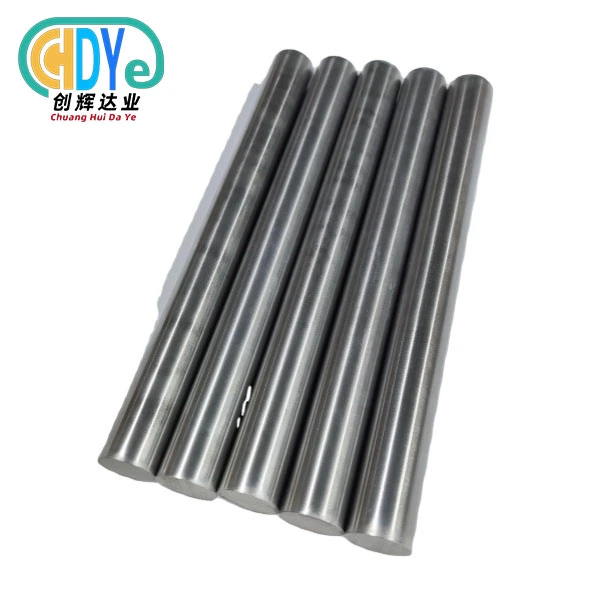
Understanding Polished Niobium Bar Rods and Their Properties
In the refractory metals, niobium has a unique position. It has a comparatively low density of 8.57 g/cm 3, a melting point of 2,468 °C, a Body-Centered Cubic (BCC) crystal structure and it is naturally superconducting at 9.25 K (the highest critical temperature of any elemental metal). These inherent properties make niobium rods not only theoretically appealing but also really beneficial for difficult situations.
The difference between polished and unpolished niobium rods is more than just visual. Unpolished rods are often centerless ground or pickled, and the surface will exhibit tool marks, tiny pits, and evidence of oxidation. These defects are removed at the micron level by mechanical abrasion and then electrochemical polishing of the polished rod, resulting in a smooth, reflective, contamination-resistant surface. We provide our rods in diameters from 1 mm to 50 mm and lengths up to 3,000 mm, with alloy purity Nb >99.9% according to ASTM B392 requirements. This range of dimensions supports not just precision-machined components for pacemaker leads but bigger structural components for chemical reactors.
How Polishing Enhances Niobium Bar Rod Performance
The surface condition defines much more than mere look; it directly dictates electrochemical behavior, fatigue initiation, and tribological contact with mating components. When engineers describe a polished niobium bar rod, they are defining a quantifiable change in material behavior.
Polishing eliminates the thin distorted layer produced by the milling process, which contains residual tensile stress. The polished surface eliminates these stress concentrators, thereby increasing the fatigue life under cyclic loading, which is a significant property for implanted medical devices and superconducting RF cavity components in particle accelerators. Electrochemical polishing also makes the Nb₂O₅ passive layer denser, compacting its structure and, thus, there are fewer paths for hostile media such as organic acids, chloride-rich surroundings, and bodily fluids to reach the base metal. Published corrosion investigations of electropolished niobium have shown much lower passive current densities than manually finished surfaces.
All these advantages transfer into real-world dependability. Aerospace manufacturers that deal with C-103 alloy components have seen a decreased onset of surface oxidation when polished rod stock is utilized for thruster nozzle preforms. For medical device manufacturers, the increased biocompatibility of a surface free of contamination is a critical factor, as residual machining debris may induce inflammatory reactions under implant conditions.
Comparing Polished Niobium Bar Rods to Alternatives
Procurement teams often benchmark niobium against titanium, stainless steel, and tantalum. Every material has its rightful domain, but polished niobium holds a unique cost-performance position demanding a closer look.
Here's how the materials stack up against the traits most critical to B2B buyers:
- Polished niobium against tantalum: Tantalum has somewhat better corrosion resistance in highly concentrated acids over 200°C but is almost twice as dense as niobium (16.69 g/cm³ vs 8.57 g/cm³) and much more expensive per unit. For most chemical process settings below 200°C, niobium has equal chemical immunity at about half the weight penalty and far lower material cost, allowing total cost of ownership calculations to clearly favor niobium.
- Polished niobium or titanium? Titanium (Grade 2) has the same biocompatibility and corrosion resistance in oxidizing media as niobium, but niobium has a superconducting transition at 9.25 K and is stable in high-energy radiation, making it indispensable in cryogenic and nuclear environments where titanium cannot work.
- Polished niobium versus stainless steel: Stainless steel has cost and machinability benefits for benign conditions, but breaks down swiftly in chloride-rich or extremely acidic media while niobium’s passive oxide coating survives. Stainless steel is not used for semiconductor production equipment, since iron or chromium ions would contaminate the wafers and destroy yields.
These comparisons indicate that polished niobium bar rods are not a luxury, but the sensible engineering decision when the environment or application requires what only niobium can do.
Procurement Considerations for Polished Niobium Bar Rods
Choosing the proper material is just half the battle in terms of procurement. The difference between a project taking off or a project going nowhere is finding a supplier that can fulfill that spec consistently, with all the paperwork and support logistics to go with it.
Seasoned procurement executives don’t only focus on the price per kilogram. These are the qualities that really separate trusted suppliers from opportunistic providers:
- Certification and traceability: ISO 9001:2015 certification ensures that quality management procedures are auditable and systematic, not on a case-by-case basis. Buyers in regulated sectors such as medical devices and aircraft are protected with full material traceability documentation from raw feedstock through melting, forging, machining, and final inspection.
- Manufacturing capabilities & customization: A supplier may control every production variable by running electron beam furnaces, precision lathes, rolling machines and annealing furnaces in-house. Buying straight from the factory means no middleman markups, and special diameter, length, and finish specs may be worked out directly with the manufacturing team.
- Delivery reliability and technical support: In urgent projects, you need a supplier that is honest about lead times and has buffer stock of standard dimensions. Engineers knowledgeable about machining considerations are also available – niobium’s gummy cutting behavior necessitates carbide tools and water-soluble coolants – so expensive mistakes are avoided during production.
Suppliers based in established clusters of the rare metal industry benefit from linked supply chains and established transportation infrastructure, reducing lead times and shipping risk for international orders of polished niobium bar rod.
Optimizing Use and Maintenance of Polished Niobium Bar Rods
Purchasing a good polished rod is only half the battle. It is contingent upon handling and storage techniques whether that surface quality will endure until the rod arrives at the machining center or assembly line.
Polished niobium surfaces are susceptible to mechanical wear and contamination with iron particles that may damage the passive oxide layer. Rods should be kept in dry, climate-controlled settings, separately wrapped in polyethylene film or separated by acid-free tissue to avoid contact damage. Handling with bare hands introduces chloride deposits from sweat; clean cotton or nitrile gloves are acceptable for any interaction with polished surfaces.
In the case of niobium rod stock, if it is to be processed at temperatures over 400°C, a vacuum or inert gas atmosphere is necessary to avoid fast oxidation and structural damage. For restoring the surface quality of the components after machining, repolishing utilizing electrochemical techniques maintains the integrity of the passive layer with no dimensional loss. For sustained high-temperature service, silicide coatings and other complementary treatments are available to further preserve the base material in intense thermal cycling applications.
Conclusion
The polished surface of a niobium rod is not just a finishing element. It is a functional engineering specification that changes the way the material interacts with its surroundings at the microstructural level. The standard is justified by the measured increases in fatigue resistance, corrosion immunity, and biocompatibility seen in medical implants, superconducting electronics, chemical processing equipment, and aircraft components, supported by hard performance data. Polished niobium bar rod products are a reliable long-term investment with strict procurement conditions such as verified vendors, verifiable paperwork, and competent in-house manufacture, not a short-term cost premium...
FAQ
Q: What purity grade do your niobium rods carry?
A: Our rods maintain Nb >99.9% purity, complying with ASTM B392. Both commercial-grade and reactor-grade (R04200/R04210) configurations are available depending on whether the application involves nuclear or superconducting use cases.
Q: Can a niobium rod be machined after polishing?
A: Yes. Niobium is ductile but gummy, behaving similarly to soft copper during cutting. Carbide or high-speed steel tooling, low cutting speeds, and water-soluble coolants minimize tool buildup. Post-machining repolishing restores the surface finish where required.
Q: Does niobium oxidize during storage?
A: At room temperature, niobium is stable and does not oxidize meaningfully. Above 400°C in air, oxidation accelerates sharply. Proper dry storage with protective wrapping prevents any ambient degradation of the polished surface.
Q: What delivery states are available?
A: Rods are supplied annealed (recrystallized) for maximum ductility or in the cold-worked condition for higher tensile strength. A polished surface finish is applied as a final step after dimensional finishing.
Q: Is niobium rod biocompatible for medical use?
A: Yes. Niobium's physiological inertness and absence of nickel make it a preferred material for pacemaker leads and orthopedic components. The polished surface further reduces particulate contamination risk in implant environments.
Request a Quote from Chuanghui Daye — Trusted Polished Niobium Bar Rod Supplier
Chuanghui Daye, based in China's Titanium Capital, Baoji, delivers ISO 9001:2015-certified polished niobium bar rod in custom dimensions (1–50 mm diameter, up to 3,000 mm length) with full traceability documentation. Our factory-direct model keeps pricing competitive without compromising purity or precision. Contact our technical team today at info@chdymetal.com or visit www.chdymetal.com to request specifications, samples, or bulk pricing.
References
1. Journal of Nuclear Materials — Corrosion Behavior of Niobium in Aqueous Environments, 2018.
2. International Journal of Refractory Metals and Hard Materials — Surface Finish Effects on Fatigue Life of Refractory Metal Rods, 2020.
3. ASTM B392 Standard Specification for Niobium and Niobium Alloy Bar, Rod, and Wire, ASTM International, 2022.
4. Biomaterials — Biocompatibility Assessment of Niobium Implant Materials, 2019.
5. Journal of Electronic Materials — High-Purity Niobium for Superconducting RF Cavity Applications, 2021.
6. Corrosion Science — Passive Film Characterization on Electropolished Niobium Surfaces, 2017.
Learn about our latest products and discounts through SMS or email