- English
- French
- German
- Portuguese
- Spanish
- Russian
- Japanese
- Korean
- Arabic
- Greek
- German
- Turkish
- Italian
- Danish
- Romanian
- Indonesian
- Czech
- Afrikaans
- Swedish
- Polish
- Basque
- Catalan
- Esperanto
- Hindi
- Lao
- Albanian
- Amharic
- Armenian
- Azerbaijani
- Belarusian
- Bengali
- Bosnian
- Bulgarian
- Cebuano
- Chichewa
- Corsican
- Croatian
- Dutch
- Estonian
- Filipino
- Finnish
- Frisian
- Galician
- Georgian
- Gujarati
- Haitian
- Hausa
- Hawaiian
- Hebrew
- Hmong
- Hungarian
- Icelandic
- Igbo
- Javanese
- Kannada
- Kazakh
- Khmer
- Kurdish
- Kyrgyz
- Latin
- Latvian
- Lithuanian
- Luxembou..
- Macedonian
- Malagasy
- Malay
- Malayalam
- Maltese
- Maori
- Marathi
- Mongolian
- Burmese
- Nepali
- Norwegian
- Pashto
- Persian
- Punjabi
- Serbian
- Sesotho
- Sinhala
- Slovak
- Slovenian
- Somali
- Samoan
- Scots Gaelic
- Shona
- Sindhi
- Sundanese
- Swahili
- Tajik
- Tamil
- Telugu
- Thai
- Ukrainian
- Urdu
- Uzbek
- Vietnamese
- Welsh
- Xhosa
- Yiddish
- Yoruba
- Zulu
How Does Titanium Welding Rod Resist Corrosion and Heat?
A thick, self-healing oxide layer forms on the surface of a titanium welding rod on its own, protecting it from rust and heat. This protective passivation film, which is mostly made up of titanium dioxide, heals almost quickly when it becomes damaged and stays solid even at high temperatures. Due to its high melting point (about 1668°C) and low intermediate impurity content, the rod doesn't break down much when heated and cooled many times. Because of the way this metal behaves, titanium welding rods are essential in harsh settings where chemical attack and high temperatures can damage joints.
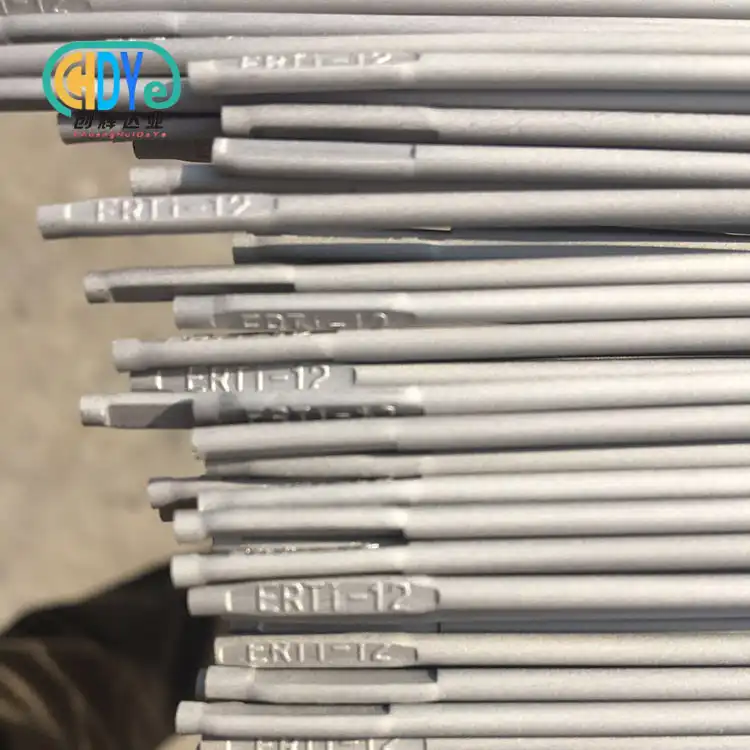
Understanding Titanium Welding Rods and Their Corrosion & Heat Resistance
Learn about titanium welding rods and how they resist corrosion and heat.
What Defines a Titanium Welding Rod?
For Gas Tungsten Arc Welding (GTAW/TIG) and Gas Metal Arc Welding (GMAW/MIG), a titanium welding rod is a high-purity filling metal. Unlike most steel fillers, these rods are made from commercially pure titanium or titanium alloys that are made to fit the chemistry of the base metal. Grades like ERTi-1, ERTi-2, and ERTi-5 are most commonly used in industry because they have the right amount of flexibility, strength, and weldability. The rods meet strict standards like AWS A5.16, which makes sure that they work the same way in industries like aircraft, chemical processing, and medical device production.
Key Properties That Drive Performance
Titanium filler metals work so well because they carefully control their chemical makeup. While the product is being made, interstitial elements like oxygen, nitrogen, and hydrogen are carefully controlled. Usually, oxygen levels stay below 0.10%, nitrogen levels stay below 0.015%, and hydrogen levels stay below 0.005% to keep the material from becoming weak. This fine control maintains the flexibility needed to make parts that are both flexible and strong. The material also has a low density of 4.51 grams per cubic centimetre, which gives it a remarkable strength-to-weight ratio that makes it better than stainless steel options in uses that need to be light or resistant to corrosion. We make pure titanium welding rods at Chuanghui Daye. The sizes range from 1.0 mm to 3.2 mm, and the usual length is 1000mm. Each rod is carefully checked to make sure it meets the requirements of AWS A5.16 for ERTi-2 and ERTi-5 ratings. The surface is "silver bright," which means it doesn't have any drawing oils, oxides, or micro-cracks that could weaken the weld.
Welding Techniques That Preserve Material Integrity
Because it can precisely control the heat and protect against toxic gases, TIG welding is still the best way to work with titanium. The DCEN (Direct Current Electrode Negative) setup keeps the arc constant while putting out the least amount of heat. Argon shielding gas keeps the liquid weld pool clean from airborne contaminants. This is critical because titanium quickly takes oxygen, nitrogen, and hydrogen above 400°C. Trailing covers guard the cooling weld metal and stop the formation of brittle layers in the alpha case that make the joint much less reliable. Our rods produce a clean curve with little spatter, which makes them easy to use in flat, horizontal, vertical, and overhead situations.
The Science Behind Titanium Welding Rods' Resistance to Corrosion and Heat
The science behind why titanium welding rods don't rust or melt in hot conditions.
The Self-Healing Oxide Layer Mechanism
Titanium's ability to form a strong oxide film is what makes it resistant to erosion. Titanium surfaces quickly form a thin layer of titanium dioxide (TiO₂) when they come into contact with air, even minimal amounts. There is a passivation layer that sticks well to the material and keeps out chloride ions, acidic solutions, and oxidising conditions. Unlike stainless steel, where limited cracking can happen when the chromium oxide layer breaks down, titanium's oxide film grows back right away after being damaged mechanically or chemically, protecting the part continuously throughout its service life.
Metallurgical Stability at Elevated Temperatures
Titanium keeps its solid structure by changing phases. At lower temperatures, it goes from the hexagonal close-packed (HCP) alpha phase to the body-centred cubic (BCC) beta phase above about 882°C. This change doesn't involve big changes in volume that could cause cracking. The alloy's makeup affects its thermal stability. For example, the ERTi-5 grade, which has aluminium and vanadium in it, stays stronger at high temperatures than pure grades that are sold in stores. During welding, the heat-affected zone undergoes controlled microstructural changes that preserve the metal's mechanical properties and prevent grain growth, which can weaken other metals.
Real-World Validation From Demanding Industries
Titanium is better than other metals in situations where heat and rust are present, like in marine uses. Offshore sites that use titanium heat exchangers say that their service lives are longer than 25 years in saltwater conditions where stainless steel would break in five years. Aerospace companies use titanium engine parts because they can withstand temperatures above 600°C and don't rust when hot gases hit them. After multiple failures with other materials, chemical plants that handle chlorinated substances at high temperatures have completely switched to titanium piping systems. These case studies indicate that the material works well in situations where other metals would fail.
Comparing Titanium Welding Rods to Alternatives in Corrosion and Heat Resistance
Titanium welding rods are better at resisting corrosion and heat than other options.
Titanium Versus Stainless Steel Rods
When buying teams look at filler metals for settings that are likely to rust, they often compare titanium and stainless steel. Stainless steel needs chromium to make an oxide layer that protects it. However, in chloride-rich settings, this layer breaks down, allowing pitting and crevice rust to happen. Titanium's oxide film stays solid in seawater, strong acids (but not hydrofluoric acid), and alkaline solutions, but stainless steel breaks down quickly in these conditions. Titanium is also better at withstanding high temperatures. Austenitic stainless steel starts to lose its strength above 540°C, but titanium alloys keep their structure at temperatures close to 600°C. The edge in weight is also crucial. Titanium parts weigh about 45% less than stainless steel parts of the same size, which lowers structural loads in marine and aircraft uses.
Differentiating Rod Forms and Applications
Engineers can choose the right goods when they know the differences between rod designs. To make sure that the wire feeds evenly and the arc stays stable, welding rods made for TIG and MIG processes have tight limits on their diameters and are controlled in how straight they are. Titanium wires may be physically identical, but they may not have the smooth surface and precise measurements needed for good welds. Filler rods for manual welding come in standard lengths. Our 1000mm rods are the best size for handling a wide range of joint designs while reducing waste caused by frequent rod changes.
Grade Selection for Specific Performance Requirements
To choose between ERTi-2 and ERTi-5 grades, you need to make sure that the qualities of the filler metal match those of the base material and the working conditions. ERTi-2 is very flexible and has a tensile strength of about 50 ksi. This makes it perfect for corrosion-resistant uses where flexibility is more important than ultimate strength. This grade can handle thermal growth without cracking, which is excellent for heat exchanges, chemical tanks, and marine parts. ERTi-5, which has aluminium and vanadium in it, makes it stronger (nearly 130 ksi) while still being able to be bent easily. The better mechanical qualities of this grade are needed for structural aerospace parts, pressure tanks that work above 300°C, and landing gear assemblies. Galvanic rust, which could shorten the life of a joint, can't happen if the replacement metal and base metal are chemically compatible.
Practical Guidance for Using Titanium Welding Rods to Maximise Corrosion and Heat Resistance
How to use titanium welding rods in a way that resists corrosion and heat the best.
Contamination Control and Environment Preparation
To get the best weld quality, you have to be very clean during the whole welding process. There can't be any drafts in the work area because they could mess up the protecting gas covering or bring in airborne contaminants. Welders should wear gloves that don't have lint on them because skin oils can make the hardened metal porous. Base metal surfaces need to be mechanically cleaned with stainless steel wire brushes. After that, they need to be wiped down with acetone or methanol. Pickling with a mix of nitric acid and hydrofluoric acid gets rid of surface oxides that could let air into the weld pool. The rods themselves should be kept in their safe package until they are needed, and they should only be handled with clean gloves to keep grease from building up.
Storage Practices That Maintain Material Integrity
When titanium rods are stored correctly, they last longer and work the same way every time. Climate-controlled spaces with relative humidity below 50% keep wetness from building up, which could cause hydrogen to form during welding. Even though titanium doesn't rust, chemical vapours or dust on the surface can make welds worse. The best security is provided by sealed cases with desiccant packs. Rods should be stored either vertically or horizontally so they don't bend, which could make it hard for automatic systems to feed wires. Following the first-in, first-out rule for inventory movement makes sure that older stock is used up before it goes bad.
Troubleshooting Common Defects
Finding and fixing welding flaws saves money on repairs and keeps the machine from breaking down. The colour of the weld bead indicates how well the shielding is working: silver or light straw means the shielding is working well, blue means the shielding isn't working very well, and purple or grey means the shielding is completely failing and the weld needs to be removed. Most of the time, porosity is caused by surface contamination or not enough gas coverage. This problem can be fixed by increasing gas flow rates or extending following shield coverage. When you use the wrong filler grade, the heat-affected zone often cracks. When you use ERTi-9 to join ERTi-5 base metal, the weld zone becomes more flexible and can handle thermal loads. If there is too much entry or not enough fusion, it means that the amperage settings or trip speed need to be changed based on the thickness of the material and the shape of the joint.
Procurement Insights: Buying and Sourcing High-Quality Titanium Welding Rods
Tips for Buying: Finding and Getting High-Quality Titanium Welding Rods.
Certification and Quality Verification Criteria
When making sourcing choices, sellers with clear quality systems and the ability to track materials should be given the most weight. ISO 9001:2015 approval means that the whole process is controlled, from checking the raw materials to packing them up at the end. The filler metal meets industry-recognised standards for chemical makeup and mechanical properties, as shown by AWS A5.16 compliance. For full traceability, material test records (MTRs) should be sent with every package. These describe the real chemistry, tensile strength, and surface quality. When suppliers offer lot-specific paperwork, it's easier to figure out what's wrong with production by comparing welding performance to groups of materials.
Chuanghui Daye's factory in Baoji, which is known as China's "Titanium Capital", uses high-tech melting, forging, and rolling tools to make sure that the qualities of the materials are always the same. Our controlled atmosphere annealing furnaces improve the microstructure without adding any contaminants, and our electron beam furnaces make titanium that is very pure. Before it is shipped, each production lot is chemically analysed, measured, and checked for surface quality.
Pricing Strategy and Order Optimisation
Procurement teams can make the most of their budgets without sacrificing performance when they know how prices are related to the grade and quality of materials. Because they are easier to work with and require less science, commercially pure types like ERTi-2 usually cost 15 to 20 per cent less than alloyed ERTi-5. Buying in bulk creates savings of scale. For example, orders over 500 kilograms often get a special price that lowers the cost per unit by 10 to 15 per cent. Custom width or length requirements may lead to extra tooling costs, so common sizes are usually more cost-effective for everyday uses. Setting up blanket purchase deals with planned releases strikes a balance between the costs of keeping inventory and the benefits of stable prices and a steady supply.
Logistics Considerations for Material Integrity
Titanium is reactive, so it needs to be handled carefully during shipping to keep it from getting contaminated. Rods should come in packaging that keeps out wetness and has safe end caps that keep them from getting damaged by impacts. To speed up clearance, international shipments need the right customs paperwork that lists the material grade, planned use, and place of origin. Lead times change with the seasons. For example, when demand for aircraft parts is highest in the second and third quarters, supply times are often pushed back from four to eight weeks. Strategic inventory management that keeps the right amount of safety stock on hand helps keep production from being interrupted by delays in the supply chain and keeps too much capital from being stuck in raw materials.
Conclusion
Titanium welding rods are better at resisting rust and heat because they have a controlled chemical makeup, a high melting point, and an oxide layer that heals itself. Because of these qualities, they can't be replaced in medical, aircraft, chemical processing, and sea settings where failure of the material would have terrible results. Engineering teams can get the best welding results while keeping costs low by learning about mechanical science, the right way to handle materials, and how to buy them. By choosing the right grades, keeping strict control over contamination, and working with approved sources, joints can last for decades and work well in the harshest conditions.
FAQ
Q: Can ERTi-5 Rods Weld Grade 2 Commercially Pure Titanium?
A: ERTi-5 rods can join Grade 2 titanium that is sold in stores, but the joint will be stronger than the material around it. This doesn't cause any problems with compatibility because the weld is now the stronger part. If you use Grade 2 rods on ERTi-5 base metal, on the other hand, you create a weak point that makes the structure less stable if the design depends on the alloy's mechanical qualities.
Q: What Does Weld Bead Colour Indicate?
A: The colour of the beads directly shows how well the protective gas is working. A silver or light straw colour means that the material is well-protected from the elements and has good welds. Blue means that there is some rust, but the quality is only average. If it looks purple, white, or flaky grey, it means that the shielding has failed. This colour means that the welds are weak and need to be taken out and redone with better gas covering.
Q: Why Use Trailing Shields During Welding?
A: Titanium is still chemically reactive above 427°C, which means it easily takes in nitrogen and oxygen from the air, which makes it very weak. Inert gas is spread over the cooling weld metal by trailing screens or purge tanks until temperatures drop below the reactivity threshold. This keeps the metal from getting contaminated, which would weaken the joint's ability to bend and resist corrosion.
Partner With a Trusted Titanium Welding Rod Supplier
Work with a reputable company that sells titanium welding rods. For over 30 years, Shaanxi Chuanghui Daye Metal Material Co., Ltd. has been working with rare metals. They can help you with your important welding jobs. Our ISO 9001:2015-certified production methods make titanium welding rods that meet AWS A5.16 standards and can be fully tracked back to their source. We are located in Baoji, which is a major titanium production hub, so we can consistently meet the needs of both small trial orders and big production orders. Email our tech team at info@chdymetal.com to talk about the needs of your particular application. We offer expert advice, low prices directly from the factory, and custom rod specs that match your base material and service conditions. This makes sure that the welding process goes smoothly from the first arc strike for decades to come.
References
1. American Welding Society. (2014). Specification for Titanium and Titanium-Alloy Welding Electrodes and Rods (AWS A5.16/A5.16M). Miami: American Welding Society.
2. Donachie, M.J. (2000). Titanium: A Technical Guide (2nd Edition). Materials Park: ASM International.
3. Schutz, R.W. & Watkins, H.B. (1998). "Recent Developments in Titanium Alloy Application in the Energy Industry." Materials Science and Engineering: A, 243(1-2), 305-315.
4. Boyer, R., Welsch, G., & Collings, E.W. (1994). Materials Properties Handbook: Titanium Alloys. Materials Park: ASM International.
5. Lutjering, G. & Williams, J.C. (2007). Titanium (2nd Edition). Berlin: Springer-Verlag.
6. Liu, S. & Olson, D.L. (1986). "Weld Pool Solidification in Titanium Weldments." Welding Journal, 65(5), 139-145.
Learn about our latest products and discounts through SMS or email