- English
- French
- German
- Portuguese
- Spanish
- Russian
- Japanese
- Korean
- Arabic
- Greek
- German
- Turkish
- Italian
- Danish
- Romanian
- Indonesian
- Czech
- Afrikaans
- Swedish
- Polish
- Basque
- Catalan
- Esperanto
- Hindi
- Lao
- Albanian
- Amharic
- Armenian
- Azerbaijani
- Belarusian
- Bengali
- Bosnian
- Bulgarian
- Cebuano
- Chichewa
- Corsican
- Croatian
- Dutch
- Estonian
- Filipino
- Finnish
- Frisian
- Galician
- Georgian
- Gujarati
- Haitian
- Hausa
- Hawaiian
- Hebrew
- Hmong
- Hungarian
- Icelandic
- Igbo
- Javanese
- Kannada
- Kazakh
- Khmer
- Kurdish
- Kyrgyz
- Latin
- Latvian
- Lithuanian
- Luxembou..
- Macedonian
- Malagasy
- Malay
- Malayalam
- Maltese
- Maori
- Marathi
- Mongolian
- Burmese
- Nepali
- Norwegian
- Pashto
- Persian
- Punjabi
- Serbian
- Sesotho
- Sinhala
- Slovak
- Slovenian
- Somali
- Samoan
- Scots Gaelic
- Shona
- Sindhi
- Sundanese
- Swahili
- Tajik
- Tamil
- Telugu
- Thai
- Ukrainian
- Urdu
- Uzbek
- Vietnamese
- Welsh
- Xhosa
- Yiddish
- Yoruba
- Zulu
How Does Titanium Welding Wire Perform in TIG Welding?
Titanium welding wire delivers exceptional performance in TIG welding applications, combining superior corrosion resistance with consistent arc stability for critical industrial joints. These specialized filler metals maintain metallurgical integrity while producing defect-free welds in demanding environments, including aerospace, chemical processing, and medical device manufacturing. The wire's ultra-pure composition and optimized chemical balance ensure reliable fusion characteristics, minimizing contamination risks while achieving high-strength joints that match the base material's performance properties.
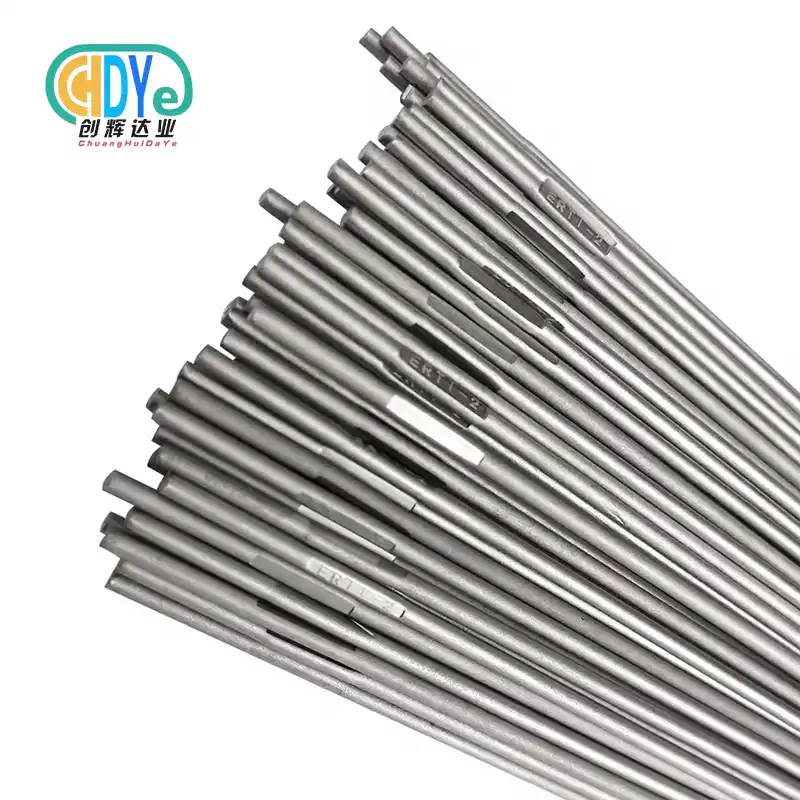
Understanding Titanium Welding Wire in TIG Welding
When it comes to welding supplies, titanium filler metals are designed to work with Gas Tungsten Arc Welding (GTAW) methods. These ultra-pure materials fill in important gaps while keeping the unique qualities that make titanium so important in many fields.
Chemical Composition and Metallurgical Properties
Titanium filling wire is made by carefully controlling chemicals and making sure they meet strict purity standards. The commercial grades are ERTi-1 through ERTi-23, and each one is designed to meet the needs of a particular purpose. ERTi-2 (Commercially Pure Grade 2) has the best ductility and tensile strength between 345 and 450 MPa. On the other hand, ERTi-5 (Ti-6Al-4V) has better strength properties and can handle loads of up to 895 MPa in aircraft uses.
Controlling the interstitial elements is very important for the stability of the weld. To keep the material from becoming too weak, the oxygen content usually stays below 0.25%, and the nitrogen content stays below 0.05%. Carbon content stays below 0.08% so that carbides don't form, which could make the material less flexible. These rules make sure that the properties of the weld zone match or go beyond the properties of the base material.
Grade Selection for Optimal TIG Performance
Choosing the right wire types for the job will directly affect how well the weld turns out and how well the joint works in the long run. Grade 1 and Grade 2 lines work great in chemical handling areas that need the most corrosion protection. Grade 5 (Ti-6Al-4V) is used in aircraft applications that need high strength-to-weight ratios and performance at high temperatures.
Palladium additions in Grade 7 make it more resistant to crevice rust in less acidic settings. This makes it perfect for piping systems in chemical plants. Grade 9 (Ti-3Al-2.5V) is a reasonable choice because it has good formability and only moderately higher strength gains compared to widely pure grades.
The choice of wire thickness affects how much heat is absorbed and how far it travels. For thin-section welding and accurate heat-affected zone control, smaller diameters (0.4–1.0mm) work best. For heavy-section joining that needs higher deposition rates, bigger diameters (3.0-6.0mm) work best.
Key TIG Welding Techniques Using Titanium Welding Wire
To successfully TIG weld titanium filler materials, they need to be carefully prepared, and the parameters must be carefully controlled. These methods make sure that the parts are clean and have the best mechanical qualities and corrosion protection.
Pre-Welding Preparation and Cleaning Protocols
Preparing the surface is the first step in making a good titanium weld. Base materials need to be cleaned thoroughly with stainless steel wire brushes made just for titanium work. Using nitric-hydrofluoric acid solutions for chemical cleaning gets rid of metal layers and surface contaminants that could weaken the weld.
The way titanium welding wire is stored has a direct effect on the quality of the weld. Filler metals need to stay in places that don't have any wetness and have a relative humidity below 40%. Acid cleaning or mechanical peeling should be used to get bright, oxide-free finishing on wire surfaces. Any change in color means that the wire might be contaminated and needs to be replaced.
Joint preparation includes an exact fit-up with few gaps so that less heat is needed. Root openings are usually between 0 and 2 mm, but this depends on the width of the part and the way the joints are set up. Backing gas systems protect the atmosphere completely during the root pass processing.
Welding Parameters and Shielding Gas Selection
Argon gas that is purer than 99.995% is needed to protect the atmosphere during TIG welding. Most of the time, flow rates for torch protection are between 15 and 25 CFH, and 10-15 CFH of backing gas protects the root side. In important situations, wind screens and protected welding areas keep the air from getting contaminated.
Setting the amps depends on the width of the wire and the thickness of the base material. Welding thin parts (0.5 to 2.0 mm) usually needs 20 to 60 amps, while welding thicker sections might need 100 to 200 amps. DCEN (Direct Current Electrode Negative) welding gives the best arc properties and penetration control for titanium uses, so AC welding is not needed.
Travel speeds match the need for entry with the amount of heat that can be put in. Too much heat makes grains grow and lowers the resistance to corrosion, while not enough heat makes flaws in the unfinished fusion process. Travel speeds are usually between 4 and 8 inches per minute, but they depend on the type of joint and the width that is needed.
Contamination Prevention and Quality Control
The main problem with bonding titanium materials is that alpha case formation can happen. This oxygen-rich top layer makes the material less flexible and more rigid, which could cause the joint to break early. Covering the area with protective gas beyond the obvious heat-affected zone stops the formation of alpha cases.
Cleaning after welding gets rid of any surface coloring that could mean contamination. Light straw colors might work for non-essential uses, but blue or purple rust needs to be removed by chemical cleaning or mechanical means. Completely clean welds keep the bright, shiny look of the base material.
Performance Comparison: Titanium Welding Wire vs Other Welding Wires
Understanding the differences in performance between titanium and other filler metals helps sourcing workers choose the right material for the job based on cost and application needs.
Corrosion Resistance and Environmental Performance
When used in most industrial settings, titanium filler metals are more resistant to rust than stainless steel options. When used in salt water, titanium welds stay strong forever, but 316L stainless steel starts to corrode within months of being exposed. When working with chemicals that contain chlorides, sulfuric acid, or nitric acid solutions, titanium welding supplies will last longer and be more reliable.
Titanium welding wire products are different from aluminum welding wires in how well they work at high temperatures. Aluminum loses its strength quickly above 200°C, but titanium can still be useful up to 400°C or even higher, based on the combination. This steadiness at high temperatures is very important for heat exchangers and devices that use high-temperature pipes.
Galvanic interaction factors make titanium a better choice for mixed-metal systems. Titanium is higher in the galvanic series than aluminum, which makes it more likely to rust when joined to stainless steel or other popular building materials. Aluminum, on the other hand, makes rusting faster through galvanic coupling effects.
Mechanical Property Advantages
Titanium welding materials are good for uses that need to be light because of their high strength-to-weight ratios. Specific strengths of Ti-6Al-4V weld layers are close to 200 kN/m/kg, which is much higher than the strengths of aluminum alloys, which are around 100 kN/m/kg. In aircraft and automobile uses, this benefit directly means less structural weight.
When titanium weld parts are loaded and unloaded over and over, their fatigue resistance properties are very good. When properly done, titanium welds can withstand more than 10^6 cycles of stress at levels higher than 300 MPa, while similar aluminum parts break at much lower stress levels or cycle counts.
Most other materials can't be used to make medical devices because they don't meet biocompatibility standards. Because titanium doesn't react with living things and has great mechanical qualities, it can't be replaced for uses in implants and surgical instruments.
Procurement Considerations for Titanium Welding Wire
When buying titanium filler metals strategically, you need to carefully look at the supplier's skills, quality systems, and overall cost factors that go beyond the initial material price. These things to think about make sure that the supply chain works reliably and supports important business processes.
Supplier Qualification and Certification Requirements
A quality management system approval is a basic way to make sure that the standard of a product will stay high over time. Getting ISO 9001:2015 certification shows that a provider is committed to maintaining quality throughout the whole production process. For better tracking and paperwork needs, aerospace uses may need extra certifications like AS9100.
Each lot of wire comes with a material test certificate that lists the chemicals used, the wire's mechanical qualities, and the factors used in its production. These certificates allow full tracking from the raw materials to the delivery of the finished product. They help with quality check standards and, if needed, failure probes. For long-term component lifetime management, suppliers should keep production records for at least seven years.
The melting methods, wire drawing tools, and surface treatment facilities are all part of the manufacturing capability review. Vacuum arc remelting (VAR) and electron beam melting make the purest titanium materials. Cold drawing processes make sure that the dimensions are consistent and the surface finish is good. The abilities of acid cleaning and bright annealing make surfaces free of contamination, which is important for welding tasks.
Economic Evaluation and Supply Chain Management
Calculating the total cost of ownership means taking into account performance factors that are important beyond the initial purchase price. Higher-grade titanium wires may be worth the extra cost because they last longer, don't need to be reworked as often, and are more reliable in critical situations. Life cycle cost analysis often chooses titanium options even though they cost more up front.
Inventory management methods weigh the risks of not having enough supplies against the costs of keeping them on hand. Titanium welding wire specifications should be able to work with wire from more than one provider while still keeping the same level of performance. Standardizing on popular types like ERTi-2 and ERTi-5 makes the supply more flexible and the inventory less complicated.
Decisions about project scheduling and product planning are affected by lead times. Standard grades usually have delivery times of 4 to 6 weeks, while special specs may need 8 to 12 weeks to make and test. Through vendor-managed inventory programs or blanket buy agreements, strategic ties with suppliers can cut down on wait times.
Case Studies and Real-World Applications
The usefulness of titanium filler metals in tough TIG welding conditions across many industries is shown by real-world performance data from industrial uses.
Aerospace Industry Success Stories
A major airplane engine maker said that switching from nickel-based welding supplies to ERTi-23 for fixing turbine parts cut upkeep costs by a large amount. The titanium welds showed better resistance to thermal fatigue, which increased the time between repair intervals for parts from 5,000 to 12,000 flight hours while still meeting the standards for structural integrity.
When titanium welding wire was used for main structure joining in airframe manufacturing, first-pass acceptance rates were 99.2%, compared to 94% with previous stainless steel options. The improvement came about because titanium is good at welding and is less sensitive to small changes in parameters during production welding.
Quantifying the weight savings showed that wing box structures had 15% less structural mass when titanium welding made it possible to use thinner gauge base materials while still meeting the needed joint strength qualities. Since these saves were put into better fuel economy and more payload space for commercial airplanes...
Chemical Processing Industry Applications
A big petroleum plant switched from heat exchanger tubes made of 316L stainless steel to ones made of titanium that were joined together with ERTi-2 filler metal. The installation had no corrosion-related problems after three years of use in environments with a lot of sulfuric acid, where older stainless systems had to be replaced every year.
Equipment used to make chlor-alkali that had titanium weld joints showed great strength under conditions with wet chlorine gas. After five years of continual operation, a post-service check showed that there was no measurable corrosion. However, similar stainless steel welds had a lot of pitting and crevice corrosion damage.
The cost study showed that the total ownership costs went down by 40%, even though the original material costs were 300% higher. The gain came about when planned replacement intervals were taken out, and repair downtime that affected output capacity was cut down.
Medical Device Manufacturing Benefits
Orthopedic implant makers use Grade 23 (Ti-6Al-4V ELI) welding materials to put parts together; the biocompatibility test results are always the same. The very low interstitial content makes sure that the tissue integrates well while still meeting the mechanical property needs for load-bearing uses.
Titanium's nonmagnetic and sterilization-resistant qualities make it useful for making surgical instruments. TIG-welded parts stay strong even after many autoclave cycles, and the sharp geometry of the edges is important for surgical function. One way that manufacturing efficiency has improved is by cutting the number of post-weld finishing steps by 60% compared to stainless steel options.
Quality measures show that 99.8% of welded implant assemblies meet key dimension standards. This shows how precise titanium TIG welding methods can be when they are used correctly.
Conclusion
Titanium welding wire works better than any other wire in TIG welding applications in the medical device, chemical processing, and aircraft industries. These specialized filling metals are essential for important uses because they are biocompatible, have high strength-to-weight ratios, and are very resistant to rust. Even though the original costs are higher than other options, the total ownership value through longer service life, less upkeep, and higher reliability makes the investment worth it in harsh industrial settings.
FAQ
Q: What makes titanium welding wire different from other filler metals?
A: Titanium welding tools have special benefits, such as not rusting in most industrial settings, being very strong for their weight, and being biocompatible for medical uses. Titanium, unlike stainless steel or aluminum, keeps these qualities over a wide range of temperatures and has better fatigue resistance for uses that load and unload many times.
Q: Which titanium wire grade should I select for aerospace applications?
A: ERTi-5 (Ti-6Al-4V) is the normal aircraft grade because it has the best strength and performance at high temperatures. ERTi-23 (Ti-6Al-4V ELI) has better fracture toughness for important tasks that need the highest level of dependability. Which grade to use depends on the required strength, the working temperature, and the crack toughness.
Q: How do I prevent contamination during titanium TIG welding?
A: To keep contamination from happening, you need argon shielding gas that is at least 99.995% pure, full air protection with backing gas systems, and careful cleaning of the base materials and wire surfaces. Oxygen pickup that makes alpha case layers brittle is stopped by protection that goes beyond the obvious weld zone.
Q: What quality certifications should I require from suppliers?
A: As a minimum, require certification to ISO 9001:2015. For aircraft uses, a certification to AS9100. Each lot of wire must come with a material test report that lists its chemical makeup and mechanical qualities. Suppliers should keep all the paperwork needed for full traceability that backs up quality audit standards and failure probes.
Partner with Chuanghui Daye for Superior Titanium Welding Solutions
When you need trustworthy titanium welding wire for important TIG welding jobs, Shaanxi Chuanghui Daye gives you top-notch quality and full expert support. Our production methods are ISO 9001:2015 certified, which means that every wire meets the strict standards of the aircraft and medical industries. We are in Baoji, China, which is known as the "Titanium Capital," and we have full AWS A5.16 compliance on all of our grades, from ERTi-1 to ERTi-23. Get in touch with our expert team at info@chdymetal.com to talk about your needs and get reasonable prices from a reputable titanium welding wire manufacturer.
References
1. ASM Handbook Volume 6: Welding, Brazing, and Soldering. Materials Park, OH: ASM International, 2018.
2. Donachie, Matthew J. Titanium: A Technical Guide, 2nd Edition. Materials Park, OH: ASM International, 2000.
3. American Welding Society. AWS A5.16/A5.16M:2013 Specification for Titanium and Titanium Alloy Welding Electrodes and Rods. Miami, FL: AWS, 2013.
4. Boyer, Rodney, Gerhard Welsch, and E.W. Collings. Materials Properties Handbook: Titanium Alloys. Materials Park, OH: ASM International, 1994.
5. Lutjering, Gerd and James C. Williams. Titanium, 2nd Edition. Berlin: Springer-Verlag, 2007.
6. Schutz, R.W. and D.E. Thomas. "Corrosion of Titanium and Titanium Alloys." Metals Handbook, Vol. 13, Corrosion. Materials Park, OH: ASM International, 1987.
Learn about our latest products and discounts through SMS or email