- English
- French
- German
- Portuguese
- Spanish
- Russian
- Japanese
- Korean
- Arabic
- Greek
- German
- Turkish
- Italian
- Danish
- Romanian
- Indonesian
- Czech
- Afrikaans
- Swedish
- Polish
- Basque
- Catalan
- Esperanto
- Hindi
- Lao
- Albanian
- Amharic
- Armenian
- Azerbaijani
- Belarusian
- Bengali
- Bosnian
- Bulgarian
- Cebuano
- Chichewa
- Corsican
- Croatian
- Dutch
- Estonian
- Filipino
- Finnish
- Frisian
- Galician
- Georgian
- Gujarati
- Haitian
- Hausa
- Hawaiian
- Hebrew
- Hmong
- Hungarian
- Icelandic
- Igbo
- Javanese
- Kannada
- Kazakh
- Khmer
- Kurdish
- Kyrgyz
- Latin
- Latvian
- Lithuanian
- Luxembou..
- Macedonian
- Malagasy
- Malay
- Malayalam
- Maltese
- Maori
- Marathi
- Mongolian
- Burmese
- Nepali
- Norwegian
- Pashto
- Persian
- Punjabi
- Serbian
- Sesotho
- Sinhala
- Slovak
- Slovenian
- Somali
- Samoan
- Scots Gaelic
- Shona
- Sindhi
- Sundanese
- Swahili
- Tajik
- Tamil
- Telugu
- Thai
- Ukrainian
- Urdu
- Uzbek
- Vietnamese
- Welsh
- Xhosa
- Yiddish
- Yoruba
- Zulu
How Is a niobium titanium tube Made to Tight Tolerances?
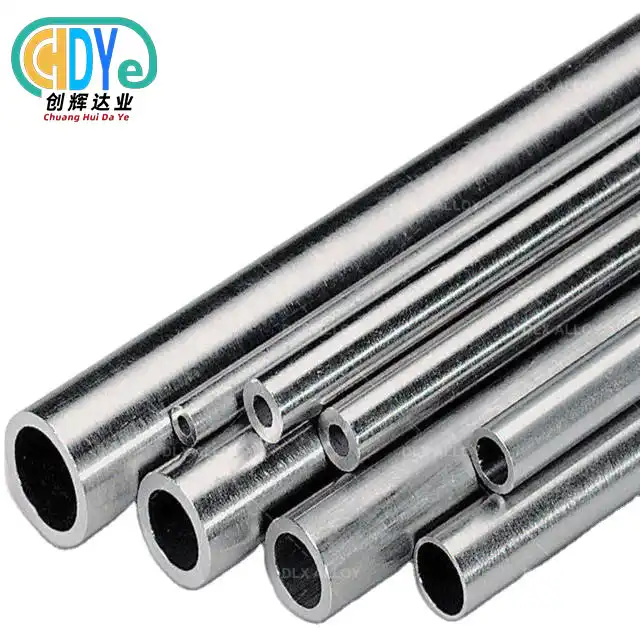
The tight tolerances on a niobium titanium tube are not accidental; they are the consequence of purposeful engineering at every step of the manufacturing process. Starting with vacuum arc melting of Nb-Ti ingots, followed by multi-stage cold drawing and controlled annealing cycles, each process step is calibrated to preserve dimensional precision in the range of ±0.01 mm to ±0.05 mm. The alloy’s 8 K to 10 K superconducting transition temperature, along with its seamless structure and density of 8.6–8.7 g/cm³, necessitates a level of process control few manufacturers can reliably offer. This process awareness enables better sourcing choices for procurement teams.
What Makes Niobium Titanium Tubes So Demanding to Manufacture
Nb-Ti alloy tubes have a special place in modern engineering. These seamless tubes are produced mostly of niobium and titanium, usually in the ratios of Nb-47Ti or Nb-50Ti, and are used in MRI magnet cladding, aircraft hydraulic systems, and chemical processing equipment. Outer diameters vary from 1 mm to 200 mm, wall thicknesses from 0.2 mm to 10 mm, and lengths up to 3,000 mm, offering an unusually broad application area.
In the manufacture of superconducting magnets, a NbTi tube serves as a diffusion barrier sleeve in the billet assembly. Any little variation from wall homogeneity might destroy the multifilamentary architecture of the finished wire. Wall thickness discrepancy directly impacts the pressure tolerance and fatigue life of aeronautical hydraulic lines. If the dimensions vary, there is a danger of regulatory rejection for components near medical implants. Tight tolerances are not a choice; they are a practical necessity with regard to safety and performance.
The Core Challenges of Holding Tolerances in Nb-Ti Tubing
Niobium titanium tubes both gall, spring back when formed, and are susceptible to interstitial contamination. These inclinations multiply when they are alloyed together. Oxygen, nitrogen, and hydrogen absorbed during processing may boost interstitial impurity levels to over 150 ppm, leading to brittleness that can induce micro-cracking during drawing. Throughout the whole production cycle, mechanical accuracy is as vital as chemical purity.
The hardness and strain-hardening behavior of NbTi is not compatible with the conventional extrusion and pilgering equipment for stainless steel or copper. In the absence of accurate control of the reduction ratios for each pass and intermediate annealing temperatures, the wall eccentricity increases gradually. A tube that begins 2% out of round may end up 8% out of round after five drawing passes — much over aerospace or superconductor-grade specs. This is why the companies dealing with refractory alloy tube need to invest in the technology and process procedures suitable to their purpose.
Advanced Manufacturing Techniques That Deliver Tight Tolerances
The modern precision tube manufacture of Nb-Ti starts long before the initial forming process. The Nb/Ti ratio is verified by raw material qualification using ICP-OES or GDMS, and the interstitial impurities are confirmed to be within acceptable limits. Only ingots that have been tested and melted in vacuum electrode arc or electron-beam furnaces go on to shaping.
The production process has multiple precision-oriented steps. Here are the main aspects of the method to ensure dimensional control is consistent:
- Vacuum arc or electron beam melting: removal of oxide impurities and management of the alloy homogeneity at the ingot level, which provides the chemical basis for the dimensional stability downstream.
- High-precision mandrel-supported extrusion: Provides the first hollow with regulated inner diameter geometry, decreasing the eccentricity that accumulates in subsequent design steps.
- Multi-stage cold drawing with intermediate annealing: Each drawing pass decreases the cross-section by a pre-determined ratio. Annealing between passes removes residual stress and restores ductility, avoiding micro-cracking that would cause tolerances to expand.
- Laser micrometry in-line and eddy current testing: Real-time OD and wall thickness monitoring catches deviations instantly so they may be corrected before a whole production run goes out of spec.
- Final ultrasonic testing following ASTM E213: Detects interior faults, delamination, or inclusions that dimensional gaging cannot show, assuring structural integrity as well as geometric precision.
- These process controls are working together. Remove just one step, and you increase the chance of drift in tolerance. Consistently applying all of them results in a perfect tube with wall thickness homogeneity and OD/ID concentricity that meets requirements of aerospace, medical, and superconductor applications.
These skills immediately translate into tangible performance benefits for procurement teams. Regulated businesses demand an audit trail, and this is provided by suppliers that keep comprehensive traceability paperwork at each of these steps.
How Nb-Ti Tubes Compare Against Alternative Materials
The trade-offs of using NbTi or pure niobium, stainless steel, or niobium titanium tube depend on the application. Stainless steel is cheaper, but is not superconducting and bears a considerable weight penalty in aircraft systems. Pure niobium offers good corrosion resistance in acidic environments, but has less tensile strength and is more costly per kilogram. Titanium grade 2 tubes are lightweight and biocompatible; however, they are not effective as diffusion barriers during superconductor billet processing.
The Nb-Ti alloy presents a reasonable compromise of a tensile strength surpassing 480 MPa, a density of 8.6–8.7 g/cm^3, a superconducting temperature of 8 K to 10 K, and an outstanding resistance to nitric and hydrochloric acid conditions. NbTi tubing has a higher initial material cost, but this is countered by lower maintenance frequency and replacement rates during a component’s service life. This makes it a solid lifetime investment for demanding applications.
Procurement Considerations for B2B Buyers Sourcing Nb-Ti Tubes
Purchasing precise Nb-Ti tubing is more than just a cost per kg issue. The ISO 9001:2015 certification of suppliers means that quality management systems are in place to oversee inspection of raw materials, melting, forming, and final inspection – not just the finished product. The buyers should need comprehensive materials test reports including chemical composition, mechanical properties, and non-destructive test findings for each heat or batch.
The flexibility to customize is just as important. The wall thickness, OD, length, alloy grade, and surface treatment must all be able to be specified without requiring the customer to accept the closest standard parameters that compromise fit. Lead time transparency and minimum order quantity flexibility are key for R&D institutes and aerospace prototype projects where significant delays or excess inventory are not an option.
By working with an established manufacturer that has its own vacuum melting equipment (not a trading middleman), there is direct access to technical assistance when application needs change and accountability along the supply chain.
Conclusion
Making a niobium titanium tube to tight tolerances requires synchronizing control of chemical, forming mechanics, temperature cycles, and real-time dimensional monitoring. No one method provides accuracy on its own. The process discipline required for aerospace, medical, and superconductor applications is established by combining vacuum arc melting, multi-stage cold drawing, intermediate annealing, and in-line inspection. Procurement professionals who understand this process may better assess suppliers, ask better qualification questions, and develop supply relationships that can stand up to project pressure. Often the difference between a tube that reaches spec and one that doesn’t is the rigor of the manufacturer’s process, not the alloy itself.
FAQ
1. What tolerance range is achievable for Nb-Ti seamless tubes?
Achievable tolerances typically fall between ±0.01 mm and ±0.05 mm on OD and wall thickness, depending on tube size and application requirements. Smaller OD tubes in the 1–10 mm range can hold tighter tolerances than larger structural tubes approaching 200 mm OD.
2. How does the Nb-Ti alloy's superconducting transition temperature affect tube specification?
The critical temperature of 8 K to 10 K is a material constant of the alloy, but interstitial impurity levels directly affect it. Oxygen or nitrogen contamination above ~150 ppm can suppress critical current density, making chemical purity control during tube manufacturing an integral part of superconductor-grade qualification.
3. Can Nb-Ti tubes be welded in field assembly?
Welding is possible but requires electron beam or TIG welding in a vacuum or high-purity inert gas environment. Exposure to atmospheric oxygen or nitrogen during welding causes rapid embrittlement at the joint.
4. What grades are available, and can dimensions be fully customized?
Standard grades include Nb-47Ti and Nb-50Ti. OD ranges from 1 mm to 200 mm, wall thickness from 0.2 mm to 10 mm, and lengths up to 3,000 mm. Custom alloy compositions and non-standard dimensions are available upon request.
5. What quality documentation should buyers require?
Buyers should request chemical composition reports (ICP-OES or GDMS), dimensional inspection records, ultrasonic test reports per ASTM E213, and eddy current test results. Full traceability to the original melt heat is standard practice for regulated industries.
Partner With Chuanghui Daye for Precision Niobium Titanium Tube Supply
Shaanxi Chuanghui Daye manufactures seamless Nb-Ti tubing from our own vacuum arc and electron-beam melting facilities in Baoji — China's recognized titanium processing hub. As an ISO 9001:2015-certified niobium titanium tube supplier, we deliver full traceability documentation, custom dimensions, and competitive factory-direct pricing. Send your specifications to info@chdymetal.com to request a technical consultation and quotation tailored to your project timeline.
References
1. Baranowski, S. L., & Larbalestier, D. C. (2014). Superconductor Science and Technology — Review of NbTi multifilamentary wire processing and billet architecture.
2. ASTM International. (2022). ASTM E213: Standard Practice for Ultrasonic Testing of Metal Pipe and Tubing.
3. ASTM International. (2021). ASTM B394: Standard Specification for Niobium and Niobium Alloy Seamless and Welded Tubes.
4. Collings, E. W. (1986). Applied Superconductivity, Metallurgy, and Physics of Titanium Alloys — Plenum Press.
5. Peters, M., Kumpfert, J., Ward, C. H., & Leyens, C. (2003). Advanced Engineering Materials — Titanium alloys for aerospace applications: mechanical performance and processing challenges.
6. Wilson, M. N. (1983). Superconducting Magnets — Oxford University Press. Chapter on NbTi conductor fabrication and dimensional control.
Learn about our latest products and discounts through SMS or email