- English
- French
- German
- Portuguese
- Spanish
- Russian
- Japanese
- Korean
- Arabic
- Greek
- German
- Turkish
- Italian
- Danish
- Romanian
- Indonesian
- Czech
- Afrikaans
- Swedish
- Polish
- Basque
- Catalan
- Esperanto
- Hindi
- Lao
- Albanian
- Amharic
- Armenian
- Azerbaijani
- Belarusian
- Bengali
- Bosnian
- Bulgarian
- Cebuano
- Chichewa
- Corsican
- Croatian
- Dutch
- Estonian
- Filipino
- Finnish
- Frisian
- Galician
- Georgian
- Gujarati
- Haitian
- Hausa
- Hawaiian
- Hebrew
- Hmong
- Hungarian
- Icelandic
- Igbo
- Javanese
- Kannada
- Kazakh
- Khmer
- Kurdish
- Kyrgyz
- Latin
- Latvian
- Lithuanian
- Luxembou..
- Macedonian
- Malagasy
- Malay
- Malayalam
- Maltese
- Maori
- Marathi
- Mongolian
- Burmese
- Nepali
- Norwegian
- Pashto
- Persian
- Punjabi
- Serbian
- Sesotho
- Sinhala
- Slovak
- Slovenian
- Somali
- Samoan
- Scots Gaelic
- Shona
- Sindhi
- Sundanese
- Swahili
- Tajik
- Tamil
- Telugu
- Thai
- Ukrainian
- Urdu
- Uzbek
- Vietnamese
- Welsh
- Xhosa
- Yiddish
- Yoruba
- Zulu
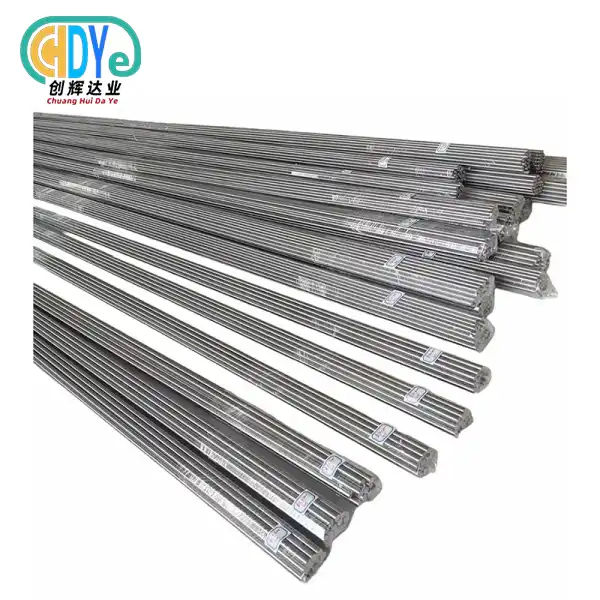
How is niobium round bar manufactured to meet ASTM Standards?
To make niobium round bars that meet ASTM standards, you have to carefully choose high-purity raw materials, use advanced vacuum melting techniques, be very careful when hot working the bars, and be very strict with quality control. Finding bars of niobium that are 99.99% pure is the first step in the production process. Impurities are then removed by vacuum arc remelting or electron beam melting. The material is shaped into bars by hot forging and rolling, and its mechanical properties are improved by controlled heat treatment. Every step is checked to make sure it meets the requirements of ASTM B392-95. This makes sure that every finished bar has the corrosion resistance, accuracy in measurements, and consistent performance needed for high-tech, chemical processing, and aerospace uses.
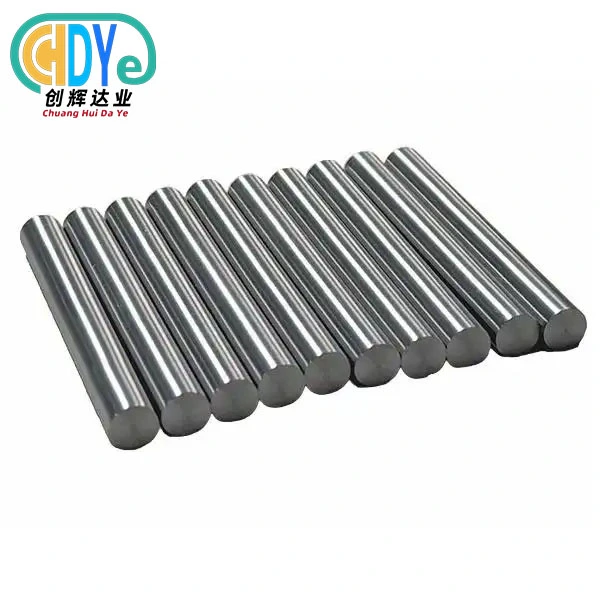
The Manufacturing Process of Niobium Round Bars
Raw Material Sourcing and Preparation
So that ASTM will accept niobium round bars, the first thing that needs to be done is to find a source. We only pick niobium bars that are very pure and come from pyrochlore rock, which is where niobium is mostly found. They give us approved products with papers that lets us keep track of them. In this way, elements like tantalum, iron, and carbon are kept within safe levels. We use spectroscopic analysis to make sure the lots are pure before they are put into production once they get to our facility. This step is very important because even small differences in the quality of the raw materials can make the finished product less strong and less resistant to rust.
Vacuum Melting for Purity and Homogeneity
So that ASTM will accept niobium round bars, the first thing that needs to be done is to find a source. We only pick niobium bars that are very pure and come from pyrochlore rock, which is where niobium is mostly found. They give us approved products with papers that lets us keep track of them. In this way, elements like tantalum, iron, and carbon are kept within safe levels. We use spectroscopic analysis to make sure the lots are pure before they are put into production once they get to our facility. This step is very important because even small differences in the quality of the raw materials can make the finished product less strong and less resistant to rust.
Hot Forging and Rolling
Heat is used to break up the cast structure and make the grain polishing better after the bars are smooth. By controlling the compression at temperatures between 1200°C and 1400°C, our hydraulic forging presses change the shape of the ingots into intermediate billets. The cloth is now more flexible and ready for the next step, which is rolling. The billets are then put through our rolling tools, which cut them down further and further over several passes. It takes a lot of care with each pass to make sure that the damage is even and that the surface doesn't crack. Hot rolling the bar not only gets it to the right thickness, but it also lines up the grains so they face the direction of distortion. This makes the tensile strength and bending qualities better. In this step, the temperature and reduction ratios are checked to make sure they meet the mechanical property standards set by ASTM.
Precision Machining and Surface Finishing
Once the bars are hot, they are carefully made to get them to the right length with very little error. When our CNC lathes are done, they remove surface scale and rust, leaving a clean, smooth finish that meets ASTM specs for size. Most of the time, diameter tolerances are kept within 0.1 mm. This makes sure that they can be used with tools and methods of assembly that are made just for each customer. When you choose the right tools and cutting settings, you can smooth out the surface and get a finish that doesn't have any defects like pits, scratches, or spots. Once the bars are cut, they are put through non-destructive tests, like ultrasound inspection, to see if there are any flaws that may have formed inside during the process.
Heat Treatment and Annealing
Once the bars are hot, they are carefully made to get them to the right length with very little error. When our CNC lathes are done, they remove surface scale and rust, leaving a clean, smooth finish that meets ASTM specs for size. Most of the time, diameter tolerances are kept within 0.1 mm. This makes sure that they can be used with tools and methods of assembly that are made just for each customer. When you choose the right tools and cutting settings, you can letth out the surface and get a finish that doesn't have any flaws like pits, scratches, or spots. Once the bars are cut, they are put through non-destructive tests, like ultrasound inspection, to see if there are any flaws that may have formed inside during the process.
Quality Assurance and Testing to Meet ASTM Requirements
Mechanical Testing for ASTM Compliance
Each batch of niobium round bars is tested mechanically to make sure it meets the ASTM B392-95 requirements for tensile strength, elasticity, and hardness. Tensile tests are done on samples taken from production lots using uniform testing tools that are set up to international standards. The tensile strength of RO4200 grade niobium is usually between 200 and 350 MPa, and its elongation is between 20 and 30%. These numbers depend on how much cold work and annealing are done. Using the Vickers or Rockwell methods to test the material's hardness confirms that it still has its soft, bendable properties. These tests not only make sure that the rules are followed, but they also give customers useful information that they can use to guess how materials will behave during forming or welding.
Chemical Composition Verification
Optical emission spectrometry (OES) or inductively coupled plasma mass spectrometry (ICP-MS) is used for chemical research. These methods can find trace elements at parts-per-million levels. We make sure that the amount of niobium is higher than 99.95% and that the amounts of elements like tantalum, tungsten, iron, carbon, and oxygen are less than the standards set by ASTM B392-95. There is a Certificate of Analysis (CoA) for each output lot that lists the measured composition. This gives buying teams the information they need to make sure that the materials are compliant. Customers in regulated industries, like aerospace and medical devices, need this paperwork because they have to be able to track where materials come from.
Dimensional and Visual Inspection
When dimensions are checked, each bar is made sure to be within the allowed ranges for length, width, and straightness. To check the length of the bar at different points, we use precise measuring tools such as micrometers and coordinate measuring machines (CMM). Visual analysis, which is done in controlled lighting, finds problems on the surface such as scratches, spots, or changes in colour that could affect how well it works. Once all the checks are done, the bars are given a heat lot number and are ready to be packed. Anything that doesn't meet standards is put in a different place and either thrown away or made again so it doesn't get shipped.
Comparing Niobium Round Bars with Alternative Materials
Niobium vs. Titanium and Stainless Steel
Titanium and stainless steel are often used for things that need not to rust, but niobium round bars can be useful in some situations as well. Titanium is great for seas and making light structures, but it can break easily and doesn't let heat pass through it well. While cheap and good at preventing rust, stainless steel, especially austenitic types, is not as stable at high temperatures or as good at superconductivity as niobium. Because it can handle natural acids like sulphuric and hydrochloric acids better, niobium is the best metal for heat exchangers and chemical reactors. It's not as thick as tantalum and is very simple to join. This makes it a good choice for use in medicine and aviation that don't need big materials or difficult production.
Niobium vs. Other Refractory Metals
It is not the same as tantalum, molybdenum, or tungsten. Niobium has its own place in the world. Tantalum is more expensive and dense (16.65 g/cm³ vs. 8.57 g/cm³) than niobium, but it doesn't break down easily and is safe for living things. Niobium is more flexible and doesn't rust than molybdenum or tungsten. Their strength at high temperatures and lack of expansion make them less useful. Because of this, they are not as good for heater parts and electrical contacts. What kind of material to use depends on what the job calls for. Procurement managers should think about the budget, the working temperature, the toxic climate, the amount of weight that can be moved, and so on in order to find the cheapest option that still does its job.
Procurement Considerations for Niobium Round Bars
Pricing Trends and Lead Time Factors
Prices for niobium round bars depend on a lot of things, like the supply of raw materials, the amount that can be made, and the demand from key industries that use it, like making steel alloys and superconductors. Brazil sets most of the prices in the world for niobium because it provides about 85% of the world's niobium through CBMM. Price changes can happen when there are problems with the supply chain, which could be caused by environmental laws or government issues. Lead times for bars that are made to order are usually between four and eight weeks, but this depends on the number of orders and how complicated the processing is. Bulk orders save money because of economies of scale, which lower the cost per unit and ensure that they are scheduled first in production lines. Price changes and delays in the supply chain can be less of a problem if you plan ahead and keep strategic inventory levels.
Importance of Certifications and Documentation
Compliance with ASTM standards is more than just a box to be checked; it's a promise that the material is correct. Make sure that the providers you're considering are ISO 9001:2015 approved and can give you all the paperwork you need for tracking, like mill test results, Certificates of Analysis, and heat lot identification. These papers show that the seller has good processes in place to make sure the quality of the things they send meets the needs of the customer. Every time we make something, we keep careful records so that buyers can see where the parts came from, from the raw ingot to the finished bar. To pass checks and meet the strict paperwork needs of the aerospace, defence, and medical device businesses, you need to be this open.
Selecting a Reliable Supplier
If you want to find the best source, you should think about more than just price. Find out how much the supplier knows about science, how well they can make things, how they keep an eye on quality, and how many times they've worked with companies in your field before. It is also important to know where the seller is. Local suppliers may have shorter lead times and make shipping easier, while foreign suppliers such as Chuanghui Daye offer fair prices and easy access to rare metal experts. When it comes to heating, casting, and drilling, our Baoji plant has the most up-to-date tools. The people who work there have been working with niobium for more than 30 years. We have quick prototyping, small-batch production that is flexible, and helpful customer service. Make sure that everything goes quickly when you buy things and that you get the things you need on time.
Conclusion
Making niobium round bars that meet ASTM standards is a hard, multi-step process that needs to be done correctly at every step. Every step, from using advanced vacuum heating, controlled hot working, and thorough quality testing to find high-quality raw materials, makes the final product more reliable and useful. When engineers and procurement managers understand this process, they can judge sellers, guess how materials will behave, and make smart choices about what to buy. Compliance with ASTM standards is not only the law, but also a promise to make products that will work reliably even in the worst conditions. This will protect your operations from costly breakdowns and downtime.
FAQ
Q: What factors affect the tensile strength of niobium bars?
A: The amount of cold work, the heating temperature, and the grain size are the main things that affect tensile strength. Bars that go through a lot of cold working are stronger but less flexible. By lowering the strength and increasing the length, annealing at high temperatures relieves internal stresses. Controlled hot working can improve both strength and hardness by making the grain smoother. The amount of impurities, especially intermediate elements like carbon and oxygen, can also change the mechanical properties by creating solid solutions that make it hard for dislocations to move.
Q: How does ASTM B392-95 ensure product quality?
A: ASTM B392-95 sets the lowest standards for chemical make-up, mechanical properties, and size variations. By saying what amounts of elements are allowed and how to test them, the standard makes sure that all suppliers and output batches follow the same rules. Customers can be sure that the material will work as planned when it meets ASTM B392-95 standards. This lowers the risks of failure and makes it easier for the material to be used in manufacturing processes.
Q: Can niobium round bars be welded in aerospace applications?
A: Yes, niobium round bars are very easy to weld, especially types RO4200 and RO4210. Gas tungsten arc welding (GTAW) or electron beam welding (EBW) can be used to join the materials together in inert or vacuum environments to keep them from oxidizing. To get good joints, you need to prepare the surface properly, choose the right protective gas, and heat treat the joints after they are welded. Niobium is good for aircraft structures that have to deal with quick temperature changes because it does not expand or contract much when it heats up or cools down.
Partner with a Trusted Niobium Round Bar Supplier
We at Shaanxi Chuanghui Daye have been working with rare metals for 30 years and have ISO 9001:2015-approved quality management. This lets us make ASTM-compliant niobium round bars that are exactly what you need. Our grades RO4200 and RO4210 are made to meet ASTM B392-95 standards and are 99.95% pure. They offer better corrosion protection and mechanical reliability for use in aircraft, chemical processing, electronics, and medicine. Our team can help you with custom diameters, small-batch samples, or big production runs. We offer quick shipping and prompt support to keep your projects on track. Contact us today at info@chdymetal.com to talk to one of our technical experts about your needs and get a price on high-quality niobium round bars for sale.
References
1. ASTM International. (2020). ASTM B392-95: Standard Specification for Niobium and Niobium Alloy Ingots. West Conshohocken, PA: ASTM International.
2. Davis, J. R. (Ed.). (1997). ASM Specialty Handbook: Heat-Resistant Materials. Materials Park, OH: ASM International.
3. Agulyansky, A. (2004). The Chemistry of Tantalum and Niobium Fluoride Compounds. Amsterdam: Elsevier Science.
4. Gupta, C. K. (1992). Extractive Metallurgy of Niobium. Boca Raton, FL: CRC Press.
5. Leyens, C., & Peters, M. (Eds.). (2003). Titanium and Titanium Alloys: Fundamentals and Applications. Weinheim: Wiley-VCH.
6. Metals Handbook Committee. (1990). Properties and Selection: Nonferrous Alloys and Special-Purpose Materials (10th ed., Vol. 2). Materials Park, OH: ASM International.
Learn about our latest products and discounts through SMS or email